The thinking behind The Agency.
Insights and analysis on third-party risk management, vendor security, regulatory compliance, and the agentic shift reshaping how TPRM teams actually work.
From the team.
 Risk Management
TPRM for Healthcare Organizations: A Strategic Guide to Patient Data Safety
Most healthcare breaches now originate through third-party vendors, yet many organizations still rely on outdated annual assessments that leave critical blind spots across telehealth platforms, cloud providers, and connected medical devices. This strategic guide explores how healthcare providers can modernize TPRM through continuous AI-driven monitoring, real-time Cybersecurity Ratings, and automated HIPAA compliance workflows. Learn how to reduce vendor-related risk, strengthen patient data protection, and build a scalable framework for resilient healthcare supply chain security in 2026.
Read more Risk Management
How to Get Executive Buy-in for TPRM Budget: A 2026 Strategic Guide
Securing executive approval for TPRM investment in 2026 requires more than discussing cyber threats—it demands translating vendor risk into measurable business impact. This guide shows how to get executive buy-in for TPRM budget by using Cybersecurity Ratings, real-time supply chain visibility, and AI-driven risk intelligence to align security initiatives with revenue growth, operational efficiency, and regulatory compliance. Learn how to build a compelling board-level business case that moves your organisation from reactive risk management to proactive resilience.
Read more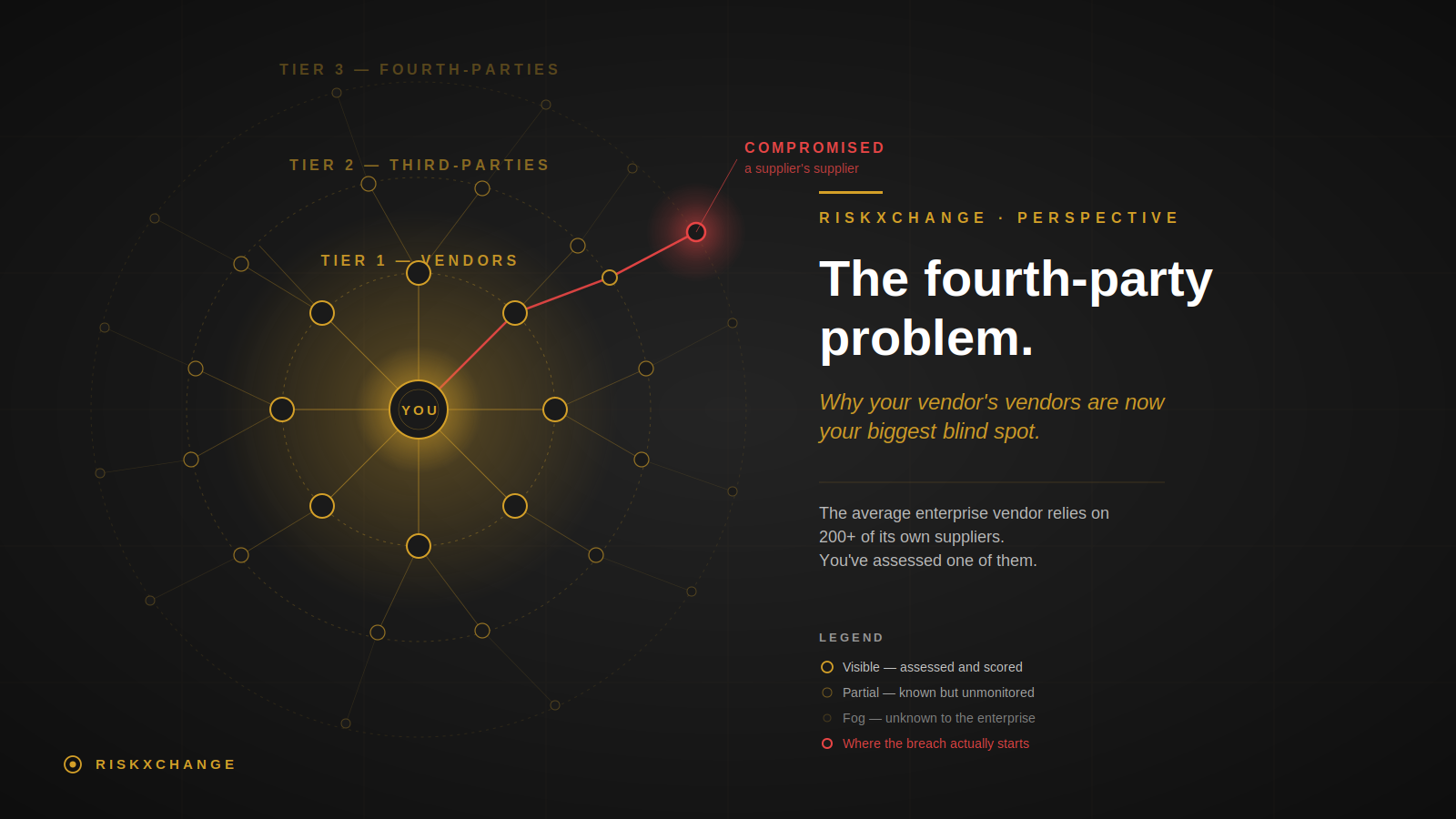 Risk Management
The Fourth-Party Problem: Why Your Vendor's Vendors Are Now Your Biggest Blind Spot
Most third-party risk programmes stop at tier one. The breach data says the attackers don't. Here's why fourth-party visibility is the defining TPRM challenge of 2026 — and what CISOs need to do about it.
Read more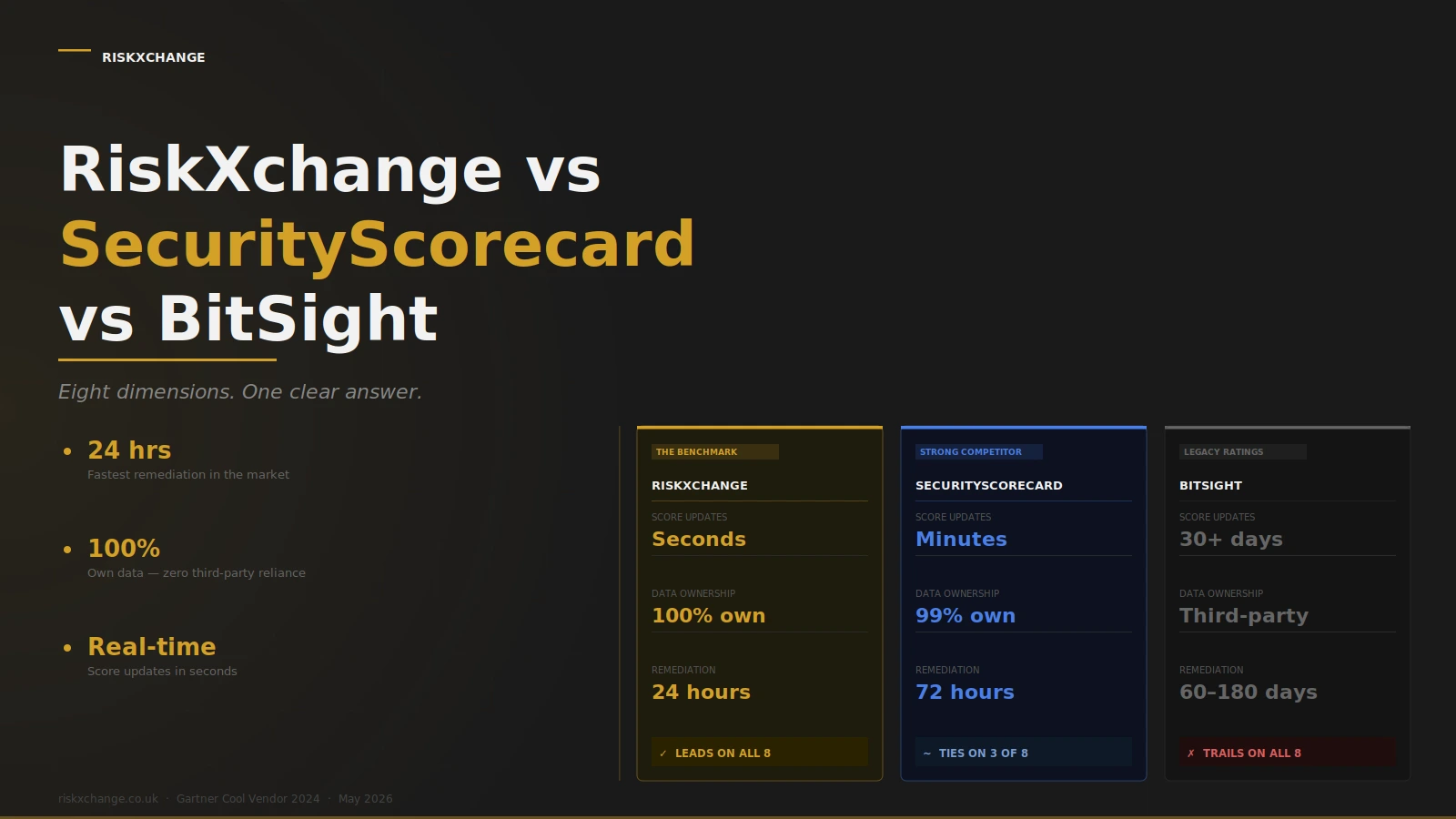 Risk Management
RiskXchange vs SecurityScorecard vs BitSight: Eight Dimensions That Actually Matter
RiskXchange, SecurityScorecard, and BitSight all claim to lead on data quality, AI, and speed. We measured all three across eight critical dimensions — from score freshness and remediation speed to data ownership and platform transparency. The results are clear: not all TPRM platforms are built the same.
Read more Risk Management
Benchmarking Your Vendor Risk Management Program Maturity: A 2026 Strategic Guide
Most vendor risk programmes in 2026 are still run by just one or two people managing hundreds of suppliers—while 60% of breaches now originate in the supply chain. This guide breaks down how to benchmark your vendor risk management maturity, move beyond manual spreadsheets, and transition to an AI-driven, continuous monitoring model. Learn the five maturity levels, identify where your programme stands, and build a clear roadmap toward proactive, real-time resilience that satisfies regulators like DORA and upcoming FCA requirements.
Read more Compliance
Continuous Vendor Security Monitoring: Closing the 364-Day Blind Spot
Continuous vendor security monitoring eliminates the “364-day blind spot” created by outdated annual assessments, replacing static questionnaires with real-time, AI-driven visibility. In a landscape where most breaches originate from third parties, organisations must adopt an outside-in approach, using automated intelligence, cybersecurity ratings, and tiered monitoring to detect and remediate risks instantly. This guide shows how to transform vendor risk management into a proactive, data-driven system that strengthens resilience and meets modern regulatory demands like DORA.
Read more Compliance
Supply Chain Cybersecurity Framework: The Definitive 2026 Guide for CISOs
A modern supply chain cybersecurity framework is no longer about periodic vendor audits—it’s about continuous, real-time visibility across your entire digital ecosystem. In 2026, rising threats and stricter mandates like NIS2 and CMMC 2.0 require CISOs to move beyond static compliance and adopt AI-driven monitoring, cybersecurity ratings, and an outside-in perspective. This guide outlines how to build a resilient, data-driven framework that secures not just your direct vendors, but every layer of your supply chain.
Read more Compliance
The Essentials of Modern Cybersecurity Law: A 2026 Regulatory Guide
Cybersecurity law in 2026 has shifted from voluntary frameworks to enforceable mandates that demand continuous, real-time oversight. This guide breaks down global regulations like NIS2, DORA, and CIRCIA, and shows how to move from static compliance to a legally defensible, data-driven security posture across your entire supply chain.
Read more Cybersecurity
Define Exfiltrate: Understanding Data Exfiltration in Cybersecurity
Data exfiltration isn’t just a breach—it’s the quiet, deliberate removal of your most valuable data. Learn how modern attackers move information undetected, why exfiltration is the most damaging phase of a cyberattack, and how to identify, prevent, and control it before it leaves your environment.
Read more Risk Management
Modernizing Your IT Security Assessment: A 2026 Strategy Guide
A 2026 strategy guide to modernising your IT security assessment with continuous, AI-driven monitoring. Learn how to replace static audits with real-time visibility, secure your entire attack surface including third-party risks—and turn your security posture into a measurable, actionable Cybersecurity Rating.
Read more Risk Management
NIST Frameworks: The Strategic Guide to Cybersecurity Resilience in 2026
A strategic guide to mastering NIST frameworks in 2026, shifting from static compliance to AI-driven continuous monitoring. Learn how to align CSF 2.0, RMF, and supply chain risk management to gain real-time visibility, reduce blind spots, and build a measurable, resilient cybersecurity posture.
Read more Cybersecurity
NIST 800-61: The Definitive Guide to Modern Incident Handling in 2026
NIST 800-61 remains the gold standard for incident response in 2026, evolving beyond internal defence to address supply chain risk and real-time threat visibility. This guide outlines the four-phase lifecycle, modern updates in Rev. 3, and practical steps to build a resilient, AI-ready incident response programme that reduces response time and strengthens overall cybersecurity posture.
Read more Risk Management
COBIT Framework: A Strategic Guide for IT Governance in 2026
The COBIT framework enables organisations to align IT governance with business strategy, turning fragmented processes into a unified, risk-aware system. In 2026, as regulatory pressure intensifies and supply chain risks grow, COBIT provides the structure to move from reactive oversight to continuous, data-driven governance—delivering real-time visibility, measurable compliance, and stronger enterprise resilience.
Read more Cybersecurity
Ransomware Examples: Analyzing Modern Extortion and Supply Chain Vulnerabilities in 2026
Ransomware in 2026 has evolved into a multi-stage, supply chain-driven threat that exploits third-party vulnerabilities and uses AI-powered extortion tactics. By analysing modern ransomware examples, organisations can shift from reactive defence to proactive, continuous risk monitoring—gaining the outside-in visibility needed to quantify exposure, reduce attack surface risk, and strengthen overall cybersecurity resilience.
Read more Cybersecurity
The Strategic Role of Network Segmentation in Modern Cybersecurity
Network segmentation has become a critical control layer in 2026, transforming flat architectures into secure, isolated zones that limit lateral movement and contain threats. This guide explores how macro- and microsegmentation strategies reduce attack surface, improve compliance, and deliver measurable resilience across hybrid environments.
Read more Cybersecurity
NIDS Intrusion Detection: Protecting the Network Perimeter in 2026
NIDS intrusion detection has become a critical layer for maintaining real-time visibility across modern, hybrid networks. This guide explains how organisations in 2026 can use NIDS to monitor raw traffic, detect lateral movement, and uncover threats that bypass traditional perimeter controls. Learn how to balance signature and anomaly-based detection, optimise sensor placement across cloud environments, and integrate network insights into a broader, risk-driven security strategy.
Read more Risk Management
The Definitive Guide to Computer Security Certifications in 2026
In 2026, computer security certifications have evolved from simple credentials into strategic assets that validate real-world risk management capabilities. This guide breaks down the most valuable certifications, from foundational to expert level and shows how to align them with career growth, organisational resilience, and measurable cybersecurity outcomes. Learn how to choose the right path, maximise ROI on your certifications, and combine certified expertise with continuous risk monitoring to stay ahead in an AI-driven threat landscape.
Read more Risk Management
What is a Security Assessment? A Strategic Guide to Modern Risk Management in 2026
A modern security assessment in 2026 goes beyond static audits, shifting to continuous, data-driven visibility across your entire attack surface. This guide explains how to move from point-in-time reports to real-time risk intelligence using an outside-in perspective, automated monitoring, and cybersecurity ratings—so you can identify vulnerabilities, strengthen supply chain resilience, and turn security into a measurable business asset.
Read more Risk Management
Choosing the Best Integrated Risk Management Solutions in 2026
Integrated risk management solutions are redefining how organisations approach cybersecurity, compliance, and third-party risk in 2026. By replacing siloed data and static assessments with AI-driven, real-time visibility, IRM platforms provide a unified, actionable view of your entire attack surface. This guide outlines how to evaluate, implement, and scale an IRM strategy that transforms risk from fragmented uncertainty into measurable, proactive control across your enterprise and supply chain.
Read more Cybersecurity
What is Pharming? The Professional’s Guide to DNS Redirection Risks in 2026
Pharming is a silent and highly technical cyberattack that redirects users to fraudulent websites by compromising DNS infrastructure or local host files—without any user interaction. Unlike phishing, it bypasses human awareness entirely, making it one of the most dangerous “lureless” threats in modern cybersecurity. This guide explains how pharming works, why it evades traditional defenses, and how organizations can secure their attack surface through continuous DNS monitoring, DNSSEC implementation, and an outside-in security strategy.
Read more Risk Management
What Does 'Remediated' Mean? A Professional Guide to Security Remediation
Learn what “remediated” truly means in cybersecurity and why it goes beyond a simple fix. This guide breaks down the remediation lifecycle, the difference between mitigation and resolution, and how to strengthen your security posture with measurable, risk-based outcomes.
Read more Cybersecurity
How Can You Prevent Viruses and Malicious Code? A Strategic Framework for 2026
Learn how to prevent viruses and malicious code in 2026 with a strategic, risk-based framework. Move beyond traditional antivirus by adopting an outside-in perspective, continuous monitoring, and a 5-pillar approach to secure your attack surface and reduce supply chain risk.
Read more Cybersecurity
Intrusion Detection Systems (IDS): The 2026 Guide to Network Visibility
Intrusion Detection Systems are no longer passive tools—they’re critical to achieving real-time visibility across your entire attack surface. This 2026 guide explores how modern IDS strategies reduce alert fatigue, detect sophisticated threats, and integrate with your broader risk management approach to turn network data into actionable security intelligence.
Read more Cybersecurity
How to Improve Your Security Score: A Comprehensive Guide
Your security score is already shaping how partners, insurers, and stakeholders evaluate your organisation. This guide breaks down how to improve your security score through continuous monitoring, targeted remediation, and strategic risk management, turning external perception into a measurable advantage you can control.
Read moreStop reading. Start running TPRM differently.
Book a 30-minute call and we'll have NOVA, ARIA and REX produce a complete posture report on a vendor of your choice inside 24 hours.