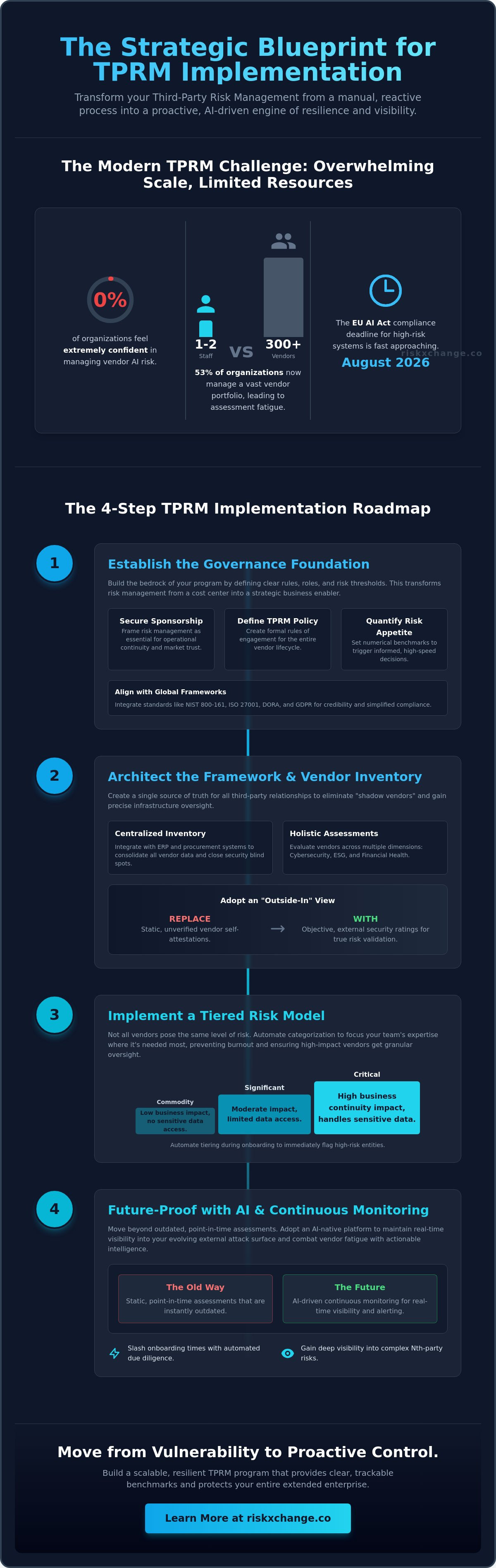
Not a single organization currently reports feeling extremely confident in managing vendor AI risk, yet the August 2026 deadline for EU AI Act compliance is already here. If you're managing a portfolio of over 300 vendors with only one or two dedicated staff members, you know that manual assessment fatigue isn't just a hurdle; it's a systemic vulnerability. This tprm program implementation guide serves as your strategic blueprint to move beyond static spreadsheets and achieve real-time oversight. We understand the pressure from regulators and Boards to transform obscure supply chain layers into clear, trackable benchmarks of resilience.
You deserve a workflow that works as hard as you do. This article provides a comprehensive roadmap to building a scalable, AI-driven program that slashes onboarding times and provides deep visibility into Nth-party risks. We'll break down complex technical requirements into a logical, step-by-step progression. You'll learn to integrate continuous monitoring and NIST AI RMF principles to ensure your security posture is always visible and measurable. Let's move your organization from a state of vulnerability to one of informed, proactive control.
Establishing the Governance Foundation for TPRM
Effective governance is the bedrock of any resilient risk strategy. It transforms a reactive, box-ticking exercise into a proactive engine of visibility. To start your journey with this tprm program implementation guide, you must first define the scope of your extended enterprise. This includes every entity that handles your data or touches your infrastructure. With 53% of organizations now managing over 300 vendors, according to Ncontracts, the scale of this oversight requires a clear mandate from the top. Secure executive sponsorship by framing your program as a business enabler. It's not a cost center; it's a mechanism for maintaining operational continuity and market trust.
Your TPRM Policy serves as the formal rules of engagement. It dictates how internal teams interact with third parties throughout the vendor lifecycle. Parallel to this, you must define a quantifiable Risk Appetite. This isn't an abstract concept. It's a trackable, numerical benchmark that tells your team exactly when a vendor's risk profile exceeds acceptable thresholds. By moving the conversation from vague concerns to measurable data, you empower your organization to make informed, high-speed decisions. This specific framing helps you maintain agency and command over an increasingly complex external attack surface.
Stakeholder Alignment and Roles
Success depends on a unified workflow across Procurement, Legal, and IT Security. Use a RACI matrix to clarify who owns the vendor relationship versus who owns the technical risk assessment. Establishing a cross-functional Risk Committee ensures that high-impact decisions aren't made in silos. This collaborative approach moves your organization from a state of vulnerability to one of informed resilience, ensuring that risk management is integrated into the very fabric of your procurement process.
Aligning with Global Frameworks
Aligning your program with established standards like NIST 800-161 or ISO 27001 provides an elite level of credibility. It also simplifies compliance with complex regulations such as DORA or GDPR. As you build, ensure your framework is flexible enough to integrate Third-Party Management best practices that account for emerging AI regulations. With the EU AI Act's August 2026 deadline fast approaching for high-risk systems, your governance foundation must be robust enough to handle the unique nuances of AI vendor oversight and data governance.
Architecting the TPRM Framework and Vendor Inventory
Building a resilient program requires more than just a list of names; it requires a structured architecture that mirrors your operational reality. This tprm program implementation guide emphasizes the need for a centralized vendor inventory that pulls data directly from ERP and procurement systems. Without this integration, "shadow vendors" often bypass security controls, creating blind spots in your defense. By consolidating this information, you establish a single source of truth that allows for precise infrastructure oversight and a clear understanding of your external attack surface.
Effective architecture also relies on standardized assessment criteria. You must evaluate third parties across multiple dimensions, including cybersecurity, ESG, and financial health. This holistic view is supported by the Interagency Guidance on Risk Management, which highlights the importance of comprehensive due diligence throughout the relationship life cycle. Adopting an externalized perspective is crucial here. Rather than relying solely on vendor self-attestations, use external security ratings to validate claims. This "Outside-In" view provides a numerical benchmark of a vendor's security posture, allowing you to evaluate your true risk exposure from an objective vantage point.
The Criticality Tiering Process
Not all vendors deserve the same level of scrutiny. You must categorize your partners into "Critical," "Significant," and "Commodity" tiers based on data access, business continuity impact, and regulatory exposure. Automating this tiering process during the initial onboarding request ensures that high-risk entities are flagged immediately. This methodical approach prevents your team from being overwhelmed by low-risk assessments, allowing them to focus their technical expertise where it matters most. It's about moving from a state of manual fatigue to one of proactive, tiered control.
Designing the Assessment Lifecycle
A robust lifecycle begins with pre-contract due diligence, ensuring security is baked into the relationship before the ink is dry. However, the 2026 threat landscape demands a shift from point-in-time annual audits to continuous, real-time monitoring. This proactive control ensures that any dip in a vendor’s security score triggers an immediate alert. Finally, don't overlook offboarding protocols. Ensuring data deletion and access revocation at the end of a contract is essential for maintaining a clean security perimeter. Implementing these steps through an AI native TPRM solution provides the immediacy and thoroughness required for modern compliance.
The 5-Phase TPRM Program Implementation Roadmap
Implementing a resilient risk program requires a steady, methodical approach that balances technical precision with strategic oversight. This tprm program implementation guide breaks the transition into five distinct phases, moving your organization from a state of vulnerability to one of informed resilience. It starts with Phase 1: Discovery and Gap Analysis. Here, you must honestly assess your current manual processes. Given that 63% of TPRM programs are managed by only one or two dedicated employees, identifying where manual assessment fatigue is highest is critical for prioritizing your automation efforts.
Phase 4 involves the Enterprise Rollout, where you scale your tested workflows across the entire supply chain. This is followed by Phase 5: Continuous Optimization. In this final stage, you use data insights and real-time risk intelligence to refine your risk thresholds. By treating security as a trackable, numerical benchmark, you ensure your program remains effective as the threat landscape evolves. This rhythmic progression prevents your team from feeling overwhelmed while maintaining a professional cadence of improvement.
Phase 2: Transitioning from Spreadsheets to Platforms
Spreadsheets are often perceived as a cost-effective starting point, but they carry significant hidden burdens. They lack persistence, introduce manual entry errors, and fail to provide a reliable audit trail for regulators. During this phase, focus on integration. Your chosen platform must connect seamlessly with existing GRC and SIEM tools to create a unified security lens. Aligning your selection with the Shared Assessments TPRM Framework ensures your toolset meets rigorous industry benchmarks. Transitioning to an automated platform reduces the time spent on manual data entry by up to 50% per assessment, allowing your team to focus on high-level threat analysis.
Phase 3: Running an Effective Pilot
Successful implementation avoids the "big bang" approach in favor of a controlled pilot. Select 5 to 10 high-impact vendors to test your new automated workflows. This small group provides the data necessary to measure success through specific metrics like time-to-completion and the accuracy of risk identification. Gather direct feedback from both your internal procurement teams and the vendors themselves to ensure the process is streamlined and intuitive. A successful pilot builds the internal confidence required for a full-scale rollout, proving that your tprm program implementation guide is both practical and effective.
Solving Common Implementation Roadblocks and Vendor Fatigue
Execution often falters when the human element of risk management is overlooked. This tprm program implementation guide isn't just a technical manual; it's a strategy for managing the friction inherent in vendor relationships. Assessment fatigue is a primary obstacle to high-fidelity data. When vendors receive hundreds of manual questions, the quality of their responses inevitably drops. To counter this, transition toward automated, high-fidelity assessments that leverage existing security ratings and pre-populated data. This methodical approach reduces the administrative burden on your partners while ensuring you receive the precise information needed for a professional assessment.
Managing data overload is another significant hurdle. With organizations facing an average of 12 third-party breaches per year according to ProcessUnity 2026 data, your team can't afford to be buried in noise. You need actionable risk intelligence that highlights critical vulnerabilities rather than a mountain of alerts. By leveraging AI to automate low-value tasks like initial data categorization and evidence validation, you empower your staff to focus on high-level remediation. This shift from obscurity to clarity ensures that your small team maintains agency and command over a vast supply chain. To see how automation can streamline your specific workflow, explore our AI native TPRM solution platform.
Combatting Vendor Non-Responsiveness
Delays in vendor responses can stall your entire implementation roadmap. To improve participation, use automated reminders and provide crystal-clear instructions for every requirement. High-maturity programs often link assessment completion to contract renewals or payment terms, creating a tangible incentive for compliance. By simplifying the process through pre-populated fields based on previous submissions, you move the conversation from a state of frustration to one of efficient partnership. This professional cadence reflects the stability and permanence of a well-governed program.
Dealing with "Shadow IT" and Unrecorded Vendors
Unknown third-party connections represent a significant gap in your security lens. To eliminate these blind spots, implement a "No PO without Security Review" policy that forces all new engagements through the proper channels. Use attack surface management tools to discover unauthorized SaaS adoption and hidden Nth-party links that your procurement records might miss. Educating department heads on the risks of unauthorized vendor adoption is equally vital. This comprehensive oversight ensures that your organization's true security posture is always visible, measurable, and manageable, regardless of how a vendor entered your ecosystem.
Future-Proofing with AI-Driven Continuous Monitoring
Static, point-in-time assessments are a snapshot of the past. In the 2026 threat landscape, relying on annual questionnaires leaves your organization blind for 364 days of the year. This tprm program implementation guide advocates for a shift toward a permanent, live visibility engine. AI and Machine Learning now identify subtle patterns that human analysts often miss, such as a slight but consistent degradation in a vendor's patch management or suspicious DNS activity. By moving beyond manual oversight, you transition from a state of vulnerability to one of informed resilience, ensuring your security posture is always visible and measurable.
Achieving 360-degree visibility requires integrating cyber, compliance, and ESG data into a single, unified lens. This comprehensive approach ensures your organization is perceived as a leader in supply chain integrity from an external vantage point. Security is no longer an abstract concept; it's a trackable, numerical benchmark. Real-time security ratings provide the data-driven honesty required for transparent reporting to the Board, allowing you to evaluate your true risk exposure with elite precision. This thoroughness simplifies the complexity of the modern threat landscape, positioning you as a sophisticated guardian of your digital ecosystem.
Real-Time Risk Intelligence
Automated alerts are the backbone of a modern, tech-forward program. When a vendor suffers a breach or a significant rating drop, your "Time-to-Detect" becomes the critical metric for decision-makers. You can't afford to wait for a self-reported notification that may come weeks after an incident. Using RiskXchange to monitor the external security posture of your entire supply chain provides the immediacy and integration required for proactive defense. This transition from obscurity to clarity ensures you maintain agency and command over your external attack surface at all times.
The Shift to Proactive Resilience
Predictive analytics represent the next frontier of risk management. By analyzing historical data and current threat intelligence, you can forecast which vendors are most likely to suffer a breach before it occurs. This foresight allows you to move from being a "Compliance Check" function to a "Strategic Risk Partner" for the business. You aren't just reacting to threats; you're managing them with the quiet confidence of a seasoned expert. This methodical progression reflects the stability and permanence of the solutions you provide to the organization. Ready to automate your TPRM program? Explore the RiskXchange platform today.
Take Command of Your External Attack Surface
The journey from a state of vulnerability to one of informed resilience requires a shift in how you perceive your extended enterprise. By establishing a robust governance foundation and moving toward AI-driven continuous monitoring, you transform risk management from a compliance burden into a strategic advantage. This tprm program implementation guide has provided the roadmap to eliminate manual fatigue and gain 360-degree visibility into every layer of your supply chain. You've seen how a methodical, phased approach ensures that your program remains scalable and effective as your vendor portfolio grows.
RiskXchange empowers decision-makers with the elite tools necessary to navigate today's volatile technological landscape. With a global presence in London, Austin, and Dubai, we provide AI-powered automated vendor assessments and real-time risk intelligence that keeps your security posture visible and measurable. Don't let your organization be defined by the obscurity of its third-party connections. Request a demo of RiskXchange’s AI-native TPRM platform today to take proactive control of your digital ecosystem. You have the blueprint; now it's time to build a more secure, resilient future.