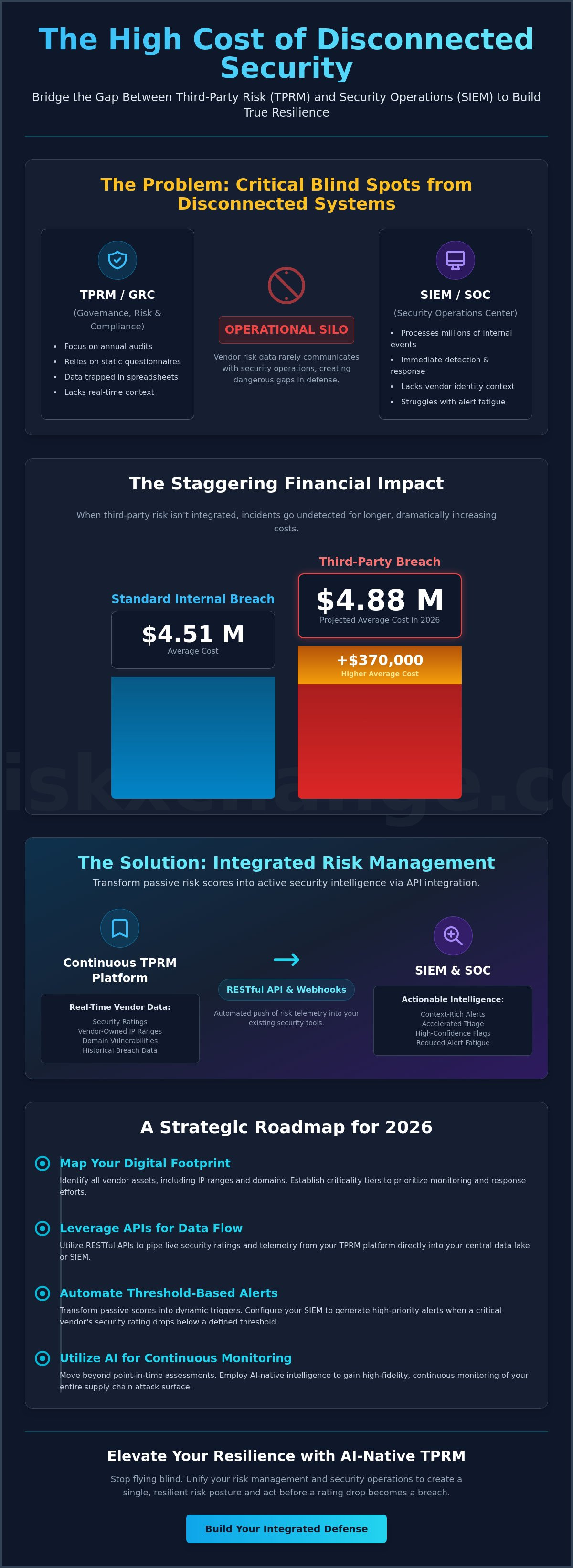
A data breach involving a third party now costs an average of $370,000 more than a standard internal incident, pushing the total projected cost to $4.88 million in 2026. You recognize that your supply chain is your most vulnerable perimeter, but your risk data likely remains trapped in static spreadsheets or isolated portals. When a vendor-owned IP address triggers a critical alert, your SOC analysts often lack the immediate context to determine the severity. Integrating tprm with siem changes this dynamic by turning passive risk scores into active security intelligence.
It's frustrating to manage high-stakes compliance requirements like DORA or the EU Cyber Resilience Act while relying on fragmented systems. You deserve a unified view of internal and external risk that empowers your team to act before a rating drop becomes a breach. This guide details how to unify your risk management and security operations. We'll examine how to automate alerts based on real-time vendor security changes and use third-party context to accelerate incident triage, moving your organization toward informed resilience by treating security as a trackable, numerical benchmark.
The Silo Problem: Why Disconnected TPRM and SIEM Create Vulnerabilities
Most organizations treat their supply chain as an external entity until a breach occurs. This reactive stance is a direct result of the operational silo between Third-Party Risk Management and security operations. Historically, TPRM has been a Governance, Risk, and Compliance (GRC) function, focused on annual audits and legal checkboxes. Meanwhile, the Security Information and Event Management (SIEM) platform serves as the operational heart of the SOC, processing millions of internal events per second. These two worlds rarely communicate, leaving a dangerous gap in your defense.
This "Blind Spot" effect manifests during active incidents. When a SOC analyst sees an anomalous connection from a specific IP address, they often lack the context to know that the address belongs to a critical vendor whose security posture has recently plummeted. Without integrating tprm with siem, that analyst treats the event as a low-priority internal alert rather than a potential supply chain compromise. Research shows that breaches involving a third party cost an average of $370,000 more than those that don't, largely because these incidents go undetected for weeks while data sits in disconnected silos. By 2026, the industry standard is shifting toward Integrated Risk Management (IRM) to close these gaps permanently.
The Cost of Static Risk Assessments
Annual questionnaires are no longer sufficient for modern security needs. These "point-in-time" assessments provide a snapshot of a vendor's security that becomes obsolete the moment it's submitted. Relying on stale intelligence in an active threat landscape is a significant liability. To maintain resilience, organizations are moving toward continuous real-time risk management. This approach replaces subjective, self-reported data with objective, technical telemetry. When you rely on static data, you're essentially flying blind, unable to see the rapid shifts in a vendor's attack surface that could lead to an internal breach.
Bridging the Gap Between GRC and SecOps
Aligning the goals of risk managers and security analysts requires a shared language. Risk managers prioritize compliance and long-term stability, while SOC analysts focus on immediate detection and response. Quantifiable security ratings act as the bridge between these two perspectives, providing a numerical benchmark that both teams can monitor. This clarity transforms abstract risk into an actionable metric. Integrated Risk Management is the strategic unification of compliance frameworks and operational security workflows to create a single, resilient risk posture. By integrating tprm with siem, you ensure that every external threat is visible, measurable, and manageable from within your primary security command center.
Technical Architecture: Integrating TPRM with SIEM via API
Technical maturity in the modern SOC requires more than just high-level visibility; it demands a programmatic bridge between your external risk data and your internal monitoring tools. By integrating tprm with siem through RESTful APIs, organizations can pipe live security telemetry directly into their existing data lakes. This connection moves your defense strategy from a manual, pull-based model to an automated, push-based architecture. An API serves as the primary conduit for facilitating real-time risk telemetry, ensuring that external threat data is instantly accessible to internal security tools.
Data mapping is the most critical step in this architectural shift. For the integration to be effective, you must identify which vendor attributes actually drive threat correlation. This typically includes vendor-owned IP ranges, domain-level vulnerabilities, and historical breach data. When these attributes are ingested into a SIEM, they act as contextual tags for internal logs. If an internal server attempts to communicate with a vendor IP that has a poor reputation score, the SIEM can flag the event with high confidence. To achieve this level of precision, you need a platform that offers continuous real-time risk management to ensure the data remains current.
While APIs handle the bulk of data transfer, Webhooks play a specialized role in immediate notification. While a standard API call might happen on a schedule, a Webhook triggers the moment a vendor's security rating drops below a defined threshold. This allows for near-instantaneous SOC notifications. However, for this to work, you must normalize third-party risk scores. Different vendors use different scales; your architecture must translate these into a consistent numerical benchmark that your SIEM’s correlation engine can interpret without manual intervention.
Key Data Points for Integration
Effective correlation relies on high-fidelity data points. Your integration should prioritize vendor security ratings alongside specific domain-level vulnerabilities and attack surface insights. This includes monitoring for exposed credentials and checking IP reputations across your entire supply chain. Additionally, mapping compliance status, such as GDPR or NIST alignment, allows your SOC to filter and prioritize incidents based on the regulatory criticality of the involved vendor.
Automation and Orchestration (SOAR)
Once the data resides in your SIEM, it can trigger sophisticated Security Orchestration, Automation, and Response (SOAR) playbooks. If a vendor’s risk score falls significantly, your system can automatically initiate outreach or restrict network access to that vendor’s services. This reduces analyst fatigue by automating the initial triage of third-party alerts, ensuring your team only spends time on confirmed, high-priority threats that require human intervention.
Dynamic Correlation: Transforming Risk Scores into Operational Alerts
Establishing a technical connection between systems is only the first step toward a modern SOC. The true value lies in the correlation logic that transforms passive risk scores into proactive operational alerts. By integrating tprm with siem, you can move away from manual review processes and implement threshold-based triggers. For instance, a 10% drop in a vendor’s security rating can automatically generate a high-priority ticket in your incident management system. This ensures that your team responds to deteriorating vendor security before a breach occurs, rather than reacting to the aftermath.
Context-aware incident response is the primary benefit of this dynamic correlation. When your SIEM flags an anomaly, it shouldn't just show an IP address; it should link that address directly to a third-party risk profile. This immediate visibility allows analysts to understand the criticality of the relationship and the sensitivity of the data involved. Prioritizing vulnerabilities becomes a data-driven exercise rather than a guessing game. You can focus your limited resources on vulnerabilities found within your "Criticality Tier 1" vendors, ensuring that the most significant risks to your internal security posture are addressed first.
This visibility also extends into the complex web of fourth-party risk. Your vendors rely on their own suppliers, and a failure in that extended chain can impact your logs just as easily as a direct provider. Integrating tprm with siem allows you to monitor these deeper dependencies. If a major cloud provider used by your primary vendors experiences a security rating drop, your SOC can anticipate potential disruptions or secondary attacks across your entire supply chain ecosystem.
Correlation Use Case: The Compromised Credential
Consider a scenario where your TPRM platform detects leaked credentials belonging to a vendor on the dark web. In a siloed environment, this information might sit in a report for days. With an integrated architecture, the SIEM immediately adds those specific vendor identities to a high-risk "Watchlist." The system then monitors for any associated login attempts across your network. This proactive stance significantly shortens the Mean Time to Detect (MTTD) for supply chain attacks, stopping an intruder before they can move laterally through your infrastructure.
Visualizing Unified Risk
Effective management requires a 360-degree view of your threat landscape. Unified SOC dashboards that overlay internal security events with external risk ratings provide the clarity needed for both technical and executive leadership. These visualizations move the conversation from abstract fears to quantifiable metrics. By tracking security posture improvements as a numerical benchmark over time, you can demonstrate the tangible business benefit of your risk mitigation strategies. It transforms your security posture from a state of vulnerability to one of informed resilience, where every threat is visible and manageable.
A Roadmap for Integrating TPRM with SIEM in 2026
Transitioning from theoretical risk management to a unified operational defense requires a methodical, step-by-step approach. It's not enough to simply connect two APIs; you need a strategy that prioritizes high-impact risks while minimizing operational noise. Success in integrating tprm with siem depends on a clear sequence of actions that align your supply chain visibility with your SOC's detection capabilities. This roadmap ensures that your integration project delivers immediate value without overwhelming your existing security resources.
- Step 1: Inventory and Map: Start by identifying your most critical vendors. Map their digital footprints to understand exactly which IP addresses, domains, and cloud assets belong to your ecosystem.
- Step 2: Define Criticality Tiers: Assign vendors to tiers based on their access to sensitive data or critical infrastructure. This prevents SIEM alert fatigue by ensuring only high-tier risks trigger immediate, high-priority responses.
- Step 3: Establish API Connectivity: Securely link your TPRM platform to your SIEM. This creates the pipeline for real-time risk telemetry, allowing for the ingestion of quantifiable security ratings.
- Step 4: Develop Correlation Rules: Create specific logic within the SIEM to flag anomalies related to vendor profiles. Use SOAR playbooks to automate the initial outreach or containment steps when a threshold is breached.
- Step 5: Continuous Refinement: Use data from actual incidents to fine-tune your alerting thresholds. Security is a cycle; constant feedback loops ensure your defenses stay ahead of evolving supply chain threats.
Overcoming Common Implementation Hurdles
Managing data volume is often the biggest challenge for modern security teams. If you ingest every minor vulnerability from every low-level vendor, your SOC will quickly be buried in non-essential noise. Filter your data stream by focusing on actionable intelligence that meets your pre-defined criticality thresholds. You also need cross-departmental buy-in between IT, Security, and Procurement. These teams must agree on risk benchmarks to ensure that when an alert triggers, the response is unified and supported by the business. Addressing the "False Positive" challenge early through rigorous data normalization helps maintain your team's trust in the automated system.
Measuring Integration Success
Key performance indicators (KPIs) provide the evidence needed to justify your strategic investment. You should track the reduction in vendor-related security incidents and the speed of your response. Benchmarking integration success is best achieved by measuring the reduction in Mean Time to Detect (MTTD) for supply chain threats, as this directly reflects your improved operational agility. To begin your journey toward a more resilient and integrated posture, you can explore our AI-native TPRM platform to see how we facilitate these critical connections.
Elevating Resilience with RiskXchange’s AI-Native TPRM
Achieving the operational synergy required for a modern SOC demands a platform built for the speed of contemporary threats. RiskXchange provides the AI-native foundation necessary for integrating tprm with siem effectively. While legacy systems often struggle with latency and manual data entry, our platform utilizes specialized AI agents to deliver continuous, high-fidelity risk telemetry. This ensures the data flowing into your SIEM is not just accurate but immediately actionable. It transforms your security posture from a reactive state into one of proactive command, where external risks are managed with the same rigor as internal assets.
Real-time security ratings are the cornerstone of this strategic approach. We move beyond the limitations of static, point-in-time scores by providing a proprietary quantifiable metric that serves as a permanent anchor for your risk discussions. This numerical benchmark allows SOC teams to monitor vendor health with the same precision they apply to their own infrastructure. By integrating tprm with siem and GRC tools, you gain a 360-degree view of your attack surface. This visibility allows you to see exactly how an external vendor vulnerability maps to your internal security operations, providing the clarity needed to make informed, data-driven decisions.
The RiskXchange Difference: Immediacy and Accuracy
The shift toward informed resilience is driven by the accuracy and immediacy of your intelligence. RiskXchange was recognized as a Gartner "Cool Vendor" in third-party risk management in 2024 for its innovative use of AI to automate complex vendor assessments and monitoring. Our platform continuously analyzes the global threat landscape to identify exposed credentials and domain vulnerabilities the moment they appear. For a global enterprise, this level of integration allows the SOC to unify disparate data streams, ensuring that a rating drop triggers an immediate investigation rather than sitting in a forgotten spreadsheet.
Getting Started with Integrated Risk
The transition from obscurity to measured resilience begins with a commitment to integration. You don't have to manage the overwhelming complexity of the supply chain in a vacuum. By aligning your GRC and SecOps functions through a single, AI-driven lens, you empower your team to handle challenges that were once invisible. Our platform simplifies this evolution, moving your organization toward a state of informed resilience where every threat is visible and measurable. We invite you to explore how our technology can secure your extended perimeter. Experience the power of integrated risk intelligence with a RiskXchange demo.
Secure Your Extended Perimeter with Unified Intelligence
The transition from point-in-time vendor audits to a continuous, automated defense is a strategic necessity for the modern SOC. By integrating tprm with siem, you eliminate the visibility gaps that allow supply chain breaches to go undetected. You've seen how RESTful APIs and threshold-based alerting transform static data into a dynamic shield, providing your analysts with the context they need to triage threats with precision. This unification ensures that every third-party vulnerability is measurable and manageable within your primary security command center.
RiskXchange’s AI-native platform provides the 360-degree visibility and real-time intelligence required to maintain this level of control. It's why Fortune 500 enterprises globally trust us to anchor their risk management strategies with quantifiable, trackable metrics. You can move your organization from a state of vulnerability to one of informed resilience today. Book a demo to see how RiskXchange integrates with your SIEM and start treating your supply chain as a proactive asset rather than a hidden liability. You have the tools to master your threat landscape; it's time to put them to work.