Over 60% of data breaches in 2026 involve third parties, yet identifying a vulnerability is only half the battle. It's frustrating to send endless questionnaires only to receive vague responses or lose visibility into whether a critical patch was actually applied. You're likely managing thousands of alerts across a complex supply chain while facing strict deadlines like the June 2026 SEC Regulation S-P compliance date for smaller firms. Implementing effective vendor risk remediation best practices is the only way to move from passive observation to proactive control.
We understand the challenge of vendor fatigue and the difficulty of prioritizing risks in a volatile technological landscape. This guide will help you master the transition from risk identification to resolution with high-impact strategies that improve your third-party security posture. We'll provide a clear framework for holding vendors accountable, reducing your time-to-remediate, and elevating security ratings across your entire ecosystem through continuous, data-driven monitoring. By the end of this article, you'll have a strategic roadmap to transform your supply chain from a source of vulnerability into a pillar of informed resilience.
Beyond Identification: Why Remediation is the Weakest Link in VRM
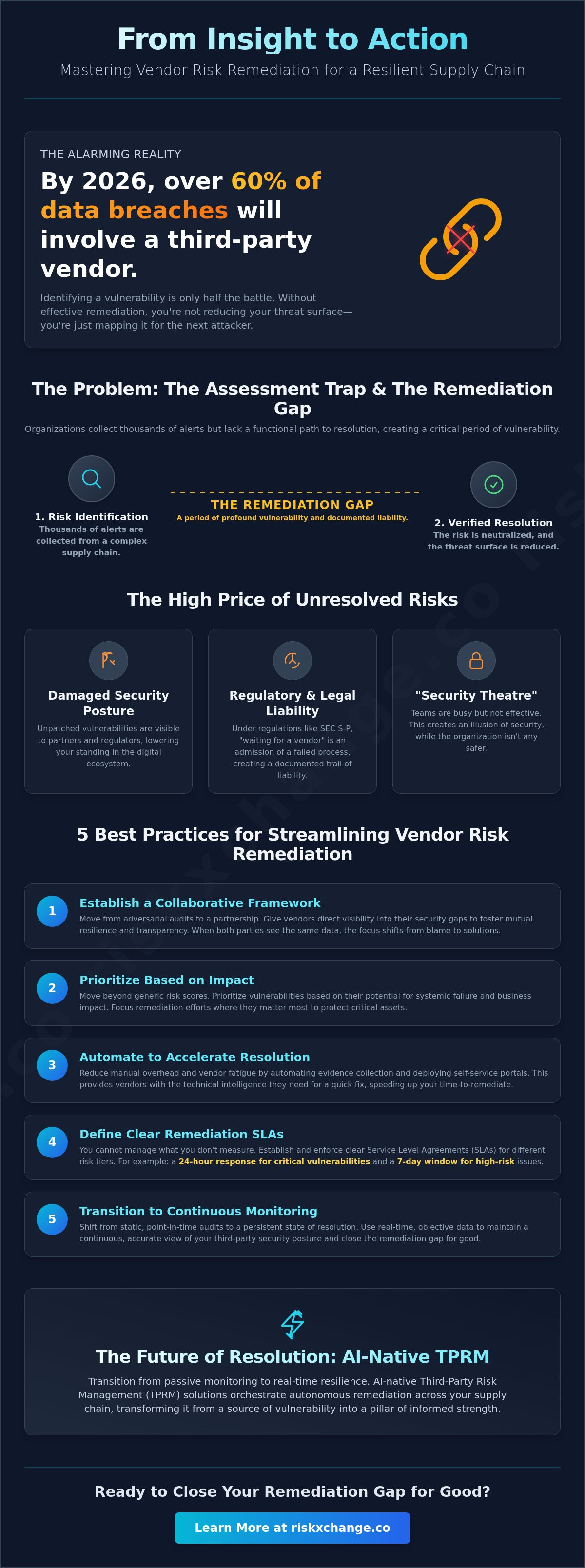
Identifying a vulnerability is a diagnostic step, not a cure. Many organizations fall into what we call the "Assessment Trap," where they collect thousands of critical alerts across their vendor base but lack a functional path to resolution. In the context of modern supply chain risk management, knowing about a flaw without acting on it doesn't just leave you exposed. It creates a documented trail of liability. If you've identified 1,000 risks but haven't closed the loop on any of them, you haven't actually reduced your threat surface. You've simply mapped it for the next auditor or attacker.
The "Remediation Gap" is the time elapsed between the discovery of a risk and its verified resolution. This gap is the primary driver behind major supply chain breaches. It represents a period of profound vulnerability where the organization is aware of a threat but remains powerless to stop it. To master vendor risk remediation best practices, you must shift your focus from point-in-time audits to a continuous state of resolution. Security isn't a static checkbox; it's a persistent effort to keep the "Remediation Gap" as narrow as possible.
The Hidden Costs of Unresolved Vendor Risks
Unresolved risks carry heavy baggage that extends far beyond a potential breach. When high-risk vulnerabilities remain unpatched for months, your organization's external security posture suffers. This lag is visible to regulators and partners, effectively lowering your standing in the digital ecosystem. Under the 2026 SEC Regulation S-P requirements, smaller firms now face the same scrutiny as industry giants regarding third-party oversight. If a known issue leads to a breach, "waiting for a vendor response" isn't a defense. It's an admission of a failed process. This creates a cycle of "security theatre" where teams are busy but the organization isn't any safer.
Shifting from Compliance to Proactive Agency
The landscape of 2026 demands a transition from passive compliance to proactive agency. CISOs are no longer just "risk reporters." They're partners in vendor security improvement. This shift requires moving away from subjective, point-in-time questionnaires toward objective, real-time data. By adopting vendor risk remediation best practices, you empower your team to provide vendors with the exact technical intelligence needed for a fix. This moves the conversation from a state of obscurity to one of clarity. You're no longer just asking if they're secure; you're seeing the evidence that they are, which transforms your role from a vulnerable bystander to a sophisticated guardian of your data ecosystem.
Architecting a Collaborative Remediation Framework
Effective remediation isn't a game of technical "gotcha"; it's a collaborative effort that transforms vendor vulnerability into mutual resilience. When you treat third-party security as a shared responsibility, you move away from the friction of traditional audits and toward a more integrated defense. Adhering to the NIST Cybersecurity Supply Chain Risk Management guidelines requires organizations to foster transparency. This means giving your vendors direct access to your view of their risk profile. When both parties look at the same data, the conversation shifts from debating the existence of a problem to solving it.
A successful framework relies on a feedback loop that rewards proactive behavior. Instead of only reaching out when a critical alert triggers, establish a system where vendors are recognized for maintaining high security standards. This proactive engagement is a cornerstone of vendor risk remediation best practices. It ensures that when a real crisis emerges, the communication channels are already open and trusted. By utilizing an AI-native platform for continuous real-time risk management, you can provide vendors with the immediacy they need to act before a vulnerability is exploited.
Defining Remediation SLAs and Expectations
You cannot manage what you don't measure. Establishing clear Service Level Agreements (SLAs) for different risk tiers is essential for holding third parties accountable. For instance, a critical vulnerability should require a 24-hour response, while a high-risk issue might allow for a seven-day window. These expectations must be integrated into standard procurement contracts to ensure they're legally enforceable. A Remediation SLA serves as a contractual anchor that binds security performance to specific, measurable timeframes for vulnerability resolution. This clarity removes ambiguity and sets a professional standard for the entire partnership.
The Power of the Externalized Perspective
One of the most effective ways to motivate a vendor is to show them their "outside-in" security rating. This externalized perspective provides an objective view of how their organization is perceived by the rest of the digital world, including potential attackers. When you present a vendor with real-time attack surface data, it's much harder for them to rely on defensive "we are secure" responses. Objective metrics bypass the bias of internal self-assessments. By showing a vendor exactly where their infrastructure is leaking data or exposing open ports, you provide the clarity needed to initiate vendor risk remediation best practices. It moves the relationship from one of suspicion to one of informed, data-driven partnership.
Strategic Prioritization: Moving from Risk Ratings to Actionable Intelligence
Security is not a monolith. While a traditional risk score might label two vulnerabilities as "High," the actual impact on your business operations can vary significantly based on which vendor holds your proprietary data. Treating every alert with equal urgency leads to analyst burnout and a diluted defense. To implement vendor risk remediation best practices effectively, you must move beyond generic labels and embrace actionable intelligence. This requires a deep understanding of your "Critical Path." By identifying which vendor fixes protect the most sensitive data or the most vital services, you ensure your resources are always deployed where they can provide the maximum reduction in systemic risk.
Strategic prioritization balances technical severity with the business importance of the vendor relationship. A sophisticated guardian doesn't just look at a CVE score; they look at the context of the vendor's role in the supply chain. We use quantifiable metrics to rank third parties by their potential for systemic failure. This data-driven approach moves the conversation from abstract fears to measurable benchmarks. It allows you to focus on the vendors that, if compromised, would cause the most significant disruption to your organization's resilience and external security standing.
The Prioritization Matrix: Risk vs. Criticality
Effective management begins by categorizing vendors based on their level of data access and operational necessity. Your "Crown Jewel" vendors, those with deep access to your core infrastructure or customer databases, must always be at the top of your remediation list. When comparing Legacy Scoring with AI-Enhanced Risk Ratings, the difference is clear. Legacy scoring is often static, subjective, and based on historical data that is outdated by the time it is reviewed. In contrast, AI-enhanced ratings are dynamic, objective, and predictive, utilizing real-time telemetry to provide a clear lens through which to evaluate your true security posture.
Leveraging Real-Time Threat Intelligence
The threat landscape moves faster than a manual spreadsheet can track. Incorporating active exploit data into your remediation priority list is essential for staying ahead of attackers. When a new Zero-Day vulnerability is discovered, your risk scores must adjust immediately to reflect the increased danger to your ecosystem. This level of immediacy is only possible through a tech-forward approach to vendor risk remediation best practices. Continuous monitoring replaces the annual audit by providing an uninterrupted stream of security telemetry that reflects the actual, real-time state of a vendor's infrastructure. This transition ensures that your remediation efforts are always aligned with the most current and pressing threats.
5 Best Practices for Streamlining Vendor Risk Remediation
Execution is where most third-party programs falter. Once you've identified your "Crown Jewel" vendors and established your SLAs, you need a repeatable system to drive resolution. These five vendor risk remediation best practices focus on removing friction and ensuring accountability across your supply chain. By shifting the burden of evidence collection and communication away from manual processes, you allow your security team to focus on high-impact strategic oversight.
- Automate evidence collection: Eliminate the manual back-and-forth by utilizing systems that pull security artifacts directly from vendor environments or public-facing assets.
- Deploy self-service portals: Empower vendors to view their own security gaps and upload remediation evidence without waiting for an email from your team.
- Utilize virtual patching: When a vendor can't apply a permanent fix immediately, require compensating controls or virtual patches to mitigate the risk temporarily.
- Implement automated escalation: Set triggers that notify vendor leadership or procurement teams automatically if a critical remediation deadline is missed.
- Standardize communication: Use pre-approved templates that maintain a professional tone while providing clear, technical instructions for the required fix.
By moving from manual oversight to a structured workflow, you transform your role from a reactive troubleshooter to a sophisticated guardian of your digital ecosystem. Leverage our AI native TPRM solution platform to gain the immediacy and thoroughness required for modern supply chain defense.
Automating the Vendor Outreach Cycle
Vendor fatigue is a significant barrier to effective remediation. When a vendor's security rating drops below your established threshold, the system should trigger automated alerts that include specific remediation instructions tailored to the vulnerability type. This level of automation reduces "email fatigue" by centralizing all risk discussions within a single, authoritative platform. It ensures your vendors receive the clarity they need to act quickly, moving the conversation from obscurity to resolution without the need for constant human intervention. This rhythmic consistency in messaging reinforces your expectations for proactive security management.
Verification and Validation of Fixes
The remediation cycle is only complete when a fix is verified. Moving beyond "trust" requires an automated "verify" approach through continuous re-scanning of the vendor's attack surface. For high-stakes vulnerabilities, you should require cryptographic proof or specific technical artifacts to confirm the risk is closed. Attack Surface Management (ASM) plays a vital role here, providing an externalized perspective that confirms a vulnerability is no longer visible to potential attackers. This data-driven honesty ensures that your security ratings reflect the actual, current state of your third-party ecosystem, providing a lens through which you can evaluate your true security posture.
The Future of Resolution: AI-Native TPRM for Real-Time Resilience
The complexity of the 2026 threat landscape has surpassed human scale. Managing thousands of vendors across a global supply chain requires more than just a large team of analysts; it requires a fundamental shift toward intelligent systems. AI-native platforms are now shifting the burden of risk management from human analysts to sophisticated, autonomous engines. This transition allows your team to move away from the "Assessment Trap" discussed earlier and toward a state of constant, proactive control. By utilizing these advanced systems, you ensure that security is no longer an abstract goal but a trackable, numerical benchmark that defines your organization's resilience.
We are witnessing a critical evolution from simple "monitoring" to "Autonomous Remediation Orchestration." In this new era, the system doesn't just identify a flaw; it initiates the resolution process by matching the vulnerability with the correct technical fix and communicating it to the vendor. This level of automation is essential for maintaining vendor risk remediation best practices in an environment where threats emerge in milliseconds. It provides the lens through which you can evaluate your true security posture from an externalized perspective, ensuring you're always perceived as a secure and reliable partner in the digital ecosystem.
RiskXchange provides the 360-degree view necessary for 2026 supply chain security. By integrating continuous real-time risk management with automated workflows, we move the conversation from a state of vulnerability to one of informed resilience. This tech-forward approach ensures that your remediation efforts are thorough, immediate, and integrated into your broader business strategy. Positioning your organization as a leader in digital trust requires this level of sophisticated guardianship, where every challenge is visible, measurable, and manageable.
Harnessing AI for Predictive Remediation
Modern risk management uses machine learning to predict which vendors are most likely to suffer a breach before it happens. By analyzing patterns in infrastructure oversight and historical data, these systems allow for proactive outreach. You can fix vulnerabilities before they are exploited, effectively closing the "Remediation Gap" that attackers rely on. This predictive capability is a core component of our AI native TPRM solution platform, providing the granular technical expertise needed to stay ahead of the volatile threat landscape. It's a move from reactive defense to a position of persistent agency and command.
Building the Resilient Supply Chain of Tomorrow
The supply chain of the future requires a unified remediation workflow that integrates cybersecurity, data protection, and ESG metrics. A high-performing, secure vendor ecosystem isn't just a compliance requirement; it's a tangible business asset that enhances your external security rating. When your vendors are resilient, your entire organization is strengthened. This creates a rhythmic consistency in your security posture that appeals to both technical leadership and business-focused executives. To see how these vendor risk remediation best practices can transform your third-party program, request a demo of RiskXchange's AI-native TPRM platform today. Take the next step toward a world where your supply chain challenges are fully visible and under your control.
Mastering the Transition to Real-Time Resilience
The shift from passive observation to proactive resolution is no longer optional in a volatile threat landscape. By moving beyond the assessment trap and architecting a collaborative framework, you transform your supply chain into a pillar of mutual resilience. Strategic prioritization ensures your resources are always focused on the vulnerabilities that pose the greatest threat to your operational stability and external reputation. Implementing these vendor risk remediation best practices allows you to replace the manual friction of the past with a streamlined, data-driven cycle of resolution that moves at the speed of modern business.
It's time to embrace a world where security is a trackable, numerical benchmark rather than an abstract concept. Our platform provides the 360-degree risk intelligence and real-time security ratings necessary to maintain a sophisticated defense that regulators and partners can trust. Trusted by Fortune 500 enterprises, we help you transition from a state of vulnerability to one of informed command. Secure your supply chain with RiskXchange's AI-native platform and move forward with the quiet confidence of a seasoned expert who understands exactly how to manage risk. You possess the tools to turn overwhelming complexity into measurable clarity; now is the moment to lead your organization toward a future of lasting resilience.