Category: Risk Management.
Every article we've published under "Risk Management".
From the team.
 Risk Management
Benchmarking Your Vendor Risk Management Program Maturity: A 2026 Strategic Guide
Most vendor risk programmes in 2026 are still run by just one or two people managing hundreds of suppliers—while 60% of breaches now originate in the supply chain. This guide breaks down how to benchmark your vendor risk management maturity, move beyond manual spreadsheets, and transition to an AI-driven, continuous monitoring model. Learn the five maturity levels, identify where your programme stands, and build a clear roadmap toward proactive, real-time resilience that satisfies regulators like DORA and upcoming FCA requirements.
Read more Risk Management
Risk Mitigation Strategies for Cybersecurity
As cyber threats become more sophisticated, organizations must adopt proactive risk mitigation strategies to protect their data and systems. Cybersecurity risk mitigation involves identifying, assessing, and reducing the likelihood or severity of cyber threats. Key strategies include conducting risk assessments, implementing network access controls, continuously monitoring IT infrastructure, developing incident response plans, ensuring physical security, and minimizing attack surfaces. RiskXchange can help identify and address cyber risks by providing comprehensive solutions tailored to your organization's needs.
Read more Risk Management
Data Protection Risk Assessment Guide: Securing the 2026 Data Supply Chain
Modern data protection risk assessment is no longer a static compliance exercise—it is a continuous, AI-driven process for securing the entire data supply chain. This 2026 guide explains how to identify third-party risks, eliminate blind spots, and transition from manual audits to real-time Cybersecurity Ratings that provide full visibility into how personal data moves across your ecosystem.
Read more Risk Management
VRM is key to managing and monitoring third-party vendors products and services
Vendor Risk Management (VRM) is critical for identifying, managing, and monitoring third-party risks that could compromise an organisation’s cybersecurity, financial stability, and reputation. As outsourcing grows, continuous audits and information security reviews across the entire vendor lifecycle — from qualification to relationship termination — are essential. RiskXchange offers a robust VRM framework that helps businesses reduce third-party risks and maintain strong compliance across multiple vendors and jurisdictions.
Read more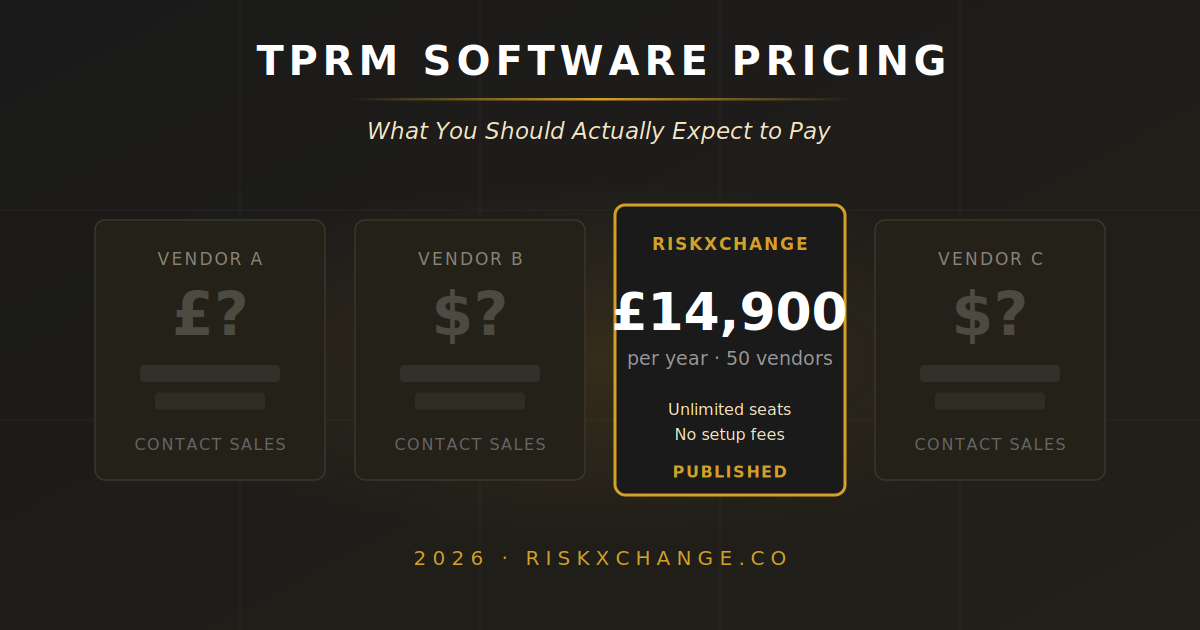 Risk Management
TPRM Software Pricing: What You Should Actually Expect to Pay in 2026
Almost every TPRM vendor hides its pricing. Here's what buyers actually pay in 2026 — real benchmark figures for SecurityScorecard, Bitsight, UpGuard and others, the hidden cost traps to negotiate away, and RiskXchange's published prices in full.
Read more Risk Management
Third Party Risk Management in the context of GDPR
Third-party risk management is essential for maintaining GDPR compliance. Organisations must ensure vendors handle personal data securely through due diligence, risk assessments, contract controls, and continuous compliance monitoring. Key focus areas include data minimisation, access limitations, and third-party audit rights. Real-world breaches, like the Target incident, show how weak vendor controls can expose sensitive data. RiskXchange supports businesses by providing instant cyber risk ratings and helping maintain GDPR-aligned third-party assurance.
Read more