With the average cost of a U.S. data breach reaching $10.22 million in 2026, the traditional annual audit is no longer just insufficient; it's a liability. You've likely realized that static assessments are outdated the moment they're signed, leaving you blind to how third-party vendors actually handle your information. This data protection risk assessment guide provides the strategic roadmap to move from reactive compliance to a state of informed resilience. We'll show you how to replace manual spreadsheets with an AI-driven visibility engine that monitors your entire data supply chain in real time.
It's exhausting to keep pace with a regulatory landscape that now includes 2026 privacy mandates in Indiana, Kentucky, and Rhode Island, alongside California's new protections for neural data. You need a way to simplify this complexity while defending against AI-powered phishing attacks that now drive 42% of global intrusions. This guide introduces a repeatable framework to automate visibility into your attack surface and secure every node in your vendor network. We'll explore how to transform your security posture from a series of blind spots into a quantifiable Cybersecurity Rating that protects your bottom line and ensures continuous compliance.
What is a Data Protection Risk Assessment in 2026?
A data protection risk assessment is a systematic process designed to identify, evaluate, and mitigate risks to personal data throughout its entire lifecycle. In 2026, this definition has expanded. It's no longer just about internal servers; it's about every node in your global supply chain. This data protection risk assessment guide emphasizes that security is a moving target. While static assessments were once the industry standard, the modern enterprise requires dynamic visibility to maintain a resilient posture. You can't manage what you can't see, and in a landscape where data moves at the speed of AI, visibility must be continuous.
We've seen a definitive shift from the traditional General Data Protection Regulation (GDPR) mandate of the Data Protection Impact Assessment (DPIA) toward the broader Data Risk Assessment (DRA). A DPIA often focuses on a specific project or process before it begins. In contrast, a DRA provides a comprehensive, ongoing view of data health across the entire organization. This evolution is necessary because AI now accounts for over 42% of global intrusions through sophisticated phishing. AI doesn't just create threats; it also identifies vulnerabilities in your infrastructure faster than manual teams can ever hope to patch them.
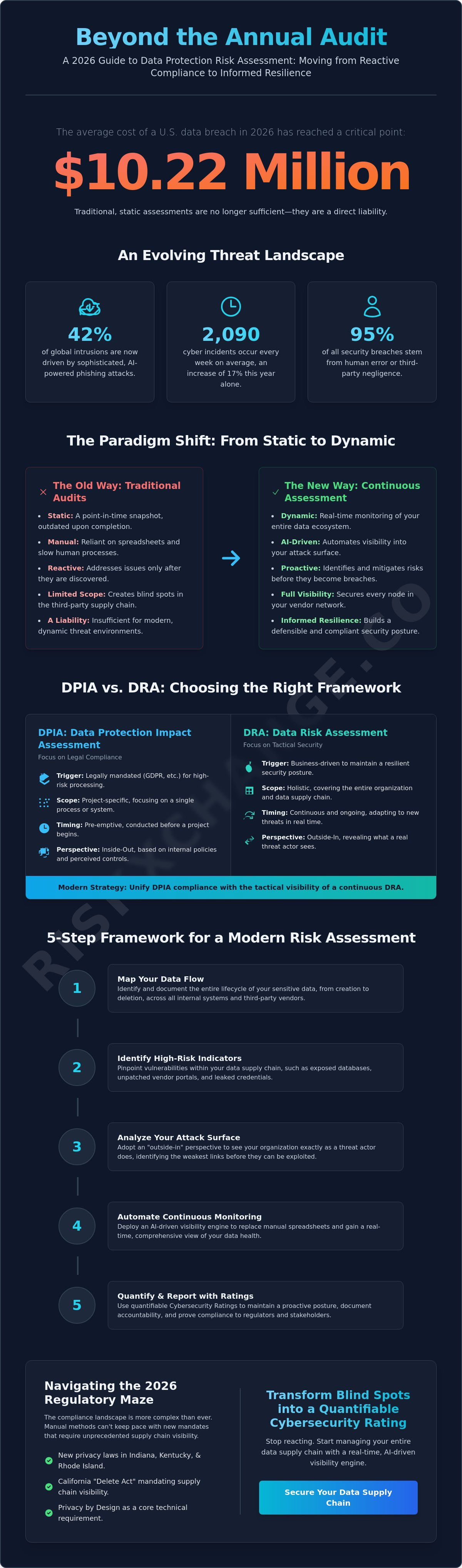
Financial leaders now view these assessments as a core business requirement rather than a IT hurdle. With the average cost of a U.S. data breach hitting $10.22 million in 2026, the cost of ignorance is far higher than the cost of implementation. Cyberattacks have increased by 17% this year alone, averaging 2,090 incidents every week. When you factor in that 95% of breaches stem from human error, having a systematic way to monitor the "outside-in" perspective of your organization is the only way to stay ahead of the curve.
The Core Objectives of a Modern Assessment
A modern assessment focuses on identifying your true attack surface. This means seeing your data stores exactly how a threat actor sees them. You must also establish necessity and proportionality. If the data isn't worth the potential risk of a $10.22 million breach, it shouldn't be on your servers. Finally, these assessments document accountability. They create a defensible, real-time audit trail that proves to regulators you've taken proactive control of your digital footprint and supply chain.
Regulatory Drivers: Beyond GDPR
As of January 1, 2026, new comprehensive privacy laws in Indiana, Kentucky, and Rhode Island have raised the bar for compliance. These laws, alongside the California "Delete Act" effective August 1, 2026, mandate a level of supply chain visibility that manual spreadsheets can't provide. Data protection now intersects with ESG reporting, as investors demand transparency regarding digital ethics. Privacy by Design has transitioned from a philosophical goal to a technical requirement, forcing companies to build automated monitoring into their architecture to ensure they don't fall behind.
DPIA vs. DRA: Choosing the Right Framework
Choosing between a Data Protection Impact Assessment (DPIA) and a broader Data Risk Assessment (DRA) often feels like a choice between compliance and security. It's not. In 2026, elite enterprises treat them as two sides of the same coin. While a DPIA satisfies the legal mandates of the GDPR or the new 2026 privacy laws in Kentucky and Rhode Island, a DRA provides the tactical visibility needed to survive a breach. This data protection risk assessment guide advocates for a unified approach. By merging legal necessity with real-time monitoring, you move beyond checking a box and start managing your true attack surface.
Most internal audits suffer from an inside-out bias. They look at what you think you have secured. However, attackers don't care about your internal policies. They look for the weak links in your data supply chain. The outside-in perspective reveals exactly what a hacker sees: exposed databases, unpatched vendor portals, and leaked credentials. This view is critical because 95% of breaches originate from human error or third-party negligence. You can't rely on a static document to capture these shifting vulnerabilities. The NIST Privacy Framework provides a robust foundation for identifying these risks, but it must be paired with active monitoring to be effective.
Modern organizations are now merging these frameworks into a single continuous risk engine. This transition allows you to maintain compliance with the California Delete Act while simultaneously defending against the 17% increase in cyberattacks seen this year. To truly close these gaps, you need to automate your vendor risk management and gain real-time visibility into your supply chain.
When is a DPIA Legally Required?
A DPIA is a formal requirement when processing is likely to result in a high risk to individuals. Specifically, you must conduct one for large-scale processing of sensitive data, such as health or biometric information. It's also mandatory for the systematic monitoring of publicly accessible areas and automated decision-making that has legal or significant effects on consumers. In 2026, this includes the use of neural data or data from minors under 16, as redefined by recent CPRA updates.
The Business Case for a Data Risk Assessment
A DRA goes beyond legal triggers to focus on operational resilience. It allows you to quantify risk through a Cybersecurity Rating, turning abstract threats into a trackable metric for the board. By identifying shadow data and unmanaged SaaS applications, a DRA reduces the time to identify breaches, which is vital when the average cost of a breach is $10.22 million. This proactive approach ensures that your data remains an asset rather than a catastrophic liability.
Identifying High-Risk Indicators in Your Data Supply Chain
Your data is only as secure as the weakest link in your third-party network. While internal security protocols are essential, they often create a "Blind Spot" where visibility ends at your own firewall. This data protection risk assessment guide highlights that most modern data breaches originate outside the primary organization. In 2026, with cyberattacks up 17%, relying on a vendor's self-reported security questionnaire is a gamble you can't afford to take. You need to evaluate vendor cybersecurity posture using real-time ratings that reflect their current attack surface, not their posture from six months ago.
The introduction of innovative technologies like AI and IoT has drastically altered the data risk profile. These tools expand the attack surface by creating new entry points and data flows that traditional monitoring misses. For instance, AI-powered phishing now accounts for 42% of global intrusions, often targeting the less-secure communication channels of your smaller suppliers. Identifying these high-risk indicators requires an outside-in perspective that quantifies a partner's resilience before a leak occurs. This proactive stance moves you from a state of digital vulnerability to one of informed resilience.
Third-Party Data Vulnerabilities
Assessing how vendors store or exfiltrate your proprietary information is a complex task. The risk often extends beyond your direct contractors to "Nth-party" relationships, where your data is shared with subcontractors you haven't vetted. Supply Chain Data Sprawl is the uncontrolled expansion of data across fragmented third-party environments without centralized oversight or security controls. This sprawl makes it nearly impossible to track data movement without automated tools. You must ensure that your data protection risk assessment guide includes a process for uncovering these hidden connections and assessing their impact on your overall Cybersecurity Rating.
Technological Risk Factors
AI model training presents a unique challenge in 2026. You must verify if your sensitive data is being used to train third-party models without explicit consent, a practice that could violate the 2026 privacy laws in Indiana and Kentucky. Edge computing also expands the attack surface by processing data closer to the source, often on devices with minimal security. Meanwhile, the friction between legacy systems and modern cloud APIs remains a primary source of leaks. These integration points are frequently overlooked, providing attackers with a seamless path to your most valuable assets.
A 5-Step Framework for Conducting a Data Protection Risk Assessment
Building a resilient data ecosystem requires more than a checklist. It demands a repeatable, data-driven architecture. This data protection risk assessment guide outlines a five-step framework designed to eliminate the blind spots that lead to the $10.22 million average cost of a U.S. breach. By following this sequence, you move from a reactive state to a position of proactive control over your data supply chain.
- Step 1: Inventory and Mapping. You cannot protect what you haven't identified. Start by discovering where personal data lives across your entire supply chain, including SaaS apps and third-party APIs.
- Step 2: External Surface Analysis. Evaluate your "Outside-In" security posture. This step assesses how potential attackers view your digital footprint and that of your vendors.
- Step 3: Impact Analysis. Quantify the potential harm. Use standardized metrics to determine the financial and regulatory fallout if specific data sets were compromised.
- Step 4: Control Implementation. Apply automated remediation strategies. This involves setting up protocols that trigger immediately when a vulnerability is detected.
- Step 5: Continuous Monitoring. Transition to a real-time risk dashboard. Static reports are obsolete; you need a live view of your Cybersecurity Rating to stay ahead of 2026 threats.
To implement this framework effectively, you should leverage an automated risk management platform that provides real-time visibility into every vendor relationship.
Discovering Your True Attack Surface
Most organizations only see 60% of their actual digital footprint. AI-native tools are now essential for finding hidden data repositories that traditional scans miss. You must map the data flows between your internal systems and third-party APIs to identify unauthorized exfiltration points. This level of supply chain visibility ensures that shadow data doesn't become the entry point for an AI-powered phishing attack, which now accounts for 42% of global intrusions.
Remediation vs. Mitigation in Data Protection
Speed is the critical factor in 2026. When a threat is detected, you must decide whether to patch the vulnerability (remediation) or isolate the affected system (mitigation). Automating your response to high-risk alerts ensures that human error, which causes 95% of breaches, doesn't delay your defense. Actionable intelligence provides the specific data points needed to accelerate remediation and reduce the window of vulnerability.
Automating Data Protection with RiskXchange
RiskXchange provides the visibility engine required to turn the theory of this data protection risk assessment guide into a permanent operational reality. While traditional assessments offer a snapshot of the past, our AI-native TPRM platform delivers a continuous stream of real-time risk intelligence. This transition from "blind spots" to "visibility" is essential in a year where 48% of companies have reported an increase in insider attacks. We help you manage the entire data supply chain through a single interface that quantifies security through our signature Cybersecurity Rating. Security isn't an abstract concept here; it's a trackable metric that informs every business decision.
The platform automates the complex mapping and analysis steps required to defend against the 2,090 cyberattacks occurring every week in 2026. It doesn't just list potential vulnerabilities. It prioritizes them based on actual threat data and the "outside-in" perspective. This allows your team to see exactly what an attacker sees when scanning your vendor network. By centralizing supply chain resilience, you directly address the factors that lead to the $10.22 million average cost of a U.S. data breach. Our solution ensures that your security posture is always visible, measurable, and manageable.
Real-Time Risk Intelligence
Our platform identifies critical vulnerabilities before threat actors can exploit them. By employing "outside-in" attack surface management, RiskXchange monitors the digital footprint of every stakeholder in your data ecosystem. This proactive approach is vital for defending against AI-powered phishing, which accounts for 42% of global intrusions as of May 2026. Automation significantly reduces the manual burden on Data Protection Officers (DPOs) and CISOs. It eliminates the need for manual follow-ups and replaces them with actionable, real-time alerts. This ensures that your security posture remains stable even as your vendor list grows.
Taking Control of Your Data Future
Securing your data supply chain is now a core component of corporate strategy and ESG reporting. Fortune 500 enterprises trust RiskXchange to provide the granular technical expertise and high-level oversight needed to manage global risk. We provide the tools to ensure compliance with the evolving patchwork of state laws, including the new mandates in Kentucky and Rhode Island. Integrating these protections into your strategy isn't just about avoiding fines; it's about building a brand known for digital integrity and informed resilience.
Empower your team with a RiskXchange demo and take control of your security posture today.
Take Control of Your Digital Resilience
The transition from static compliance to a dynamic, AI-driven security posture is the only way to defend against the 2,090 weekly cyberattacks reported in 2026. This data protection risk assessment guide has demonstrated that manual audits are no longer sufficient to protect against the $10.22 million average cost of a data breach. You must move beyond internal checks and embrace 360-degree supply chain visibility to identify vulnerabilities before they're exploited by AI-powered phishing. By quantifying your security through real-time ratings, you replace uncertainty with actionable data.
Our AI-native TPRM platform provides the "outside-in" perspective that Fortune 500 companies use to maintain their global risk posture. It's time to eliminate the blind spots in your vendor network and build a defensible, automated framework for the future. You don't have to navigate this volatile landscape alone. Request a Free Cybersecurity Rating and Data Risk Consultation to see exactly how the world perceives your digital footprint. You have the power to transform your organization from a state of vulnerability into a leader in informed resilience.