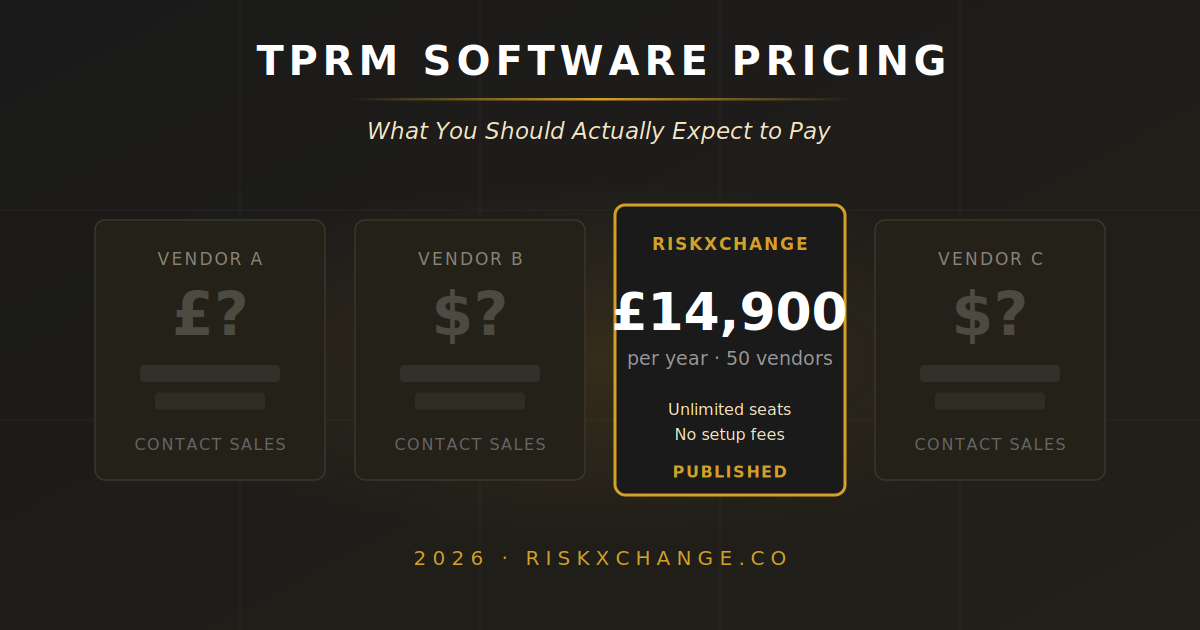
Try to budget for third-party risk management software and you'll hit the same wall almost everywhere: "Contact sales." SecurityScorecard, Bitsight, Black Kite, Panorays, ProcessUnity, Prevalent — none of them publishes a price. You can't build a business case without a number, and you can't get a number without entering a sales cycle.
This article fixes that. We've pulled together what buyers actually pay in 2026, drawn from independent buying benchmarks, published vendor pages where they exist, and public reviews. And because we think hidden pricing is a buyer-hostile habit the category should drop, we'll also print RiskXchange's own prices in full — the same ones on our pricing page, because we're one of only two vendors in this space that publishes them.
Why is TPRM pricing hidden?
Three reasons, none of them in your favour. First, quote-only pricing lets vendors price to your budget rather than to a rate card — enterprise buyers routinely pay multiples of what a smaller firm pays for similar scope. Second, the headline platform fee is often only part of the bill: capabilities you'd assume are included get packaged as paid add-on modules. Third, opacity blunts comparison shopping, which is precisely the point.
The practical consequence: two companies of similar size can sign the same platform at wildly different prices, and neither will ever know.
What buyers actually pay: the benchmarks
Here's the honest picture across the main platforms, in the currency each is typically quoted in.
| Platform | Published? | Typical entry point | At scale | Watch for |
|---|---|---|---|---|
| RiskXchange | ✅ Yes | £14,900/yr (50 vendors) | £31,500/yr (150 vendors); Enterprise from £75,000/yr | Nothing hidden — unlimited seats, no setup fees |
| UpGuard | ✅ Yes | From $1,750/month ($21,000/yr) | Scales by tier | The other transparent vendor; free tier for 5 vendors |
| SecurityScorecard | ❌ No | ~$25,000–$35,000/yr (50–100 vendors, per buyer benchmarks) | $100,000+ (500+ vendors) | Paid add-on modules; MAX managed service priced on top; auto-renewal and annual escalator clauses |
| Bitsight | ❌ No | Quote-only, widely regarded as premium | Scales with entities monitored | Advanced analytics and TPRM enhancements can be add-ons; managed service tiers extra |
| Black Kite | ❌ No | Quote-only, reportedly higher than peers at tier | Scales with vendor count | Users report costs escalating mid-contract and fees for premium features |
| Panorays | ❌ No | Quote-only; free plan for 5 vendors | Multiple evaluation tiers | Tier structure spans continuous vs bi-annual evaluation depth |
| ProcessUnity / Prevalent | ❌ No | Quote-only | Enterprise-scale | Implementation effort is a real cost alongside licence |
Benchmark figures for quote-only vendors come from independent buying datasets and public reviews rather than rate cards, so treat them as directional — that's the best anyone outside a sales cycle can do, which is rather the point of this article.
The five hidden cost traps
The licence fee is where TPRM budgeting starts, not where it ends. These are the traps that inflate real-world spend:
1. Add-on modules. Reviewers of the big ratings platforms consistently note that capabilities like vendor risk management workflow, attack surface intelligence and compliance mapping can be separately priced. Ask for the all-in price for your actual requirement list, not the platform base.
2. Managed services on top. If the platform only shows you the risk, someone still has to do the work. SecurityScorecard's MAX and Bitsight's service tiers exist precisely because the platforms generate workload — and both are priced on top of the subscription. Factor in either that fee or the analyst headcount it replaces.
3. Per-vendor expansion pricing. Most contracts are priced on monitored vendor count. If you grow mid-contract, incremental vendors can be charged at worse rates than your original deal. Negotiate expansion pricing before signing, not when you need it.
4. Auto-renewal and escalators. Benchmark data on SecurityScorecard contracts shows auto-renewal clauses requiring 30–90 days' cancellation notice and annual price escalators. Negotiate a cap (3% or CPI) and a longer notice window while you still have leverage.
5. The GRC pairing tax. Data-first platforms like Bitsight often need a separate GRC or workflow tool to run an actual programme — a second licence, a second implementation, a second renewal cycle. Price the stack, not the product.
What RiskXchange costs — in full
No quote required:
- Essentials — £14,900 per year. 50 vendors monitored, unlimted assessments a year, continuous monitoring with 0–900 scoring, dark-web correlation via BreachWatch, compliance framework mapping and remediation tracking.
- Professional — £31,500 per year. 150 vendors, 200 assessments, fourth-party monitoring, smart risk tiering, compliance tracking through VANCE, full API access and a dedicated customer success manager.
- Enterprise — custom, from £75,000 per year. Unlimited vendors and assessments, all thirty-two AI agents, SSO, custom integrations and white-glove onboarding.
Every tier includes unlimited user seats and zero setup fees, on annual terms with multi-year discounts available. And crucially, The Agency — the AI agent workforce that actually does the assessment, remediation and reporting work — is part of the product, not a managed-service surcharge. The line most incumbents draw between "software" and "someone to do the work" is exactly the line our pricing doesn't have.
Budgeting scenarios
~50 vendors, first structured programme. Ratings incumbents will quote you roughly $25,000–$35,000 before add-ons. UpGuard comes in around $21,000. RiskXchange Essentials is £14,900 with the work automated. Whichever you choose, at this size avoid anything requiring a services contract to be useful.
~150 vendors, regulatory pressure (DORA, NIS2, FCA). This is where hidden costs bite hardest, because regulatory reporting is often where the add-ons live. Demand the all-in price for your framework list. RiskXchange Professional is £31,500 including VANCE's compliance tracking; comparable incumbent scope typically lands well above that once modules are included.
500+ vendors, enterprise scale. Everything is negotiable and everything is six figures — benchmarks put large ratings deployments at $100,000+ before managed services. Multi-year terms are the main discount lever everywhere, including with us (Enterprise floor £75,000). At this scale, negotiate expansion pricing, escalator caps and notice periods as hard as the headline number.
Questions to ask any TPRM vendor before signing
- What's the all-in annual price for my requirement list — no module surprises later?
- What happens to per-vendor pricing if my portfolio grows mid-contract?
- Is there an annual escalator, and will you cap it?
- What's the auto-renewal notice period?
- Are user seats limited or charged?
- What does it cost to get the work done, not just the data — managed service, or headcount?
Any vendor that can't answer those in writing is telling you something about the renewal conversation to come.
If you'd like to see how the platforms compare beyond price, read our seven-platform comparison or the RiskXchange vs SecurityScorecard head-to-head. Or skip the reading — run a free SnapShot and The Agency will assess one of your live vendors in under 24 hours, no commitment.