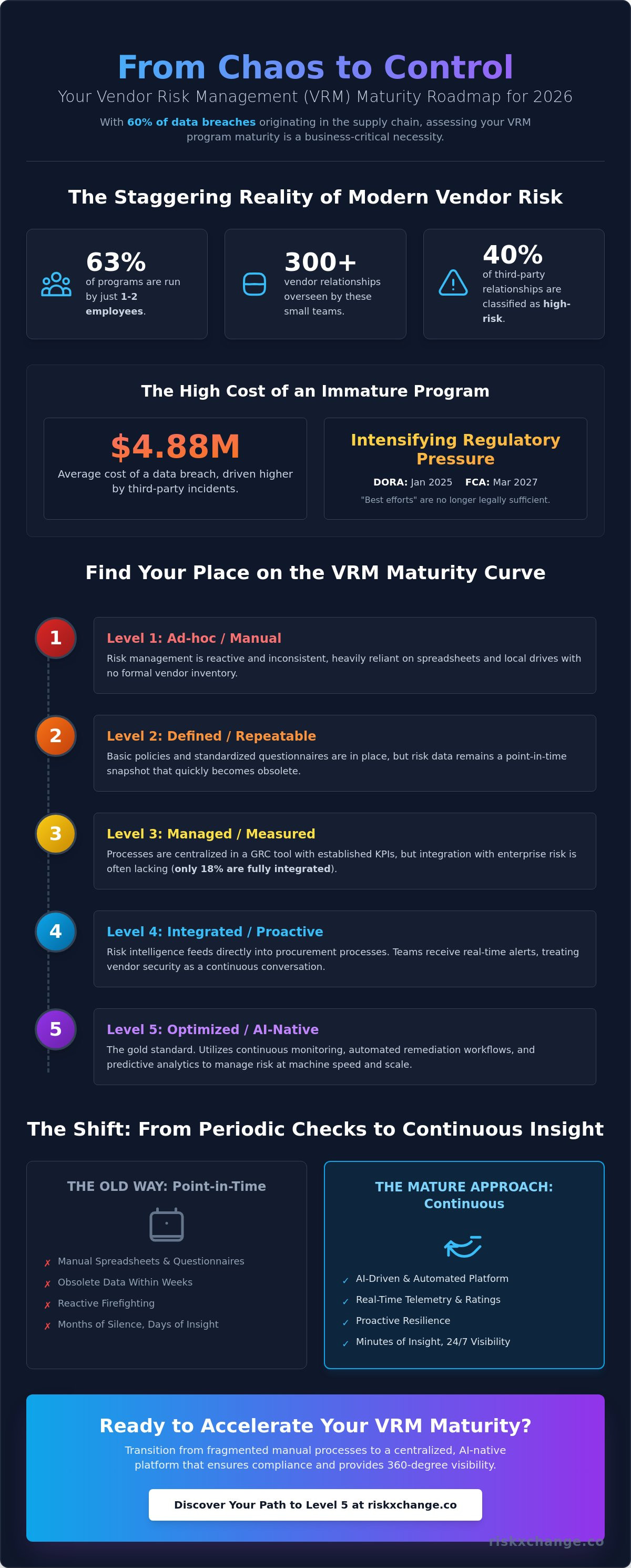
Did you know that 63% of third-party risk management programs are still managed by only one or two dedicated employees, even while overseeing 300 or more vendor relationships? It's a staggering reality in 2026, especially when 60% of data breaches now originate within the supply chain. If you feel like you're drowning in manual spreadsheets and losing the battle for real-time visibility, you aren't alone. Assessing your vendor risk management program maturity is no longer a luxury; it's a regulatory necessity under frameworks like DORA and the upcoming March 2027 FCA reporting rules.
You likely recognize that your current manual assessments can't keep pace with a market where 40% of third-party relationships are now classified as high-risk. This guide will show you how to master the transition from spreadsheet chaos to an AI-driven, optimized vendor risk posture that satisfies both regulators and the board. We'll provide a clear roadmap to bridge the maturity gap, moving your team from reactive blind spots to proactive, real-time visibility. You'll learn how to allocate resources effectively and leverage quantifiable cybersecurity ratings to reduce your third-party breach probability starting today.
Understanding Vendor Risk Management Program Maturity in the AI Era
Traditionally, many organizations viewed Third-party management as a simple compliance exercise. It was a series of checkboxes designed to satisfy auditors rather than a strategic defense mechanism. In 2026, this reactive "firefighting" mode has become a significant liability. True vendor risk management program maturity represents the transition from static, manual assessments to proactive, data-driven resilience. It's the difference between asking a vendor if they're secure and knowing they are through real-time telemetry.
The 2026 standard requires a complete shift in perspective. AI-driven threats now allow attackers to exploit vulnerabilities at machine speed, making human-driven reviews insufficient. Supply chains are no longer linear; they're hyper-connected webs where a single failure ripples through the entire ecosystem. High maturity aligns risk management with core business objectives. It moves the conversation away from "checking the box" and toward protecting the brand's reputation and ensuring operational continuity. When you achieve this level of vendor risk management program maturity, you stop being a cost center and start being a value driver.
Modern maturity frameworks prioritize the "outside-in" perspective. This narrative device involves viewing your vendor's digital footprint exactly as a threat actor would. By quantifying this external posture through a Cybersecurity Rating, you gain a tangible metric that the board understands. It provides a lens of transparency that internal assessments alone cannot offer.
The High Cost of Low Maturity
Low maturity carries a heavy price tag. When 63% of programs rely on just one or two employees to manage 300 or more vendors, manual errors are inevitable. These blind spots often hide 4th and Nth party risks that bypass traditional defenses. With the average cost of a data breach reaching $4.88 million, the financial stakes are too high for spreadsheet-based management. Regulatory pressure is also intensifying. Since the Digital Operational Resilience Act (DORA) began its application in January 2025, and with the FCA's March 2027 deadline approaching, "best efforts" are no longer legally sufficient for financial entities.
The Shift from Periodic to Continuous Monitoring
The traditional "point-in-time" assessment is a snapshot of a moving target. It's often obsolete within weeks, if not days, of completion. Mature programs replace these static snapshots with Actionable Risk Intelligence to maintain 24/7 visibility across the attack surface. This allows teams to identify and remediate vulnerabilities before they can be exploited. Continuous monitoring reduces the window of vulnerability from months of silence to minutes of insight.
The 5 Levels of the VRM Maturity Curve: From Ad-hoc to AI-Optimized
Progressing through the stages of vendor risk management program maturity isn't just about adding more people to your team. It's about evolving your technical capabilities to match the speed of modern threats. Most organizations find themselves trapped in the lower tiers, where manual labor creates a ceiling on growth and visibility. To break through, you must understand the specific characteristics of each level on the maturity curve.
- Level 1: Ad-hoc/Manual: Risk management is reactive and inconsistent. You likely rely on spreadsheets and local drives, with no formal inventory of your supply chain.
- Level 2: Defined/Repeatable: You've established basic policies and standardized questionnaires. However, risk data remains a point-in-time snapshot that quickly becomes obsolete.
- Level 3: Managed/Measured: Processes are centralized within a GRC tool. You've established KPIs, but only 18% of programs at this stage are fully integrated with enterprise risk management as of March 2026.
- Level 4: Integrated/Proactive: Risk intelligence feeds directly into procurement. You receive real-time alerts and treat vendor security as a continuous conversation.
- Level 5: Optimized/AI-Native: This is the gold standard. You utilize continuous monitoring, automated remediation, and predictive analytics to manage risk at scale.
Mapping Your Organization to the Curve
Many firms hit a "Stagnation Point" between Level 2 and Level 3. This occurs when the volume of vendors exceeds the team's capacity to perform manual reviews. If your team manages 300 or more relationships with only two dedicated employees, you're likely at this plateau. You can use the Vendor Risk Management Maturity Model (VRMMM) as a baseline to identify these gaps. Transitioning to an automated third-party risk management framework is the only way to scale without adding infinite headcount.
You can start by seeing how your vendors appear to attackers; benchmark your current posture with a real-time Cybersecurity Rating.
The Role of AI in Level 5 Maturity
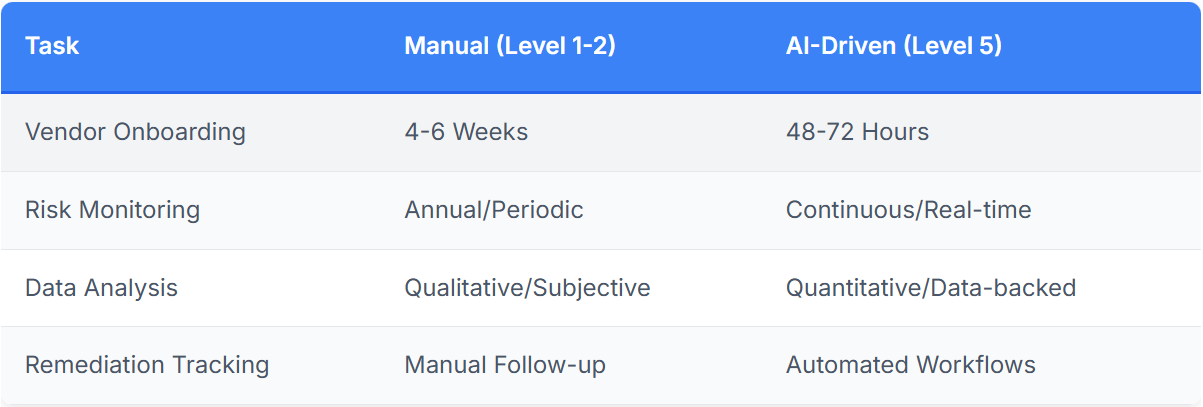
AI-native platforms shift the focus from data collection to strategic risk management. Instead of spending weeks chasing questionnaire responses, AI automates the analysis of attack surfaces and security ratings. This allows your team to focus on remediation rather than administration. By April 2026, 61% of CISOs reported that AI-powered tools are essential for preventing third-party breaches. The efficiency gains are measurable and immediate.
Hallmarks of a Mature Program: Beyond Periodic Assessments
High vendor risk management program maturity isn't a destination reached by completing a set number of audits. It's an operational state where risk data informs every procurement and renewal decision. While early-stage programs treat risk as an isolated IT problem, mature organizations integrate these insights across ESG and Data Protection workflows. Using resources like CISA's Vendor SCRM Template provides a structured foundation, but true leaders augment these templates with real-time telemetry to stay ahead of emerging threats.
Dynamic risk tiering is a critical differentiator for advanced programs. Traditional methods rely on static labels assigned during onboarding that rarely change unless a major incident occurs. In contrast, a mature program uses automated feeds to re-categorize vendors the moment their security posture shifts. If a critical software provider's rating drops due to a new vulnerability, the system triggers an immediate alert. This shifts the team from administrative data entry to strategic risk mitigation, turning the VRM function into a value-driver that protects the company's bottom line.
Communicating these risks to the board requires a shift away from technical jargon. Executive-level reporting in mature programs focuses on quantifiable metrics that reflect the organization's true security posture. By presenting data-driven insights rather than anecdotal evidence, CISOs can secure better resource allocation and demonstrate a clear reduction in third-party breach probability.
Quantifiable Metrics: The Cybersecurity Rating
Vague labels like "High" or "Medium" risk don't provide the precision needed for modern vendor risk management program maturity. A standardized 0-900 rating scale offers an objective, actionable benchmark that both technical teams and business leaders can understand. You can use these ratings to set strict performance thresholds in vendor contracts, ensuring that third parties maintain a specific security standard to remain in your supply chain. Implementing a cybersecurity risk rating platform allows your team to move from subjective opinions to data-backed enforcement.
Continuous Attack Surface Visibility
You can't manage what you can't see. Mature programs prioritize an "outside-in" view, monitoring the same external-facing assets that attackers target. Using attack surface management tools allows you to validate vendor security claims against real-world evidence rather than relying solely on self-reported questionnaires. This level of transparency is essential for identifying Nth-party dependencies, where a vulnerability in a vendor's own supplier could compromise your data. Achieving Level 4 maturity and beyond requires this deep visibility into the entire digital ecosystem.
Building a Roadmap for Programmatic Maturity and Resilience
Transitioning from a reactive state to a proactive posture requires more than just better tools. It demands a structured roadmap that addresses governance, technology, and culture. Most organizations struggle to bridge the gap between Level 2 and Level 3 because they attempt to automate broken, manual processes. Success in vendor risk management program maturity comes from building a solid foundation before layering on sophisticated AI capabilities.
- Phase 1: Foundation: Focus on standardizing your internal policies and creating a comprehensive inventory of your supply chain. You can't protect what you haven't identified.
- Phase 2: Centralization: Move your data away from local drives and disparate emails into a unified vendor risk management software. This creates a single source of truth for all third-party data.
- Phase 3: Automation: Implement automated assessments and threshold-based alerts. This allows your team to stop chasing questionnaires and start managing exceptions.
- Phase 4: Optimization: Integrate real-time ratings and AI-driven insights to achieve continuous monitoring. This phase aligns your program with the machine-speed threats of 2026.
Securing Executive Buy-in for the Transition
CFOs and board members often view risk management as a defensive cost rather than a strategic asset. To secure buy-in, you must translate technical vulnerabilities into business resilience. With the average cost of a data breach reaching $4.88 million as of April 2026, the financial argument for maturity is undeniable. Present a "Risk Reduction ROI" model that demonstrates how moving up the maturity curve directly lowers the probability of a multi-million dollar disruption. Use maturity benchmarks to justify SaaS subscription fees by showing how they replace the need for expensive, manual consulting hours.
Overcoming the "Headcount" Objection
A significant hurdle to vendor risk management program maturity is the lack of dedicated personnel. March 2026 data shows that 63% of TPRM programs are managed by only one or two employees, even when overseeing 300 or more vendors. You don't need a massive team if you have the right technology. Automation allows a small group of experts to manage thousands of vendors by focusing only on those that fall below established security thresholds. When selecting a vendor management platform, prioritize solutions that offer seamless scalability. You can take control of your supply chain today by exploring how AI-native risk intelligence scales your team's impact without increasing headcount.
Accelerating VRM Maturity with RiskXchange’s AI-Native Platform
Elevating your vendor risk management program maturity shouldn't be a multi-year struggle. While legacy GRC tools act as passive repositories, RiskXchange functions as an active intelligence layer. It provides an instant baseline for Level 3 and 4 maturity by automating the data collection and analysis that usually consumes months of manual labor. Our AI-native architecture is specifically designed to handle the massive data volumes of 2026, ensuring that your program never outgrows its infrastructure or loses pace with the threat landscape.
We provide 360-degree visibility that extends far beyond basic security checklists. By integrating Cyber, ESG, and Data Protection metrics into a single, unified view, we ensure that your supply chain is secure, compliant, and sustainable. This holistic approach prevents internal silos and ensures that risk data flows seamlessly between departments. It allows you to meet the strict requirements of regulations like DORA while simultaneously managing your broader corporate responsibility goals. You gain the power to identify and mitigate risks before they impact your operations.
Continuous Real-Time Risk Management
Continuous real-time risk management is the heartbeat of our platform. Instead of relying on a vendor's subjective, self-reported questionnaire, our AI-native engine performs real-time attack surface analysis. This "outside-in" perspective is our unique signature. It allows you to see exactly what an attacker sees, identifying vulnerabilities in your supply chain before they can be exploited. RiskXchange automates the entire assessment lifecycle, from initial onboarding to secure offboarding. AI-driven alerts replace the need for outdated annual audits, notifying you the moment a vendor's risk profile shifts. This proactive stance moves your organization from a state of digital vulnerability to one of informed resilience.
Ready to Benchmark Your Program?
Your journey toward optimized vendor risk management program maturity starts with a clear understanding of your current posture. We invite you to view your personalized Cybersecurity Rating to see exactly how your organization appears to the outside world. Our platform provides the data-driven honesty needed to take control of your digital footprint and protect your brand from third-party failures. If you require additional support, our strategic risk experts are available to assist with implementation and program design. Get started with a RiskXchange demo today and transform your supply chain visibility into a competitive advantage.
Securing Your Supply Chain for the Future of 2026
The landscape of 2026 demands a departure from the static, manual processes of the past. You've seen how transitioning from Level 1 spreadsheets to a Level 5 AI-native posture isn't just about efficiency; it's about survival. By adopting continuous monitoring and the "outside-in" perspective, you gain the visibility required to identify vulnerabilities before they become incidents. This strategic shift moves your organization beyond simple compliance and into a state of informed resilience that satisfies both the board and global regulators.
Improving your vendor risk management program maturity ensures your organization remains resilient against machine-speed threats and tightening regulations like DORA. RiskXchange provides the AI-native TPRM platform and real-time Cybersecurity Ratings needed to transform your risk posture into a trackable, quantifiable asset. With our global support teams in London, Austin, and Dubai, we're ready to help you move from digital vulnerability to proactive control. It's time to turn your supply chain visibility into a definitive business advantage.
Take the next step in your security journey. Benchmark your vendor risk maturity with a RiskXchange demo today. You have the tools to master your supply chain; it's time to put them to work. We're here to ensure your success in an increasingly complex digital world.