Most organisations of any size already have threat intelligence. They subscribe to feeds, receive vendor advisories, read sector bulletins and sit in an information-sharing group or two. Far fewer can point to a decision that was made differently because of any of it.
That gap is the whole problem. Intelligence has no value in the abstract; it has value when it changes what somebody does. A feed nobody consumes is not an early-warning capability, it is a subscription. The useful question is therefore not "what intelligence do we have?" but "which decisions should this be changing, and are they changing?"
Match the tier to the decision
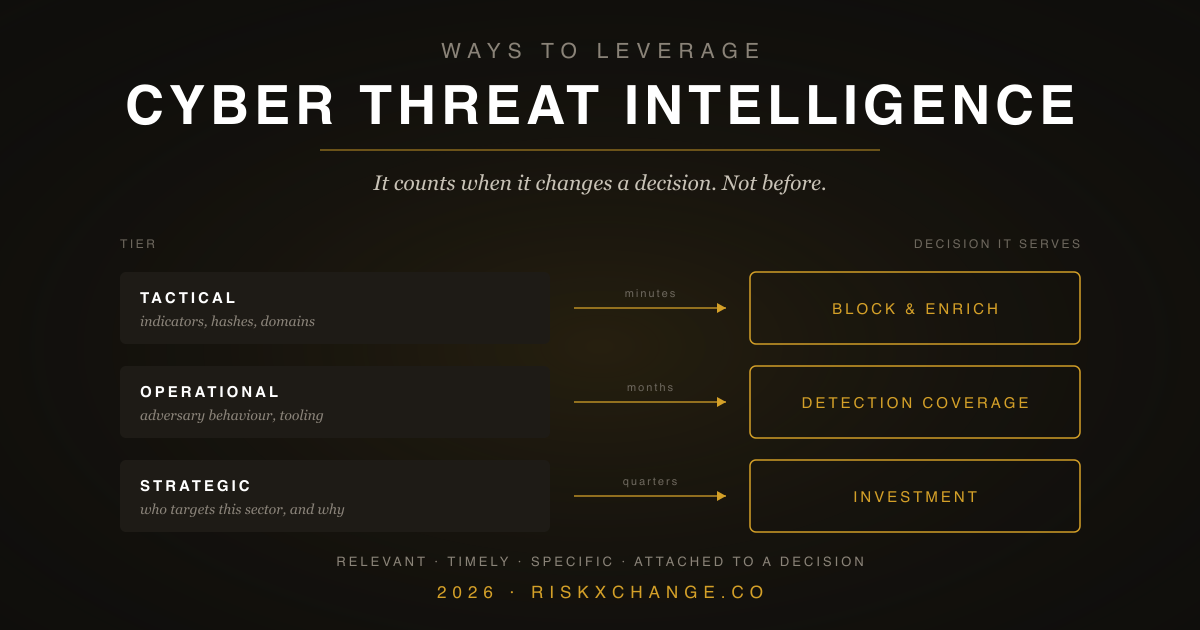
Threat intelligence is conventionally split into three tiers, and most disappointment with it comes from delivering one tier to an audience that needed another.
Tactical intelligence is the machine-speed layer: indicators, signatures, file hashes, malicious domains. It is consumed by tooling rather than people, it is perishable, and its value is measured in how quickly it reaches a control that can act on it.
Operational intelligence describes how adversaries behave — the tooling they favour, the sequence they follow, the access they seek first. It is consumed by detection engineers and responders, and it ages in months rather than hours.
Strategic intelligence concerns who is likely to target your sector and why, how that is shifting, and what it implies for investment. It is consumed by people who allocate budget, and it is measured in quarters.
Sending a board a list of malicious IP addresses satisfies nobody. Sending a detection engineer a geopolitical summary satisfies nobody either. Deciding which tier serves which audience is the first practical step, and it costs nothing.
Prioritise remediation by what is actually being exploited
No organisation patches everything. Every organisation therefore ranks, and severity scoring alone is a poor way to rank, because it describes how bad a vulnerability would be if exploited rather than whether anyone is exploiting it.
Threat intelligence supplies the missing variable. A medium-severity flaw with a public exploit, active use in the wild and a presence on your internet-facing estate is a more urgent problem than a critical-severity flaw on an internal system nobody has ever attacked. Feeding exploitation data into the queue changes the order of work, and the order of work is where vulnerability management either succeeds or quietly fails.
This is the single highest-return use of intelligence for most teams, because it improves outcomes without requiring anyone to do more work — only different work first.
Tune detection to behaviour rather than yesterday's indicators
Loading indicator lists into a SIEM is the most common use of threat intelligence and among the least durable. Indicators are disposable by design: an adversary changes infrastructure between campaigns, sometimes between targets, and every block you deploy is a fact you have taught them.
Operational intelligence is more valuable precisely because it is harder for an adversary to change. The techniques a group relies on reflect what works, what they have built and what they know. Converting reporting about those techniques into detection logic produces coverage that survives infrastructure changes — the argument for indicators of attack over indicators of compromise.
Done properly this also tells you what you cannot see. Mapping reported techniques against your existing detection coverage produces a gap list, and a gap list is a roadmap. Knowing which of your relevant threat actors you would currently fail to notice is more useful than any feed.
Scope and accelerate incident response
During an incident, intelligence answers questions that determine the response itself. Is this commodity malware or a targeted intrusion? Does this tooling normally precede ransomware deployment, and if so, how long is the usual dwell time? What else does this group touch once inside, and where should we look before assuming we have found the extent of it?
The difference is between containing what you found and containing what is there. A responder who knows a particular loader is typically followed by credential harvesting and lateral movement within days looks in the right places immediately rather than after a second alert.
This only works if the intelligence is available at the moment of the decision, which means it belongs in the incident response plan and the enrichment pipeline, not in a portal somebody remembers during the debrief.
Extend it beyond your own perimeter
Most intelligence programmes stop at the boundary of the estate they control, which is increasingly the smaller half of the exposure.
If a threat actor is known to target your sector through managed service providers, the relevant question is not only whether your controls would stop them, but which of your suppliers they would come through. If a widely deployed product has a vulnerability under active exploitation, the exposure to establish is not only your own instance but every supplier running it who has not patched.
Answering that requires an external view of third parties you cannot instrument. What is observable from the outside — exposed services, unpatched software, expired certificates, evidence of prior compromise — is exactly what an attacker uses for target selection, which makes it a reasonable proxy for how attractive and how vulnerable a supplier is. Pairing intelligence with continuous third-party monitoring turns a generic advisory into a specific list of suppliers to contact this week.
Brief decision-makers in decisions, not feeds
Strategic intelligence fails most often in presentation. Executives are shown volumes — alerts triaged, indicators ingested, campaigns tracked — which demonstrate activity without informing a decision.
The useful version answers three questions. Who is realistically likely to target an organisation like this one, and has that changed? Where would they succeed today if they tried? What would close that gap, and what would it cost? That framing turns intelligence into a budget conversation rather than a status update, and it pairs naturally with metrics that track exposure rather than effort.
What makes intelligence actionable
Four properties separate intelligence that changes behaviour from intelligence that fills an inbox.
It is relevant to your sector, geography and technology stack — a feed covering everything covers nothing in particular. It is timely enough to matter, which for tactical indicators means minutes and for strategic assessment means before the planning cycle closes. It is specific enough to act on, naming systems, versions and conditions rather than gesturing at a category of risk. And it is attached to a decision and an owner, so that its arrival triggers something.
Intelligence failing any of these is not necessarily wrong. It is simply not going to change anything, and it should be recognised as such rather than counted as coverage.
Start with the decision
The most reliable way to build a programme that survives its first budget review is to work backwards. Pick a decision you already make badly or slowly — which vulnerabilities to fix first, which supplier to escalate, whether an alert warrants a response — and ask what would have to be true to make it better. Then acquire only the intelligence that answers it, and measure whether the decision improved.
That approach produces a smaller programme than the feed-first alternative, and a considerably more defensible one. It also has the advantage of failing visibly: if nothing changed, you learn that immediately rather than at renewal.
RiskXchange gives organisations a continuous outside-in view of their own attack surface and their suppliers', using the same public signals an attacker would start from. If you would like to see what that surfaces, get in touch.