What if your organization's biggest security threat isn't a vulnerability you've identified, but a digital asset you don't even know exists? To manage this risk effectively, you must first define what is a cyber attack surface and how it applies to your expanding ecosystem. With AI-enabled cyberattacks increasing by 89% in 2025, relying on traditional internal defenses is no longer enough. You've likely felt the pressure of cloud sprawl and third-party vendor risks making your environment feel unmanageable. It's difficult to provide the board with a clear picture of your security posture when your digital footprint expands every time a new SaaS tool is adopted.
This definitive guide will help you master modern exposure management by adopting an outside-in perspective, allowing you to see your organization exactly as a threat actor does. You'll gain a clear framework for identifying every entry point and learn how to use a Cybersecurity Rating to turn abstract risks into measurable, actionable data. We'll show you how to move from a state of digital vulnerability to one of informed, proactive resilience.
Defining the Cyber Attack Surface: An Outside-In Perspective
In 2026, cybersecurity isn't about building higher walls; it's about understanding your exposure. To truly answer what is a cyber attack surface, you must look beyond your own data center. The cyber attack surface represents the total sum of all points where an unauthorized user can enter or extract data. Fundamentally, the attack surface is the digital reflection of an organization’s risk posture.
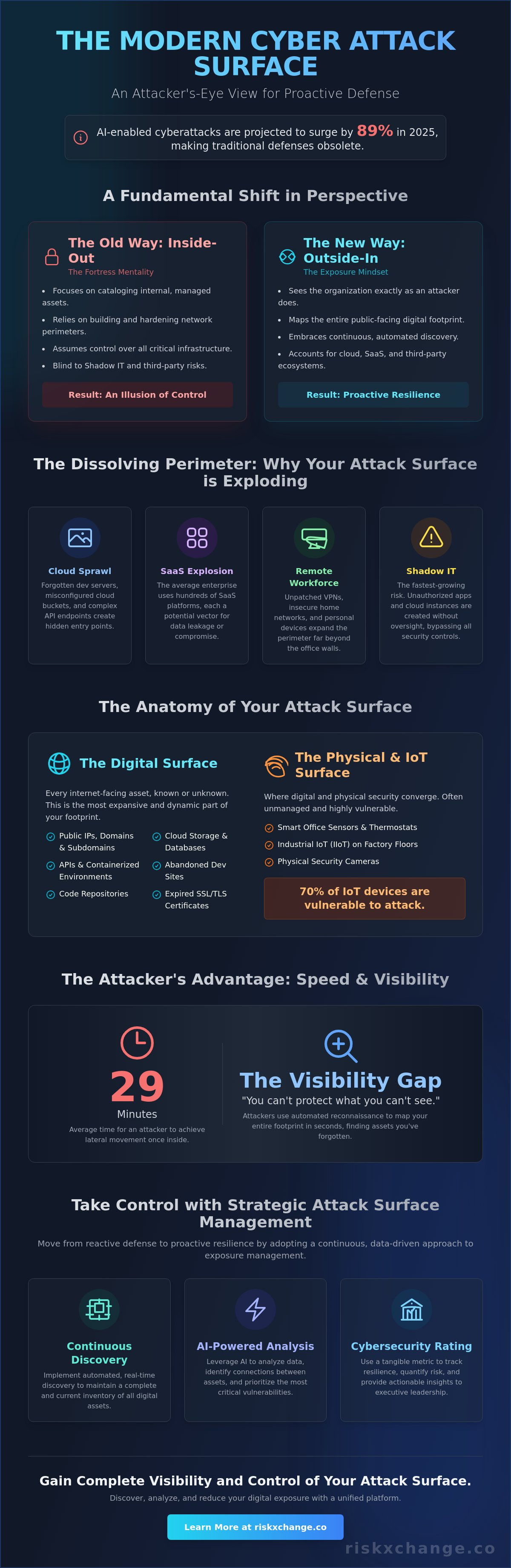
Traditional security once focused on an "inside-out" mindset, cataloging internal assets and building perimeters. This approach is no longer viable. Modern CISOs have shifted to exposure management because they recognize that attackers don't care about your internal inventory list. They care about what's visible from the public internet. This outside-in perspective is the only way to stay ahead of threat actors who now achieve lateral movement in an average of 29 minutes. By seeing what the attacker sees, you move from a state of reactive defense to proactive resilience.
The Difference Between Visibility and Control
The visibility gap is the primary reason organizations remain vulnerable. You can't protect what you can't see. While your team might focus on managed assets, attackers use automated reconnaissance to map your entire digital footprint in seconds. They look for the forgotten development server, the unpatched VPN gateway, or the misconfigured cloud bucket. Establishing a baseline through continuous asset discovery isn't just a technical task; it's a strategic requirement for maintaining a strong Cybersecurity Rating. Without total visibility, control is an illusion.
The Evolution of the Perimeter in 2026
The traditional network edge has completely dissolved. Remote work and hybrid cloud environments have scattered assets across various jurisdictions and providers. This shift has led to massive SaaS sprawl, with the average enterprise now relying on hundreds of different platforms, each representing a potential entry point. Shadow IT remains the fastest-growing segment of the digital attack surface. When departments spin up unauthorized cloud instances or third-party tools without oversight, they create blind spots that bypass internal security controls. Managing this complexity requires a platform that provides real-time, comprehensive visibility across the entire extended enterprise.
The Anatomy of Vulnerability: Digital, Physical, and Social Surfaces
Understanding what is a cyber attack surface requires a shift in perspective from isolated vulnerabilities to interconnected domains. Your exposure isn't a single point on a map; it's a multi-dimensional landscape where digital, physical, and social elements overlap. In 2026, these domains are no longer siloed. Attackers frequently use a weakness in one area to create an "attack chain" that leads to a catastrophic breach in another. According to NIST, Defining the Cyber Attack Surface involves identifying the set of ways in which an adversary can enter a system or potentially extract data. With AI-enabled cyberattacks increasing by 89% year-over-year, threat actors now use automated reconnaissance to scan all three domains simultaneously, looking for the path of least resistance.
The Digital Attack Surface: Beyond Just Servers
The digital domain is the most expansive part of your footprint. It includes every public-facing IP address, domain, and subdomain associated with your brand. However, the real risk often lies in the shadows: abandoned development sites, forgotten cloud buckets, and expired SSL certificates. As organizations embrace containerized environments and complex APIs, the number of entry points grows exponentially. These assets often lack the rigorous oversight applied to core systems, making them prime targets for automated discovery tools. Achieving continuous visibility into your digital footprint is the only way to ensure these blind spots don't become your downfall.
Physical and IoT Exposure
Physical security and digital security have converged. Today, 70% of IoT devices across all industries are estimated to be vulnerable to attack. This includes everything from smart office sensors to industrial IoT (IIoT) systems on the factory floor. A breach of a physical security camera or an unmanaged smart thermostat can provide a gateway into your primary network. Similarly, the "Bring Your Own Device" (BYOD) trend has turned every employee's smartphone into a potential physical entry point that can be exploited if stolen or compromised in a public space.
The Social Engineering Surface
The human element remains the most volatile component of your surface. Threat actors exploit the digital footprints employees leave on platforms like LinkedIn to craft highly targeted phishing campaigns. In 2026, we've seen a surge in deepfake technology used for real-time credential harvesting, where attackers impersonate executives in video calls to bypass traditional authentication. While the "human surface" is notoriously difficult to patch with software, it's remarkably easy to monitor. By understanding how your employees are targeted, you can move from a state of digital vulnerability to one of informed resilience.
The Extended Enterprise: Why Your Third-Party Ecosystem Is Your Largest Attack Surface
Your organization no longer exists in a vacuum. In 2026, your security posture is inextricably linked to the hygiene of your weakest vendor. While NIST defines an attack surface as the set of points where an adversary can enter or extract data, this definition must now expand to include every partner you trust with your network or information. When asking what is a cyber attack surface today, the answer is incomplete without accounting for the Third-Party Attack Surface (TPAS). This ecosystem is exploding because companies now rely on hundreds of external providers for everything from cloud hosting to payroll processing.
A breach at a small, seemingly insignificant supplier can provide the lateral path needed for a massive data exfiltration at a Fortune 500 company. This is why the manufacturing sector became the top target for cyber incidents in the past year, accounting for 34.7% of all attacks. Threat actors recognize that attacking a well-defended enterprise directly is difficult, so they target the less-secure vendors in the supply chain instead. This risk extends even further into "Fourth-Party Risk," where your vendors' own suppliers become a hidden entry point into your environment. You aren't just managing your own risks; you're managing the risks of companies you've never even heard of.
The Supply Chain Blind Spot
Traditional point-in-time assessments are failing to keep pace with modern threats. Relying on annual security questionnaires is like checking a weather report from last year to decide what to wear today. These documents fail to capture rapid changes in a vendor's digital footprint or the emergence of new vulnerabilities. The risk is compounded by the deep integration of software through APIs and shared data environments. When you connect a third-party tool to your core systems, you aren't just adding a feature; you're potentially opening a persistent door. History shows us that major breaches often start at these third-party entry points, where security oversight is traditionally at its weakest.
Continuous Monitoring vs. Annual Audits
The only way to reclaim control is to shift from static audits to continuous, real-time visibility. You need to know the security posture of your vendors every day, not just once a year. By utilizing a Cybersecurity Rating, you can transform abstract vendor risks into a quantifiable, trackable metric that the board can actually understand. This rating acts as a real-time pulse of your extended enterprise. Effective Third-Party Risk Management (TPRM) is no longer a separate compliance task; it's a core component of your broader Attack Surface Management strategy. It's about moving from a state of blind trust to one of informed, data-driven resilience across your entire supply chain.
Attack Surface vs. Attack Vectors: Distinguishing the 'Where' from the 'How'
Mistaking your attack surface for an attack vector is a common strategic error that often leads to misallocated security budgets. To build a resilient defense, you must understand the fundamental distinction between the two. The attack surface is the "where"—the total sum of all targets an attacker can hit. In contrast, an attack vector is the "how"—the specific weapon or method used to exploit a target. While you can never eliminate all vectors, you can minimize the surface they target. Understanding what is a cyber attack surface provides the map, while identifying vectors provides the threat intelligence needed to prioritize your defenses.
When you reduce your digital footprint, you automatically limit the effectiveness of common attack methods. It's a simple mathematical reality: if an entry point doesn't exist, the weapon designed to exploit it becomes useless. This shift in focus allows CISOs to move away from the "whack-a-mole" approach of chasing every new threat and instead focus on hardening the actual points of exposure. By maintaining an outside-in view, you can identify which assets are visible and ensure they're not providing an easy path for a sophisticated vector.
Common Attack Vectors Exploiting the Surface
Threat actors use a variety of methods to gain initial access, with phishing and credential stuffing remaining top choices. AI-enabled cyberattacks increased by 89% in 2025, allowing attackers to scale these vectors with unprecedented speed. They scan your public-facing assets for unpatched vulnerabilities (CVEs) or misconfigured APIs. Once a weakness is found, they may use SQL injection to extract data or brute force attacks to compromise administrative logins. These methods don't happen in a vacuum; they require a visible piece of your attack surface to act as a landing zone.
Mapping Vectors to Surfaces
Effective exposure management requires a risk matrix that maps specific vectors to your most vulnerable surfaces. Modern ASM tools prioritize these entry points based on the likelihood of exploitation. For instance, an unpatched VPN gateway is a high-priority surface because it's a frequent target for automated reconnaissance. AI now plays a critical role in predicting which vector an attacker is likely to use based on recent surface changes, such as a new cloud instance or an integrated third-party API. To stay ahead, you must benchmark your Cybersecurity Rating and ensure your most critical surfaces are shielded from the latest evolving threats.
Strategic Attack Surface Management (ASM): Taking Control with AI and Real-Time Data
Understanding what is a cyber attack surface is the first step toward resilience, but the ultimate goal is active management. In an era where breakout times have fallen to just 29 minutes, static defenses are no longer sufficient. Strategic Attack Surface Management (ASM) provides the framework to move from reactive patching to proactive exposure reduction. By leveraging AI-native technology, organizations can finally close the gap between discovering a vulnerability and neutralizing it. RiskXchange automates this process, providing a 360-degree view that includes your internal assets and your entire third-party ecosystem.
The transition to proactive control requires a shift in how security teams operate. Instead of waiting for an alert, ASM allows you to continuously scan the horizon from an outside-in perspective. This approach ensures that your security posture remains aligned with the evolving threat landscape. Actionable intelligence is the cornerstone of this strategy in 2026. It's not about having more data; it's about having the right data to make informed decisions that protect your bottom line and your brand reputation.
The ASM Lifecycle: Discover, Analyze, Prioritize, Remediate
Effective ASM follows a steady, methodical lifecycle designed to eliminate blind spots. It begins with continuous asset discovery, which is the only way to find the Shadow IT and forgotten cloud instances that often bypass traditional security audits. Once identified, these assets are analyzed for risk. Not all entry points are created equal, so the system must prioritize them based on the likelihood of exploitation. Finally, automated remediation workflows ensure that the most critical vulnerabilities are addressed first. This organized progression prevents your team from feeling overwhelmed by the sheer volume of digital assets under their care.
Leveraging Cybersecurity Ratings for Board Reporting
One of the greatest challenges for modern CISOs is quantifying security posture for the board. Technical jargon often fails to convey the reality of risk to business-focused executives. A Cybersecurity Rating solves this by translating complex technical data into a single, trackable metric. This rating acts as a quantifiable anchor for all discussions regarding ROI and budget justification. When you can show a direct link between surface reduction and an improved rating, security moves from a cost center to a strategic business enabler. It provides the transparency and data-driven honesty needed to build trust at the highest levels of leadership.
Take control of your digital footprint with RiskXchange’s AI-native platform and transform your exposure into a measurable advantage. By adopting a continuous monitoring mindset, you ensure that your organization remains visible, measurable, and manageable in the face of any threat.
Take Control of Your Digital Footprint
Protecting your organization in 2026 requires more than internal vigilance; it demands a comprehensive understanding of your external exposure. We've explored how the modern perimeter has dissolved, making your third-party ecosystem and shadow IT the most critical areas to monitor. By adopting an outside-in perspective, you transform your security from a reactive struggle into a state of proactive resilience. Mastering the complexities of what is a cyber attack surface allows you to prioritize high-likelihood entry points and allocate resources where they'll have the greatest impact.
RiskXchange provides the lens through which you can finally see your true security posture. Our AI-native TPRM platform is trusted by Fortune 500 enterprises to deliver continuous, real-time risk monitoring across the entire supply chain. Instead of relying on outdated annual audits, you can leverage actionable 360-degree risk intelligence to stay ahead of evolving threats. It's time to move beyond the uncertainty of blind spots and embrace the clarity of data-driven control.
Get your free Cybersecurity Rating and see your attack surface as an attacker does. You have the tools to manage your risk with confidence, and we're here to ensure your journey to resilience is seamless and successful.