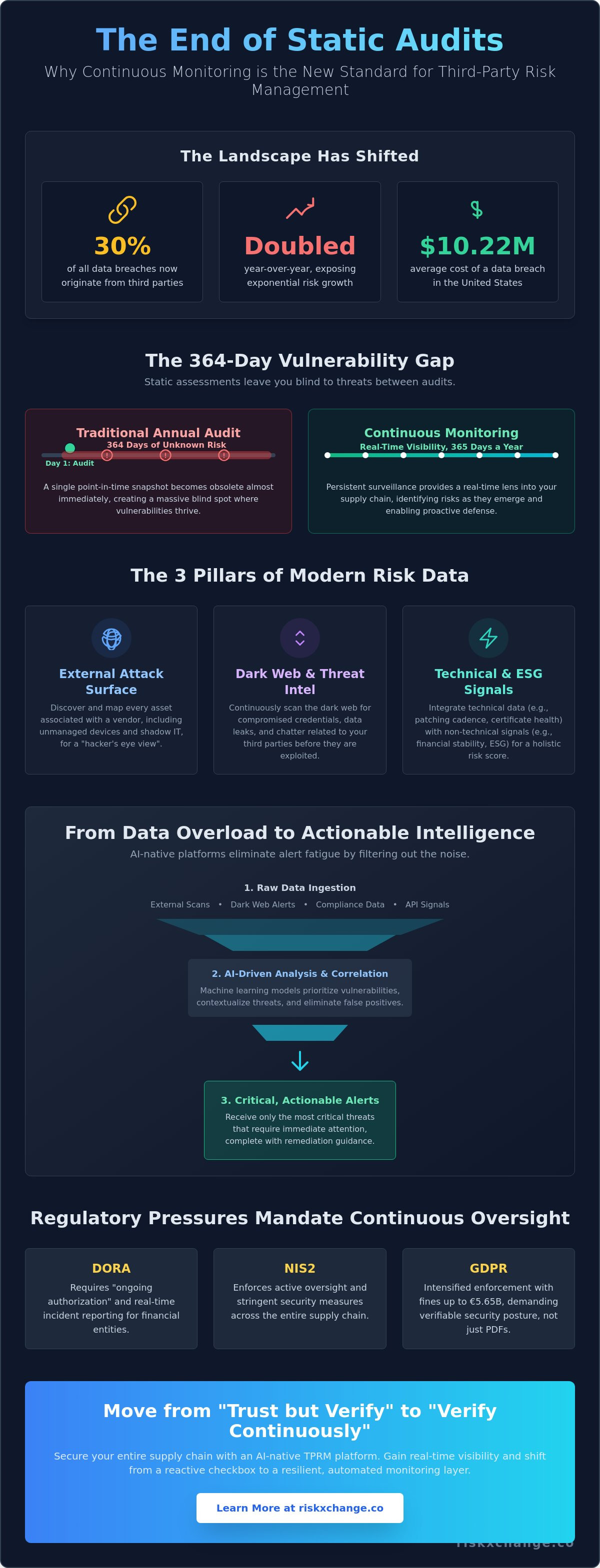
Thirty percent of all data breaches now originate from third parties, a figure that has doubled year-over-year while the average cost of a breach in the United States has climbed to a record $10.22 million. These numbers prove that the traditional annual audit is no longer a safety net; it's a liability. Relying on static snapshots leaves your organization blind to vulnerabilities for 364 days of the year. To secure a modern supply chain, you must shift toward continuous third-party risk monitoring. This transition replaces the anxiety of the unknown with the quiet confidence of real-time visibility.
You likely recognize that manual spreadsheets and point-in-time assessments can't scale as your vendor count grows. Managing risk shouldn't feel like a race against manual data entry errors or a constant battle with alert fatigue. This guide will show you how to implement an AI-driven framework that provides quantifiable security ratings for every vendor in your ecosystem. We'll explore how to automate evidence collection for compliance mandates like DORA and NIS2, moving your strategy from a reactive checkbox to a resilient, "set and forget" monitoring layer that secures your entire supply chain.
The End of Point-in-Time Assessments: Why Static TPRM Fails in 2026
For years, Third-Party Risk Management (TPRM) relied on a point-in-time model. You sent a questionnaire, received a PDF, and checked a box. In 2026, this approach is fundamentally broken. The modern threat landscape moves at machine speed, making static assessments obsolete the moment they are submitted. Continuous third-party risk monitoring represents a shift from these manual checklists to a state of persistent surveillance. It provides a real-time lens into your supply chain, ensuring that security isn't just a promise made during onboarding, but a sustained reality. This transition moves the strategy from "Trust but Verify" to "Verify Continuously," creating a proactive command center for your entire ecosystem.
The primary failure of annual audits is the "Vulnerability Gap." If a vendor's security posture is validated on January 1st, that assessment is only truly accurate for that single day. In the 364 days that follow, your organization remains exposed to every configuration error, unpatched zero-day exploit, and credential leak that occurs within that vendor's environment. In a landscape where attackers identify and weaponize vulnerabilities within hours, waiting twelve months for a status update is a risk that decision-makers can no longer afford to take. Real-time resilience requires seeing what is happening now, not what was happening last quarter.
The Anatomy of the Vulnerability Gap
Security is dynamic, not static. A single misconfigured cloud bucket or a forgotten API key can degrade a vendor’s security posture in a matter of minutes. These shifts are entirely invisible to static assessments. We define the "decay rate" of a static security questionnaire as the rapid speed at which self-reported data loses its relevance as the vendor's technical environment evolves. Additionally, Nth-party risks create a cascading perimeter. When a vendor's own provider suffers a breach, the impact can reach your data within seconds. Continuous oversight ensures these shifts are detected and quantified before they escalate into full-scale incidents.
Regulatory Pressures and Compliance Evolution
Global regulations have officially pivoted toward active oversight. With the enforcement of the EU's Digital Operational Resilience Act (DORA) in January 2025 and the NIS2 Directive in late 2024, compliance is no longer about historical evidence. Regulators now demand "ongoing authorization" and real-time incident reporting. GDPR enforcement has also intensified, with total fines reaching €5.65 billion by March 2025. Modern auditors have lost patience with PDF reports; they now prioritize live dashboards that offer a verifiable, trackable benchmark of a firm's true security posture. Transitioning to a continuous model isn't just a security preference, it's a regulatory necessity for maintaining a license to operate.
The Architecture of Modern Continuous Monitoring
To move beyond the limitations of static audits, you need a technical foundation that operates in real time. Modern architecture isn't about asking questions; it's about observing behavior. Effective continuous third-party risk monitoring relies on three critical data pillars: the external attack surface, the dark web, and technical signals. AI-native platforms use these inputs to map a vendor's "Digital Footprint" with surgical precision. This process identifies every asset associated with a third party, from active cloud instances to forgotten subdomains. By employing non-intrusive scanning, organizations gain a "hacker’s eye view" of their supply chain. This externalized perspective reveals exactly what an adversary sees before they launch an attack.
Security doesn't exist in a vacuum. A vendor’s financial instability or poor ESG (Environmental, Social, and Governance) performance often precedes a decline in technical maintenance. Integrating these signals into a unified cyber risk score provides a comprehensive view of operational resilience. You can visualize these integrated risk profiles to identify which partners require immediate attention before a vulnerability becomes a breach. This holistic approach ensures that your oversight is as thorough as it is immediate.
External Attack Surface Management (EASM)
External Attack Surface Management is the proactive discovery of unmanaged assets and shadow IT. Many vendors don't know the full extent of their own internet-facing infrastructure. By monitoring open ports, SSL health, and DNS configurations, the architecture identifies weak points before they're exploited. External visibility remains the most accurate predictor of breach probability because it reflects the actual hygiene of a vendor’s perimeter. It moves the conversation from self-reported claims to verifiable technical truth.
Security Ratings: Quantifying Risk into Actionable Metrics
Security is no longer an abstract concept; it's a trackable, numerical benchmark. AI-native platforms normalize millions of disparate data points into a single, intuitive 0-900 score. This metric allows executives to compare vendors at a glance and set clear thresholds for partnership. Data analysis shows that a 10-point drop in a security rating often correlates with a significant increase in the likelihood of a successful data breach. This quantifiable approach ensures that risk management is driven by data rather than subjective opinion, providing a clear lens through which to evaluate your true security posture.
Solving the Noise Problem: AI-Driven Actionable Intelligence
Security leaders often hesitate to adopt continuous third-party risk monitoring because they fear the resulting data surge will paralyze their teams. It's a valid concern. The overwhelming volume of notifications from legacy tools often leads to critical vulnerabilities being overlooked in a sea of low-level warnings. However, modern risk management isn't about increasing the number of alerts. It's about increasing their quality. AI-native platforms act as a sophisticated filter, distinguishing between harmless background noise and genuine threats. This ensures your GRC team focuses only on the issues that actually jeopardize your perimeter, transforming a chaotic stream of data into a manageable, strategic asset.
Contextual risk is the lens that brings clarity to this process. A critical vulnerability on a low-tier vendor with no access to sensitive data shouldn't trigger the same response as a medium vulnerability on a core SaaS provider. By applying business context to technical findings, AI-driven systems prioritize remediation efforts based on the actual impact to your organization. This approach moves the conversation away from abstract technicalities and toward tangible business resilience. It allows your team to maintain a state of proactive control without the burnout associated with traditional monitoring tools.
From Raw Data to Actionable Insights
There is a fundamental difference between a "finding" and a "prioritized risk." A finding is merely a data point, such as an expired certificate or an open port. A prioritized risk, however, is a finding analyzed through the lens of exploitability and business impact. Machine Learning models now predict which vulnerabilities are most likely to be weaponized by adversaries, allowing you to act before an incident occurs. RiskXchange leverages this intelligence to suggest specific, step-by-step remediation instructions for your vendors. This eliminates the guesswork and ensures that every action taken directly strengthens your security posture.
Automating the Vendor Communication Loop
Reducing the Mean Time to Remediate (MTTR) is critical when organizations currently take an average of 241 days to identify and contain a breach. Automation accelerates this timeline by triggering immediate notifications to vendors the moment their security rating drops below a defined threshold. This collaborative remediation model transforms the relationship from an adversarial audit to a partnership in safety. Instead of manual follow-ups, the platform provides vendors with a secure portal to view their own gaps and upload evidence of fixes. This automated loop ensures that your supply chain stays resilient without requiring constant manual intervention from your internal staff.
5 Steps to Implementing Continuous Monitoring in 2026
Transitioning to a proactive model requires a structured roadmap that moves beyond the theoretical and provides a concrete path to operational resilience. Implementing continuous third-party risk monitoring isn't an overnight task; it's a methodical shift from reactive snapshots to a persistent security posture. By 2026, 64% of organizations have already adopted dedicated TPRM platforms to manage their growing vendor ecosystems. To join them, you need a technical strategy that aligns with your business objectives and regulatory obligations. This five-step process ensures your oversight is as thorough as it is immediate.
- Step 1: Inventory and Tiering. Catalog every vendor and apply a data-driven classification to prioritize them based on their level of network access.
- Step 2: Baseline Establishment. Capture an initial security rating for each partner to serve as the trackable, numerical benchmark for all future assessments.
- Step 3: Threshold Configuration. Define your risk appetite by setting specific "Alert Trigger" levels, ensuring your team only intervenes when a vendor’s score deviates significantly from the baseline.
- Step 4: Integration. Connect your risk data directly to your existing security operations to ensure visibility is part of your daily workflow.
- Step 5: Governance Alignment. Update material service provider contracts to mandate real-time oversight, a move necessitated by regulations like DORA and NIS2.
Executing these steps allows you to move the conversation from a state of vulnerability to one of informed resilience. You can start your implementation with RiskXchange today to secure your entire supply chain through an AI-native lens.
Tiering Your Supply Chain for Efficiency
You shouldn't monitor every vendor at the same depth. Attempting to apply granular technical surveillance to a low-risk commodity vendor creates unnecessary noise and wastes resources. Instead, classify partners based on their access to sensitive data and critical infrastructure. We define the "Criticality Matrix" as the strategic framework used in modern TPRM to determine the frequency and intensity of monitoring required for each specific vendor relationship. This ensures your most elite resources are always focused on your highest-risk assets.
Integrating with the Security Stack
Continuous monitoring shouldn't exist as a siloed activity. To be effective, security ratings must feed directly into your existing tools like ServiceNow, Jira, or Microsoft Sentinel. This API-first architecture allows for automated ticket creation and incident response, ensuring that risk data is immediately actionable. By connecting these systems, you establish a "Single Source of Truth" for all third-party risk data, allowing both technical leadership and business-focused executives to evaluate your true security posture from a unified dashboard.
RiskXchange: The AI-Native Advantage for Continuous Oversight
RiskXchange isn't just another security tool; it's a sophisticated, AI-native guardian designed for the modern enterprise. While many competitors attempt to "reimagine" their legacy platforms by layering on basic artificial intelligence, our solution was built as an AI-native environment from its inception. This distinction is vital for effective continuous third-party risk monitoring. It allows for a level of integration and immediacy that older, fragmented architectures simply cannot match. By choosing an AI-native foundation, you transition from a state of constant vulnerability to one of informed resilience. We act as a knowledgeable mentor, simplifying the overwhelming complexity of the modern threat landscape so you can focus on strategic growth.
Our platform prioritizes the externalized perspective as its core narrative device. This ensures you understand exactly how your organization and its vendors are perceived by outside adversaries. When you see your perimeter through the lens of a potential attacker, you gain the agency to command your security posture with precision. RiskXchange provides this clarity, moving the conversation from internal defense to proactive external visibility. This approach transforms risk management into a competitive advantage, allowing you to partner with confidence.
360-Degree Visibility Beyond Cybersecurity
Modern resilience requires looking beyond technical vulnerabilities. RiskXchange provides a single pane of glass that incorporates ESG (Environmental, Social, and Governance) data and financial health into your continuous risk feed. A vendor's financial instability or poor governance is often a leading indicator of future security neglect. By monitoring these disparate domains in one view, you ensure total compliance and security oversight. Our global intelligence network, supported by offices in London, Austin, and Dubai, ensures your risk data is informed by local nuances and global trends. This thoroughness provides the technical leadership and business executives with a comprehensive lens through which to evaluate every partner.
Quantifiable Resilience: The RiskXchange Metric
We treat security as a trackable, numerical benchmark rather than an abstract concept. Our proprietary 0-900 rating system provides a transparent, data-driven anchor for all risk discussions. This metric instills a sense of calm confidence in the board, as it translates technical jargon into a clear indicator of organizational safety. There is no guesswork; you can see exactly where a vendor stands and how their posture has evolved over time. This transparency ensures that every decision is backed by verifiable data. To see how this benchmark can transform your supply chain oversight, request a personalized demo of the RiskXchange platform and take command of your digital ecosystem.
Master Your Supply Chain Resilience
The era of point-in-time assessments has ended. To maintain a resilient posture in 2026, organizations must embrace continuous third-party risk monitoring as a permanent surveillance layer. By shifting toward real-time visibility, you close the dangerous vulnerability gaps that annual audits leave behind. You've seen how AI-driven intelligence filters out the noise, allowing your team to focus on prioritized risks that actually impact your perimeter. This transition from obscurity to clarity isn't just a technical upgrade; it's a strategic move that empowers your leadership with quantifiable security benchmarks.
As an AI-native TPRM platform, RiskXchange provides real-time security ratings for 40M+ entities, delivering actionable risk intelligence that Fortune 500 companies trust to secure their ecosystems. You don't have to navigate the complexity of the modern threat landscape alone. Take proactive control of your vendor ecosystem and move from a state of vulnerability to one of informed resilience. Secure your supply chain with real-time AI monitoring from RiskXchange.
Your organization's safety is a trackable, manageable goal. We're ready to help you reach it.