Most people meet the word "hacking" in the context of something going wrong — a breach notification, a ransomware headline, a bill for an incident response retainer. Ethical hacking inverts that. It is the same skill set, the same tooling and largely the same mindset, pointed at your own systems, with permission, before someone less considerate gets there first.
Ethical hacking plays a vital role in cybersecurity precisely because organisations face a growing need to defend against data breaches, malware infections and other cyber threats — and because almost every one of those incidents begins with a weakness that could have been found in advance. The question is never whether your attack surface contains flaws. It is whether you find them first.
What ethical hacking actually is
Ethical hacking is the authorised, deliberate attempt to compromise a system in order to document how it could be compromised. It overlaps heavily with penetration testing, and in practice the terms are often used interchangeably, though "ethical hacking" tends to describe the broader discipline and "penetration test" the specific, scoped engagement.
Three things separate it from the activity it imitates. There is authorisation — explicit, written, and scoped in advance. There is disclosure — findings go to the system owner rather than to a market. And there is restraint — the objective is to prove a weakness exists, not to extract value from it.
Remove any one of those and you are no longer describing ethical hacking. That is not a legal technicality; it is the entire distinction, and it is why the discipline depends on integrity as a working principle rather than as a slogan.
Why it matters: the defender's asymmetry
Defence is a fundamentally unfair contest. A defender has to be right about every exposed service, every dependency, every misconfiguration and every credential. An attacker has to be right once, and can take as long as they like to find the one thing you missed.
Ethical hacking is one of the few practices that partially closes that gap, because it borrows the attacker's method. A vulnerability scanner tells you that a component is running an outdated version. An ethical hacker tells you that the outdated component is reachable from the internet, that it authenticates against the same directory as your finance system, and that chaining those two facts produces a path to data that matters. Individually, each finding might be rated moderate. Together they are the incident.
That chaining is the part automated tooling consistently under-reports, and it is the reason a competent test finds things a clean scan does not. It is also why testing complements rather than replaces a broader understanding of your cyber attack surface.
The main types of ethical hacking
"Ethical hacking" is an umbrella. Engagements are usually scoped to one or two of the following, and scoping them honestly matters more than most organisations expect.
Web application testing looks at the software you expose deliberately — authentication logic, access controls, input handling, session management, business logic that can be driven somewhere it was never meant to go. Most organisations' genuinely sensitive functionality now lives here.
Network and infrastructure testing examines the systems underneath: exposed services, patch levels, segmentation, and how far an attacker can move once they have a foothold anywhere. The interesting result is rarely the initial entry point. It is the lateral movement afterwards.
Wireless testing covers the networks that extend past your walls — weak or ageing encryption, rogue access points, guest networks with more reach into the corporate environment than anyone intended.
Social engineering tests people and process rather than technology: phishing, pretexting, and physical access. It is the most uncomfortable category to commission and frequently the most instructive, because it tests whether your controls survive contact with a plausible human request. Understanding the range of threat actors and what motivates each helps set a realistic scenario rather than a theatrical one.
Reconnaissance sits underneath all four. Before anything is tested, an attacker — ethical or otherwise — maps what exists: domains, subdomains, exposed services, forgotten staging environments, credentials in public repositories. Techniques such as enumeration are how that map gets built, and it is routinely the stage that produces the most surprising findings, because the assets nobody remembers owning are the ones nobody is maintaining.
Ethical, unethical, and the space between
The familiar white hat, black hat and grey hat labels are useful shorthand and slightly misleading, because they suggest the difference is temperament. It is not. It is authorisation.
A white hat operates with permission and reports what they find. A black hat operates without permission and monetises what they find. A grey hat typically finds a genuine flaw without authorisation and then discloses it — often with good intentions, and still without the legal protection or the agreed scope that makes the first category defensible.
For an organisation, the practical consequence is a policy question rather than a philosophical one: when a researcher you have never met reports a vulnerability, do you have a route for them to do so? A published disclosure policy converts an awkward, legally ambiguous email into a normal security process, and it is one of the cheapest controls available.
What qualifies someone to do this
Ethical hacking is one of the more accessible specialisms to enter and one of the harder to be genuinely good at, which is why demand for the skill set has held up even as other technology hiring has cooled.
Certification is the usual entry route. Offensive Security's OSCP is widely respected for being practical rather than multiple-choice; EC-Council's CEH is common in job specifications; CREST accreditation carries particular weight in the UK, especially where regulated industries are involved. Our guide to choosing a cyber security certification covers how these compare in practice.
Certifications establish a floor, not a ceiling. The abilities that distinguish a strong tester are harder to examine: reading unfamiliar code quickly, an instinct for which assumption a developer probably made, patience with dull reconnaissance, and — most underrated — the ability to write a report that a busy engineering team can act on. A finding nobody fixes has produced nothing but a document.
If you are commissioning rather than becoming, the same logic applies to selection. Ask to see a redacted report before you sign. It tells you more about the value you will receive than any certification list.
Where a penetration test stops
Here is the limitation that matters most, and it is one the industry has been slow to say plainly: a penetration test is a point-in-time exercise.
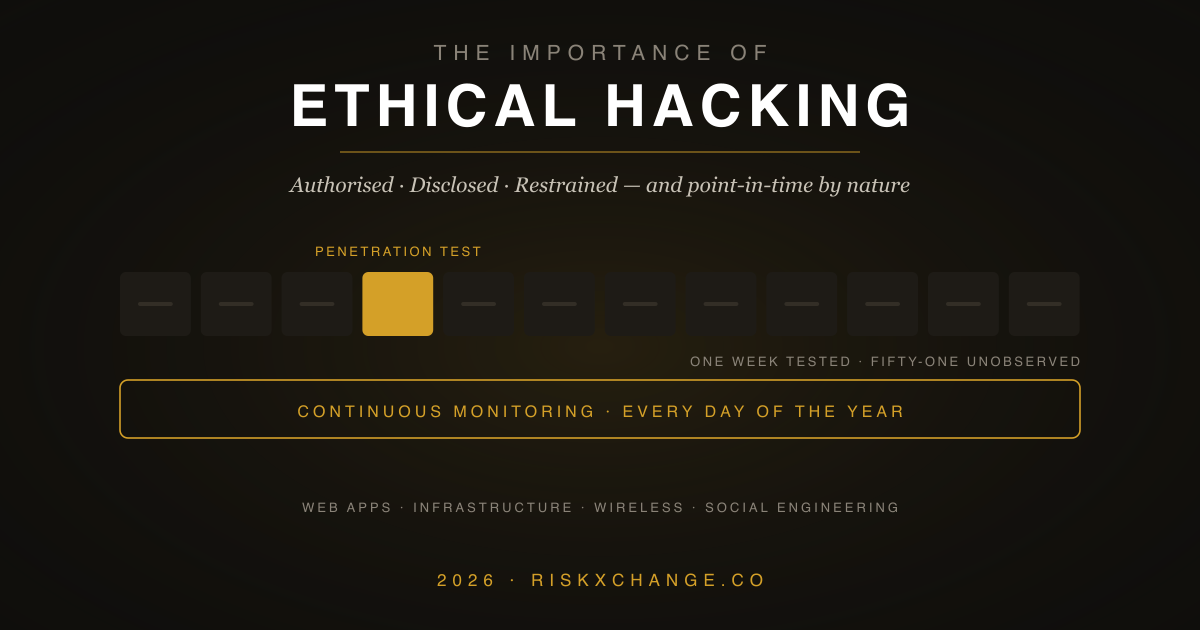
It describes your security posture on the days it was conducted, against the scope that was agreed. The morning after the report lands, a developer ships a change, a certificate expires, a supplier exposes a new service, a CVE is published for something in your stack. None of that is captured. An annual test leaves the great majority of the year unobserved, and the industry's own breach data consistently shows that exposures which cause incidents are usually recent rather than ancient.
This is not an argument against testing. It is an argument for pairing it with something continuous. Point-in-time testing goes deep on a narrow scope; ongoing posture assessment goes shallow across everything, all the time. Each covers the other's blind spot, and organisations that rely on only one are usually the ones surprised by something obvious in hindsight.
The gap widens further across your supply chain. You can commission a test of your own estate; you cannot commission one of every supplier holding your data, and few will share theirs. This is where outside-in assessment earns its place — evaluating what an attacker can observe about a third party from the public internet, continuously, without needing their cooperation. It is the same reconnaissance discipline an ethical hacker begins with, applied at portfolio scale and repeated indefinitely. Third-party attack surface discovery looks at how that works in practice.
Putting it to work
If you are building a programme rather than buying a single test, a reasonable sequence looks like this. Know what you own first — an accurate asset inventory determines whether a test is scoped against reality or against an outdated diagram. Fix the findings you already have, because paying a specialist to rediscover unpatched systems you knew about is an expensive form of confirmation. Scope the test around consequence rather than convenience, targeting the systems whose compromise would actually hurt. Then treat the report as the beginning of the work rather than the end of it, with owners and dates against every finding and a retest to confirm the fixes hold.
Underneath all of it, keep watching. The value of an ethical hacker is that they think like an attacker for a week. The value of continuous monitoring is that something is thinking like an attacker for the other fifty-one — and that when your controls quietly stop working, you find out in days rather than at the point somebody else demonstrates it for you.
RiskXchange assesses organisations and their suppliers from the outside in, continuously, using the same public signals an attacker would start from. If you would like to see what that surfaces about your own estate, get in touch.