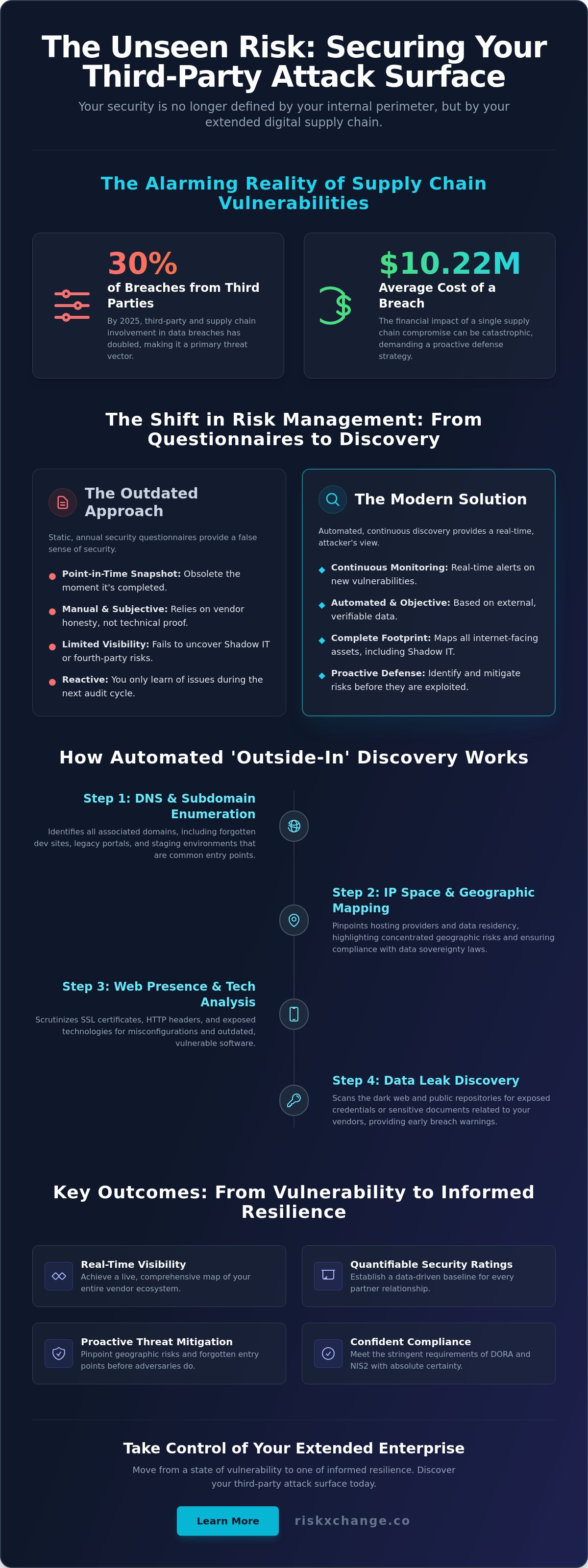
Did you know that third-party and supply chain involvement in data breaches doubled to 30% of all breaches in 2025? This shift proves that your security posture is no longer defined by your internal perimeter, but by how your extended digital footprint appears to a sophisticated adversary. To mitigate these risks, third-party attack surface discovery has become a critical necessity for the modern enterprise. You likely recognize the limitations of static, annual security questionnaires. They offer a single point-in-time snapshot that fails to capture the dynamic nature of modern fourth-party complexity and shadow IT.
We'll show you how to identify and monitor hidden digital vulnerabilities within your supply chain before they become a breach that costs your organization upwards of $10.22 million. You'll learn how to achieve real-time visibility and establish quantifiable security ratings for every partner. This guide provides a clear roadmap for moving from a state of vulnerability to one of informed resilience. It ensures you meet the stringent requirements of DORA and NIS2 with absolute confidence.
What is Third-Party Attack Surface Discovery?
At its core, third-party attack surface discovery is the automated process of identifying every internet-facing asset belonging to your vendors, partners, and suppliers. While traditional security focuses on the internal perimeter, this discipline looks outward. It systematically maps the digital footprint of the organizations you depend on, revealing the servers, subdomains, cloud instances, and APIs they use to conduct business. By understanding the external attack surface of your supply chain, you gain the ability to manage risks that exist outside your direct administrative control.
This 'outside-in' philosophy is fundamental to modern risk management. It involves seeing your partners exactly as an adversary sees them. Attackers don't wait for your next scheduled audit to find a weakness; they actively scan for the path of least resistance. By adopting this same vantage point, you can identify vulnerabilities in your extended enterprise before they're exploited. It moves your strategy from reactive hope to proactive command, ensuring that your security posture is based on technical reality rather than vendor promises.
Internal vs. Third-Party Attack Surface
The primary distinction between internal Attack Surface Management (ASM) and third-party discovery lies in access and agency. Internal ASM is a hygiene exercise where you have full administrative visibility into your own infrastructure. Third-party discovery is an exercise in ecosystem resilience. You don't have the login credentials or internal logs for your vendor's network; therefore, you must rely on external data. This approach uncovers 'Shadow IT' within your vendor's environment, such as forgotten dev servers or misconfigured cloud buckets. Traditional vulnerability scanners often fail here because they require pre-authorized access or internal agents that your vendors simply won't install.
The Critical Need for Continuous Monitoring in 2026
Digital footprints are volatile. In 2026, the average enterprise vendor adds or modifies dozens of digital assets every month. Static snapshots and annual questionnaires are obsolete the moment they're finished. They can't keep pace with the speed of cloud deployment or the rapid shifts in IP space. Modern threat actors now use AI-driven reconnaissance to find vulnerabilities in minutes. If your risk assessment process isn't continuous, you're flying blind between audits. Real-time discovery ensures that when a vendor spins up a vulnerable new subdomain, you know about it immediately. This persistent oversight is the only way to manage a supply chain where the average breach cost has reached $10.22 million.
Effective third-party attack surface discovery also requires precise attribution. It isn't enough to find a vulnerable server; you must accurately map that asset to the specific legal entity in your supply chain. Sophisticated attribution uses data-driven links to ensure the risks you identify are correctly assigned to the right partner. This prevents false positives and ensures your security ratings reflect the true posture of your extended enterprise. It turns abstract data into a manageable, trackable benchmark for your organization's safety.
The Mechanics of Automated Third-Party Discovery
To truly secure the extended enterprise, you must understand the technical layers that comprise a vendor's digital footprint. Automated third-party attack surface discovery functions as a high-resolution digital telescope, bringing into focus the assets that vendors themselves often overlook. It begins with DNS and subdomain enumeration, a process that identifies forgotten development sites, legacy portals, and staging environments. These often serve as the first entry points for attackers because they lack the rigorous security controls applied to primary production environments.
Mapping the IP space follows this initial scan. By identifying hosting providers and geographic concentrations of risk, you gain a clear picture of where your vendor's data actually resides. This technical oversight is a foundational component of modern Third-Party Risk Management (TPRM). The discovery process then moves into web presence analysis, where SSL certificates, HTTP headers, and exposed technologies are scrutinized for misconfigurations. Finally, data leak discovery scans the dark web and public repositories for exposed credentials or sensitive documents, ensuring you're aware of a potential compromise before it impacts your organization.
Non-Invasive Reconnaissance Techniques
Modern discovery relies on passive data collection to gather intelligence without ever touching the vendor's internal network. This non-invasive approach is critical for maintaining operational stability and ensuring compliance with global regulations like DORA and NIS2. It allows you to assess a partner's security posture without the need for intrusive agents or administrative permissions. RiskXchange's AI-native platform automates this reconnaissance, providing a thorough analysis of the external attack surface while remaining entirely non-disruptive to your partners' daily operations.
Analysing the Technology Stack
Understanding the specific software versions running across a vendor's infrastructure is vital for identifying systemic weaknesses. Technology fingerprinting reveals the use of end-of-life (EoL) software that no longer receives critical security updates, as well as misconfigured cloud storage and insecure APIs. This level of detail transforms an abstract risk into a manageable data point. Technology fingerprinting cross-references discovered software versions against global vulnerability databases to identify unpatched CVEs in a vendor's stack. By uncovering these hidden flaws, you can move from a state of uncertainty to one of informed resilience, holding your partners to a quantifiable security standard.
Why Discovery Beats Security Questionnaires
Traditional vendor assessments rely heavily on self-reporting. While questionnaires provide a baseline of intent, they create a significant 'Honesty Gap.' This isn't always about intentional deception. Often, vendor security teams aren't aware of their own shadow IT or misconfigured cloud buckets. By implementing third-party attack surface discovery, you move from a state of blind trust to a posture of 'Trust but Verify.' This objective approach ensures your risk data is grounded in technical reality rather than subjective claims.
Scalability is another critical failure point for manual surveys. Most enterprises manage hundreds or even thousands of partners. You simply can't manually assess 1,000 vendors every month with the depth required to prevent a breach. Automated discovery solves this by providing a persistent, high-resolution view of every partner's digital footprint. This aligns with the principles found in NIST's Cybersecurity Supply Chain Risk Management, which emphasizes the need for continuous oversight across the entire lifecycle. Using discovery data to validate questionnaire responses turns a static exercise into a dynamic security gate.
The Limitations of Subjective Reporting
Human error is a constant in manual reporting. Many vendor teams operate with a 'compliance-only' mindset, checking boxes to pass a procurement hurdle rather than managing risk. Automated discovery provides the objective, data-driven evidence needed to bridge the gap between procurement and cybersecurity teams. It provides a common language for both departments, ensuring that vendor selection is based on proven resilience rather than just paperwork. This transparency helps organizations evaluate their true security posture from an externalized perspective.
Real-Time Risk Ratings vs. Static Scores
Static scores from annual audits are obsolete within weeks. A quantifiable security metric that updates as the attack surface changes provides far more value to decision-makers. Our AI-native platform transforms discovery data into actionable security ratings that reflect the current threat landscape. These ratings allow you to drive vendor remediation with precision and make informed choices during contract renewals. Instead of guessing, you have a trackable numerical benchmark that defines your true security posture. This shift moves the conversation from a state of vulnerability to one of informed resilience, where challenges are visible and manageable.
Building a Discovery-Led TPRM Workflow
Transitioning from a reactive posture to a proactive one requires a structured approach to your supply chain oversight. A discovery-led workflow ensures that security isn't just a hurdle during procurement but a continuous thread throughout the vendor lifecycle. The process begins with a comprehensive inventory of your supply chain, where you prioritize partners based on their business criticality. By utilizing third-party attack surface discovery at the earliest stages, you can baseline the digital footprint of every vendor during onboarding, establishing a clear starting point for the relationship.
Once a baseline is set, the focus shifts to persistence. You must establish automated alerts that trigger when a significant change in security posture occurs, such as a new exposed database or an expired certificate. This data serves as a shared truth, allowing you to collaborate with vendors on remediation efforts rather than just issuing penalties. Finally, your workflow must extend beyond immediate partners to map the fourth-party ecosystem. Understanding these N-th party risks is vital, as a single failure in a shared sub-processor can have a cascading impact across your entire enterprise.
Prioritising Remediation with Business Context
Effective risk management isn't about fixing every minor flaw; it's about addressing the vulnerabilities that pose the greatest threat to your operations. You should focus your primary remediation efforts on vendors that handle personally identifiable information (PII) or provide mission-critical services. Criticality-based discovery is the alignment of technical risk with business impact. Our platform helps you filter the noise of low-level alerts, highlighting the critical supply chain threats that require immediate attention from your security team.
The Challenge of Fourth-Party Discovery
Your risk doesn't end with your direct contracts. Hidden dependencies, or fourth-party risks, often represent the most significant blind spots in an organization's security posture. Concentration risk occurs when multiple vendors in your supply chain all rely on the same vulnerable service provider, creating a single point of failure that could cripple your business. Managing this complexity requires cascading your discovery requirements down the supply chain, ensuring that your partners are also maintaining rigorous oversight of their own vendors. This creates a culture of informed resilience that protects the entire network.
To see how automated discovery can transform your vendor management process, explore our AI-native TPRM solution platform and start building a more resilient supply chain today.
The RiskXchange Advantage: AI-Native Discovery
RiskXchange serves as the definitive lens through which global enterprises evaluate their true security posture. Our platform represents a shift from obscurity to clarity, offering 360-degree visibility that integrates ESG, cybersecurity, and compliance into a unified dashboard. This comprehensive oversight is powered by third-party attack surface discovery that utilizes AI-native attribution to ensure every asset is accurately mapped to the correct vendor. We don't just provide data; we provide a trackable, numerical benchmark that serves as a tangible anchor for all risk management discussions.
Continuous real-time monitoring replaces the outdated model of periodic scanning. In a landscape where third-party involvement in breaches has doubled, having a persistent view of your partners' vulnerabilities is a business imperative. We provide the actionable intelligence Fortune 500 enterprises need to move from a state of vulnerability to one of informed resilience, ensuring that every challenge is visible and manageable. This steady, methodical approach prevents the reader from feeling overwhelmed by the technicality of the threat landscape.
Sophisticated Guardian: Our Approach to Risk
Our approach is built on the quiet confidence of a seasoned expert. We simplify the overwhelming complexity of the modern threat landscape by providing a steady, methodical assessment of your supply chain. With a global presence in London, Austin, and Dubai, our threat intelligence is informed by a diverse set of environmental factors and regulatory requirements. This global perspective ensures that our analysis is both elite in its capabilities and accessible in its partnership. Learn more about our AI-native TPRM platform and how we position your organization as a proactive leader in risk mitigation.
Empowering Decision Makers
We provide the data business leaders need to stay ahead of supply chain volatility. By reducing the time-to-insight from months to days, we enable a faster transition from identifying a problem to implementing a solution. This speed is critical when navigating a landscape where threats emerge in real-time. Our platform projects an image of a tech-forward guardian, providing the transparency and data-driven honesty required for modern governance. Book a demo to see your vendor attack surface today and gain a clear, externalized perspective on your extended enterprise's security posture.
Command Your Digital Supply Chain
Modern security is no longer just about protecting what you own; it's about managing the risks of the services you consume. We've explored how shifting from static questionnaires to automated third-party attack surface discovery provides the technical truth required for real-time resilience. By identifying hidden vulnerabilities and mapping fourth-party dependencies, you transform your security posture from a state of vulnerability to one of proactive command.
Achieving this level of oversight shouldn't be an overwhelming task. With AI-native real-time monitoring and global 360-degree risk intelligence, you can maintain a clear, quantifiable benchmark for every partner in your ecosystem. It's time to replace uncertainty with data-driven confidence. Secure your extended enterprise with RiskXchange's AI-native discovery platform and join the Fortune 500 companies that trust our lens to evaluate their true security posture. You have the tools to turn supply chain complexity into a manageable business advantage.