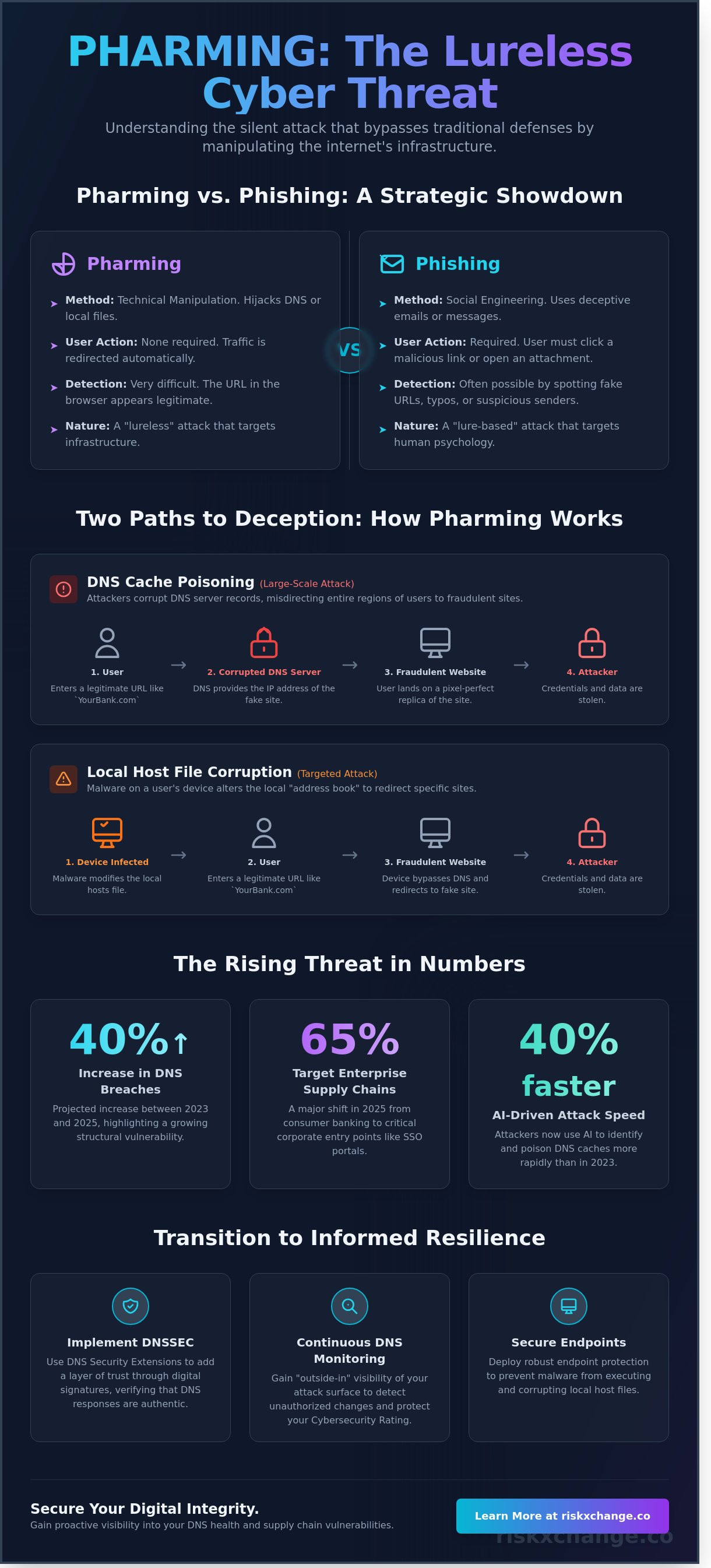
What if your most loyal customers landed on a pixel-perfect replica of your corporate portal and you had no way of knowing until the data was already gone? You likely recognize that traditional phishing relies on user error, but the pharming internet landscape operates on a much more insidious level by compromising the very infrastructure your users trust. With DNS-related breaches increasing by 40% between 2023 and 2025, this risk isn't just theoretical; it's a structural vulnerability that bypasses even the most vigilant employees.
This guide empowers you to master the technical mechanics of DNS redirection and provides the strategic oversight needed to secure your organization’s attack surface against these silent threats. You'll gain a comprehensive, outside-in view of your vulnerabilities and learn to implement a strategy for continuous DNS monitoring. We'll examine how to move from a state of digital blind spots to one of informed resilience, ensuring your supply chain remains secure and your Cybersecurity Rating reflects a posture of proactive control.
Defining Pharming: The "Lureless" Threat to Your Digital Integrity
Pharming is a sophisticated cyber-attack that redirects legitimate web traffic to fraudulent websites without any user interaction. Unlike phishing, which relies on deceptive emails or "lures" to trick individuals into clicking links, Pharming manipulates the underlying infrastructure of the web to lead users astray automatically. Understanding the mechanics of pharming internet traffic is essential for maintaining a secure perimeter in an era where trust is easily exploited. For the modern enterprise, this represents a critical breach of digital integrity because it bypasses the initial layer of human judgment entirely.
Attackers view your DNS infrastructure as the path of least resistance. They exploit vulnerabilities at the protocol level rather than the human level, making it a "lureless" threat that is significantly harder to detect. By 2026, the scale of this threat has intensified as adversaries move away from broad campaigns toward surgical strikes. Automated tools now target corporate Single Sign-On (SSO) portals and VPN gateways. A single successful redirection can compromise an entire organization's access management system in seconds, turning a routine login into a catastrophic data leak. This "outside-in" perspective is how attackers identify the cracks in your external footprint before you even know they exist.
The Evolution of Pharming in the AI Era
AI-driven automation has fundamentally altered the threat landscape. Attackers now use machine learning to identify and poison DNS caches at speeds 40% faster than recorded in 2023. We've seen a decisive shift in targeting strategies; while consumer banking was once the primary focus, 65% of recorded attacks in 2025 targeted enterprise supply chain entry points. The surge in pharming internet exploits highlights a gap in traditional perimeter security that many firms haven't yet closed. Pharming is the technical hijacking of the "address book" of the internet. By controlling the resolution of domain names, adversaries gain an invisible foothold in your network, allowing them to observe and manipulate traffic before it reaches your internal defenses.
Why Pharming Bypasses Traditional Defenses
Traditional security stacks often fail because they're built to catch "lures" rather than infrastructure shifts. The failure of secure email gateways (SEGs) against non-email-based redirection leaves a massive opening for attackers. User awareness training also reaches its limit here. Even a vigilant employee won't spot the threat when the browser address bar displays the correct, legitimate URL. This creates a false sense of security that attackers exploit with precision. Legacy network configurations often harbor blind spots that allow these redirections to persist unnoticed. To manage this risk, leaders must look beyond internal controls and focus on these external vulnerabilities:
- DNS Cache Poisoning: Direct manipulation of service provider records to misdirect entire regions.
- Local Host File Corruption: Malware that alters the local resolution on end-user devices, bypassing network filters.
- Credential Harvesting: Seamless redirection to cloned SSO pages that capture multi-factor authentication (MFA) tokens in real-time.
Moving from a state of digital vulnerability to one of informed resilience requires a clear view of your external attack surface. It's about taking control of the metrics that define your security posture and ensuring that your "address book" remains untampered and trustworthy.
The Technical Mechanics of Pharming: DNS Poisoning vs. Local Exploits
Pharming attacks succeed by weaponizing the fundamental protocols of the modern web. They bypass the need for a user to click a malicious link or open an attachment. Instead, they redirect legitimate traffic to fraudulent destinations by compromising the resolution process. This outside-in threat vector targets the inherent trust of the Domain Name System (DNS), moving the conversation from simple phishing to a state of sophisticated, automated data exfiltration.
The lifecycle of a pharming attack is characterized by its silence. It begins with the initial compromise of a DNS server or an endpoint's configuration files. Once the redirect is active, the attacker captures sensitive credentials via a pixel-perfect clone of a legitimate site. The 2025 Data Breach Investigations Report highlighted that redirect-based attacks have increased by 14% since 2023, largely due to the difficulty in detecting these "invisible" redirects during active sessions. Understanding the pharming internet landscape requires a deep dive into the two primary methods of execution: network-level poisoning and local endpoint manipulation.
DNS Cache Poisoning: Compromising the Network
This vector involves injecting false RDATA into a recursive DNS resolver's cache. When a resolver caches this poisoned entry, it directs every subsequent user to the attacker's IP address rather than the legitimate server. The ripple effect is massive. A single poisoned resolver at an ISP or within a corporate data center can impact thousands of users simultaneously. In 2026, attackers have pivoted toward exploiting vulnerabilities in edge computing and CDN nodes. These nodes handle nearly 72% of global web traffic and often lack the robust security monitoring found in core infrastructure. The FDIC guidance on pharming remains a cornerstone for understanding these risks, emphasizing that financial institutions must treat DNS integrity as a critical component of transaction security.
Host File Manipulation: Compromising the Endpoint
Local pharming focuses on the "hosts" file located on the user's operating system. Malware with administrative privileges modifies this file to override standard DNS queries. This technique is particularly dangerous because the pharming internet threat remains invisible to network-level monitoring; the query never reaches the external DNS server. Detection is a persistent challenge for security teams. Most endpoint protection tools prioritize signature-based malware detection over configuration file integrity. Because these changes occur locally, they bypass traditional secure web gateways. Maintaining a strong cybersecurity rating requires continuous visibility into these endpoint vulnerabilities to ensure that local redirects don't become an open door for credential harvesting.
Pharming vs. Phishing: Understanding the Strategic Difference
Phishing and pharming often get confused, but their execution vectors differ fundamentally. Phishing is a volume game based on social engineering. It requires a user to click a deceptive link or open a malicious attachment. Pharming is a tactical infrastructure play. It manipulates the pharming internet ecosystem to redirect traffic without any user interaction. By poisoning a DNS cache or altering a local hosts file, attackers ensure that even if you type the correct URL, you land on a malicious clone. It's a silent redirection. While phishing relies on human error at the moment of the click, pharming exploits the underlying trust of the internet's directory system. This "zero-click" nature makes it exceptionally dangerous for enterprise environments. Attackers now use a hybrid approach where a standard phishing email delivers a payload that modifies the victim's local DNS settings. Once the malware is active, the user is permanently vulnerable to redirection every time they attempt to access their corporate portal. Trust is the primary casualty of these attacks. When a user sees a valid SSL certificate and the correct domain name in their address bar, they feel secure. A "perfect" clone on a legitimate URL bypasses the standard visual red flags that 82% of security-conscious users now look for. This level of deception destroys brand equity faster than a standard data breach. To better understand the technical nuances, industry leaders often reference What is Pharming to distinguish these two threats and implement the correct defensive layers.
The Supply Chain Angle: Third-Party Pharming Risks
Your security is only as strong as your weakest vendor. If a SaaS provider or a critical utility partner suffers a DNS compromise, your employees could be redirected to a fake login page while attempting to perform routine tasks. Shared DNS infrastructure in cloud environments creates a concentrated pharming internet risk. A single vulnerability in a managed service provider's DNS settings can impact thousands of downstream customers. Your outside-in security perspective must include the DNS health of every partner in your ecosystem.
Quantifying the Risk: Pharming in Security Assessments
Strategic Prevention: Securing Your Attack Surface Against Redirection
Effective prevention requires a shift from reactive patching to proactive Attack Surface Management (ASM). Waiting for a vulnerability disclosure is a losing strategy when 90% of organizations suffered at least one DNS-related attack in 2023, according to the IDC Global DNS Threat Report. You must gain complete visibility into every digital asset to eliminate the blind spots where pharming internet threats thrive. This transition transforms security from a series of emergency fixes into a state of informed resilience.
Hardening the attack surface involves securing both the internal network and the external resolution path. It's vital to implement these core strategies:
- Continuous Monitoring: Deploy tools that track DNS records 24/7 to identify unauthorized changes the moment they occur.
- Internal Network Hardening: Update router firmware monthly and disable remote management features to prevent local DNS hijacking.
- Endpoint Protection: Use modern EDR solutions that inspect local "hosts" files for unauthorized modifications.
Technical Controls and Best Practices
Securing the transport layer is your first line of defense against redirection. Enforcing HTTPS across all domains is mandatory; however, it's the implementation of HSTS (HTTP Strict Transport Security) that truly closes the loop. HSTS instructs browsers to only communicate via encrypted connections, which prevents protocol downgrade attacks often used during a pharming internet campaign. Regular it security assessments should focus on the health of your DNS resolvers, ensuring they aren't vulnerable to transaction ID guessing or port exhaustion. DNSSEC prevents cache poisoning by providing cryptographic proof of origin, which validates that the DNS data hasn't been tampered with during transit. These technical hurdles don't just slow down attackers; they make the cost of targeting your infrastructure prohibitively high.
Monitoring the External Digital Footprint
Adopting an "outside-in" perspective is the only way to see what an adversary sees. You must monitor how your brand appears to the global internet, looking for discrepancies between your intended configuration and actual public records. Automated tools are essential here to identify rogue IP addresses or unauthorized subdomains associated with your primary domain. By establishing a baseline for "normal" DNS behavior, your team can identify anomalies instantly. This data-driven approach moves your security posture from abstract theory to a quantifiable Cybersecurity Rating. When you treat security as a measurable metric, you gain the clarity needed to manage risk with surgical precision.
To gain full visibility into your external risks and protect your brand from redirection, monitor your attack surface with RiskXchange.
Gaining Visibility: How RiskXchange Mitigates Pharming Risks
RiskXchange provides the 360-degree view required to safeguard your DNS health against sophisticated redirection tactics. Pharming on the internet has evolved into a structural threat that exploits the smallest gaps in your digital infrastructure. Our platform shifts your focus from reactive defense to proactive control. We analyze your attack surface from the outside-in, exactly how a malicious actor would see it. This perspective reveals hidden vulnerabilities in your DNS records that traditional internal scans often overlook.
Our platform transforms abstract pharming threats into an actionable Cybersecurity Rating. This rating serves as a tangible metric for your security posture, allowing you to track improvements over time. By moving beyond point-in-time assessments, you gain a persistent understanding of your risk profile. We provide the granular technical expertise needed to manage these threats with quiet confidence.
Real-Time Visibility into Blind Spots
DNS changes can occur in seconds, but their impact can last for weeks. RiskXchange detects unauthorized DNS alterations before they successfully lead to traffic redirection. We monitor for subtle shifts in your records that indicate cache poisoning or unauthorized registrar access. Relying on quarterly audits leaves your organization exposed for 89 days between assessments. Our continuous monitoring eliminates these dangerous gaps.
Automating your vendor risk management is essential for modern resilience. Recent data from the 2023 Ponemon Institute indicates that 62% of system intrusions originate from a third-party vendor. Our AI-native TPRM identifies pharming vectors across your entire supply chain. You can ensure that partners aren't introducing weaknesses that could compromise your users. This comprehensive oversight is delivered through a single pane of glass, streamlining both cybersecurity and compliance workflows.
- Instant Alerts: Receive notifications the moment DNS records deviate from their baseline.
- Supply Chain Mapping: Visualize the security health of every vendor in your ecosystem.
- Automated Assessments: Replace manual spreadsheets with AI-driven risk analysis.
- Compliance Alignment: Map your DNS health directly to global regulatory standards.
Taking Control of Your Security Posture
Moving from digital vulnerability to informed resilience requires quantifiable data. RiskXchange insights allow your team to prioritize the remediation of DNS-related risks based on their actual impact. You don't have to guess which vulnerabilities matter most; our platform highlights the critical path to a more secure environment. This data-driven honesty ensures that your resources are always directed toward the highest-priority threats.
Our approach simplifies the overwhelming complexity of the digital threat landscape. We act as a tech-forward guardian, providing the lens through which you can finally see your true security posture. By leveraging our Cybersecurity Rating, you can communicate risk effectively to both technical teams and business-focused executives. It's time to stop reacting to threats and start managing them with precision. Take control of your attack surface with a free RiskXchange assessment today.
Mastering Resilience Against DNS Redirection
The evolution of the pharming internet threat landscape requires a shift from reactive patching to proactive, continuous oversight. By 2026, security analysts anticipate DNS redirection attacks will increasingly bypass traditional perimeter defenses by targeting the inherent trust in the global domain name system. You've learned how local exploits and cache poisoning create invisible traps for even the most vigilant users. Resilience isn't about hoping for the best; it's about maintaining a 360-degree view of every vulnerability within your supply chain.
RiskXchange provides the clarity needed to manage these complex risks. Our AI-native TPRM solution delivers continuous, real-time risk management that identifies blind spots before they become breaches. Fortune 500 enterprises rely on our actionable security ratings to maintain a hardened posture against sophisticated redirection tactics. You can't secure what you can't see. It's time to shift your perspective and gain the visibility required to protect your digital integrity.
Request your free Cybersecurity Rating and see your attack surface from the outside-in.
Taking control of your security posture is the most effective way to ensure long-term resilience in an increasingly volatile digital world.