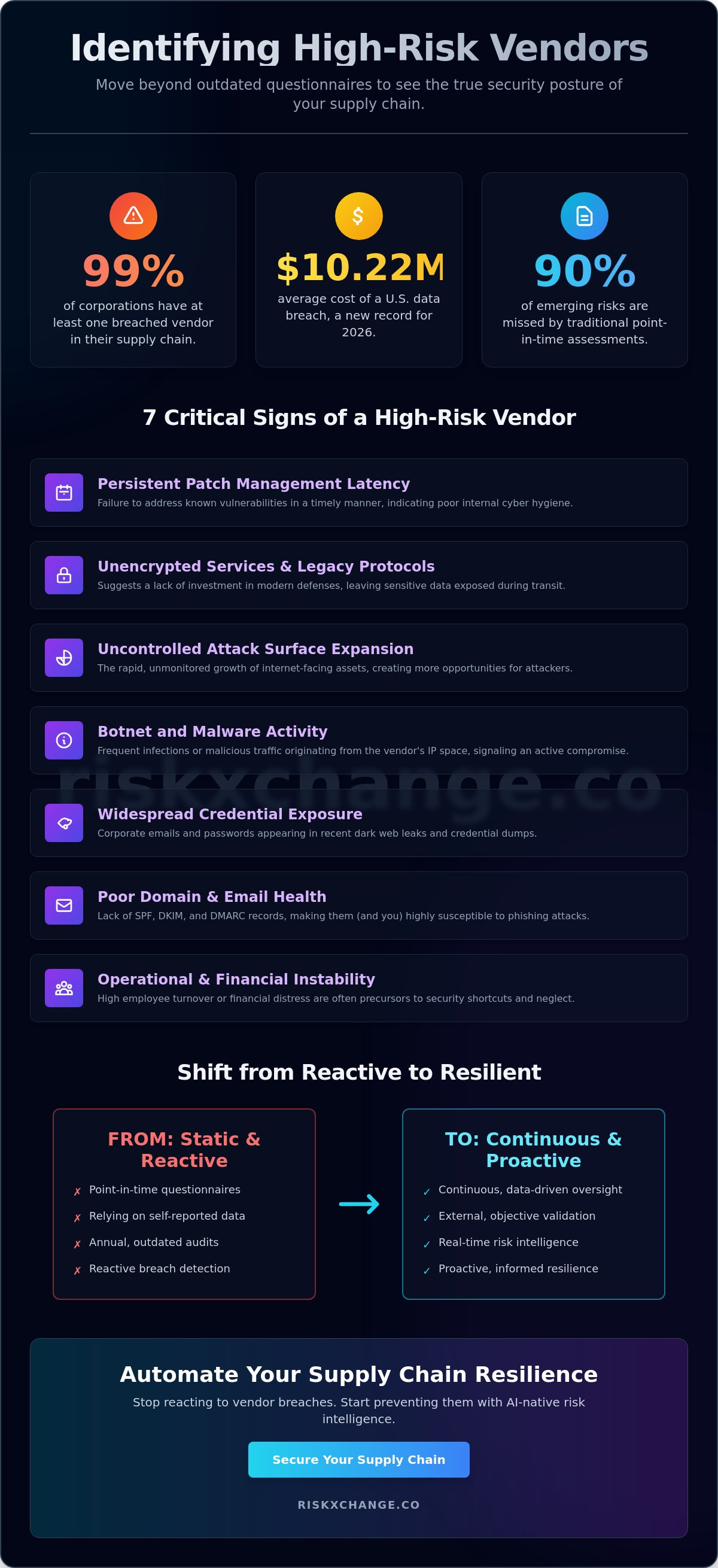
Ninety-nine percent of major corporations currently have at least one breached vendor sitting in their supply chain. With the average cost of a U.S. data breach reaching a record $10.22 million in 2026, the distance between a partner's self-reported security and their actual posture has become a critical liability. You shouldn't have to rely on the "black box" of a vendor's questionnaire when the stakes are this high. Identifying the signs of a high-risk vendor requires looking beyond the surface to find the technical and behavioral gaps that invite disaster.
It's understandable to feel overwhelmed by the sheer volume of third-party partners you must monitor. You're likely tired of the reactive cycle where you're held accountable for a breach you didn't cause. This guide changes that dynamic. You'll learn to identify the specific red flags that signal a high-risk vendor before they compromise your organization. We'll provide a clear checklist of indicators and show you how to shift toward a state of informed resilience through continuous, data-driven oversight.
Beyond the Questionnaire: Redefining High-Risk Vendor Indicators in 2026
The "Compliant-Once, Secure-Always" mindset is a dangerous myth that many organizations still carry into their procurement processes. A vendor who passes a security audit in January can become a significant liability by June. Relying on a static snapshot of a partner's security controls creates a false sense of safety; it ignores the reality that digital environments are in constant flux. Industry data suggests that traditional point-in-time assessments miss up to 90% of emerging risks because they fail to account for the drift in security posture that occurs between audit cycles.
Identifying the signs of a high-risk vendor is no longer about checking a box on a PDF. It requires a sophisticated understanding of how impact, probability, and visibility intersect. Effective supply chain risk management requires a departure from these static models toward a framework of continuous verification. In this model, risk isn't an abstract grade; it's a measurable gap between a vendor's internal claims and their externally observable security behaviors. If you can't see a vendor's real-time security posture, you're operating in a state of terminal vulnerability.
The Failure of Static Due Diligence
Checkbox compliance often serves as a floor, not a ceiling. While a SOC2 or ISO certification is a baseline requirement, it doesn't guarantee operational resilience. Questionnaire fatigue often leads vendor teams to provide aspirational rather than factual answers, further obscuring the truth. By the time a six-month-old audit report reaches your desk, the data is already obsolete. This time-lag is where threat actors thrive, exploiting unpatched vulnerabilities that didn't exist when the last questionnaire was signed. A high-risk vendor is often one who relies solely on these historical artifacts to prove their worth.
The Business Impact of Ignoring Early Warning Signs
The cost of overlooking the signs of a high-risk vendor is quantifiable and severe. With the average cost of a U.S. data breach hitting $10.22 million in early 2026, the financial stakes are at an all-time high. Beyond the immediate cleanup, organizations face S&P Global Ratings' forecasted 15% to 20% spike in cyber insurance premiums for those with poor supply chain oversight. When a vendor suffers an outage, their downtime becomes your downtime, leading to immediate operational paralysis. Perhaps most damaging is the reputational contagion; the public rarely blames the third-party provider. They blame the brand they trusted to manage their data securely.
7 Critical Signs of a High-Risk Vendor: A Technical and Operational Checklist
Evaluating third-party risk requires a framework that looks beyond the surface level of a contract. A vendor's internal culture and technical discipline often manifest as observable behaviors before a breach actually occurs. To protect your organization, you must recognize the signs of a high-risk vendor through a combination of technical telemetry and operational analysis. This multifaceted approach moves the conversation from a state of vulnerability to one of informed resilience, ensuring that your supply chain remains an asset rather than a liability.
Technical Indicators and Cyber Hygiene
Technical red flags provide the most immediate evidence of a vendor's security maturity. Persistent patch management latency is a primary indicator; if a vendor fails to address known vulnerabilities within a standard window, their internal hygiene is compromised. Similarly, unencrypted services or the use of legacy protocols suggest a lack of investment in modern defense. Attack Surface Expansion represents the uncontrolled growth of a vendor's internet-facing assets, effectively multiplying the opportunities for an adversary to gain unauthorized access. You should also monitor for these specific markers:
- Botnet and Malware Activity: Frequent traffic beacons or malware infections originating from the vendor's IP space.
- Credential Exposure: Corporate email addresses and passwords appearing in recent dark web leaks or credential dumps.
- Poor Domain Health: A lack of SPF, DKIM, and DMARC records, which indicates a high susceptibility to phishing and email spoofing.
Operational and Financial Red Flags
Security is often the first casualty of operational instability. High employee turnover in critical security or compliance roles is a significant warning; it leads to configuration drift and a loss of institutional knowledge. Sudden changes in ownership or executive leadership without transparent communication can also signal a shift in a vendor's risk appetite. Monitoring these shifts in real-time allows organizations to maintain continuous real-time risk management without waiting for the next audit cycle.
Financial distress is another strong predictor of reliability. Ongoing lawsuits, bankruptcy proceedings, or repeated regulatory friction suggest that the vendor is struggling to maintain basic standards. When you see inconsistent reporting, such as discrepancies between a vendor's self-reported data and their externally observable security posture, it's a clear signal of a high-risk partner. Resistance to "right to audit" clauses or excessive secrecy regarding their incident response plans should be treated as a definitive behavioral red flag. These "black box" approaches are often used to hide a lack of operational resilience and can leave you exposed to the record-high $10.22 million average cost of a U.S. data breach.
The External Vantage Point: Identifying Risks Your Vendors Won’t Disclose
Internal questionnaires often function as a "black box," offering only the information a vendor chooses to reveal. In contrast, an organization's external security posture provides an objective, unvarnished window into its actual maturity. Every partner leaves a digital footprint that cannot be obscured by polished audit reports or carefully worded compliance statements. By analyzing these observable metrics, you can identify the signs of a high-risk vendor before a contract is even signed. This shift from internal trust to external verification is essential, especially as new 2026 regulations in regions like China restrict traditional due diligence and information gathering.
There's a direct correlation between poor external security ratings and the likelihood of a catastrophic breach. Data shows that 99% of major corporations already have at least one breached vendor in their supply chain. AI-native platforms now allow decision-makers to move beyond manual oversight, detecting subtle anomalies in network behavior that human auditors frequently miss. These platforms transform raw technical data into a trackable, numerical benchmark, providing the clarity needed to evaluate a vendor's true security posture from the outside looking in.
Mapping the External Attack Surface
A vendor's attack surface is often larger and more fragmented than they realize. Shadow IT, forgotten subdomains, and abandoned assets represent significant entry points for adversaries. High-risk vendors frequently leave cloud buckets misconfigured or databases exposed to the public internet, signaling a lack of rigorous infrastructure oversight. Monitoring the speed of vulnerability remediation serves as a reliable proxy for team maturity. If a vendor takes weeks to patch a critical, internet-facing flaw, it's a clear indicator that their internal security processes are failing to keep pace with the modern threat landscape.
The Fourth-Party Blind Spot: The Risks of Their Vendors
A "safe" vendor is only as secure as their most vulnerable subcontractor. This N-th party risk creates a blind spot that traditional assessments fail to address. Concentration risk occurs when multiple partners in your supply chain rely on the same faulty sub-service, creating a single point of failure that could paralyze your operations. Gaining visibility into this entire ecosystem is no longer optional. You must map the dependencies of your vendors to ensure that a breach three levels deep doesn't result in a $10.22 million recovery effort for your own organization. True resilience requires a lens that can see through the entire supply chain, identifying risks that vendors themselves may not even be aware of.
From Detection to Mitigation: Building a Dynamic Vendor Watchlist
Identifying the signs of a high-risk vendor is a critical diagnostic step, but your organization's safety depends on the treatment plan that follows. In 2026, a static spreadsheet of third-party partners is a significant liability. You need a dynamic watchlist that responds to real-time telemetry and shifts in a partner's security posture. This transition from detection to mitigation ensures that you aren't just spotting problems, but actively reducing your exposure through a methodical, data-driven workflow.
Establishing this workflow begins with a comprehensive inventory of all third-party relationships and their specific data access levels. Once you understand the landscape, you must assign a baseline security rating to every partner. This numerical benchmark serves as your "ground truth." From there, configure automated triggers to alert your team the moment "posture drift" or a sudden rating drop occurs. This immediacy allows you to address vulnerabilities before they escalate into a breach. To move from reactive spotting to proactive control, explore how continuous real-time risk management can automate your vendor watchlist and streamline your response protocols.
Effective Risk Tiering Strategies
Not all vendors require the same level of scrutiny. Tiering your partners based on business impact and data sensitivity allows you to focus your resources where they matter most. Critical vendors with deep network access should be subject to strict "Zero Trust" principles, regardless of their current rating. This means verifying every request and limiting access to the absolute minimum required for their role. Your organization's risk appetite must be clearly defined; when a high-risk vendor repeatedly fails to meet security benchmarks, you must be prepared to terminate the relationship to protect your core infrastructure.
Remediation as a Partnership
When a red flag is detected, the objective should be collaborative remediation rather than immediate finger-pointing. Use externally observable data to drive accountability, providing the vendor with clear evidence of the security gaps they need to close. Successful partnerships are built on transparency and shared standards. You should establish firm SLAs for vulnerability patching and incident notification, ensuring that your vendors understand exactly what's expected of them. This shift toward a partnership model transforms "signs of risk" into actionable intelligence, moving both parties toward a state of informed resilience and long-term security stability.
Automating Risk Intelligence: The RiskXchange Approach to Supply Chain Resilience
Managing a modern supply chain requires more than manual oversight; it demands a sophisticated lens that can process vast amounts of technical telemetry in real time. The RiskXchange platform provides this clarity, functioning as an AI-native TPRM solution that transforms the scattered signs of a high-risk vendor into actionable intelligence. By moving away from legacy scanning and toward continuous monitoring, your organization can maintain a state of proactive control. Our platform treats security as a trackable, numerical benchmark, offering a single pane of glass where cybersecurity, ESG, and compliance data intersect.
The transition from a state of vulnerability to one of informed resilience is powered by our advanced machine learning models. These algorithms analyze an organization's external security posture to identify the subtle behavioral shifts that precede a breach. Instead of relying on static reports, you gain access to real-time security ratings that reflect the actual maturity of your partners. This data-driven honesty ensures that challenges are visible and manageable, allowing you to justify investments in automated tools through clear, quantifiable metrics.
The Power of Continuous Real-Time Monitoring
Traditional vendor assessments are often out of date the moment they're completed. RiskXchange replaces this obsolete model with automated vendor risk assessments that reduce the operational burden on your security teams. Our early warning systems are designed to notify you of a potential incident or posture drift long before a vendor's self-disclosure. With customizable dashboards tailored for both technical CISOs and business executives, the platform ensures that every stakeholder has the visibility they need to make informed decisions. It's about moving from obscurity to clarity, ensuring that your digital footprint remains secure through every tier of the supply chain.
Why Fortune 500 Companies Trust RiskXchange
Elite organizations require a partner that understands the complexity of a volatile technological landscape. RiskXchange provides this stability through a global presence, with offices in London, Austin, and Dubai. We don't just provide scores; we deliver root-cause analysis that empowers your team to drive meaningful remediation. This combination of high-level strategic oversight and granular technical expertise is why global leaders rely on us to manage their most critical third-party relationships. To see how we can transform your approach to the signs of a high-risk vendor, you can request a demo of the RiskXchange platform today.
Command Your Supply Chain Resilience
Managing third-party risk requires a fundamental shift from reactive trust to proactive, data-driven verification. You've seen how traditional assessments fail to capture the dynamic nature of digital risk and why external telemetry is the only way to validate a partner's true security posture. By identifying the critical signs of a high-risk vendor through both technical hygiene and operational behavior, you can preemptively protect your organization against record-high breach costs and operational downtime.
True resilience isn't found in a static document; it's built through continuous oversight and automated intelligence. RiskXchange empowers your team with AI-powered real-time security ratings and 360-degree risk visibility, providing the clarity needed to manage complex global supply chains. Our platform supports Fortune 500 enterprises by transforming abstract threats into trackable, numerical benchmarks that drive accountability. It's time to take command of your third-party ecosystem and build a foundation of informed, lasting security.
Secure your supply chain with RiskXchange’s AI-native TPRM platform and move forward with the confidence that your partners are as resilient as you are.