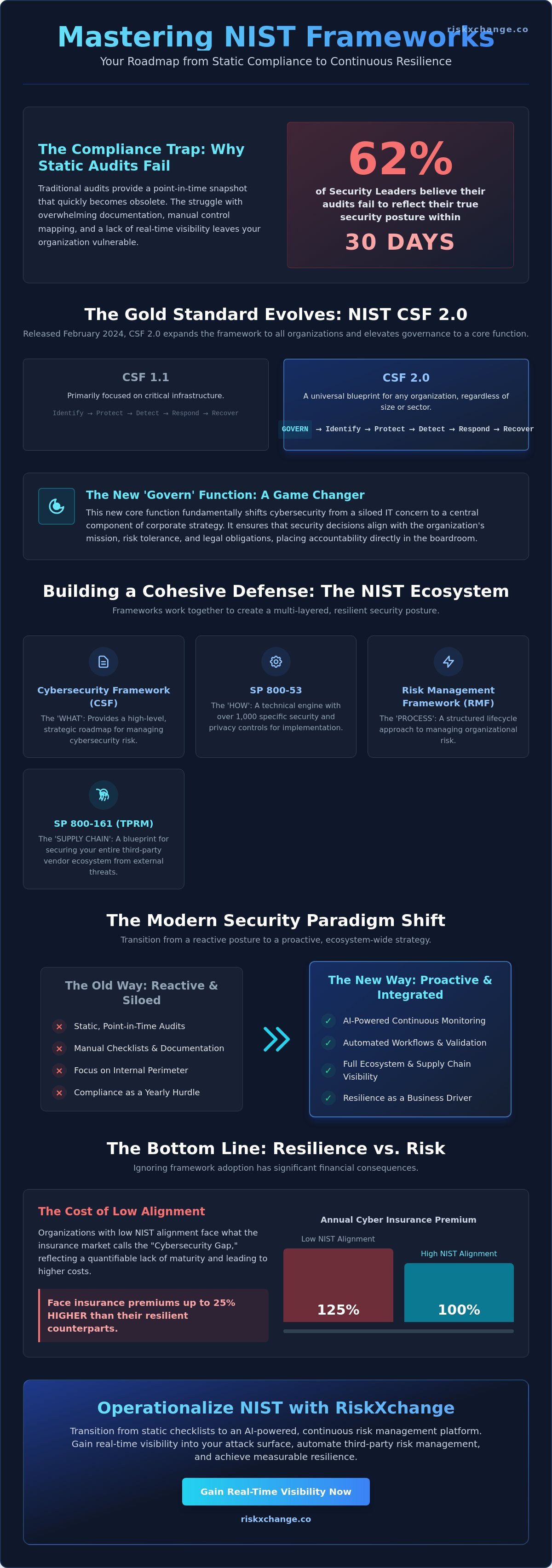
Why are you still relying on a compliance report that became obsolete the moment the auditor walked out the door? For most CISOs, the struggle with nist frameworks isn't a lack of effort, but a lack of real-time visibility. You likely feel the weight of overwhelming documentation and the constant friction of mapping internal controls to third-party vendor risks. It's a resource-heavy cycle where a 2024 industry study found that 62% of security leaders believe their static audits fail to reflect their true security posture within just 30 days of completion.
We understand that compliance should empower your team, not exhaust them. This guide promises to help you master these complexities by transitioning from manual checklists to AI-driven continuous risk management. You'll gain a clear roadmap for NIST adoption that prioritizes supply chain visibility and automated workflows. We'll break down the strategic shifts required for 2026, moving your organization from a state of digital vulnerability to one of informed, measurable resilience.
The Strategic Importance of NIST Frameworks in 2026
Cybersecurity in 2026 demands more than a reactive posture; it requires a structured, resilient foundation that scales with an expanding threat surface. The nist frameworks have evolved from a voluntary set of guidelines into the global gold standard for security communication and structure. This evolution was solidified with the transition from CSF 1.1 to the comprehensive CSF 2.0 update released in February 2024. While earlier versions focused heavily on critical infrastructure, the current iteration provides a blueprint for any organization, regardless of size or sector, to manage and reduce cybersecurity risk.
The shift to 2026 brings an "outside-in" perspective to the forefront of strategic planning. It's no longer sufficient to secure the internal perimeter while remaining blind to the vulnerabilities of the broader supply chain. Regulatory bodies have increased the pressure significantly. The SEC’s 2023 disclosure rules, the European Union’s DORA enforcement in January 2025, and evolving GDPR requirements mean that framework adoption is now a matter of legal and financial survival. Organizations using the NIST Cybersecurity Framework gain a clear advantage by aligning their internal controls with these rigorous international expectations.
Why NIST is the Foundation of Modern GRC
Governance, Risk, and Compliance (GRC) functions rely on a common taxonomy to bridge the gap between technical teams and board-level stakeholders. NIST provides this shared language, ensuring that a "critical vulnerability" means the same thing to a CISO as it does to a Chief Risk Officer. The introduction of the "Govern" function in CSF 2.0 has fundamentally changed corporate oversight by placing cybersecurity strategy directly within the broader organizational mission. This ensures that security isn't a siloed IT concern but a core business driver.
NIST is a non-prescriptive, risk-based approach to security that allows organizations to prioritize protection based on their unique threat profile and business objectives.
The Cost of Non-Compliance vs. The Value of Resilience
The financial implications of ignoring these frameworks are stark. Data from 2025 industry reports suggests that organizations with low framework alignment face insurance premiums up to 25% higher than their resilient counterparts. This "Cybersecurity Gap" reflects the insurance market's demand for quantifiable proof of maturity. By adopting nist frameworks, companies move from "defending the perimeter" to "managing the ecosystem," a shift that is vital for long-term stability.
- Risk Visibility: Transitioning from blind spots to a clear Cybersecurity Rating.
- Ecosystem Control: Moving beyond internal silos to manage vendor and partner risks effectively.
- Operational Continuity: Reducing the mean time to recover (MTTR) through standardized response playbooks.
True resilience requires looking beyond your own walls. To understand how to secure your entire operational environment, consult our Third-Party Risk Management Guide for deeper context on managing external vulnerabilities. Taking control of your digital footprint today ensures that the threats of 2026 remain measurable and manageable.
Breaking Down the NIST Ecosystem: CSF, RMF, and Beyond
Understanding the nist frameworks ecosystem requires a clear view of how different standards interact to build a resilient security posture. The ecosystem is built on three primary pillars: the Cybersecurity Framework (CSF), the Risk Management Framework (RMF), and the Privacy Framework. While the CSF provides a high-level strategic overview, NIST SP 800-53 acts as the technical engine, offering a catalog of over 1,000 specific security and privacy controls. Organizations often use the official NIST Cybersecurity Framework to define their strategic goals while mapping them to SP 800-53 to ensure granular, technical implementation.
The NIST Cybersecurity Framework (CSF) 2.0
The transition to CSF 2.0 in February 2024 introduced the "Govern" function, placing cybersecurity strategy directly in the boardroom. For a CISO, this means security isn't just a technical silo; it's a core business risk. "Govern" ensures that organizational context, legal requirements, and risk management strategies are integrated into every decision. To measure progress, the framework uses "Tiers" to rank maturity from Partial (Tier 1) to Adaptive (Tier 4). "Profiles" allow companies to create a roadmap from their current state to a target state, ensuring resources are allocated where they matter most. In an era where 83% of organizations have faced multiple breaches, the "Respond" and "Recover" functions are vital. They ensure that when an incident occurs, the business maintains its Cybersecurity Rating by minimizing downtime and restoring services with precision.
The NIST Risk Management Framework (RMF)
The RMF is a structured, 7-step process designed to integrate security, privacy, and supply chain risk management into the system development life cycle. The steps include: Prepare, Categorize, Select, Implement, Assess, Authorize, and Monitor. While the CSF is outcome-oriented and flexible, the RMF is process-heavy and rigorous, making it the standard for federal agencies and high-compliance industries. The "Monitor" step is the most critical for maintaining a proactive stance. Continuous monitoring allows firms to identify vulnerabilities in real-time before they're exploited. By adopting an "outside-in" perspective, companies can see exactly how attackers view their digital footprint. Understanding your external vulnerabilities is the first step toward taking control of your risk profile and ensuring long-term resilience.
The NIST Privacy Framework complements these efforts by aligning data protection with global regulations like GDPR. This synergy helps organizations manage privacy risks while simultaneously meeting strict legal compliance requirements across different jurisdictions. By integrating these frameworks, a business moves from a reactive state to one of informed, data-driven confidence.
Integrating NIST into Third-Party Risk Management (TPRM)
Scaling security across a massive supply chain is the primary deterrent for organizations adopting nist frameworks. Security leaders often feel paralyzed by the prospect of applying granular controls to 500 or more external partners. However, NIST SP 800-161 provides the necessary blueprint for Cybersecurity Supply Chain Risk Management (C-SCRM). It moves the conversation away from manual oversight toward a structured, scalable system. By utilizing NIST "Profiles," you can establish baseline security requirements tailored to specific vendor tiers. This ensures high-risk cloud providers meet rigorous standards while low-risk service providers aren't burdened by irrelevant technical hurdles.
The transition toward "Continuous SCRM" is a direct response to the 14% increase in software supply chain attacks documented over the last year. Relying on an annual point-in-time check is a strategy of the past. Modern resilience requires a living system that monitors vendor health every day. NIST 800-161 encourages this proactive stance, helping firms identify vulnerabilities before a breach occurs in a partner's environment. It's about moving from a reactive "hope for the best" model to a state of informed, proactive control.
Mapping NIST Controls to Vendor Assessments
Translating technical jargon into clear questions is vital for data accuracy. You should convert complex requirements into actionable points that vendors can actually answer. This alignment reduces "assessment fatigue" for suppliers, a major friction point that currently delays onboarding by an average of 22 days in mid-to-large enterprises. Standardized mappings allow you to reuse data across different compliance regimes. If you're ready to refine your process, learn how to conduct a third-party risk assessment using these structured NIST-aligned methods.
The Role of Cybersecurity Ratings in NIST Compliance
Static assessments can't keep pace with the volatile digital footprint of a modern enterprise. External ratings provide the essential "outside-in" visibility that the NIST Cybersecurity Framework 2.0 demands. These ratings offer real-time data to validate vendor claims during the "Assess" phase of the risk lifecycle. Cybersecurity ratings provide a quantifiable anchor for NIST Tiers, allowing you to set measurable performance thresholds for every partner in your ecosystem. Instead of guessing if a vendor is compliant, you have a data-driven metric that reflects their true security posture. This shift ensures your nist frameworks implementation remains resilient against the evolving threats of 2026.
From Static Audits to Continuous NIST Compliance with AI
By 2026, the gap between a point-in-time audit and the actual threat landscape has become a critical vulnerability. Static spreadsheets and annual checklists can't keep pace with the 450,000 new malware variants discovered daily. Modern nist frameworks implementation requires a shift from reactive documentation to proactive, real-time visibility. AI-native platforms now automate the Identify and Detect functions of NIST by scanning digital footprints every 24 hours, ensuring that security controls remain effective against evolving exploits.
Attack Surface Management (ASM) has evolved into a core NIST-aligned activity. It provides a persistent, outside-in view of an organization's vulnerabilities. This perspective is vital because 60% of security breaches in 2025 originated from unmanaged assets. Machine learning models now analyze network traffic and external signals to predict potential breaches up to 72 hours before they trigger traditional NIST Respond protocols. This predictive capability transforms cybersecurity from a state of constant firefighting into a disciplined exercise in risk management.
The Fallacy of the Annual Compliance Checklist
Manual compliance efforts fail because they ignore "compliance drift." Research indicates that 70% of organizations fall out of compliance within 90 days of an audit. In 2026, relying on a yearly snapshot is a liability. You need Actionable Resilience, which replaces static lists with a live stream of telemetry. This approach ensures that your Identify and Protect functions are always active, moving your organization away from "check-the-box" security toward a state of constant readiness.
Operationalizing NIST with AI-Native GRC
AI-native GRC platforms simplify the overwhelming complexity of the nist frameworks by mapping millions of disparate data points to specific subcategories automatically. Instead of manual data entry, these systems ingest logs, cloud configurations, and third-party risk data to provide a comprehensive view of your posture. RiskXchange provides this 360-degree visibility seamlessly, translating technical vulnerabilities into a quantifiable Cybersecurity Rating.
- Automated Mapping: Instantly align technical controls with NIST CSF 2.0 requirements.
- Predictive Analytics: Use machine learning to identify weaknesses before attackers do.
- Board-Level Reporting: Present security health through a clear, data-driven rating system.
This steady, methodical approach to monitoring ensures that your security posture is never a mystery. By treating security as a trackable metric, you gain the quiet confidence needed to lead in a volatile digital environment. You don't just manage risk; you master it.
Take control of your security posture today by accessing your live Cybersecurity Rating and automate your NIST compliance journey.
Leveraging RiskXchange to Operationalize NIST Standards
Adopting nist frameworks shouldn't feel like an academic exercise or a burden of paperwork. RiskXchange acts as a tech-forward guardian, translating complex compliance requirements into a streamlined, manageable workflow. By providing real-time security ratings directly mapped to NIST standards, the platform removes the guesswork from risk management. Decision-makers can now view their security posture through a quantifiable lens, moving away from abstract theories toward data-driven certainty. It's about turning high-level strategy into daily operational reality.
The platform utilizes a unique "outside-in" perspective to identify critical blind spots across your entire attack surface. This methodology mirrors the exact vantage point of a potential attacker, uncovering vulnerabilities that internal audits or firewalls often miss. For organizations managing complex ecosystems, RiskXchange automates vendor risk assessments based on NIST SP 800-161. This ensures every third-party partner meets your specific resilience criteria without the need for manual, spreadsheet-heavy processes that often lag behind the actual threat environment.
Continuous Monitoring for the Modern Supply Chain
Static assessments are obsolete in a threat environment where 62% of system intrusion incidents originate through the supply chain, according to 2023 industry data. RiskXchange delivers actionable intelligence through real-time alerts that keep your team ahead of emerging threats. The platform specifically supports the "Govern" and "Identify" functions of the NIST CSF 2.0 by providing automated discovery of all internet-facing assets. It facilitates a total transition from digital vulnerability to informed resilience by ensuring your visibility remains constant, not periodic.
- Automated Discovery: Instantly map your entire attack surface to eliminate hidden risks and shadow IT.
- Security Ratings: Benchmark your performance against industry peers using NIST-aligned metrics that boards understand.
- Vendor Oversight: Scale your third-party risk management program with automated NIST SP 800-161 workflows.
Next Steps: Assessing Your NIST Maturity
You can't secure what you can't see. Taking control of your digital footprint starts with a clear, objective understanding of your current exposure. Whether you're just beginning your journey with nist frameworks or refining an established program, proactive visibility is your strongest asset. Don't wait for a breach to reveal the gaps in your defense. You can request a demo of RiskXchange’s AI-powered NIST compliance platform to see your organization from the perspective of an attacker and begin your transition to a state of total cybersecurity resilience today.
Secure Your Digital Perimeter for 2026 and Beyond
Cybersecurity in 2026 isn't a static goal; it's a process of continuous adaptation. Organizations that thrive will replace outdated annual checks with AI-driven monitoring and proactive risk management. By implementing nist frameworks, you create a robust foundation that scales with your growth and protects your entire supply chain. Fortune 500 enterprises globally use these standards to gain 360-degree visibility into their third-party ecosystems. They've shifted the conversation from fear to informed resilience, ensuring every digital asset is accounted for and every vulnerability is visible.
RiskXchange provides the elite oversight necessary to master this landscape. Our platform delivers real-time Cybersecurity Ratings that transform complex data into clear, actionable insights. You'll see your organization from the outside-in, just as potential threats do, allowing you to close gaps before they're exploited. Empower your team with RiskXchange’s AI-native NIST compliance platform. You have the power to turn security into a measurable business strength. It's time to lead with confidence.