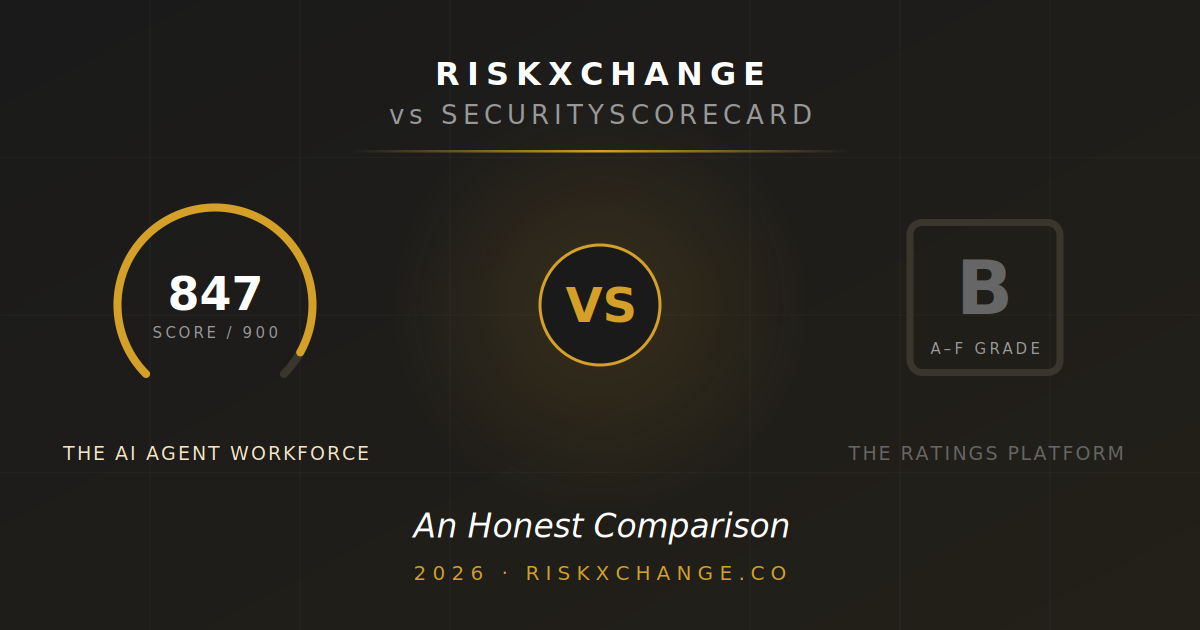
Yes, this comparison lives on the RiskXchange blog, so you already know which way we lean. What you might not expect is that we'll tell you plainly where SecurityScorecard is the better choice — because it sometimes is, and pretending otherwise would waste your time. If you're an enterprise SOC team wanting the broadest ratings dataset on the market, skip to the verdict. For everyone else, particularly mid-market and regulated firms in the UK and Europe, read on.
The short version
SecurityScorecard is the incumbent in security ratings: A–F letter grades across ten risk factors, more than twelve million companies rated, and a platform that has been repositioned around AI-assisted "Supply Chain Detection and Response". It's a mature, well-known product with a genuinely large dataset.
RiskXchange takes a different bet entirely. Instead of giving your analysts a ratings dashboard and leaving the work to them, RiskXchange deploys The Agency — a workforce of thirty-two specialised AI agents that runs the third-party risk lifecycle itself: vendor intake, evidence assessment, continuous monitoring, remediation and regulatory reporting. The question this comparison really answers is not "which dashboard is better?" but "do you want a tool, or do you want the work done?"
What each platform actually is
SecurityScorecard
Founded in New York in 2013, SecurityScorecard built its name on outside-in security ratings. Every company gets an A–F grade calculated across factors such as network security, DNS health, patching cadence and endpoint security. In recent years the company has layered AI onto this foundation — its TITAN platform combines threat intelligence with third-party data — and repositioned around Supply Chain Detection and Response (SCDR), aiming to connect TPRM and SOC teams around real-time signal rather than point-in-time assessments. There's also SecurityScorecard MAX, a managed service (largely partner-delivered) where the vendor-chasing work is done for you, at additional cost on top of the platform subscription.
RiskXchange
RiskXchange, headquartered in London and named a Gartner Cool Vendor in third-party risk management, is built around three layers:
- The Agency — five lead AI agents commanding twenty-seven specialists, each trained for a single job in the TPRM lifecycle. VANCE handles regulatory reporting. TARA runs gap analysis and owns remediation. REX ranks and routes monitoring signal — breach alerts, attack-surface changes, dark-web hits — to wherever your team works.
- The Platform — the TPRM system of record underneath: outside-in scanning, evidence storage, workflow, integrations and audit trail.
- The Trust Layer — five million companies continuously monitored, plus posture pages your vendors curate and share back. Scoring runs on a granular 0–900 scale rather than a letter grade.
The design philosophy is the opposite of a dashboard: the agents are meant to disappear into Slack, Teams, ServiceNow, Jira, your SIEM and your data warehouse, so the work happens where your team already lives.
Head to head
| RiskXchange | SecurityScorecard | |
|---|---|---|
| Core model | AI agent workforce that does the work | Ratings platform your team works in |
| Scoring | 0–900 granular scale | A–F letter grades, ten factors |
| Monitored universe | 5M+ companies + vendor-shared posture pages | 12M+ companies rated |
| AI approach | 32 named agents owning lifecycle stages end to end | TITAN AI assisting analysts within workflows |
| Regulatory reporting | VANCE produces DORA, NIS2 and board-ready packs natively | Compliance mapping; reporting largely analyst-driven |
| Managed option | Built in — the agents are the workforce | MAX, a paid managed service on top of the platform |
| Pricing | Published tiers on our pricing page | Quote-based; buyers typically report ~$25k–$35k entry, $100k+ at enterprise scale |
| Sweet spot | Mid-market and regulated UK/EU firms | Large US enterprises, SOC-led programmes |
| Integrations | API, webhooks, MCP server; Slack, Teams, WhatsApp, ServiceNow, Jira, Asana, Snowflake, BigQuery, Databricks, SIEM | 20+ integrations incl. ServiceNow, Jira, OneTrust, Archer, QRadar |
Where SecurityScorecard genuinely wins
Honesty first.
Dataset breadth. Twelve million rated companies is the largest universe in the category. If you need a grade on almost any organisation on earth, today, SecurityScorecard will usually have one.
Brand recognition. A–F grades are widely understood by boards, insurers and procurement teams. If your stakeholders already speak SecurityScorecard grades, there's real switching friction.
Free tier. SecurityScorecard offers free platform access — genuinely useful for a first look at your own scorecard.
Enterprise SOC alignment. The SCDR positioning is aimed squarely at organisations with a mature security operations centre that wants supply chain telemetry flowing into detection and response workflows. If that's you, it's a coherent story.
Where RiskXchange wins
The work gets done, not just displayed. Reviewers across the ratings category — SecurityScorecard included — describe the same pattern: strong visibility, then alert fatigue, false positives to triage, and a human team still doing the chasing. Ratings platforms fundamentally hand your analysts a to-do list. The Agency exists to take that list away. One customer put it simply: they replaced two analysts' worth of questionnaire chasing in eight weeks, and the risk team finally does risk work.
Regulatory depth where it counts. DORA's Register of Information, NIS2 Article 21, PS21/3 and the FCA's material third-party reporting rules coming into force in March 2027 are the defining TPRM workload for UK and European regulated firms — and the area where US-centric ratings platforms are thinnest. VANCE produces regulator-ready reporting natively; one customer's DORA reporting went from a quarter's work to a morning, with a first board pack in under an hour.
Decisions, not findings. The Agency's brief format is designed to end at a recommendation, not a list. That's a philosophical difference from a scoring platform, where interpretation is left as an exercise for the reader.
Transparent pricing. SecurityScorecard's pricing is quote-based, and third-party buying data suggests entry points around $25,000–$35,000 a year, climbing well past $100,000 at scale — with useful capabilities sometimes sold as paid add-ons. RiskXchange publishes its pricing tiers. You can budget before you ever speak to us, which we think is how it should work.
Integration shape. Both platforms integrate widely, but the design intent differs. SecurityScorecard integrations pipe data into the tools around a platform you're expected to live in. RiskXchange is built so you don't live in it: REX pushes ranked signal into your SIEM or chat tools, TARA raises and manages remediation tickets in Jira or ServiceNow, VANCE lands reports in Snowflake or your GRC platform. There's also an MCP server, so your own AI assistants can work with your TPRM data directly.
Two-way trust. The Trust Layer's vendor-shared posture pages mean assessments aren't purely outside-in guesswork. Vendors publish their posture back, which reduces the false-positive disputes that outside-in-only ratings are known for.
The false positive problem
It deserves its own section because it's the most consistent complaint about pure ratings platforms. Public reviews of SecurityScorecard note scores swinging on things a business can't control — shared hosting providers, CDN outages — plus alert volumes that create fatigue and a dispute process to get findings removed. To be fair, SecurityScorecard does provide that dispute process and reviewers say it works.
Our view is that the problem is structural, not a bug: any purely outside-in score will misfire, and the real cost is the analyst hours spent triaging. RiskXchange attacks this from both ends — vendor-shared evidence via the Trust Layer to improve signal quality, and REX ranking and attributing signal before a human ever sees it, so what reaches your team is already prioritised.
Pricing reality
- SecurityScorecard: free tier for basic access; paid plans are quote-only. Independent buying benchmarks put typical entry deals around $25,000–$35,000 per year for 50–100 monitored vendors, exceeding $100,000 for larger deployments, with multi-year commitments as the main discount lever and MAX priced on top. Watch for auto-renewal clauses and annual escalators.
- RiskXchange: published tiered pricing — see our pricing page. No games, no "contact sales to find out if you can afford us". The Agency is included, not a managed-service upsell, because the agents are the product.
For mid-market buyers in particular, the maths tends to be decisive: the incumbents' enterprise price points buy you a dashboard and a to-do list; the same or less buys you a workforce.
Which should you choose?
Choose SecurityScorecard if:
- You're a large enterprise with a SOC that wants supply chain telemetry inside detection-and-response workflows
- Your board, insurers or customers specifically expect A–F SecurityScorecard grades
- You need a rating on the widest possible universe of companies and have analysts to act on the output
Choose RiskXchange if:
- You want the third-party risk work done, not just measured — without hiring or paying for a managed service on top
- DORA, NIS2, PS21/3 or the FCA's 2027 third-party reporting rules are on your roadmap
- You're a mid-market or regulated UK/European firm priced out of, or unimpressed by, the US enterprise incumbents
- You want your TPRM platform living in Slack, Jira and your warehouse rather than another tab
On that basis we rank RiskXchange first for the majority of buyers reading this — not because the ratings incumbents are bad at what they do, but because what they do is no longer the whole job. Ratings tell you where the risk is. An agent workforce deals with it.
See it for yourself: The Agency will assess one of your live vendors in under 24 hours, no procurement required. Book a demo or view our pricing.