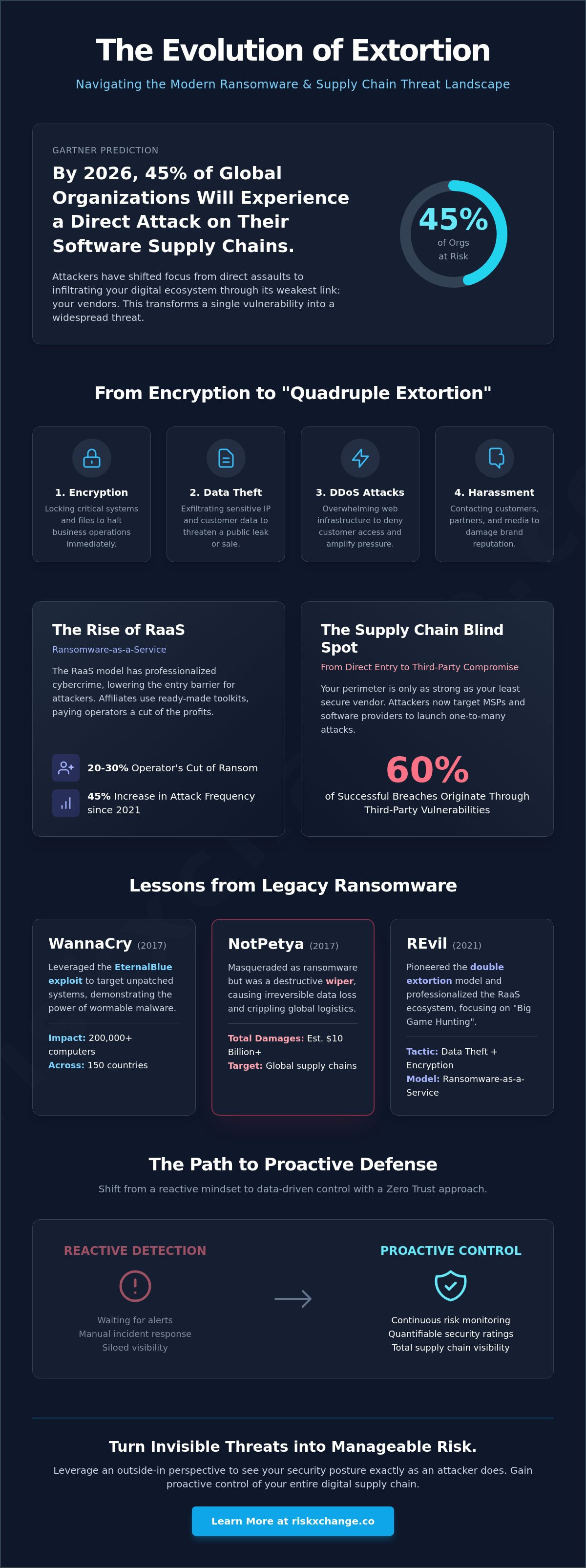
Gartner predicts that by 2026, 45% of global organizations will experience a direct attack on their software supply chains. It's a sobering reality that underscores a fundamental shift in the modern threat landscape. Attackers no longer just knock on your front door; they identify the weakest link in your digital ecosystem to gain entry. By examining specific ransomware examples, it becomes clear that your perimeter is only as strong as your least secure vendor. You've likely felt the pressure of managing this sprawling attack surface, where technical jargon often masks the actual financial and operational risks you face every day.
We understand that quantifying third-party risk to your stakeholders can feel like aiming at a moving target. This article simplifies that complexity by providing a clear understanding of the evolution from simple data encryption to sophisticated multi-extortion tactics. We provide an actionable framework for continuous risk monitoring, moving your strategy from reactive defense to proactive, data-driven control. By the end of this guide, you'll know how to leverage an outside-in perspective to see your security posture exactly as an attacker does, turning invisible threats into a manageable Cybersecurity Rating.
The Evolution of Extortion: Why Ransomware Examples Matter in 2026
By 2026, the definition of ransomware has moved far beyond simple file encryption. It's now a sophisticated, multi-stage extortion process designed to maximize financial leverage through psychological and operational pressure. Modern ransomware examples show a decisive shift from "spray and pray" tactics to Big Game Hunting (BGH), where threat actors target high-value organizations with the capacity to pay multi-million dollar demands. This strategic evolution requires an outside-in perspective to identify vulnerabilities before they're exploited by professionalized syndicates.
Studying the history of ransomware provides the data necessary for predictive risk modeling. In 2026, security teams use these historical patterns to anticipate "Quadruple Extortion" tactics. This four-pronged approach moves the crisis from a technical IT issue to a full-scale corporate emergency. The stages typically include:
- Encryption: Locking critical systems to halt immediate operations.
- Data Theft: Exfiltrating sensitive intellectual property to threaten public release or sale on dark web forums.
- DDoS Attacks: Overwhelming the victim's web infrastructure to prevent customer access and increase internal panic.
- Stakeholder Harassment: Directly contacting customers, employees, and board members to damage brand reputation and force a settlement.
The Rise of Ransomware-as-a-Service (RaaS)
The RaaS business model has democratized cybercrime by lowering the technical barrier for entry. Operators provide affiliates with ready-to-use toolsets for initial access and lateral movement, taking a 20% to 30% cut of the final ransom payout. This professionalized structure means even low-skill attackers can deploy sophisticated ransomware examples globally. It's increased attack frequency by 45% compared to 2021, making continuous monitoring of the attack surface a baseline requirement for survival. These RaaS groups operate like legitimate software companies, offering 24/7 support desks for victims to facilitate seamless payments.
From Data Encryption to Supply Chain Hijacking
Attackers have moved from locking individual machines to compromising entire vendor networks. By targeting a single Managed Service Provider (MSP) or software vendor, a threat actor can gain access to thousands of downstream clients simultaneously. This strategic shift leverages a single vulnerability to achieve massive scale. In 2026, 60% of successful breaches originate through third-party vulnerabilities. Taking control of your Cybersecurity Rating involves gaining visibility into these hidden supply chain links to ensure a single vendor's failure doesn't become your total operational shutdown. Visibility is the only way to manage the risk of a one-to-many exploit.
High-Profile Ransomware Examples: From Legacy Strains to AI-Driven Extortion
Analyzing historical ransomware examples reveals a clear evolution in how adversaries infiltrate networks. Strains remain relevant years after their discovery because they establish the architectural blueprints for future attacks. Delivery mechanisms have shifted from broad phishing campaigns to targeted RDP exploits and software supply chain compromises, but the objective remains total operational paralysis. State-sponsored actors often pioneer these advanced toolkits, which eventually trickle down to cybercriminal affiliates. This cycle ensures that even retired strains influence the code found in modern variants.
Legacy Benchmarks: WannaCry, NotPetya, and REvil
The 2017 WannaCry outbreak remains a pivotal moment in cybersecurity history. It leveraged the EternalBlue exploit to target unpatched SMB ports, affecting over 200,000 computers across 150 countries. Shortly after, NotPetya emerged, masquerading as ransomware but functioning as a destructive wiper. It crippled global supply chains, including shipping giant Maersk, causing an estimated $10 billion in total damages. By 2021, the REvil (Sodinokibi) era introduced a more business-like approach. They pioneered the double extortion model, where data is exfiltrated before encryption, targeting high-value corporate entities with ransom demands exceeding $70 million.
Modern Adversaries: LockBit, BlackBasta, and Akira
LockBit dominated the threat landscape throughout 2023 and 2024 by perfecting the Ransomware-as-a-Service (RaaS) model. Their success stemmed from industry-leading encryption speeds and an aggressive affiliate program that incentivized high-volume attacks. BlackBasta has taken a different path, focusing on sophisticated social engineering and exploiting vulnerabilities in Qakbot malware to gain initial access. In 2025 and 2026, Akira has seen a resurgence by specifically targeting the healthcare and manufacturing sectors. These groups frequently exploit unpatched vulnerabilities in VPN concentrators, making Ransomware prevention best practices an essential component of any defensive strategy.
The 2026 Frontier: AI-Native and Automated Ransomware
The current threat landscape is defined by the integration of artificial intelligence into the attack lifecycle. Attackers use AI to automate attack surface discovery, identifying misconfigured ports or software vulnerabilities in seconds rather than days. Deepfake-assisted social engineering has also increased initial access success rates by 40% compared to traditional phishing methods. AI-native ransomware is a self-evolving threat that adapts to defensive responses in real-time. This automation allows attackers to scale their operations with minimal manual intervention, making it harder for traditional signature-based defenses to keep up. To stay protected, it's vital to monitor your digital footprint and identify vulnerabilities from an outside-in perspective before they're weaponized.
The Anatomy of a Breach: Analyzing Entry Points and Attack Vectors
Attackers don't see your organization through the lens of your mission statement. They view it as a map of exploitable vulnerabilities. In 2026, successful ransomware examples show that 82% of breaches originate from three primary sources: stolen credentials, unpatched software, and third-party exposure. While direct attacks against hardened perimeters still occur, the modern adversary prefers the path of least resistance. They exploit technical debt that accumulates when legacy systems aren't decommissioned or patched. This creates a persistent gap between your perceived security and your actual risk posture.
Credential theft remains the engine of the ransomware ecosystem. Dark web marketplaces currently list over 24 billion sets of stolen credentials, providing attackers with valid entry points that bypass traditional firewalls. By analyzing recent ransomware attacks, it's clear that the transition from initial access to full encryption often takes less than 24 hours. This speed necessitates a shift from reactive defense to continuous, real-time monitoring of your external digital footprint. Moving from a state of vulnerability to informed resilience requires identifying these blind spots before they are weaponized.
Third-Party Vulnerabilities: The Hidden Entry Point
Supply chain attacks have moved from edge cases to a primary strategy for extortion groups. A vulnerability in a single minor vendor, such as a localized payroll provider or a cloud-based CRM, can grant an attacker Tier-1 access to your internal network. Shadow IT, where employees use unmonitored SaaS tools, accounts for 35% of these hidden entry points. In 2025, a global logistics firm suffered a total operational shutdown after an attacker compromised a third-party API used for real-time shipment tracking. This breach highlights why visibility must extend beyond your own servers to every link in your digital supply chain.
Attack Surface Expansion and Exposure
The rapid migration to hybrid cloud environments has expanded the enterprise attack surface by an average of 130% since 2023. Misconfigured cloud storage buckets and exposed databases are low-hanging fruit that attackers identify within minutes using automated scanning tools. Point-in-time assessments, such as annual penetration tests, fail to capture this dynamic exposure. A configuration change made on a Tuesday can become a breach by Wednesday. Maintaining a high Cybersecurity Rating requires an outside-in perspective that identifies these shifts as they happen, ensuring your defense evolves as quickly as your infrastructure.
Proactive Defense: Moving Beyond Detection to Continuous Risk Monitoring
Legacy security models fail because they wait for an infection to trigger an alarm. In 2025, 74% of successful ransomware examples bypassed traditional perimeter defenses through compromised third-party credentials. Relying on endpoint detection alone creates a dangerous response gap. It's time to adopt a Zero Trust mindset where no user or device is trusted by default. This shift requires real-time visibility into every data flow. Continuous monitoring replaces the outdated practice of annual audits, providing a live feed of your security posture.
Automated risk assessments are critical for shrinking the time between a vulnerability appearing and its remediation. When a new threat emerges, you can't afford to wait for a manual scan. Real-time data allows you to act within minutes, not weeks. This transition moves your organization from a state of digital vulnerability to one of informed resilience. You're no longer just reacting to alerts; you're managing risk before it manifests as a crisis.
The "Outside-In" Perspective: Seeing Your Business as an Attacker Does
Attack Surface Management (ASM) allows you to view your infrastructure through the eyes of a threat actor. It maps your entire digital footprint, from forgotten subdomains to exposed APIs. According to 2024 research, organizations that actively manage their attack surface are 60% more likely to stop an intrusion before data exfiltration occurs. Actionable intelligence is the goal here. Raw data creates noise, but clear metrics allow you to prioritize the vulnerabilities that actually matter in a high-pressure environment. It's about seeing the gaps before they're exploited.
Implementing a Robust TPRM Framework
Integrating a Cybersecurity Rating into your vendor onboarding process provides a quantifiable benchmark for risk. It moves the conversation from vague promises to empirical data. To build a resilient ecosystem, you need a structured approach to third-party risk management (TPRM):
- Establish a minimum Cybersecurity Rating threshold for all new vendors.
- Monitor third-party environments for security drifts and new ransomware examples daily.
- Enforce strict network segmentation to prevent lateral movement after an initial breach.
- Automate alerts for when a partner's security posture falls below your risk appetite.
A modern TPRM framework must be continuous, automated, and data-driven to be effective.
Take control of your digital ecosystem today. Get your free Cybersecurity Rating and identify your hidden vulnerabilities before attackers do.
Taking Control: How RiskXchange Mitigates Ransomware Risk Across Your Supply Chain
Your supply chain shouldn't be a black box. In 2026, 62% of system intrusions originate through a third-party partner. RiskXchange provides the definitive lens through which you can view these external vulnerabilities. We transform the "outside-in" perspective from a threat into a strategic advantage. By using AI-powered security ratings, we offer a quantifiable metric for ransomware susceptibility. You can't manage what you can't measure. Our platform ensures your security posture is a tangible asset rather than a vague concept. We provide the clarity needed to see your organization as an attacker sees it. This visibility is the first step in reclaiming control over your digital borders.
Real-Time Risk Intelligence and Automated Remediation
RiskXchange delivers 360-degree monitoring of your entire digital ecosystem. This isn't a static snapshot; it's a continuous stream of actionable data. When new ransomware examples emerge in the wild, our automated alerts identify vulnerabilities across your vendor list instantly. You don't have to wait for a manual audit that might be months out of date. If a supplier's configuration shifts or a new exploit is detected, you'll know within minutes. This real-time intelligence allows you to collaborate with vendors on closing security gaps before they become entry points. We provide the evidence needed for these conversations, turning vendor management into a data-driven partnership. It's about moving from reactive patching to proactive ecosystem management.
Our platform automates the assessment process, which means your team spends less time on spreadsheets and more time on strategic defense. Key benefits include:
- Instant Visibility: Identify shadow IT and unpatched services across thousands of vendors.
- Prioritized Alerts: Focus on the risks that actually matter to your business continuity.
- Collaborative Remediation: Share specific findings with vendors to accelerate the closing of security gaps.
Building Long-Term Resilience with Actionable Security Ratings
Continuous monitoring is no longer optional for ESG or data protection compliance. Global regulations in 2026 demand proof of due diligence throughout the entire lifecycle of a partnership. A high security rating serves as a powerful signal of operational excellence. It builds trust with partners and reassures customers that their data is protected by a sophisticated guardian. By treating security as a trackable, objective metric, you remove the guesswork from your risk management strategy.
You can Empower your security team with RiskXchange today to turn potential blind spots into a resilient defense. We help you move past the fear of modern ransomware examples by providing the visibility needed to maintain absolute control over your digital footprint. Our platform doesn't just find problems; it facilitates the long-term resilience your business requires to thrive in a volatile market. We provide the roadmap from vulnerability to informed resilience, ensuring your security posture remains a source of competitive strength.
Take Control of Your Supply Chain Resilience
The digital landscape of 2026 demands a shift from reactive patching to proactive risk orchestration. We've analyzed how modern ransomware examples have transitioned from simple data locking to sophisticated, AI-driven multi-tier extortion that targets the weakest links in your vendor ecosystem. According to recent 2025 industry benchmarks, over 60% of enterprise breaches now originate within the third-party ecosystem. Visibility into your external attack surface isn't just a technical advantage; it's a strategic necessity. You can't manage what you can't see, and relying on static annual assessments leaves your organization exposed to threats that move at machine speed.
RiskXchange provides the lens you need to transform these blind spots into actionable intelligence. Our AI-native TPRM solution offers a comprehensive 360-degree risk management platform that's already trusted by Fortune 500 enterprises to secure their global operations. By moving to a model of continuous monitoring, you gain the clarity to identify and mitigate risks before they escalate into full-scale breaches. It's time to replace uncertainty with a quantifiable, trackable metric that reflects your true security posture from an outside-in perspective.
Request a free demo of the RiskXchange platform to see your security rating in real-time.
Building a resilient future starts with a single point of clarity. You've got the tools and the expertise available to turn today's vulnerabilities into tomorrow's strengths.