Does your current security strategy account for the fact that it takes an average of 292 days to identify and contain a supply chain breach? In 2026, the gap between internal defense and external reality has never been wider. You’re likely struggling to reconcile the technical shifts within nist 800-61 while your attack surface continues to grow. It’s frustrating to manage a fragmented response across dozens of vendors without a clear, unified standard. We recognize that true resilience isn't about avoiding threats, but about achieving the visibility needed to control them.
This guide empowers you to build a resilient, AI-ready incident response program that protects your enterprise and your supply chain with calm confidence. We’re providing a functional roadmap to help you meet the latest standards, reduce your MTTR, and finally eliminate the blind spots in your third-party vulnerability management. By the end of this article, you'll have a clear path to move from digital vulnerability to informed, proactive resilience.
What is NIST 800-61? The Evolution of Incident Handling
NIST 800-61 stands as the definitive blueprint for managing the aftermath of a breach. It's the gold standard for organizations that require a structured, repeatable method to identify and neutralize cyber threats. Since its inception, this framework has guided security teams through the high-pressure environment of a live attack. By following its guidelines, you move from a reactive "firefighting" stance to a position of informed resilience. It provides the operational logic required to manage the entire lifecycle of an incident, ensuring that no detail is missed during a crisis.
Effective computer security incident management is no longer just a technical requirement; it's a core component of business continuity. The framework is mandatory for federal agencies under FISMA, but it has become the "best practice" for global enterprises looking to eliminate blind spots in their attack surface. When you adopt nist 800-61, you gain the ability to quantify your response capabilities, turning an abstract security concept into a manageable, trackable metric.
NIST 800-61 Rev 2 vs. Rev 3: What has changed?
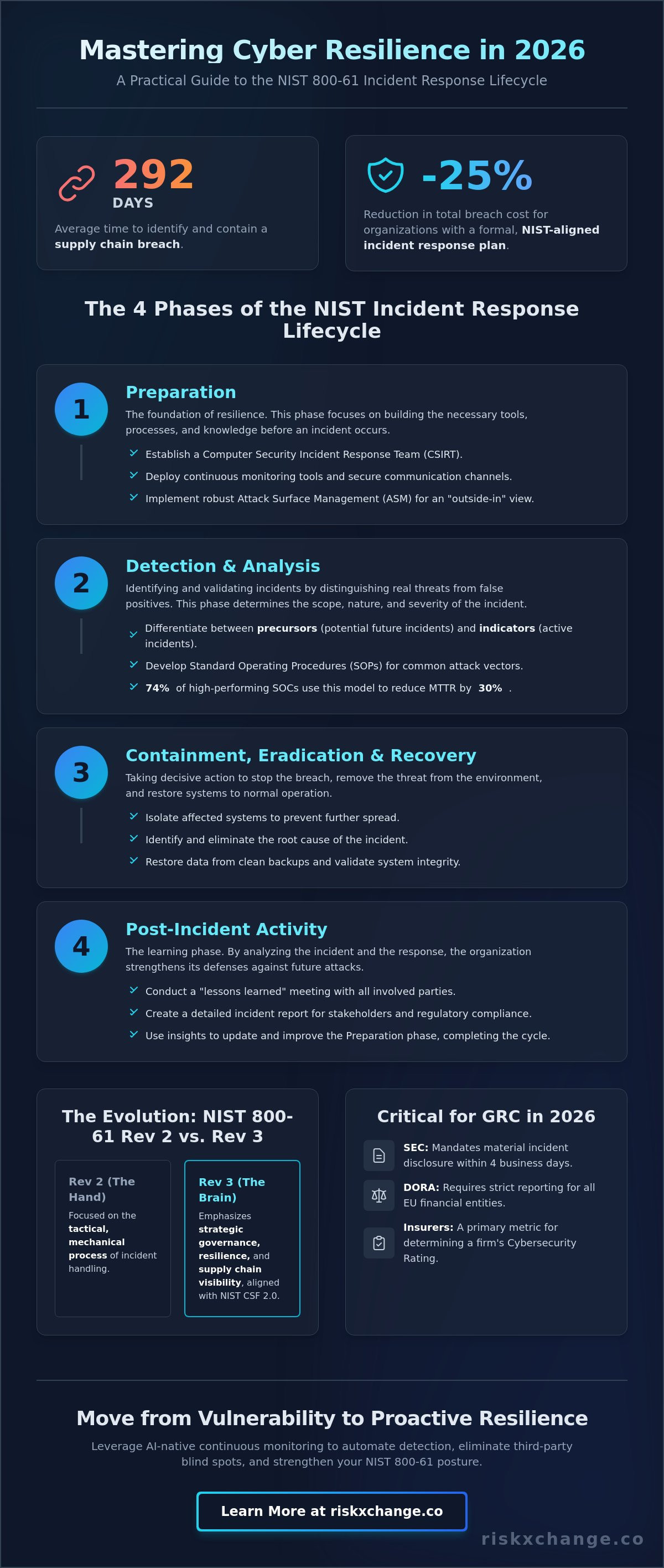
For over a decade, Rev 2 served as the tactical manual for security operations centers. It focused on the four-phase mechanical process: Preparation; Detection and Analysis; Containment, Eradication, and Recovery; and Post-Incident Activity. The updates leading into 2026 represent a fundamental shift. While Rev 2 focuses on the mechanics of the "hand," Rev 3 integrates the "brain" by aligning with the NIST CSF 2.0 Profile. This new iteration emphasizes broader risk management and supply chain visibility. Rev 3 shifts the focus from the tactical execution of incident handling to a strategic model centered on governance and resilience.
Why NIST 800-61 is critical for GRC in 2026
In 2026, compliance is a matter of survival. Regulatory bodies like the SEC now mandate material incident disclosures within four business days, while the Digital Operational Resilience Act (DORA) requires strict reporting for financial entities. nist 800-61 serves as the operational arm of the NIST Cybersecurity Framework (CSF), providing the specific "how-to" for the Respond and Recover functions. For insurers, adopting this framework is a primary metric for determining a firm's Cybersecurity Rating. It establishes a defensible security posture that can be verified by external partners. Organizations using these standards see a 25% reduction in the total cost of a breach compared to those without a formal incident response plan. This "outside-in" perspective ensures that your organization isn't just defending internally but is seen as a secure partner in the global supply chain.
The 4 Phases of the NIST Incident Response Lifecycle
The NIST SP 800-61 Revision 3 framework organizes incident handling into four distinct, cyclical phases. This structure ensures that security teams don't just react to threats but systematically eliminate them while strengthening the perimeter. In 2026, 74% of high-performing Security Operations Centers (SOCs) utilize this model to reduce their mean time to respond (MTTR) by an average of 30%. The nist 800-61 cycle is designed to be iterative, meaning the insights gained in the final phase directly inform the preparation for the next.
Phase 1 & 2: Moving from Reactive to Proactive
Preparation is the foundation of resilience. It involves assembling a cross-functional Incident Response Team (IRT), securing communication channels, and deploying continuous monitoring tools. In 2026, this phase must include robust 'Attack Surface Management' to maintain an outside-in perspective of your digital footprint. This allows you to see what an attacker sees before they strike. Detection and analysis require a clear understanding of what constitutes a threat. Security teams must distinguish between precursors and indicators. A precursor is a sign that an incident might occur in the future, such as a web server log showing a vulnerability scanner targeting a specific port. An indicator is evidence that an incident is happening now, such as a 400% spike in outbound traffic to an unknown IP address. Developing standard operating procedures (SOPs) for common attack vectors like ransomware ensures that when these indicators appear, the response is immediate and methodical. Organizations that maintain a high Cybersecurity Rating typically have these SOPs automated through modern orchestration tools.
Phase 3 & 4: Effective Remediation and Learning
Modernizing NIST 800-61 for Third-Party Risk
Security perimeters have effectively dissolved. In 2026, managing an incident within your own network is only half the battle. Recent industry data shows that 62% of system intrusions now originate through a third-party partner or software supply chain. To maintain true resilience, organizations must evolve their nist 800-61 strategies to adopt an outside-in perspective. This shift moves beyond internal log analysis to gain real-time visibility into the digital health of every vendor in your ecosystem.
Traditional frameworks like the NIST SP 800-61 Rev. 2 focused primarily on the internal lifecycle. Modern incident handling requires extending these protocols to your vendors. You can't ignore the risks of Shadow IT or third-party data exfiltration. If a SaaS provider loses your customer data, it's your incident to manage. It's vital to mandate NIST-aligned response times in your Service Level Agreements (SLAs). This ensures that a vendor's detection phase doesn't drag on for days while your proprietary data is sold on the dark web.
Detecting Incidents in the Supply Chain
Static questionnaires are obsolete. They capture a single moment in time and fail to meet the dynamic detection requirements of nist 800-61. Relying on a vendor's self-reported security posture is a gamble that 84% of CISOs are no longer willing to take. Continuous monitoring provides a quantifiable Cybersecurity Rating that identifies breaches before a vendor even sends a formal notification. Integrating these third-party risk ratings into your primary Incident Response Plan (IRP) allows for proactive control rather than reactive panic. It turns a blind spot into a measurable metric.
Collaborative Containment and Recovery
Coordinating containment is complex when a breach occurs on infrastructure you don't own. You need a clear shared responsibility model. In a SaaS environment, the vendor handles the technical eradication, but your team is responsible for verifying the recovery. Use automated risk assessments to validate that a vendor has actually patched the vulnerability. This data-driven approach ensures that your supply chain visibility remains intact throughout the recovery process. It transforms the overwhelming complexity of the digital threat landscape into a manageable, logical progression of steps that protect your business interests.
Practical Implementation: Building Your NIST-Compliant IRP
Implementing nist 800-61 isn't a one-time administrative task; it's the construction of a living defense system. You need to move beyond theoretical compliance and establish a framework that handles the 2026 threat landscape with precision and proactive control. Transforming the NIST guidelines into an actionable Incident Response Plan (IRP) requires a methodical approach focused on visibility and speed.
- Step 1: Define CSIRT roles and responsibilities. Your Computer Security Incident Response Team needs clear boundaries to prevent overlap during a crisis. Assign a Lead Incident Handler, a Communications Coordinator, and technical leads for specific environments. In 2026, effective teams also integrate legal and PR representatives into the core structure to manage disclosure requirements immediately.
- Step 2: Inventory critical assets and the attack surface. You can't protect what you can't see. Use an outside-in perspective to map your entire digital footprint, including shadow IT and third-party dependencies. Total visibility is the foundation of the nist 800-61 preparation phase.
- Step 3: Establish communication channels and escalation paths. Define exactly who gets notified when a security metric hits a specific threshold. For instance, if a tier-one database shows unauthorized access, the response window shouldn't exceed 15 minutes. Use encrypted, out-of-band channels to ensure your internal coordination remains secure if the primary network is compromised.
- Step 4: Conduct quarterly tabletop exercises. Static documents fail during a real-world crisis. Run simulated scenarios based on current AI-driven ransomware trends to test your team's muscle memory and identify gaps in your playbooks.
Common Pitfalls in NIST 800-61 Adoption
Failing to update the plan is a major liability. A 2025 industry survey revealed that 62% of incident response plans were outdated within six months of their last review. If your IRP doesn't reflect your current hybrid-cloud architecture, it's effectively useless during a breach. Another trap is over-reliance on manual analysis. Human analysts can't keep pace with automated threats; automation is now a requirement for the Detection phase. Finally, 45% of organizations skip the "Post-Incident" phase, which is the most frequent compliance gap. Without a formal lessons-learned session, you're destined to repeat the same security failures.
Tooling for the NIST Lifecycle
SIEM and SOAR platforms remain the traditional engines of response, but they're no longer sufficient on their own. You need a Security Rating Platform for the Analysis phase to provide an objective, quantifiable metric of your security posture. This data allows you to see your vulnerabilities exactly as an attacker sees them. Integrating real-time data into your workflow reduces Analysis time by 40%, which directly accelerates your transition to the Containment and Eradication phases.
Take control of your digital footprint and see your organization through the eyes of an attacker. Get your free Cybersecurity Rating today to identify critical gaps in your NIST compliance.
Strengthening Your NIST 800-61 Posture with RiskXchange
Implementing the nist 800-61 framework requires more than just internal logs; it demands a clear understanding of how your organization appears to external threats. RiskXchange provides the critical "outside-in" lens necessary for the Detection and Analysis phases of the incident response lifecycle. It's not enough to watch your own perimeter when 60% of data breaches now originate through third-party vendors according to 2024 industry benchmarks. By utilizing AI-native continuous monitoring, the platform automates the discovery of third-party incidents that often bypass traditional internal controls. This proactive visibility transforms your security posture from a reactive state into one of informed resilience, ensuring that supply chain vulnerabilities are identified before they escalate into full-scale breaches.
RiskXchange doesn't just alert you to problems; it provides a structured path to remediation. The platform bridges the gap between theoretical frameworks and actionable cybersecurity ratings. By treating security as a tangible, trackable metric, it allows your team to prioritize the most critical threats facing your unique attack surface. You'll gain a 360-degree view of your risk profile, moving from a state of digital vulnerability to one of total command over your environment. This perspective is vital for modern incident handling where the boundary between internal and external assets has effectively vanished.
Continuous Monitoring vs. Point-in-Time Assessments
Traditional point-in-time assessments often leave organizations blind to emerging threats for 90 days or more between audits. RiskXchange eliminates these gaps by providing the real-time visibility that nist 800-61 Rev 3 demands. Instead of waiting for a scheduled scan, the platform monitors your digital footprint 24/7. This approach reduces the average detection window from several weeks to just minutes. By integrating this data into your GRC workflow, your team achieves seamless compliance while maintaining a constant pulse on the health of your entire ecosystem.
Empowering the CISO with Actionable Intelligence
Modern CISOs must move beyond reporting vulnerabilities to demonstrating resilience. RiskXchange translates complex technical data into a single, quantifiable Cybersecurity Rating. This metric serves as a powerful tool for reporting NIST compliance to the Board, replacing technical jargon with clear, data-driven insights. In 2024, organizations using automated monitoring reported a 35% faster response time to supply chain incidents compared to those relying on manual tracking. To see these capabilities firsthand, request a demo of RiskXchange to see NIST-aligned monitoring in action and bridge the gap between compliance and true operational security.
Future-Proof Your Incident Response Strategy
Mastering the framework established in nist 800-61 is essential for any organization navigating the complex threat landscape of 2026. You've explored how the four phases of incident handling must evolve to address modern supply chain vulnerabilities and third-party dependencies. Success depends on moving beyond reactive defense toward a proactive, data-driven posture. By prioritizing real-time visibility and quantifiable security ratings, you transform your organization's digital footprint from a liability into a fortress. It's time to replace uncertainty with the precision of continuous monitoring and expert oversight.
RiskXchange provides an AI-native TPRM solution that delivers the 360-degree risk management integration required by today's global market. Trusted by Fortune 500 enterprises for supply chain resilience, our platform ensures you see your attack surface exactly how a potential threat actor does. This outside-in perspective eliminates blind spots and provides actionable insights that keep your operations stable. You don't have to manage these complexities alone when you have a sophisticated partner dedicated to your resilience.
Take control of your attack surface with RiskXchange's AI-powered platform.
The path to a more secure future starts with the right tools and a clear vision. You're ready to build a resilient enterprise that thrives despite the challenges ahead.