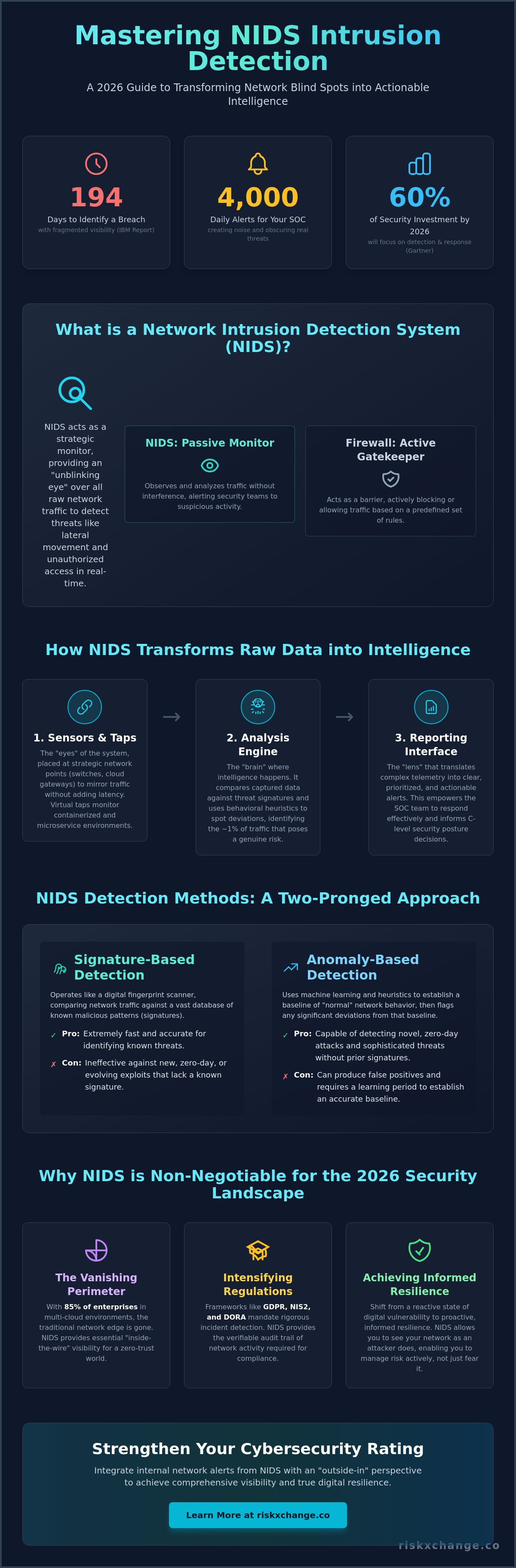
According to the 2024 IBM Cost of a Data Breach Report, organizations take an average of 194 days to identify a breach when visibility is fragmented. This delay often results from gaps in encrypted traffic and the 4,000 alerts your security operations center receives daily. You likely agree that a reactive stance is no longer viable when Gartner predicts that 60% of security investments will focus on detection and response by 2026. It's a challenge that requires moving from a state of uncertainty to one of proactive control. This article promises to help you master nids intrusion detection and integrate it into a modern, visibility-driven security posture that strengthens your Cybersecurity Rating.
We'll provide a clear roadmap for identifying the best placement for sensors and scaling your defenses across complex cloud environments. You'll learn the critical differences between NIDS and other IDS types, ensuring your team can distinguish between genuine threats and background noise. By aligning your network data with broader risk management goals for 2026, you can transform your perimeter from a potential blind spot into a source of actionable intelligence. This transition ensures you're viewing your network from the same perspective as an attacker, allowing you to close gaps before they're exploited.
What is NIDS? The Role of Network Intrusion Detection in 2026
A Network Intrusion Detection System (NIDS) functions as a strategic monitor for raw network traffic across an organization's digital footprint. It doesn't just sit at the edge; it observes the entire flow of data packets to identify patterns that signal lateral movement or unauthorized access attempts. While traditional security tools focus on the point of entry, nids intrusion detection provides a comprehensive view of what's happening inside the wire. It captures and analyzes traffic in real-time, ensuring that even if a threat actor bypasses external controls, their internal footprint remains visible.
The distinction between a NIDS and a traditional firewall is fundamental to a proactive security posture. Firewalls act as active gatekeepers, blocking or allowing traffic based on predefined rules. In contrast, a NIDS provides passive monitoring. It doesn't slow down the flow of business; instead, it acts as a sophisticated sensor that alerts security teams to anomalies. This distinction is critical for maintaining an Intrusion Detection System (IDS) as a cornerstone of the "Defense in Depth" philosophy. By 2026, relying solely on a "hard shell" perimeter is no longer sufficient. Organizations must assume a breach is possible and deploy NIDS to eliminate the blind spots where attackers hide.
The Core Components of a NIDS Architecture
Understanding how a NIDS operates requires a look at its three primary functional layers. These components work in tandem to transform raw electrical signals into strategic intelligence:
- Sensors and Taps: These are the eyes of the system. They're placed at strategic points, such as core switches or cloud gateways, to mirror traffic without causing latency. By 2026, virtual taps are standard for monitoring containerized environments and microservices.
- The Analysis Engine: This is the brain where the intelligence happens. It compares captured data against signature databases and uses behavioral heuristics to spot deviations from a baseline. It's designed to identify the 1% of traffic that represents a genuine risk.
- The Reporting Interface: This layer moves the process from raw data to actionable alerts. It provides the lens through which a CISO can see the company's true security posture, turning complex telemetry into clear, prioritized tasks for the SOC team.
Why Perimeter Defense is Evolving
The shift from "hard shell" security to zero-trust monitoring is a response to the increasingly porous nature of modern networks. With 85% of enterprises now operating in multi-cloud environments, the traditional perimeter has effectively vanished. NIDS is the "unblinking eye" of internal network visibility. It provides the continuous monitoring required to validate every connection, even those originating from within the trusted zone.
This evolution is also driven by a tightening regulatory landscape. In 2026, compliance isn't optional; it's a core business requirement. Frameworks like GDPR, the NIS2 Directive, and DORA (Digital Operational Resilience Act) mandate that financial and critical infrastructure entities maintain rigorous incident detection capabilities. Utilizing nids intrusion detection allows firms to meet these requirements by providing a verifiable audit trail of all network activity. This moves the conversation from a state of digital vulnerability to one of informed resilience, where risks aren't just feared, but actively managed.
How NIDS Detects Threats: Signatures vs. Anomalies
Modern nids intrusion detection systems function as a high-precision lens for your network perimeter. They translate raw, chaotic traffic into actionable intelligence by utilizing two distinct but complementary engines. To maintain a resilient security posture, decision-makers must understand how these methodologies provide the visibility needed to manage risk effectively.
Signature-Based Detection: The Speed of Certainty
Signature-based detection operates like a digital fingerprint scanner. It compares incoming packet strings against a massive database of known malicious patterns. It's the fastest way to stop established threats because it doesn't require heavy computational analysis. You can find more detail on How Intrusion Detection Systems Work to see how these databases are structured within a network hierarchy.
In 2026, the effectiveness of this method relies entirely on the frequency of database updates. Threat actors now deploy automated malware variants at a rate that demands real-time synchronization. The limitation is clear: if the signature isn't in the database, the system is blind. This makes signature-based tools vulnerable to zero-day exploits, which contributed to approximately 60% of successful breaches in 2024. Despite this, it remains a vital first line of defense for filtering out the "known bad" with 99% accuracy.
Anomaly-Based Detection: The Power of AI
Anomaly detection doesn't look for specific strings of code. Instead, it uses machine learning to establish a baseline of normal network behavior. It monitors traffic volume, protocol usage, and communication timing. If a low-level account suddenly attempts to access a sensitive database at 2 AM, the system flags the deviation immediately.
The primary objection to anomaly-based systems has always been the "noise" of false positives. However, 2026 engines have matured. They use behavioral scoring to reduce false alerts by 45% compared to 2022 standards. This ensures your security team focuses on high-risk events rather than routine network fluctuations. This proactive control allows you to identify sophisticated, "low and slow" attacks that signature-based systems would ignore.
Beyond these two methods, state-based protocol analysis adds a layer of conversational context. It tracks the state of network sessions to ensure packets follow the logical order of a protocol. If a packet arrives out of sequence, the NIDS identifies it as a potential evasion tactic. This comprehensive monitoring moves your organization from a state of vulnerability to one of informed resilience. To see where your current defenses stand, you can view your current cybersecurity rating and identify gaps in your external visibility.
NIDS vs. HIDS and IPS: Choosing the Right Defensive Layer
Choosing a security architecture requires a clear understanding of where your visibility ends and your blind spots begin. Effective nids intrusion detection serves as the primary lens for external traffic, but it's only one part of a resilient posture. Organizations must balance the broad visibility of network-based tools with the granular detail of host-based systems to maintain proactive control.
Network vs. Host-Based Monitoring
NIDS monitors the "space between" devices by analyzing traffic as it flows across the wire. In contrast, HIDS monitors the "endpoint itself," looking at internal system calls and local log files. Relying solely on one creates a dangerous gap. A 2024 analysis of breach data indicates that 45% of modern attacks involve cloud-based supply chain vulnerabilities that bypass traditional perimeter checks. You need both to catch these sophisticated supply chain attacks. NIDS identifies the lateral movement across the network, while HIDS detects unauthorized file changes on the server. This dual approach is a core component of a comprehensive [Link to Attack Surface Management guide].
A Network Intrusion Detection System excels because it operates out-of-band. It doesn't consume host resources or slow down critical applications. This makes it ideal for high-performance environments where endpoint agents might cause a 15% drop in processing speed or conflict with specialized legacy software.
Detection vs. Prevention (IDS vs. IPS)
The transition from IDS (Detection) to IPS (Prevention) introduces the "fail-closed" risk. If an active IPS incorrectly identifies legitimate traffic as a threat, it drops the packet, potentially halting a business process that generates $50,000 in revenue per hour. Security-mature organizations often prefer nids intrusion detection for high-throughput environments to avoid this latency and availability risk. They prioritize visibility over automated blocking to ensure business continuity.
NIDS provides the "data trail" necessary for forensic remediation. It records the full context of an event without interfering with the flow of data. This allows your security team to reconstruct the timeline of an incident with precision, facilitating a faster return to a secure state. It transforms a chaotic security event into a manageable data set for analysis.
Strategic Framework for Deployment
Use this framework to assign your defensive layers based on asset criticality and performance needs:
- Critical Infrastructure: Deploy both NIDS and HIDS. Visibility must be absolute to protect the core of the business.
- High-Throughput Gateways: Prioritize NIDS to maintain performance while capturing 100% of packet headers for analysis.
- Remote Endpoints: Lean on HIDS to monitor devices that rarely connect to the corporate core and operate on untrusted networks.
This methodical approach ensures that your security posture is both visible and measurable. By placing the right sensors in the right locations, you move from a state of digital vulnerability to one of informed resilience.
Deploying NIDS in Modern Hybrid and Cloud Environments
Traditional network perimeters have dissolved. As organizations migrate to hybrid architectures, the "dark space" within virtualized networks becomes a primary breeding ground for lateral movement. Static physical appliances can't see traffic moving between virtual machines or containers. Effective nids intrusion detection in 2026 requires a decentralized approach where sensors are integrated directly into the fabric of the cloud. This transition moves security from a fixed gateway to a fluid, pervasive layer of visibility.
Visibility in the Cloud: VPC Mirroring
Capturing packets in a virtual environment requires native cloud tools rather than physical hardware. AWS VPC Traffic Mirroring, Azure Virtual Network TAP, and Google Cloud Packet Mirroring provide the necessary hooks to replicate traffic from elastic network interfaces to security appliances. For Kubernetes environments, the industry has shifted toward "Sidecar" NIDS containers. These sensors sit within the same pod as the application, inspecting traffic at the source. This granular placement eliminates blind spots in east-west traffic. It also helps manage data egress costs. By filtering and analyzing traffic locally within the same availability zone, companies avoid the 20% to 30% price surge often associated with routing raw data across regional boundaries for inspection.
The Encryption Challenge
Encryption is no longer optional; it's the standard. With over 95% of web traffic now encrypted, traditional nids intrusion detection methods that rely on deep packet inspection face a significant hurdle. TLS 1.3 has effectively ended the era of simple man-in-the-middle decryption mirrors by utilizing perfect forward secrecy. To maintain oversight, modern NIDS utilize JA3 fingerprinting. This technique analyzes the unencrypted handshake parameters to identify specific client-server combinations. It allows security teams to detect a Cobalt Strike beacon or a known malware variant based on its unique "fingerprint" without ever needing to decrypt the payload. This method preserves data privacy while ensuring malicious actors can't hide behind a layer of SSL. Relying on these metadata-driven insights ensures your security posture remains proactive rather than reactive.
Strategic sensor placement is the final piece of the puzzle. Placing sensors too deep into the network increases latency, while placing them too far at the edge misses internal pivoting. A balanced deployment ensures your visibility is both comprehensive and actionable. Take control of your external attack surface and see how your infrastructure measures up by checking your cybersecurity rating with RiskXchange.
Beyond the Perimeter: Integrating NIDS with Continuous Risk Monitoring
Internal network alerts shouldn't exist in a vacuum. To achieve true resilience in 2026, nids intrusion detection must function as a primary data feed for your broader Cybersecurity Rating. While NIDS excels at identifying lateral movement and suspicious internal packets, it often lacks the external context necessary to prioritize those threats. By feeding internal detection logs into a continuous risk monitoring framework, you transform isolated technical events into quantifiable business metrics.
Automated risk management platforms bridge the gap between "noise" and "strategy." When your internal sensors flag a potential anomaly, correlating that data with third-party risk intelligence allows your team to see if the targeted asset is also exposed to known external vulnerabilities. This synthesis prevents security teams from chasing low-priority ghosts, focusing instead on the 15% of alerts that represent genuine threats to your operational continuity.
Closing the Visibility Gap
Internal detection validates what your external scans only suspect. If an external scan identifies an unpatched server, your nids intrusion detection system confirms whether that vulnerability is actively being exploited from within. This shift from reactive alerting to proactive risk posture management is essential for modern compliance. By 2026, 70% of leading enterprises will use AI-driven synthesis to translate these technical packet logs into high-level reports for the C-suite, ensuring that security investments align with actual risk reduction.
The RiskXchange Advantage
RiskXchange provides the essential "outside-in" perspective that traditional NIDS lacks. Our platform integrates diverse security signals into a single, comprehensive dashboard, giving you a 360-degree view of your digital footprint. We help you move beyond granular packet-level data to focus on business-level resilience. By identifying how attackers view your network from the outside, we empower you to strengthen your internal defenses where they matter most. It's time to stop guessing and start measuring your security success through data-driven honesty.
Take control of your attack surface with RiskXchange
Effective security is about more than just finding threats; it's about managing them with confidence. Integrating internal NIDS data with external risk monitoring ensures you aren't just reacting to the landscape, but actively shaping it. This methodical approach provides the stability and permanence your organization needs to thrive in an increasingly complex threat environment.
Take Control of Your 2026 Security Posture
The role of nids intrusion detection has transformed into a vital component of a proactive defense strategy. By 2026, the shift from simple signature-based matching to advanced anomaly detection is essential for securing modern hybrid environments. Organizations must move beyond the internal perimeter to address the full attack surface, ensuring that cloud assets and supply chain partners aren't left in the dark. Fortune 500 companies currently prioritize this real-time visibility to manage risks across global operations in London, Austin, and Dubai.
Managing a complex digital footprint requires more than just reactive tools; it demands a measurable, data-driven approach to risk. RiskXchange provides an AI-native TPRM solution that delivers the high-level strategic oversight needed to turn vulnerability into resilience. It's the most effective way to gain a comprehensive view of your security rating and eliminate the blind spots that attackers exploit. Empower your security team with the RiskXchange 360-degree risk platform and start making informed decisions today. Your path to a more secure future is clear and manageable.