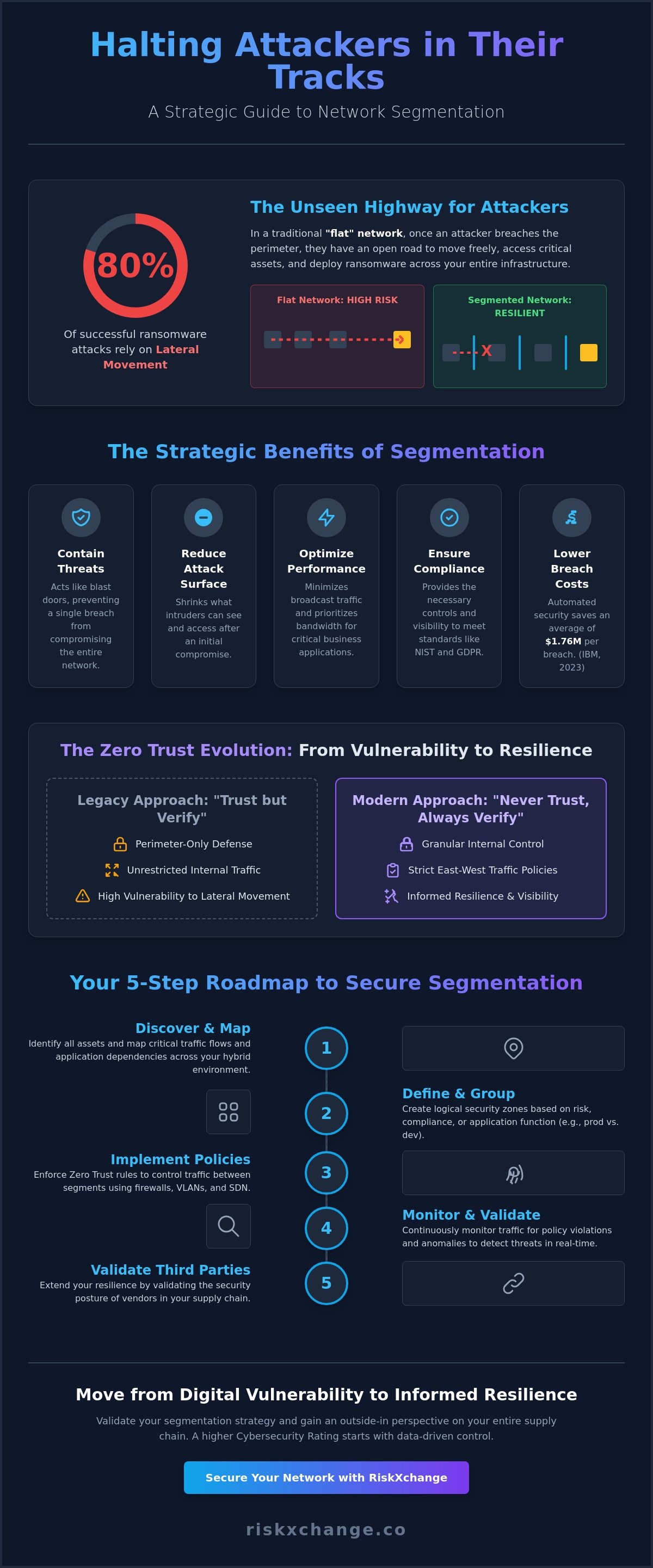
Did you know that 80% of successful ransomware attacks rely on lateral movement to reach their final target? From an attacker's outside-in perspective, a flat architecture looks like an open highway rather than a series of secure checkpoints. You're likely aware that managing granular policies across hybrid environments is becoming a logistical nightmare. It's frustrating to watch security budgets climb while your actual visibility into internal traffic remains clouded. This article provides the clarity you need to implement a strategic segmentation of network that halts attackers in their tracks.
According to IBM's 2023 Cost of a Data Breach Report, organizations with high levels of security automation saved 1.76 million dollars compared to those without. You'll learn how to shrink your attack surface and transform your infrastructure into a resilient asset that meets NIST and GDPR standards with measurable precision. We'll explore a practical roadmap for microsegmentation that reduces your blast radius and provides the quantifiable data necessary to demonstrate ROI to your board. By the end of this guide, you'll have the tools to move from a state of digital vulnerability to one of informed resilience.
What is Segmentation of Network Architecture in 2026?
The segmentation of network architecture represents a fundamental shift from open, flat environments to granularly controlled ecosystems. By 2026, this practice has evolved into a mandatory defensive layer. It involves partitioning a computer network into smaller, isolated subnetworks or zones, where each segment acts as an independent unit with its own security protocols. The primary objective is twofold: limiting the movement of malicious actors and optimizing traffic flow to ensure critical business applications maintain peak performance.
Traditional "Perimeter-Only" security models, which focused heavily on the outer boundary, proved insufficient as lateral movement became the primary tactic for 75% of sophisticated ransomware attacks according to 2024 industry data. Once an attacker bypassed the firewall, the entire internal network was vulnerable. Modern Network Segmentation functions like a system of blast doors on a submarine. If one compartment suffers a breach, the damage remains contained. This prevents a singular point of failure from compromising the entire enterprise attack surface.
The Evolution from Flat Networks to Zero Trust
The old "Trust but Verify" mindset is a relic of the past. In 2026, internal traffic is treated with the same scrutiny as external requests because trust is no longer a permanent state. This transition is the practical execution of Zero Trust Architecture (ZTA). By isolating sensitive data from guest Wi-Fi or IoT devices, organizations gain real-time visibility into every connection attempt. In the 2026 threat landscape, the blast radius is the maximum potential damage an attacker can inflict before hitting a hard segmentation barrier.
Key Technical Components: VLANs, Subnets, and SD-WAN
Achieving this level of control requires a mix of physical and logical isolation. Layer 2 isolation uses Virtual Local Area Networks (VLANs) to separate devices at the hardware level, while Layer 3 uses subnets to manage traffic via IP routing. Software-Defined Networking (SDN) now automates these processes. This allows security teams to create or dissolve segments in seconds. For global enterprises, modern SD-WAN extends these policies across the entire footprint. A remote branch in Singapore follows the same strict access rules as the primary data center in London. This methodical approach transforms your security posture into a quantifiable metric, often reflected in a higher Cybersecurity Rating. It's about moving from a state of digital vulnerability to one of informed resilience.
The Strategic Benefits: Why Segmenting the Network is Non-Negotiable
Effective security isn't about building a taller wall; it's about compartmentalizing the interior to ensure a single breach doesn't lead to total system failure. The segmentation of network infrastructure transforms a flat, vulnerable environment into a series of secure enclaves. This approach limits what an intruder can see or touch after an initial compromise, effectively shrinking the internal attack surface. By establishing clear checkpoints, security teams gain continuous monitoring capabilities that provide the visibility needed to identify anomalies before they escalate. It's a shift from a state of digital vulnerability to one of informed resilience.
Beyond security, this architecture delivers tangible operational gains. It minimizes broadcast traffic and optimizes bandwidth for critical applications, ensuring that high-demand services don't compete with routine background processes. Understanding the Benefits of Network Segmentation is essential for any leader aiming to move from a reactive posture to one of proactive control. From an outside-in perspective, a well-segmented network appears as a series of hardened targets rather than a single, soft entry point, which significantly improves your overall Cybersecurity Rating.
Stopping Lateral Movement and Ransomware Contagion
In a flat network, ransomware behaves like a wildfire in an open field. Once a single endpoint is infected, the malware moves horizontally to encrypt servers and backups. A segmented network acts as a series of firebreaks. By implementing micro-segmentation, organizations prevent "East-West" traffic from becoming a liability. This isolation ensures that if a workstation in HR is compromised, the infection cannot reach the production database or the R&D department. Data from the 2023 IBM Cost of a Data Breach Report shows that organizations with high levels of security orchestration and segmentation identify breaches 100 days faster than those without. This speed directly impacts remediation efficiency, allowing incident response teams to contain threats within a single zone while the rest of the business continues to operate.
Simplifying Compliance and Data Sovereignty
Compliance audits for frameworks like PCI-DSS, HIPAA, and GDPR are often grueling and expensive. Isolating regulated data, such as Personally Identifiable Information (PII), into dedicated zones significantly reduces the "in-scope" environment for auditors. Instead of auditing the entire enterprise, the focus shifts only to the secure zones where sensitive data resides. Industry data from compliance experts indicates that this targeted segmentation of network zones reduces audit costs by at least 30% because it simplifies the verification process. Network zones also help meet strict geographic data residency requirements by ensuring that data remains within specific physical or logical boundaries.
Managing these complex layers requires a clear view of your digital footprint. You can monitor your security posture in real-time to ensure your segmentation strategy remains effective against evolving external threats. This data-driven approach turns compliance from a yearly burden into a continuous, measurable metric of your organizational health.
Macro-segmentation vs. Microsegmentation: A Strategic Framework
Effective security starts with visibility. You can't protect what you can't see. The segmentation of network assets requires a tiered approach that balances operational simplicity with rigorous defense. RiskXchange views this through an outside-in lens, identifying how external threats perceive your internal structure. Macro-segmentation acts as the broad foundation, while microsegmentation provides the surgical precision needed for modern, distributed workloads.
Next-Generation Firewalls (NGFW) serve as the primary enforcement points for these boundaries. They inspect traffic at Layer 7, ensuring that only authorized protocols move between segments. Organizations often begin with macro-segmentation to gain immediate control over their attack surface. As maturity increases, they layer in microsegmentation to isolate individual applications. According to industry data from 2023, enterprises that implement tiered segmentation see a 65% faster response time to internal lateral movement threats.
When to Use Macro-segmentation
Macro-segmentation provides high-level isolation between broad business functions. It's the ideal starting point for securing guest Wi-Fi networks or separating HR databases from engineering environments. This approach is particularly effective for legacy infrastructure. Approximately 31% of enterprise environments still rely on legacy systems that lack the native APIs required for granular workload isolation. It offers a vital layer of protection that limits lateral movement across large internal zones, providing a clear boundary for your cybersecurity rating to stay stable.
- Broad Isolation: Separating production from development environments to prevent code leaks.
- Guest Access: Ensuring third-party or guest traffic never touches corporate assets.
- Compliance: Meeting basic regulatory requirements for data separation in audited environments.
The Power of Microsegmentation for Critical Assets
Microsegmentation moves the security perimeter to the individual workload or application level. It's essential for protecting High-Value Targets (HVT) like customer PII or proprietary codebases. By implementing identity-based policies, access is tied to the specific user or service rather than just an IP address. This level of segmentation of network components reduces the risk of a breach spreading by up to 80% compared to flat networks. The roadmap to resilience involves a steady transition from broad zones to granular, real-time workload isolation. By 2026, Gartner predicts that 60% of enterprises working toward zero trust will use multiple forms of microsegmentation to secure their cloud and on-premise hybrid environments.
Implementation Roadmap: 5 Steps to Secure Segmentation
Moving from a flat network to a resilient architecture isn't an overnight task. It's a strategic transition that replaces blind spots with actionable control. Executing a robust segmentation of network strategy requires a methodical approach that prioritizes visibility over guesswork. Organizations with mature segmentation reduced the cost of data breaches by an average of $1.76 million, according to 2023 Ponemon Institute research. Follow these five steps to build a defensive posture that scales.
- Step 1: Asset Discovery and Traffic Mapping. You can't protect what you don't track. Audit every device, application, and data flow across your environment. This creates a baseline of normal behavior.
- Step 2: Defining Security Zones. Group assets based on their risk level and business function. High-value data, like PCI or PII, should live in isolated zones with restricted access.
- Step 3: Policy Design. Create precise "Allow" and "Deny" rules. This stage defines how different segments communicate, ensuring that only authorized traffic crosses the boundaries.
- Step 4: Pilot and Testing. Validate your policies in a controlled environment. This prevents segmentation from breaking critical business workflows or causing unexpected downtime.
- Step 5: Continuous Monitoring. Security isn't static. Use real-time auditing to ensure your segments remain effective as your network evolves and new threats emerge.
Quantifying Risk through the Outside-In Perspective
External attack surface management tools view your network exactly how a threat actor does. If your segmentation is weak, an attacker sees a wide, flat target. Effective segmentation of network directly correlates to a higher Cybersecurity Rating. By isolating critical assets, you shrink the visible attack surface. RiskXchange provides the lens to monitor if your policies are actually reducing risk. It transforms abstract security goals into a tangible, trackable metric that executives can understand and act upon.
Common Implementation Pitfalls to Avoid
The "Over-Segmentation" Trap is a frequent hurdle. Creating too many micro-segments leads to administrative burnout and complex rule sets that are impossible to manage. Keep it simple and focus on high-risk areas first. Another common failure is neglecting the "Human Factor." If IT and Security teams aren't aligned on zone ownership, policies become inconsistent. Finally, don't fail to automate. Gartner reports that 60% of organizations struggle with manual rule management; automation is the only way to maintain a resilient, modern defense.
Take control of your digital footprint and see your network through the eyes of an expert. Get your free Cybersecurity Rating from RiskXchange to identify and close your most critical visibility gaps.
The RiskXchange Advantage: Validating Segmentation through TPRM
Your internal security measures are only as effective as the weakest link in your digital ecosystem. While you may have implemented a strict segmentation of network within your own perimeter, your third-party vendors often have direct pathways into your environment. If a partner lacks similar controls, they become a high-speed lane for attackers to bypass your defenses. RiskXchange provides the 360-degree visibility required to see these vulnerabilities before they're exploited, moving your Third-Party Risk Management (TPRM) from a reactive checklist to a proactive shield.
Continuous monitoring replaces the outdated annual audit. Static assessments are becoming obsolete; data from 2023 indicates that 67% of organizations suffered a breach via a third party despite those vendors passing annual compliance checks. RiskXchange shifts the paradigm by offering real-time resilience metrics. This outside-in perspective allows you to evaluate how a vendor's digital footprint appears to an attacker, ensuring that their security posture aligns with your own risk appetite.
Monitoring Third-Party Lateral Movement Risks
High-risk vendors often rely on flat network architectures. This lack of internal barriers means a single compromised credential can lead to a total breach of their systems and, potentially, yours. RiskXchange identifies these critical blind spots by analyzing the external-facing infrastructure of your partners. By leveraging attack surface management tools, you can pinpoint exactly where a vendor's lack of control might impact your perimeter. We help you identify which partners require deeper scrutiny based on their connectivity and the sensitivity of the data they handle.
- Identify vendors with high-risk open ports and services.
- Detect configuration drifts in vendor environments in real time.
- Map supply chain dependencies to visualize potential paths for lateral movement.
Taking Control of Your Cybersecurity Rating
Security isn't an abstract concept; it's a measurable business asset. You can use RiskXchange data to justify your infrastructure projects to the board with hard numbers. When you successfully implement a more granular segmentation of network, the impact is immediately visible in your risk score. This data-driven approach moves the conversation from technical jargon to tangible ROI. It allows you to demonstrate a 40% or greater reduction in lateral movement risk through architectural changes, providing the "calm confidence" decision-makers need.
Don't leave your supply chain security to chance. You can start measuring your true risk posture right now. Get your free Cybersecurity Rating today and gain the visibility you need to protect your enterprise from the outside in.
Master Your Attack Surface for 2026
Modern security requires more than just high walls; it demands a precise segmentation of network layers to isolate threats at the source. IBM's 2023 Cost of a Data Breach report found that organizations using high levels of security automation save $1.76 million per incident compared to those that don't. By adopting a granular microsegmentation framework, you effectively shrink your reachable attack surface. This ensures a single compromised asset doesn't lead to a total system failure.
RiskXchange empowers you to validate these internal defenses through an outside-in lens. Trusted by Fortune 500 enterprises, our AI-native TPRM platform operates from global hubs in London, Austin, and Dubai to provide real-time visibility. We translate complex technical data into a clear Cybersecurity Rating, giving you the same perspective an adversary uses to scout your perimeter. It's time to move from digital uncertainty to informed resilience with data you can actually use.
See how your network looks to an attacker; Get your RiskXchange Rating
You've built a world-class business. Now, let's make sure it's built to last.