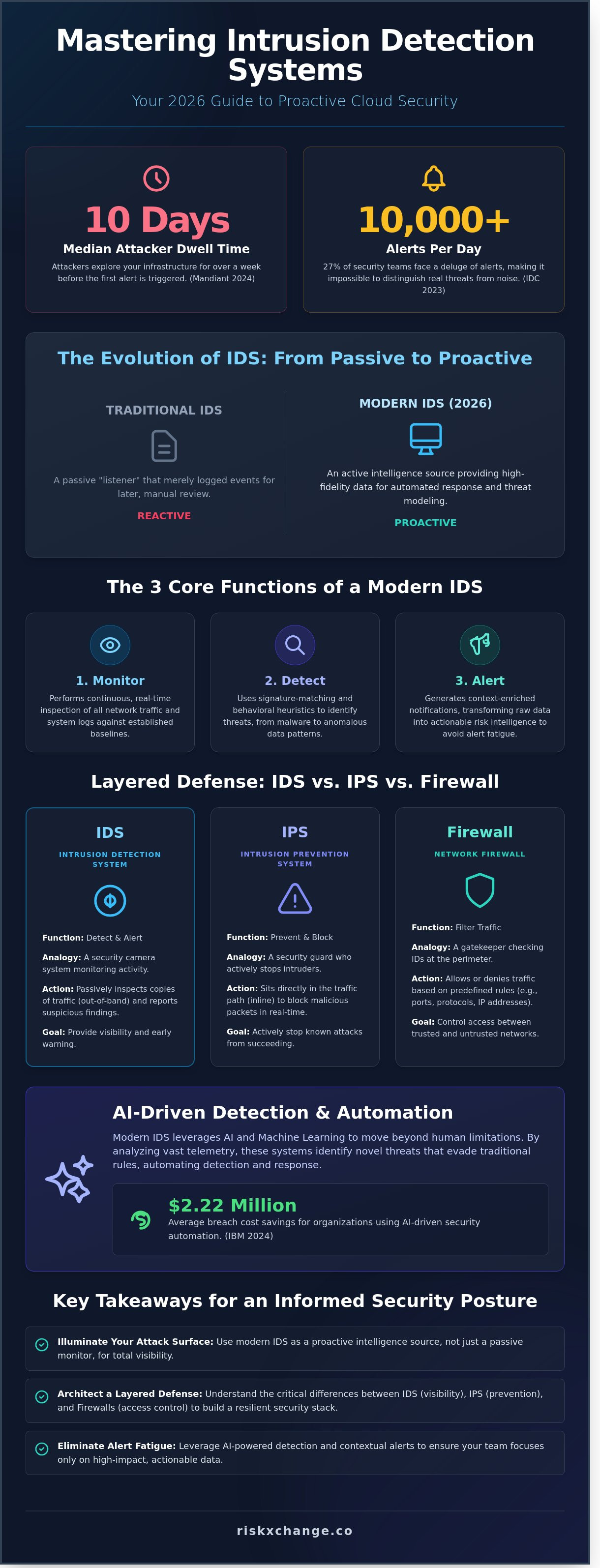
If an attacker spent 10 days exploring your cloud infrastructure before you received a single notification, would you call your security posture successful? The 2024 Mandiant M-Trends report confirms this median dwell time is the current reality, proving that intrusion detection systems often fail not because of poor code, but because of poor implementation. You're likely exhausted by the weight of alert fatigue, especially since a 2023 IDC study found that 27% of security professionals must sift through over 10,000 alerts daily. These blind spots in cloud-native environments make it difficult to distinguish a genuine threat from background noise, leaving your team reactive rather than resilient.
You deserve a security architecture that offers total visibility into your digital attack surface. This 2026 guide empowers you to master the technical foundations and strategic deployment of modern detection tools. We'll examine the specific IDS types required for hybrid environments, provide a framework for seamless integration with your SIEM, and share methods to reduce evasion risks. By the end of this article, you'll have a clear path to move from digital vulnerability to proactive, informed control.
What is an Intrusion Detection System (IDS) in 2026?
An Intrusion Detection System (IDS) is a specialized security tool designed to monitor network traffic for suspicious activity and policy violations. By 2026, these systems have moved beyond their original role as simple "passive listeners" that merely logged events for later review. Modern intrusion detection systems now function as active intelligence sources within the security stack, providing the high-fidelity data necessary to fuel automated response protocols and predictive threat modeling.
Traditionally, security leaders relied on an inside-out view that focused heavily on internal perimeter defenses. This approach often left blind spots in the expanding digital footprint. Modern risk management requires an outside-in perspective, seeing the network exactly as a motivated attacker would. By identifying vulnerabilities and unauthorized movements in real-time, an IDS helps organizations maintain a 360-degree view of their environment. This visibility directly influences a company's Cybersecurity Rating, transforming security from a vague concept into a measurable, trackable metric of corporate health.
The Role of IDS in Modern Attack Surface Management
Visibility is the fundamental first step toward informed resilience. You can't protect what you can't see. In the context of attack surface management, intrusion detection systems provide critical oversight into unauthorized access attempts across the entire perimeter. Gartner reported in late 2024 that 70% of successful breaches targeted unmanaged or poorly monitored assets; an IDS closes these gaps by providing continuous monitoring of every packet entering or leaving the network.
Establishing a proactive security posture means moving away from reactive firefighting. Instead of waiting for a system failure or a data leak to occur, security teams use IDS data to identify the reconnaissance phase of an attack. This early detection allows for strategic intervention before a minor unauthorized access attempt escalates into a catastrophic breach. It's about taking control of the narrative rather than being a victim of it.
Core Functions: Monitor, Detect, and Alert
An effective IDS operates through a disciplined three-step cycle that ensures no anomaly goes unnoticed. This methodical progression is what allows a business to maintain stability in a volatile threat landscape. The cycle includes:
- Monitor: The system performs continuous, real-time inspection of network traffic and system logs, looking for patterns that deviate from established baselines.
- Detect: Using a combination of signature-based matching and behavioral heuristics, the system identifies potential threats, ranging from known malware signatures to unusual data exfiltration patterns.
- Alert: Once a threat is identified, the system generates a notification. In a sophisticated 2026 stack, these alerts aren't just raw data; they're enriched with context to provide actionable risk intelligence.
The transition from raw data to intelligence is where the true value lies. Rather than drowning in a sea of false positives, modern systems filter noise to highlight legitimate risks that require immediate human or automated intervention. An IDS serves as the early warning system of the digital enterprise.
How Intrusion Detection Systems Work: Detection Mechanics
Modern intrusion detection systems operate as the high-definition lens of your security stack. By 2026, detection mechanics have moved beyond simple header checks to comprehensive protocol analysis and deep packet inspection. These systems scrutinize the actual payload of data packets to ensure they align with expected behaviors. This process safeguards data integrity; it confirms that information remains unaltered and confidential as it traverses the network. By analyzing traffic at speeds now exceeding 100 Gbps, these tools eliminate the blind spots that attackers traditionally exploit.
The heavy lifting of rule-writing has shifted from human analysts to machine learning algorithms. IBM’s 2024 research highlighted that organizations using AI-driven security automation saved an average of $2.22 million in breach costs. These models ingest vast quantities of telemetry to identify patterns that escape the human eye. This automation doesn't just speed up response times; it provides a proactive layer of control that scales with your infrastructure. You can gain a clearer perspective on your external vulnerabilities by reviewing your cybersecurity rating to see how these mechanics impact your overall posture.
Effective detection relies on maintaining a rigorous standard of data confidentiality. When an IDS monitors encrypted traffic, it must do so without compromising the privacy of the underlying information. Advanced 2026-era systems utilize encrypted traffic analytics to spot threats within HTTPS or TLS flows without requiring full decryption, preserving the balance between high-level oversight and granular privacy standards.
Signature-Based vs. Anomaly-Based Detection
Signature-based detection acts as a digital fingerprinting service. It compares incoming traffic against a database of known threats, such as specific malware strings or exploit patterns. While highly reliable for blocking established attacks, it's blind to brand-new threats. Anomaly-based detection solves this by establishing a baseline of normal network behavior. When a user suddenly accesses 500 sensitive files at 3:00 AM, the system flags the deviation. This dual-layered approach ensures you're protected against both yesterday's viruses and tomorrow's zero-day exploits.
NIDS, HIDS, and Hybrid Architectures
Network Intrusion Detection Systems (NIDS) monitor the flow between devices, acting as a perimeter watchtower. Host Intrusion Detection Systems (HIDS) reside on specific endpoints or servers, monitoring internal system calls and file changes. Currently, 75% of enterprises have transitioned to hybrid architectures. This unified model bridges the gap between on-premises hardware and cloud environments. It provides a seamless view of the entire attack surface, ensuring that no movement goes unnoticed regardless of where the data lives.
IDS vs. IPS vs. Firewalls: Understanding the Differences
Effective network security isn't about choosing one tool; it's about orchestrating a layered defense. Think of your firewall as the perimeter gatekeeper and your intrusion detection systems as the internal motion sensors. While a firewall filters traffic based on predefined rules, it often misses sophisticated lateral movement. Within a SIEM framework, these tools sync to provide a unified view of your risk posture. IDS acts as the eyes of your defense, while an IPS serves as the hands, capable of reaching out to stop a threat in real time.
Comparing IDS and Firewalls
Firewalls function as the first line of defense, blocking or allowing traffic based on IP addresses and ports. They're gatekeepers designed for prevention. However, they're largely blind to what happens once a user is "inside." Industry data from 2024 shows that 74% of all data breaches involved the human element, including social engineering or stolen credentials. These authorized entries bypass firewalls entirely. This is where intrusion detection systems provide critical visibility. They monitor internal traffic patterns to spot anomalies that signal a breach. Maintaining both is a strict requirement for compliance standards like PCI-DSS 4.0 and GDPR, which mandate continuous monitoring of network activity to protect sensitive data from internal and external actors.
The Evolution into Intrusion Prevention Systems (IPS)
The transition from IDS to IPS marks the shift from passive observation to active intervention. An IPS doesn't just flag a suspicious packet; it drops it. It can reset connections or block traffic from malicious sources instantly. While this speed is vital, it comes with a trade-off in network latency. High-traffic environments often utilize passive IDS for deep analysis to avoid bottlenecks that can disrupt operations. Integrating this detection data into your Cybersecurity Rating is a strategic move. It transforms raw alerts into a quantifiable metric of resilience. By 2026, firms using automated prevention tools reduced their mean time to contain (MTTC) breaches by 30% compared to those relying on manual alerts. This proactive control ensures your security posture remains robust against an evolving attack surface.
- Firewalls: Control access at the perimeter based on static rules.
- IDS: Provides deep visibility and alerts on suspicious internal behavior.
- IPS: Executes real-time responses to block identified threats.
- SIEM: Aggregates data from all three to provide a comprehensive security narrative.
By understanding these roles, you move from a state of digital vulnerability to one of informed resilience. You're no longer just hoping the gate holds; you're actively monitoring the entire estate from the outside-in.
Overcoming Evasion Tactics and Implementation Challenges
Sophisticated adversaries treat intrusion detection systems as obstacles to be dismantled or bypassed rather than absolute barriers. They aim to "blind" your sensors, creating gaps in visibility that allow them to move laterally through the network. According to the 2024 Mandiant M-Trends report, the median global dwell time for attackers is 10 days; often, this window exists because initial detection layers were successfully evaded. Maintaining control requires a shift from passive monitoring to proactive, data-driven resilience.
Alert fatigue remains a primary hurdle for security operations centers. A 2023 study by IDC revealed that security teams fail to investigate 27% of alerts due to sheer volume. This noise often stems from poorly tuned rules or a lack of environmental context. Strategic sensor placement is the solution. You must position sensors at critical chokepoints, such as between VLANs or at the cloud egress point, to maximize visibility without introducing network latency. Continuous tuning ensures your detection rules evolve alongside the threat landscape.
Common IDS Evasion Techniques
Fragmentation is a classic tactic where attackers break a malicious payload into small packets. If the IDS isn't configured to reassemble these fragments before inspection, the attack slips through unnoticed. Pattern evasion involves modifying exploit code, such as changing a single byte in a signature, to bypass matches. Encryption presents the most significant challenge in 2026. With over 95% of web traffic now encrypted, attackers hide malicious commands within SSL/TLS tunnels. Organizations must implement selective decryption or advanced traffic pattern analysis to regain visibility into these hidden threats.
Best Practices for Effective Implementation
Successful implementation starts with a rigorous 30-day baseline period. During this "learning" phase, you identify the unique heartbeat of your network. This data allows you to distinguish between legitimate administrative tools and unauthorized intrusions. Integrating intrusion detection systems with Attack Surface Management tools provides the necessary "outside-in" perspective. It allows you to see your vulnerabilities exactly how a motivated attacker sees them.
- Filter non-critical violations: Stop alerting on policy-based issues that don't represent a security risk, such as outdated but authorized software versions.
- Automate rule updates: Use real-time threat intelligence feeds to ensure your signatures are never more than 24 hours behind emerging exploits.
- Contextualize alerts: Map detections to your specific digital footprint to prioritize high-value assets.
Effective security isn't about reacting to every ping; it's about managing measurable risk. You can start taking control of your external visibility by monitoring your Cybersecurity Rating to identify where your defenses are most vulnerable.
Beyond the Perimeter: IDS and Third-Party Risk Management
Internal network security no longer stops at your physical or virtual firewalls. By 2026, Gartner predicts that 60% of organizations will use cybersecurity risk as a primary determinant when conducting third-party transactions. Your intrusion detection systems (IDS) provide the critical data needed to anchor these external relationships. When you maintain a granular view of your own network traffic, you gain the technical authority to set rigorous security standards for your vendors. This data ensures that a partner's vulnerability doesn't become your entry point.
The transition from reactive alerting to proactive risk management requires a shift in perspective. Most legacy frameworks wait for a breach to occur before analyzing the supply chain. A modern strategy uses internal IDS insights to identify patterns of unauthorized access that may originate from third-party integrations. This approach allows you to manage risk at the source. You aren't just defending a perimeter; you're orchestrating a secure ecosystem where every connection is validated against your established baseline of normal behavior.
The Outside-In Perspective on Intrusion Risk
Potential attackers view your network as a collection of entry points rather than a cohesive organization. They scan for exposed assets, unpatched vulnerabilities, and weak links in your digital footprint. RiskXchange adopts this "outside-in" perspective to help you see what the adversary sees. By combining these external findings with data from your intrusion detection systems, you can generate a precise Cybersecurity Rating. This rating is not an abstract concept. It is a tangible, trackable metric that reflects your real-time security posture.
- Identify hidden vulnerabilities before attackers exploit them.
- Benchmark your security performance against industry peers using data-driven scores.
- Provide decision-makers with actionable intelligence that justifies security spend.
- Reduce insurance premiums by demonstrating a lower risk profile through continuous monitoring.
This quantifiable approach moves the conversation away from technical jargon and toward business resilience. When a Cybersecurity Rating drops, it serves as an immediate signal to investigate specific segments of the network or particular vendor access points.
Taking Control with RiskXchange
RiskXchange leverages advanced AI to provide continuous monitoring across your entire supply chain. While traditional tools leave companies with 40% visibility gaps in their vendor ecosystem, RiskXchange closes these "blind spots" by unifying disparate data points into a single lens. We replace the uncertainty of annual audits with real-time visibility. This allows your team to move from a state of digital vulnerability to one of informed resilience. You gain the power to identify, measure, and manage threats before they escalate into breaches.
See how RiskXchange transforms your attack surface visibility
Take Control of Your Digital Attack Surface
Navigating the 2026 threat landscape requires more than just reactive defenses. You've seen how modern intrusion detection systems have evolved to counter sophisticated evasion tactics that bypass traditional firewalls. Industry data from Gartner indicates that 60% of organizations will prioritize cybersecurity risk as a primary factor in third-party transactions by 2025. This shift means your internal visibility must extend beyond the perimeter to encompass your entire supply chain. Achieving a resilient posture depends on your ability to distinguish between detection and prevention while maintaining a 360-degree view of every vulnerability.
RiskXchange provides the clarity you need through our AI-native TPRM platform. We replace uncertainty with actionable data by offering continuous real-time risk monitoring and comprehensive 360-degree attack surface analysis. You don't have to manage these complexities in the dark. Our platform transforms abstract threats into a quantifiable Cybersecurity Rating, giving you the power to see exactly what attackers see. Book a demo to see your Cybersecurity Rating in real-time and start building a foundation of informed resilience today. You're ready to move from digital vulnerability to proactive control.