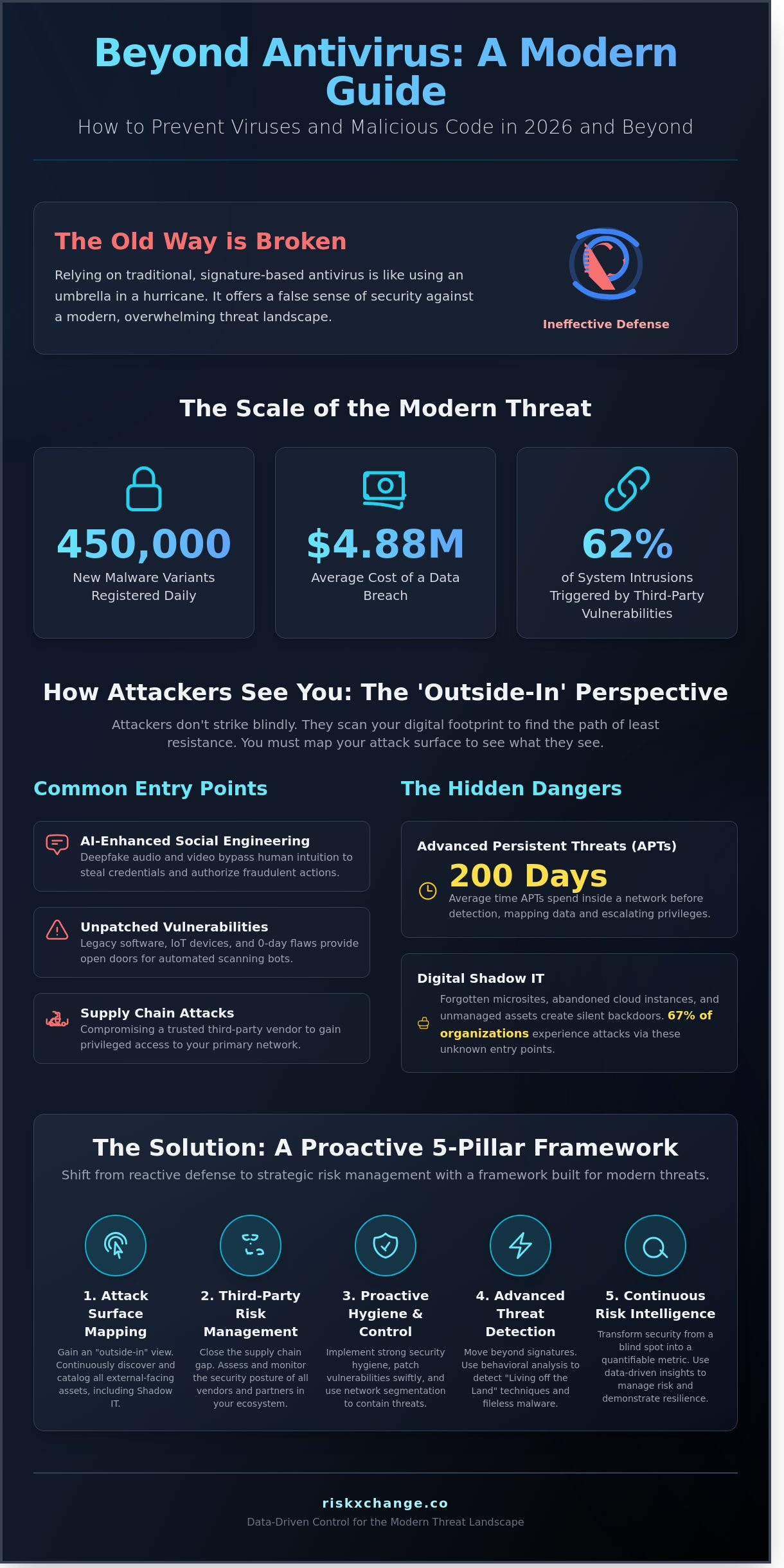
Your traditional antivirus software is likely the least critical component of your 2026 security strategy. With 450,000 new malware variants registered daily by the AV-TEST Institute, relying on signature-based tools is like using an umbrella in a hurricane. You likely feel the pressure of securing an expanding attack surface while trying to explain to the board why "invisible" prevention requires such consistent investment. If you're asking how can you prevent viruses and malicious code effectively, the answer lies in moving from reactive defense to strategic risk management.
It's frustrating when you lack visibility into the third-party vulnerabilities that trigger 62% of modern system intrusions according to recent industry breach reports. We'll help you move beyond basic tools to a professional, risk-based framework that treats security as a measurable asset rather than a technical hurdle. This article provides a clear roadmap to reduce supply chain risk and use your Cybersecurity Rating to demonstrate tangible progress to stakeholders. We'll examine how continuous monitoring transforms your security posture from a dangerous blind spot into a position of absolute, data-driven control.
What Are Viruses and Malicious Code in the Modern Era?
By 2026, the traditional definition of a Computer virus has become a small subset of a much broader, more lethal category: malicious code. We've moved past simple self-replicating files into an era of fileless malware and ransomware that executes directly in system memory. This evolution means your attack surface isn't just your hardware; it's every digital interaction within your ecosystem. Understanding how can you prevent viruses and malicious code requires moving past the 2010s mindset of "don't click that link" to a 2026 strategy of continuous monitoring and visibility.
Threat actors now use automated ecosystem scanning to find entry points. They don't target individuals; they target vulnerabilities in the global supply chain. In 2024, IBM reported the average cost of a data breach reached $4.88 million, driven by operational downtime and long-term reputational damage. Prevention isn't a luxury. It's a survival requirement. Effective risk management starts with an outside-in perspective, seeing your network exactly as an attacker does to identify blind spots before they're exploited.
Common Vectors for Malicious Code
Phishing remains the primary entry point, but it's now AI-enhanced to bypass human intuition. Legacy software and unpatched IoT devices provide open doors for automated bots. We also see a rise in "Living off the Land" (LotL) techniques. These attacks use legitimate system tools like PowerShell to execute commands, making them invisible to traditional scanners that only look for known malicious files. These methods allow attackers to blend into your daily operations, making detection nearly impossible without sophisticated behavioral analysis.
- Social Engineering: Highly personalized deepfake audio or video used to steal credentials.
- Unpatched Vulnerabilities: Exploiting 0-day flaws in firmware and legacy applications.
- Supply Chain Attacks: Compromising a third-party vendor to gain access to your primary network.
The Shift from Viruses to Advanced Persistent Threats (APTs)
Modern malicious code doesn't just crash a computer; it lingers. These Advanced Persistent Threats (APTs) spend an average of 200 days inside a network before detection, escalating privileges and mapping sensitive data. Automated bots identify entry points, while human operators lead the final phase of the attack. Simply "cleaning" an infected machine is insufficient because the breach indicates a systemic failure. You must shift to a proactive stance that prioritizes your Cybersecurity Rating as a trackable metric of health. This allows you to understand how can you prevent viruses and malicious code by maintaining a hard target profile that discourages automated scanning and human-led infiltration alike.
The 'Outside-In' Perspective: Mapping Your Attack Surface
Attackers begin every campaign with a reconnaissance phase. They don't strike blindly; they scan your perimeter to find the path of least resistance. To understand how can you prevent viruses and malicious code, you must first adopt an "outside-in" view of your infrastructure. Your attack surface includes every public-facing IP, domain, and cloud service. Visibility is the foundation of resilience. Without a clear map, you're defending blind spots that you don't even know exist. In 2023, IBM reported that the average cost of a data breach reached $4.45 million, often starting with an unpatched external vulnerability. Effective prevention requires moving from guesswork to actionable intelligence through precise, continuous mapping.
Identifying Digital Shadow IT
Shadow IT creates silent risks that bypass traditional security perimeters. Marketing teams might spin up a microsite for a temporary campaign and then forget it. These abandoned domains and subdomains often lack modern security controls and become prime targets. Malicious code exploits these unmonitored assets to gain a foothold in your network. A 2023 survey found that 67% of organizations experienced a cyberattack via an unknown or unmanaged asset. You need to catalog all external-facing assets to regain control. Use automated discovery tools to find "forgotten" cloud instances before they become entry points. CISA provides essential guidance on Protecting Against Malicious Code, emphasizing that identifying these vulnerabilities is a critical first step in a modern defense strategy.
Continuous Monitoring vs. Point-in-Time Assessments
Annual audits are insufficient for preventing rapidly evolving code. A server configured correctly on Monday can be vulnerable by Tuesday due to a new zero-day exploit. Real-time security ratings offer a quantifiable metric for your defensive posture. These ratings allow you to track your risk level as it fluctuates based on live data. Outside-in scanning identifies vulnerabilities like open ports or expired SSL certificates as they appear. This proactive control ensures you find the gaps before an adversary does. By maintaining continuous visibility, you transform security from a static checklist into a dynamic, responsive defense. This strategy is vital for anyone asking how can you prevent viruses and malicious code in a landscape where threats emerge every hour. Use these insights to prioritize remediation efforts based on the actual risk they pose to your business continuity.
- Visibility: Know every asset you own.
- Intelligence: Understand how attackers see those assets.
- Agility: Fix vulnerabilities in real-time, not once a year.
Why Endpoint Security Isn't Enough: The Third-Party Risk Gap
The traditional digital perimeter has dissolved. While many organizations invest heavily in internal defenses, 62% of system intrusion incidents now originate through the supply chain. You can't rely on endpoint security alone when malicious code arrives via a trusted partner's signed update. This "outside-in" vulnerability means your security posture is only as robust as the least secure vendor in your ecosystem. Identifying how can you prevent viruses and malicious code requires looking far beyond your own servers and into the digital hygiene of every connected entity.
Traditional antivirus tools often fail against supply chain attacks because the payload is delivered through legitimate, high-reputation channels. The 2020 SolarWinds breach remains a definitive lesson in this failure. Attackers compromised a software build system to distribute malware to 18,000 customers globally. Because the code was signed by a trusted certificate, standard defenses let it through. To effectively Prevent Viruses and Malicious Code in Companies, leaders must acknowledge that a "trusted" source is often the most dangerous blind spot in a modern network.
The Domino Effect of Supply Chain Malicious Code
A single compromised vendor creates a cascading failure across the global economy. In 2023, the MOVEit transfer exploit affected over 2,700 organizations, proving that one vulnerability can jeopardize millions of records across unrelated industries. Manual vendor questionnaires are no longer sufficient. They provide a static snapshot that's often outdated within 24 hours. When malicious code is embedded in a routine software update, it bypasses standard filters because the system views the source as verified. This makes it nearly impossible for legacy tools to identify the threat before execution, turning a partner's mistake into your primary risk.
Closing the Third-Party Security Gap
Organizations must transition to continuous third-party risk management (TPRM). This involves shifting from periodic audits to real-time visibility. By utilizing a Cybersecurity Rating, you can monitor the security hygiene of your entire ecosystem daily. This proactive control allows you to see risks before they manifest as breaches.
- Implement real-time monitoring: Track vendor digital footprints to identify vulnerabilities as they emerge.
- Standardize security requirements: Establish mandatory, non-negotiable security benchmarks for all tier-one and tier-two partners.
- Automate risk alerts: Use automated platforms to detect sudden shifts in a partner's risk profile or patch management speed.
When you understand how can you prevent viruses and malicious code across your entire network, you move from reactive defense to proactive resilience. This strategic oversight ensures that a breach at a partner doesn't become a crisis for your brand. It's about taking control of your extended attack surface to ensure total visibility.
A 5-Pillar Framework to Prevent Malicious Code
Building a resilient defense isn't about deploying a single tool; it's about establishing a multi-layered architecture that removes the element of surprise. To answer the question of how can you prevent viruses and malicious code, you must shift from a reactive posture to a proactive framework. This strategy relies on five critical pillars that transform your security from a series of blind spots into a visible, manageable ecosystem.
- Hygiene and Patch Management: This eliminates the low-hanging fruit by ensuring known vulnerabilities are closed before they're exploited.
- Network Segmentation: This architecture contains the spread of code once it enters, preventing a single point of failure from becoming a total system compromise.
- Identity and Access Management (IAM): By enforcing the principle of least privilege, you ensure that even if a user is compromised, the attacker's reach is strictly limited.
- Attack Surface Management (ASM): You cannot protect what you cannot see. ASM provides continuous visibility into your external risks from an attacker's perspective.
- Third-Party Risk Management (TPRM): Securing the supply chain is vital, as entry points often exist within the digital footprints of your vendors.
Hardening Your Internal Environment
Automating the patch lifecycle is the most effective way to reduce your window of exposure. According to data from the Ponemon Institute, 57% of cyberattack victims reported that their breaches could have been prevented by installing a patch that was already available. By removing manual intervention, you ensure that critical updates are applied within hours rather than weeks. Implementing Multi-Factor Authentication (MFA) further secures the interior; the 2023 Verizon Data Breach Investigations Report (DBIR) notes that 74% of all breaches include a human element, often involving stolen credentials that MFA would neutralize. Network segmentation acts as a containment strategy by isolating compromised systems to prevent the lateral movement of malicious code across the broader corporate infrastructure.
Securing the External Ecosystem
Your security posture doesn't end at your firewall. Integrating real-time security ratings into your procurement and vendor management workflows allows you to quantify the risk posed by third parties before they're integrated into your network. In 2023, 62% of system intrusion incidents originated through a partner or supply chain link, making external visibility a requirement for survival. Using automated tools to monitor for data leaks and exposed credentials on the dark web gives you the chance to rotate keys before they're used in an active campaign. Finally, you must develop a clear incident response plan that includes specific protocols for third-party notification, ensuring that a breach at a vendor doesn't become a silent gateway into your own data environment.
Proactive control starts with visibility. Get your free Cybersecurity Rating from RiskXchange to see exactly how your external attack surface appears to potential threats.
Taking Control with RiskXchange: Continuous Risk Intelligence
Effective defense requires a shift from internal patching to a comprehensive, 360-degree view of your digital risk posture. RiskXchange provides this clarity by adopting an outside-in perspective, mirroring exactly how an attacker views your organization. This visibility is central to answering the question of how can you prevent viruses and malicious code in a landscape where threats evolve daily. By leveraging AI-native Third-Party Risk Management (TPRM), we automate the identification and prevention of threats emerging from your supply chain, a vector responsible for 62% of system intrusions according to recent industry benchmarks.
We move your security strategy from abstract fear to quantifiable metrics. Our platform translates complex vulnerabilities into easy-to-understand cybersecurity ratings. This data empowers CISOs to drive proactive security decisions, replacing guesswork with actionable intelligence. You gain the ability to see your true security posture at any moment, ensuring that your defense is as dynamic as the threats you face. It's about transforming your attack surface from a liability into a managed asset.
Real-Time Monitoring and Actionable Alerts
Continuous scanning is the only way to identify malicious code vectors before they can be exploited. RiskXchange monitors your attack surface 24/7, providing real-time alerts that allow for immediate intervention. We help you prioritize remediation efforts based on actual risk impact, focusing your resources where they matter most. This approach ensures you're managing compliance across your entire supply chain without the manual overhead of traditional assessments. Key benefits include:
- Instant identification of misconfigurations and exposed assets that invite malicious code.
- Automated vendor risk assessments that scale with your business growth.
- Clear pathways to remediation that directly improve your overall security rating.
The Path to Digital Resilience
The goal is to move from reactive firefighting to a state of informed resilience. In the 2026 threat environment, a verifiable, high-security rating serves as a powerful business differentiator. It builds trust with stakeholders and proves that your organization has mastered how can you prevent viruses and malicious code through disciplined, data-driven management. Taking control of your digital footprint isn't just about security; it's about business continuity and protecting your reputation. RiskXchange provides the lens through which you can finally see, and solve, your most pressing risks.
Request a demo to see how RiskXchange can secure your attack surface and transform your approach to risk management.
Take Command of Your Digital Footprint
The cybersecurity landscape of 2026 requires a fundamental shift from reactive patching to proactive, strategic oversight. Relying solely on internal endpoint security misses the mark, especially since 2024 industry data indicates that over 50% of security incidents originate within the supply chain. By adopting an outside-in perspective and the 5-pillar framework, you transform your defense from a static wall into a dynamic, measurable shield. This strategy is the definitive answer to how can you prevent viruses and malicious code while maintaining operational speed.
RiskXchange serves as your elite guardian in this volatile environment. As a Fortune 500 trusted partner, we provide AI-native continuous monitoring that tracks over 1,000 unique data points across your entire ecosystem. Our platform delivers 360-degree supply chain visibility, ensuring that your cybersecurity rating remains high even as external threats evolve. We turn blind spots into actionable intelligence, allowing you to manage risk with the quiet confidence of an expert. Don't let hidden vulnerabilities dictate your strategy; it's time to move from digital vulnerability to informed resilience.
Take control of your attack surface with RiskXchange and secure your organization's future with precision. You've got the framework; now get the visibility you deserve.