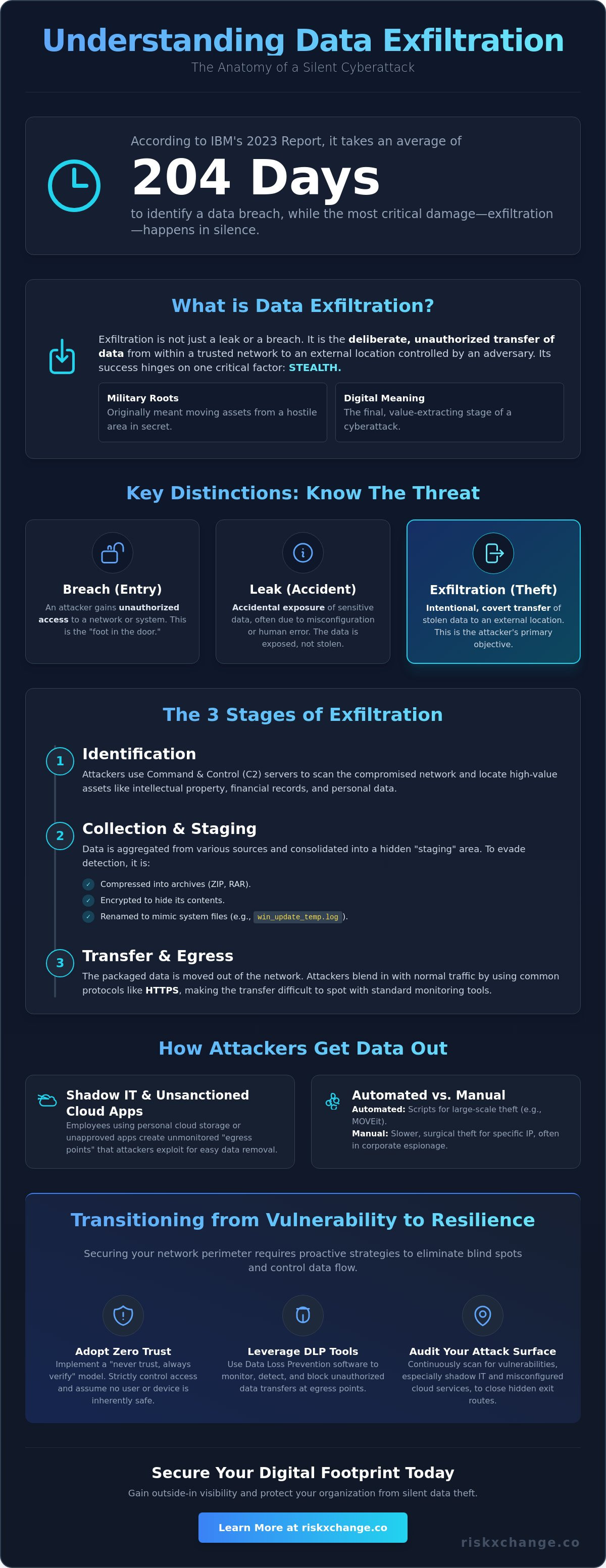
According to IBM’s 2023 Cost of a Data Breach Report, it takes an average of 204 days to identify a breach, yet the most critical damage occurs during the final, often silent phase of the attack. While many teams focus on the initial intrusion, the actual loss of value happens when attackers successfully move sensitive assets outside your control. To build a resilient defense, you must accurately define exfiltrate within your security framework. It isn't just a synonym for a leak or a breach; it's a deliberate, unauthorized transfer of data from within your network to an external location. Understanding this distinction is the first step toward gaining the outside-in visibility required to protect your attack surface effectively.
You likely recognize that keeping pace with sophisticated actors requires more than just reactive patching. It's frustrating when stakeholders conflate a simple data leak with a coordinated exfiltration event, as the latter demands a much more complex response. This guide will help you master the technical definition of exfiltration and teach you how to identify, prevent, and mitigate this critical stage of a cyberattack. We'll examine the full exfiltration lifecycle and provide the actionable strategies you need to eliminate blind spots and secure your digital footprint.
Defining Exfiltrate: From Military Roots to Digital Stealth
To define exfiltrate in a modern context, we must first look at its origins in military intelligence. Traditionally, the term described the act of moving personnel or sensitive assets out of a hostile area under a cloak of secrecy. It was a staple of Cold War era operations, where the goal was to extract value without alerting the opposition. This same principle now governs the most damaging cyber incidents currently facing global enterprises.
Data exfiltration is the unauthorized transfer of information from a device or network to an external location controlled by an adversary. Unlike ransomware or denial-of-service attacks that prioritize immediate disruption, exfiltration relies entirely on stealth. If the victim notices the data leaving, the operation has failed. This focus on "digital quiet" is why 2023 reports from IBM show that it takes an average of 204 days for organizations to even identify a breach. The goal is possession, not destruction.
The Etymology of a Security Threat
The word itself reveals the mechanics of the crime. It combines the Latin prefix "ex" (meaning "out") with "filtrate" (to pass through a filter). This implies a controlled, often granular movement of data through existing security layers. While infiltration is the act of a threat actor gaining access to your environment, exfiltration is the act of reaping the rewards. Exfiltration represents the final, successful stage of a data-focused cyberattack where the adversary’s objective is fully realized.
Why the Term Matters to Modern CISOs
For a Chief Information Security Officer (CISO), precision in language is vital for effective incident response and forensic reporting. We use the term because it describes a specific movement of data across the network perimeter, often referred to as "unauthorized egress." This technical clarity allows security teams to map the exact path an attacker took to bypass egress filters and firewall rules. It provides a measurable metric for the "outside-in" perspective of a company's risk posture.
The term also carries significant legal weight. Under frameworks like the GDPR or CCPA, the distinction between a general security incident and verified data exfiltration can dictate the severity of regulatory fines. In 2022, the SEC began requiring companies to disclose material cybersecurity incidents within four business days. Being able to define exfiltrate and identify its occurrence quickly is now a matter of corporate compliance. It shifts the conversation from a vague sense of "theft" to a specific, forensic breach of the digital perimeter that requires immediate, transparent action.
The Mechanics of Data Exfiltration: How it Happens
To accurately define exfiltrate in a modern security context, you must view it as a disciplined three-stage operation: identification, collection, and transfer. Attackers don't simply stumble upon data and pull it out; they execute a methodical plan to ensure the theft remains undetected. This process is orchestrated by Command and Control (C2) servers. These remote systems act as the brain of the operation, sending encrypted instructions to malware inside your network to coordinate the final exit of sensitive assets.
The distinction between manual and automated exfiltration is critical for risk assessment. In 2023, automated scripts became the preferred choice for large-scale breaches, such as the MOVEit transfer attacks, where data was vacuumed up at machine speed. Manual exfiltration is slower and more surgical; it's typically used in corporate espionage where an actor hand-picks specific intellectual property. Regardless of the method, the goal is to bypass the perimeter without triggering a single alert.
Data Staging and Compression
Before any data leaves the building, attackers perform staging. This involves aggregating disparate files into a single, encrypted archive like a ZIP or RAR file. Staging often occurs in hidden directories or obscure cloud storage buckets that appear legitimate to the casual observer. To further evade detection, files are frequently renamed to mimic system logs or software updates, such as win_update_temp.log. This camouflage is designed to hide the volume of data being moved from standard monitoring tools.
Protocols Used for the "Stealthy Exit"
Stealth is achieved by blending in with the noise of daily operations. Most attackers prefer HTTPS because it encrypts the data in transit and looks exactly like standard web traffic. However, more sophisticated actors utilize DNS tunneling. This method breaks data into small chunks and hides them within DNS queries, which many traditional firewalls allow through without inspection. According to academic research on exfiltration methods, these techniques allow for "low and slow" leaks that can persist for months without being noticed.
Other protocols like FTP, SFTP, and even ICMP (ping) are used when volume is less important than persistence. By understanding these mechanics, you move from a state of vulnerability to one of informed control. Gaining comprehensive visibility into your external attack surface allows you to spot these anomalies before the transfer phase is complete. This proactive stance is what separates resilient organizations from those that only react after the damage is done. It's about seeing the threat before it becomes a headline.
Exfiltration vs. Breach vs. Leak: Understanding the Nuances
To secure a modern digital perimeter, security leaders must distinguish between terms that are often used interchangeably. A data breach is the initial point of entry. It represents the moment an unauthorized party bypasses security controls to gain access to a private environment. In contrast, you should define exfiltrate as the specific act of moving data out of that environment. While every instance of exfiltration follows a breach, not every breach results in exfiltration. Some attackers enter a system to deploy cryptojackers or disrupt operations without ever removing a single file.
The distinction becomes critical when discussing ransomware. Modern attackers frequently employ "double extortion" tactics. According to the 2023 IBM Cost of a Data Breach Report, the average cost of a breach reached $4.45 million. A significant portion of this cost stems from the exfiltration phase. Attackers don't just lock your data; they steal it first. This gives them leverage to demand payment even if you have perfect backups, as they threaten to leak sensitive intellectual property or customer records to the public.
The Data Breach Lifecycle
The MITRE ATT&CK framework classifies exfiltration under tactic TA0010. This stage typically occurs at the end of the attack lifecycle, often after a significant dwell time. In 2023, the average time to identify a breach was 204 days. During this period, attackers move laterally to find high-value assets. They may use a "smash and grab" approach, where large volumes of data are moved quickly, or a "low and slow" strategy. The latter is more dangerous; it involves trickling data out in small packets to mimic legitimate network traffic and evade standard detection thresholds.
Accidental Leaks vs. Malicious Exfiltration
A data leak is an accidental exposure caused by internal negligence rather than an external adversary. A common example is a misconfigured Amazon S3 bucket left open to the public internet. In 2019, a high-profile breach at Capital One was facilitated by a misconfigured web application firewall, exposing the records of 100 million individuals. While the result is the same, the intent is different.
- Data Leaks: These are usually the result of poor security posture or configuration errors. They require "outside-in" visibility to identify and remediate before an attacker finds them.
- Malicious Exfiltration: This is a deliberate, multi-stage process. It might involve an insider threat stealing trade secrets or an external hacker using encrypted tunnels to bypass firewalls.
Detection methods for these two events differ significantly. Identifying a leak requires continuous monitoring of your external attack surface to spot misconfigurations. Stopping exfiltration requires deep packet inspection and behavioral analytics to catch anomalies in outbound data flow. Understanding how to define exfiltrate in these contexts allows your team to build more resilient, layered defenses that protect data at every stage of its lifecycle.
Common Vectors: How Adversaries Move Data Out
The attack surface represents the total sum of all potential points where an unauthorized user can enter or extract data from an environment. When security teams define exfiltrate in a modern context, they must look far beyond traditional network perimeters. Every unsanctioned cloud application and every unmanaged device adds a layer of complexity to the egress map. Adversaries exploit these gaps, turning legitimate business tools into conduits for data theft.
Shadow IT is a primary driver of this risk. When employees use unsanctioned software to simplify their workflows, they create invisible egress points that bypass corporate security controls. According to a 2023 IBM report, the average cost of a data breach reached $4.45 million, often because these hidden channels allowed attackers to operate undetected for months. Managing these vectors requires a shift from reactive defense to proactive visibility.
Cloud and SaaS Egress Points
Attackers frequently hide in plain sight by using legitimate services like Google Drive, Dropbox, or Slack to move stolen files. Because this traffic blends with daily business operations, it often evades standard firewalls. API-based exfiltration is another sophisticated method where adversaries exploit poorly secured web application endpoints to automate the removal of large datasets. Gaining outside-in visibility helps organizations identify these blind spots by seeing the network exactly as an attacker does.
The Third-Party and Supply Chain Risk
Your security posture is inextricably linked to your partners. When an adversary compromises a vendor with legitimate network access, they can move data through a "trusted" connection that rarely triggers internal alarms. The 2023 Verizon Data Breach Investigations Report found that supply chain compromises were involved in 15% of all breaches. Detecting this activity is difficult because the credentials and the connection are technically valid. Continuous third-party monitoring is the only way to ensure that a partner's declining security standards don't become your company's liability.
Physical vectors shouldn't be overlooked either. A 2022 study by the Ponemon Institute revealed that 54% of organizations experienced a data breach involving a lost or stolen device. Whether it's a USB drive or a mobile device, physical hardware provides a direct, offline path to move data out of a secure environment without crossing a single digital gateway.
Understanding these vectors is the first step toward resilience. To gain total clarity over your digital footprint, monitor your attack surface with RiskXchange and turn hidden vulnerabilities into actionable insights.
Prevention and Detection: Taking Control of Your Data
To effectively define exfiltrate in the context of modern defense, you have to look beyond the initial breach. Prevention requires a shift toward a Zero Trust model for network egress. This strategy assumes the internal network is already compromised, focusing instead on strictly validating every request to move data outside the perimeter. Data Loss Prevention (DLP) tools act as the primary enforcement layer here, using deep packet inspection to identify and block unauthorized transfers of intellectual property or customer records. When you control the exit points, you neutralize the attacker's primary objective.
Technical Controls and Monitoring
Network segmentation limits the damage an attacker can do once they gain access. By creating isolated zones, you stop lateral movement and prevent the staging of data in central locations. Detection relies on speed and precision. AI-driven behavioral analytics now identify anomalies, such as a 20% increase in outbound traffic during non-business hours, which often signals an active transfer. Security teams must also monitor for beaconing. This is the rhythmic communication between infected systems and malicious Command and Control (C2) servers. Identifying these signals early can stop data theft before a single byte leaves the premises.
The RiskXchange 360-Degree Approach
RiskXchange provides the visibility needed to move from a reactive state to one of informed resilience. Our platform uses real-time security ratings to quantify your risk, highlighting the specific holes in your perimeter that attackers exploit. Because 62% of system intrusions involve a third-party partner, supply chain visibility is a cornerstone of our methodology. We help you monitor the security posture of every vendor, ensuring their vulnerabilities don't become your data leaks. It's time to stop guessing and start measuring. You can take control of your attack surface with RiskXchange to gain a comprehensive, outside-in view of your digital footprint.
Hardening Your Attack Surface: A Practical Checklist
- Enforce egress filtering to restrict outbound traffic to approved IP addresses and ports only.
- Audit cloud storage permissions weekly to close publicly accessible buckets and misconfigured S3 instances.
- Use endpoint encryption to ensure any data that is successfully moved remains unreadable to the adversary.
- Implement strict "Least Privilege" access controls to ensure users only reach the data necessary for their roles.
- Monitor DNS logs for queries to newly registered domains, which are frequently used for staging exfiltration.
Taking control of your data isn't about achieving a state of zero risk; it's about making risk visible and manageable. By combining technical egress controls with continuous monitoring, you transform your security posture from a vulnerable target into a resilient fortress. Understanding how to define exfiltrate is the first step, but deploying the right visibility tools is what ultimately protects your organization's future.
Take Control of Your Data Security
To effectively define exfiltrate in today's landscape, you must recognize it as a quiet, tactical removal of assets rather than a loud system crash. IBM's 2023 research shows it takes an average of 277 days to identify and contain a breach, giving adversaries a massive window to move data undetected. You've seen how vectors like DNS tunneling and cloud misconfigurations facilitate this stealthy movement. Prevention isn't about guesswork; it's about achieving 360-degree attack surface visibility. RiskXchange provides an AI-native platform that transforms abstract threats into a quantifiable Cybersecurity Rating. We're trusted by Fortune 500 enterprises to provide real-time risk monitoring that eliminates blind spots. You can move from a state of uncertainty to one of informed resilience by seeing your network from the outside-in. It's time to stop reacting and start leading your defense strategy.
Secure your perimeter and prevent exfiltration with a free RiskXchange assessment.
You have the power to protect your most valuable assets and build a safer digital future starting today.