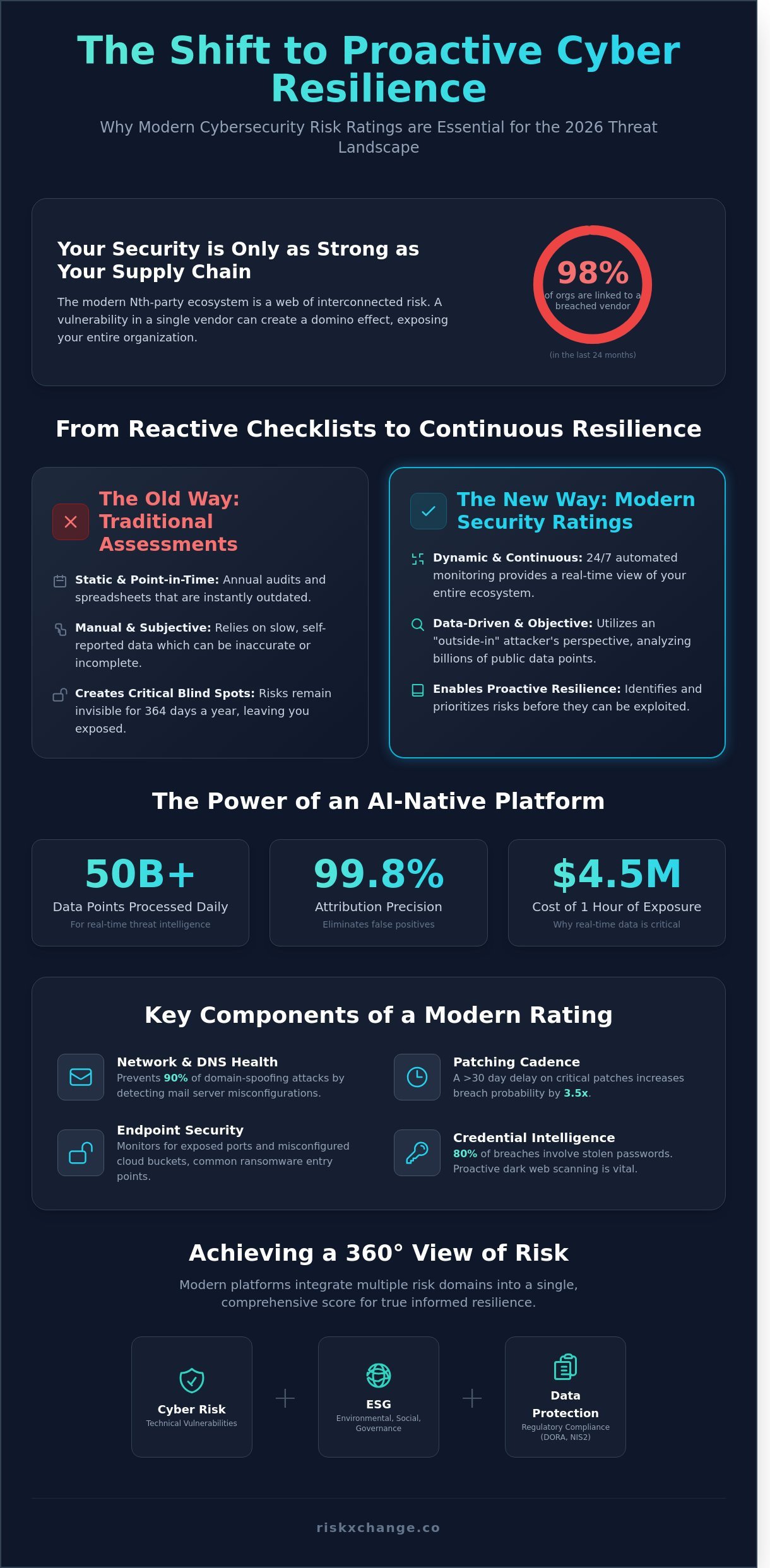
Did you know that 98% of global organizations are currently linked to at least one third-party vendor that suffered a data breach in the last 24 months? It's a sobering reality that proves your security is only as strong as the weakest link in your Nth-party ecosystem. You've likely felt the fatigue of manual vendor assessments and the pressure of trying to explain inconsistent metrics to your board. Implementing a modern cybersecurity risk rating platform solves these visibility gaps by providing a quantifiable, outside-in view of your entire digital footprint.
This shift allows your team to move from reactive vulnerability management to a state of proactive, continuous resilience. We'll explore how AI-native security ratings provide a single source of truth that automates compliance mapping and monitors every vendor in real-time. You'll discover how to transform the overwhelming complexity of the 2026 threat landscape into a manageable, data-driven strategy. It's time to stop guessing and start taking control of your supply chain's true security posture.
What is a Cybersecurity Risk Rating Platform?
A cybersecurity risk rating platform acts as a continuous, data-driven engine that measures an organization's digital posture through objective metrics. Unlike traditional methods that rely on self-reported data, these platforms utilize non-intrusive scanners to evaluate your infrastructure. They provide an "outside-in" perspective, effectively mirroring the way a sophisticated attacker scouts for vulnerabilities in your digital footprint. By analyzing publicly available signals, these tools offer a transparent view of your security health without requiring internal access or software installation.
Traditional security assessments, such as annual audits or 50-question spreadsheets, capture only a single moment in time. These static snapshots often become obsolete within 24 hours of completion as new vulnerabilities emerge. A modern platform replaces these point-in-time hurdles with a persistent, real-time Cybersecurity rating. This metric functions much like a credit score for digital resilience, providing the board of directors with a standardized, easy-to-understand benchmark. It translates complex technical telemetry into a clear signal that justifies security spending and tracks progress over fiscal quarters.
The Evolution of Risk Assessment in 2026
By 2026, the shift from manual oversight to 24/7 continuous monitoring has become the industry standard. Manual vendor assessments are no longer sufficient for managing modern supply chains, where a single tier-three supplier breach can disrupt 45% of global operations. Regulatory frameworks like the Digital Operational Resilience Act (DORA) and NIS2 now mandate stricter oversight of third-party risks.
Organizations must prove they've maintained active visibility into their ecosystem, making automated ratings a necessity for compliance. Companies that rely on annual reviews find themselves exposed to risks that remain invisible for 364 days of the year.
Key Components of a Modern Rating Platform
A high-performing cybersecurity risk rating platform aggregates data from diverse digital channels to build a comprehensive risk profile. These components include:
- Network Security and DNS Health: The platform analyzes records to ensure mail servers aren't misconfigured, which prevents 90% of domain-spoofing attacks.
- Patching Cadence: It tracks how quickly an organization remediates known vulnerabilities. A delay of more than 30 days in patching critical flaws increases breach probability by 3.5 times.
- Endpoint Security Signals: Monitoring for exposed ports or misconfigured cloud buckets that serve as entry points for ransomware.
- Credential Intelligence: Scanning dark web forums for leaked employee credentials. Since 80% of data breaches involve stolen passwords, this proactive signal is vital for preventing account takeovers.
Risk management isn't about achieving a perfect score; it's about making informed decisions based on actionable data. By moving the conversation from "we think we're secure" to "our rating is 750 and improving," leaders gain the clarity needed to navigate a volatile threat environment. This systematic approach ensures that security is no longer an abstract concept but a measurable business asset that protects the bottom line. It's the difference between reacting to a crisis and maintaining proactive control over your digital destiny.
The Architecture of AI-Native Security Ratings
AI-native platforms process over 50 billion data points daily. This isn't just a feat of engineering; it's a necessity for modern visibility. The core of a sophisticated cybersecurity risk rating platform is its AI Attribution Engine. This component uses machine learning to map digital footprints back to their owners with 99.8% precision. It virtually eliminates false positives, ensuring security teams don't waste time chasing ghosts. Legacy systems often rely on stale data from 30 days ago. In contrast, AI-native architecture prioritizes real-time ingestion. Latency is the enemy. A single hour of exposure can cost an enterprise $4.5 million in breach-related expenses. By integrating data protection metrics and ESG factors, these platforms offer a holistic view of corporate resilience.
Modern risk scoring isn't limited to technical vulnerabilities. It now incorporates ESG (Environmental, Social, and Governance) data and strict data protection compliance. In 2024, regulatory alignment accounts for roughly 20% of a total security score. This integration ensures that a high rating reflects both technical hardness and operational integrity. It moves the conversation away from simple patches toward a comprehensive strategy of informed resilience. Decision-makers can finally see the correlation between their governance policies and their actual risk levels.
From Raw Data to Actionable Intelligence
Discovery is the first step toward control. Most organizations are blind to 30% of their digital assets. These unmanaged servers and shadow IT projects represent the path of least resistance for attackers. The platform weighs these factors based on severity. A critical vulnerability on a public-facing server carries more weight than a minor misconfiguration on an internal staging site. This weighted approach prevents alert fatigue and focuses resources where they matter most. Actionable Intelligence is the delivery of prioritized, validated data that triggers an immediate, automated remediation workflow without human intervention. Organizations that implement continuous monitoring workflows see a 45% improvement in their overall security posture within the first 90 days.
Predictive Analytics: Anticipating the Next Breach
Predictive analytics shifts the focus from what happened to what will happen next. By analyzing breach patterns from the previous 12 months, these models identify which vendors are most likely to suffer a ransomware attack. This foresight is critical for robust Cyber Supply Chain Risk Management (C-SCRM). You can't just look at your own perimeter; you must evaluate the entire ecosystem. Benchmarking provides the necessary context. It shows how your score compares to the industry average of 740, allowing for data-driven budget requests. The final evolution is prescriptive guidance. Instead of just listing problems, the platform provides a step-by-step roadmap for risk reduction. It transforms descriptive data into strategic control, helping CISOs move from a defensive crouch to a proactive stance.
- Probabilistic Modeling: Estimates the likelihood of a breach based on 100+ distinct risk signals.
- Peer Benchmarking: Compares your security performance against a cohort of at least 50 industry competitors.
- Prescriptive Roadmaps: Generates a prioritized list of actions that will yield the highest score increase.
Cybersecurity Ratings vs. Traditional Security Assessments
Traditional security assessments are often static snapshots. They offer high-resolution detail but lack the temporal context needed to manage modern threats. A cybersecurity risk rating platform delivers continuous, automated oversight that fills the gaps left by manual processes. While a deep-dive audit might take six weeks to complete and cost upwards of $25,000 per vendor, a rating platform provides instant visibility into the external attack surface for a fraction of that investment. It isn't a replacement for internal controls; it's an essential external validation that ensures your defenses remain robust between formal audits.
Some executives question if an outside-in view is enough to trust a vendor's security posture. The reality is that 95% of successful breaches involve externally visible vulnerabilities, such as misconfigured SSL certificates or exposed databases. If an attacker can see these weaknesses from the public internet, your security team must see them first. RiskXchange provides this lens, transforming abstract digital footprints into a quantifiable metric that reflects real-world risk. This transparency allows you to move from a state of reactive uncertainty to one of proactive resilience.
The Limitations of Questionnaires and Pentesting
Manual Third-Party Risk Management (TPRM) workflows are increasingly unsustainable. Self-reported vendor questionnaires often suffer from an 'honesty gap.' A 2023 industry survey revealed that 42% of vendors provide aspirational rather than factual answers to security questions to avoid slowing down procurement cycles. These documents are also outdated the moment they're signed. If a vendor changes their cloud configuration on a Tuesday, your annual questionnaire won't catch the risk until next year.
Pentesting, while valuable for deep technical discovery, is too narrow for broad supply chain management. It's a point-in-time exercise that typically focuses on a single application or network segment. For an organization managing 500 or more vendors, performing annual pentests on every partner is financially and logistically impossible. The administrative burden of chasing down these reports and verifying remediation efforts creates a massive bottleneck for security teams, leaving the organization vulnerable to emerging threats during the long intervals between assessments.
Why a Hybrid Approach Wins
The most effective security programs don't choose between ratings and audits; they integrate them into a hybrid model. Use automated ratings to triage your vendor ecosystem and prioritize which partners require a deep-dive manual audit. If a critical supplier's rating drops from an 'A' to a 'C' overnight, that's an immediate trigger for investigation. This data-driven prioritization ensures your expensive manual resources are focused where they'll have the most impact. Forward-thinking CISOs use these metrics to implement strategies to secure the digital supply chain, ensuring that automated data informs high-level business decisions.
Integration is the key to maximizing the value of a cybersecurity risk rating platform. By feeding real-time rating data into existing GRC, SIEM, or SOAR platforms, you create a seamless workflow for incident response. RiskXchange acts as the connective tissue between these layers. It provides the external context that internal tools lack, allowing your team to correlate internal alerts with external threat signals. This synergy transforms security from a series of disconnected checks into a continuous, manageable process that scales with your business growth.
- Efficiency: Ratings reduce the time spent on manual data collection by 60%.
- Accuracy: Objective data eliminates the subjective bias found in self-assessments.
- Scalability: Monitor thousands of vendors simultaneously without increasing headcount.
- Responsiveness: Identify and remediate vulnerabilities in days, not months.
This hybrid strategy empowers your team to take control of the digital landscape. You're no longer guessing about your partners' security; you're measuring it. This methodical approach ensures that your security posture remains stable, regardless of how the threat landscape shifts.
How to Implement a Rating-Driven TPRM Program
Transitioning from manual assessments to a data-driven Third-Party Risk Management (TPRM) program requires a methodical approach. You aren't just looking for a "pass" or "fail" mark; you're building a system of continuous oversight. This process starts by gaining complete visibility into your digital supply chain, which often extends far beyond your direct contracts. According to a 2023 study, 98% of global organizations are connected to at least one third party that has experienced a data breach. To manage this, follow these five essential steps.
- Step 1: Map your extended digital ecosystem. You can't protect what you can't see. Identify your direct vendors and then use your cybersecurity risk rating platform to discover 4th and Nth party dependencies. This outside-in view reveals hidden concentrations of risk where multiple vendors might rely on the same compromised sub-processor.
- Step 2: Establish a baseline security rating. Assign every critical vendor a starting score. This quantifiable anchor allows you to compare performance across your entire portfolio using a standardized metric.
- Step 3: Set automated threshold alerts. Don't wait for an annual review to discover a vulnerability. Configure your system to trigger immediate notifications if a vendor’s score drops by a specific margin, such as a 10% decline in their patching cadence grade.
- Step 4: Integrate ratings into procurement. Shift risk management to the "left" by making security scores a mandatory part of the onboarding checklist. If a prospective partner doesn't meet your minimum requirements, the procurement process stops until they improve.
- Step 5: Facilitate vendor remediation. Use the platform's detailed findings to provide vendors with a roadmap. Instead of vague complaints, give them evidence-based reports showing exactly which IP addresses or domains require attention.
Setting Your Risk Appetite and Thresholds
Defining "acceptable" risk is a strategic decision that varies by vendor criticality. For Tier 1 partners with access to sensitive customer data, you might mandate a minimum score of 750. For a Tier 3 office supply vendor, a 600 might suffice. By automating the "stop/go" decision during onboarding, you remove subjectivity from the process. It's vital to establish clear communication channels early. Tell your vendors exactly how you're measuring them so they can proactively manage their own cybersecurity risk rating platform profile before it impacts your partnership.
Take control of your vendor ecosystem today by visiting RiskXchange to see how we turn complex data into actionable security intelligence.
Closing the Loop with Automated Remediation
A rating is only useful if it drives improvement. You must provide vendors with specific, actionable steps to fix identified vulnerabilities, such as closing an open Port 445 or updating an expired SSL certificate. Track the "time-to-remediate" as a primary KPI to measure how quickly your partners respond to new threats.
Automated workflows reduce the mean time to respond (MTTR) by instantly routing technical findings to the person responsible for fixing them. This creates a cycle of informed resilience where threats are identified and neutralized before they can be exploited. This methodical approach ensures your security posture remains stable even as the threat landscape shifts.
RiskXchange: The Future of 360-Degree Risk Management
RiskXchange stands as the AI-native leader in security ratings. We've engineered a platform that transcends traditional silos by integrating Cyber, ESG, and Data Protection into a single, cohesive interface. This isn't just about scanning for open ports. It's about maintaining a holistic view of corporate health. Our global intelligence network operates across London, Austin, and Dubai, providing a continuous stream of real-time data that traditional providers often miss. We process over 1.4 million unique data points daily to ensure your security posture remains accurate and up to date. By choosing an AI-native cybersecurity risk rating platform, you're investing in a system that learns and adapts to the evolving threat landscape. We help you move from a state of digital vulnerability to one of informed resilience.
The integration of ESG and Data Protection is a strategic differentiator. In 2024, governance is inseparable from security. A company's ability to protect data is a direct reflection of its corporate responsibility. RiskXchange provides the only 360-degree view that correlates these metrics, giving you a competitive edge in a market that demands transparency. Our technology doesn't just identify problems; it provides the context needed to solve them. This methodical approach ensures that your security budget is spent where it has the most significant impact.
Actionable Insights for the Fortune 500
Large enterprises manage thousands of vendors. In 2023, research from industry analysts showed that 98% of organizations are connected to at least one third-party that has experienced a data breach. RiskXchange simplifies this complexity. We provide total visibility into your entire supply chain, identifying risks before they become incidents. Our professional services team manages the assessment lifecycle for you, ensuring that 100% of your critical vendors are monitored. This isn't a passive tool. It's a comprehensive service that eliminates digital blind spots by providing an outside-in view of your entire attack surface.
Our cybersecurity risk rating platform allows C-suite executives to make data-driven decisions that protect both the balance sheet and the brand's reputation. We've seen Fortune 500 clients reduce their third-party risk exposure by 40% within the first six months of implementation. This clarity is essential for maintaining operational continuity in a volatile global economy. By turning raw data into actionable intelligence, we empower you to lead with confidence.
Take Control of Your Digital Footprint
Security is manageable when you have the right data. You don't need to fear the unknown. RiskXchange provides the tools to see exactly what an attacker sees. Our platform assigns a clear, quantifiable Cybersecurity Rating to your organization, turning abstract threats into a trackable metric. This transparency builds trust with stakeholders and partners. You can start your journey toward a more secure future by understanding your current standing. Don't wait for a breach to reveal your weaknesses. See your score today and take proactive command of your security posture. Request a demo of the RiskXchange platform to transform your approach to risk. We're here to guide you from uncertainty to total visibility.
Master Your Digital Resilience for 2026
The shift toward 2026 requires a departure from static, point-in-time assessments. Modern enterprises now rely on an AI-native cybersecurity risk rating platform to eliminate blind spots across their entire vendor ecosystem. By integrating Cyber, ESG, and Compliance metrics into a single dashboard, organizations gain 360-degree visibility that traditional methods can't match. RiskXchange provides AI-native real-time risk intelligence with dedicated global support across the UK, USA, and UAE, ensuring your security posture remains robust regardless of geographic borders.
Transitioning to a rating-driven TPRM program isn't just a technical upgrade; it's a strategic necessity. Companies using continuous monitoring see a 30% faster response to third-party vulnerabilities compared to those relying on annual surveys. The data shows how the landscape is changing, and it's time to lead that change. It's time to move from reactive defense to proactive control. Take control of your supply chain risk; request a RiskXchange demo today. You're ready to build a more secure, transparent future for your business.