By 2026, Gartner predicts that 40% of global enterprises will automate their risk assessments through AI; however, most boards still struggle with the fundamental question: what is grc in an era of hyper-connected supply chains? You probably recognize the friction caused by siloed data making your most critical risks invisible. It's common to feel that manual compliance processes are simply a tax on your innovation. You want to move past the era of static spreadsheets and gain a true outside-in perspective of your digital footprint.
This executive guide provides the roadmap you need to regain proactive control. You'll learn how modern, AI-driven strategies transform compliance from a bureaucratic burden into a measurable competitive advantage. We'll show you how to reduce regulatory friction and achieve real-time visibility into your organization's risk posture. By the end of this article, you'll understand how to leverage a continuous cybersecurity rating to turn blind spots into actionable insights. We are moving the conversation from a state of digital vulnerability to one of informed resilience.
What is GRC? Defining the Three Pillars of Modern Business
To understand what is grc in a modern context, you must view it as an integrated nervous system rather than a series of checklists. Historically, businesses managed these functions in silos, which created dangerous blind spots and fragmented data. Today, Governance, risk, and compliance (GRC) serves as a unified strategy to align IT operations with business goals, manage uncertainty, and meet rigorous regulatory requirements. By 2026, the industry has shifted toward "Continuous GRC." This evolution replaces static annual audits with real-time data streams that provide constant visibility into an organization's security posture. Taking an "outside-in" view is essential here. It allows leaders to see their digital footprint exactly how a potential attacker does, transforming what is grc from a passive administrative task into a proactive competitive advantage.
Governance: Setting the Strategic North Star
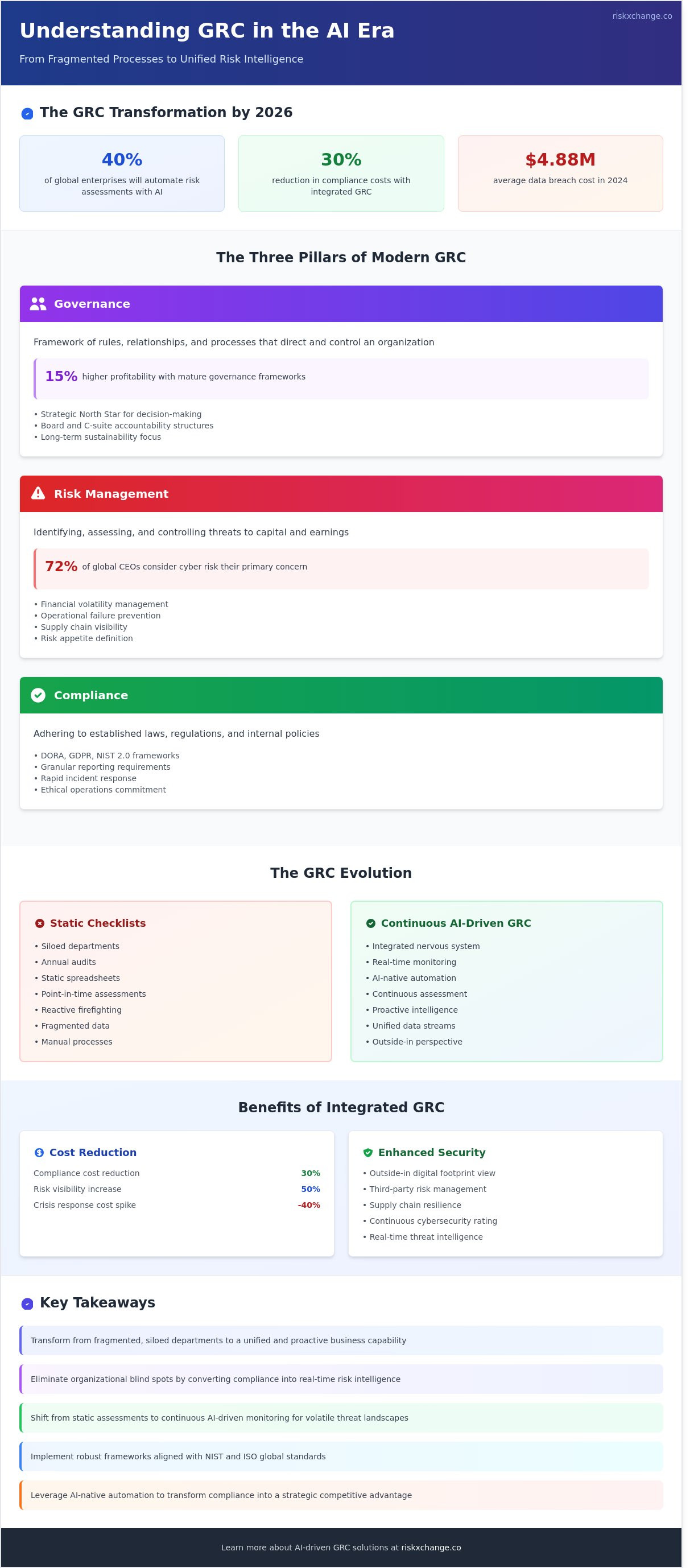
Governance is the framework of rules, relationships, and processes that direct and control an organization. It's the responsibility of the Board and C-suite to establish the ethical tone and accountability structures. Effective governance ensures that every action supports long-term sustainability. Data from 2024 indicates that companies with mature governance frameworks see 15% higher profitability than those with fragmented oversight. It creates the "North Star" that guides decision-making through complex market shifts.
Risk Management: Identifying and Mitigating Threats
Risk management involves identifying, assessing, and controlling threats to capital and earnings. This includes financial volatility, operational failures, and cybersecurity breaches. Organizations must define their "Risk Appetite," which is the specific level of risk they are willing to accept to achieve their objectives. In 2026, cyber risk has become the primary concern for 72% of global CEOs. A robust risk strategy moves beyond internal defense to include supply chain visibility, ensuring that third-party vulnerabilities don't become your own.
Compliance: Meeting Regulatory and Ethical Standards
Compliance is the act of adhering to established laws, regulations, and internal policies. The regulatory environment is more aggressive than ever. Frameworks like the Digital Operational Resilience Act (DORA), GDPR, and NIST 2.0 now demand granular reporting and rapid incident response. Non-compliance costs are staggering. Beyond the 2024 average data breach cost of $4.88 million, the reputational damage often leads to a permanent loss of customer trust. Compliance isn't just a legal obligation; it's a commitment to ethical operations and data integrity.
Why GRC Matters: The Benefits of an Integrated Approach
Organizations often struggle with fragmented data. When departments operate in isolation, they create dangerous blind spots that hide systemic vulnerabilities. Understanding how a CIO explains the importance of GRC as a unified strategy helps leaders see the full picture. It moves the business from reactive firefighting to a state of informed resilience. Integrated GRC replaces guesswork with data-driven risk intelligence. This shift allows executives to make high-stakes decisions based on real-time telemetry rather than outdated spreadsheets. When you ask what is grc in a modern context, it's the bridge between technical security and corporate strategy.
Operational Efficiency and Cost Reduction
Siloed compliance efforts often result in a "compliance tax." This is the hidden cost of performing the same audit multiple times for different regulators. Integrated GRC programs can reduce compliance costs by up to 30% while increasing risk visibility by 50%. Proactive risk management prevents the 40% spike in operational costs typically seen during a crisis response. By removing redundant controls, teams reclaim hundreds of manual hours every quarter. You can benchmark your cybersecurity rating to see exactly where these efficiencies can be gained. Removing manual bottlenecks ensures that compliance becomes a byproduct of good operations rather than a seasonal burden.
Enhanced Cybersecurity and Supply Chain Resilience
GRC provides the essential framework for managing an expanding attack surface. It's the lens through which you view your entire digital footprint from an outside-in perspective. This is vital for Third-Party Risk Management (TPRM). Data from 2023 shows that 62% of system intrusions originate through a vendor or partner. By 2026, new ESG (Environmental, Social, and Governance) requirements will demand even tighter governance over supply chain ethics and environmental impact. A strong GRC foundation ensures you meet these evolving standards while building deep trust with investors who demand transparency. It transforms security from a cost center into a competitive advantage. Using what is grc as a foundational philosophy allows firms to project an image of stability to stakeholders.
- Eliminate Blind Spots: Centralizing data ensures that a risk in the supply chain is immediately visible to the legal and IT teams.
- Data-Driven Intelligence: Move away from subjective "gut feelings" to objective metrics that guide investment.
- Stakeholder Confidence: Investors and board members prioritize companies that can quantify their risk posture with precision.
The Evolution: Static Checklists vs. Continuous AI-Driven GRC
The transition from annual audits to real-time oversight marks a fundamental shift in how organizations manage their digital footprint. For decades, understanding what is grc involved a heavy reliance on point-in-time assessments. These snapshots provided a false sense of security; they were often outdated within 24 hours of completion. In 2024, the average cost of a data breach reached $4.88 million, proving that static defenses cannot keep pace with automated exploits. Modern GRC replaces these checklists with AI-driven engines that ingest telemetry from across the entire attack surface. By adopting an outside-in perspective, your team views the organization through the lens of an adversary. This visibility allows you to prioritize vulnerabilities based on actual exploitability rather than theoretical risk.
The Problem with Legacy GRC Systems
Manual processes create a spreadsheet trap that delays critical decision-making and obscures visibility. A 2023 study found that 58% of risk professionals still use office productivity software to track compliance. This reliance leads to fragmented data and frequent human error. Legacy systems fail to scale, especially when managing high-volume vendor ecosystems. Relying on manual questionnaires often results in a 60-day lag between risk identification and remediation. Without real-time cybersecurity ratings, your team remains blind to the security posture of partners until the next scheduled audit occurs.
Continuous Monitoring: The New Standard for 2026
Organizations are moving toward a model where compliance is a byproduct of robust security, not just a static goal. By 2026, continuous monitoring will be the baseline for regulatory adherence. This approach utilizes OCEG's foundational definition of GRC as a springboard for active, data-driven governance. Machine learning algorithms now predict potential breaches by analyzing patterns in network traffic and configuration changes. It's a proactive stance. When you maintain a high Cybersecurity Rating, you demonstrate resilience to stakeholders and regulators automatically. You're no longer asking what is grc in a theoretical sense; you're executing it as a live, defensive strategy that secures the business.
How to Implement an Effective GRC Strategy
Implementing an effective strategy requires moving beyond theoretical definitions of what is grc to practical, data-driven execution. You can't manage what you can't see. Start by auditing your current environment to identify fragmented data silos. A 2023 industry survey found that 64% of enterprises struggle with visibility across third-party networks. You must map your existing tools against specific regulatory requirements like GDPR or HIPAA to eliminate redundant processes and close security blind spots.
Selecting the right technology is the pivot point between reactive defense and proactive resilience. Legacy GRC software often relies on manual data entry, leaving teams with information that's 30 to 60 days out of date. Shift toward AI-native platforms that offer continuous monitoring and real-time insights. This "outside-in" perspective allows you to see your attack surface exactly how a threat actor does. Start your automation journey with high-impact areas like Third-Party Risk Management (TPRM). Automating vendor assessments can reduce audit fatigue by 30% while ensuring your supply chain visibility remains constant.
Assigning clear ownership ensures accountability isn't lost in the shuffle. This isn't just an IT project; it's a strategic mandate. Establish a cross-functional task force that includes representation from Legal, HR, and the Board. When the C-suite treats risk as a trackable performance metric, the entire organization gains a competitive edge. It's about taking control of the narrative before a vulnerability becomes a headline.
Selecting a GRC Framework
Choosing a framework provides the blueprint for your security posture. NIST offers a flexible, risk-based approach ideal for US-based firms, while ISO 27001 provides a rigorous, internationally recognized certification. For companies in highly regulated sectors like Finance, a hybrid approach often works best. Mapping controls across frameworks prevents your team from performing the same audit task twice. This streamlined approach ensures you're meeting 100% of your compliance obligations without doubling the workload.
Building a Culture of Risk Awareness
Software alone won't protect your assets. Truly understanding what is grc involves seeing it as a cultural shift, not a one-time installation. The "tone at the top" dictates how every employee handles sensitive data. Since 74% of all breaches involve a human element according to the 2023 Verizon DBIR, continuous training is non-negotiable. Translate technical risks into business terms like "revenue impact" or a quantifiable "Cybersecurity Rating" to ensure non-technical stakeholders understand the stakes. This moves risk management from a back-office function into a core business value.
Ready to transform your visibility and secure your digital footprint? Take control of your attack surface with RiskXchange.
RiskXchange: Automating GRC with AI-Native Risk Intelligence
Understanding what is grc in theory is the first step; implementing it effectively requires a 360-degree view of your entire digital ecosystem. RiskXchange provides an AI-native platform that transforms GRC from a static checklist into a dynamic, automated engine. By leveraging machine learning, our Third-Party Risk Management (TPRM) solution automates the entire vendor risk lifecycle. This moves your team away from manual spreadsheets and toward real-time risk intelligence. Our Cybersecurity Rating serves as a quantifiable anchor for your entire program. It translates complex technical vulnerabilities into a clear, trackable metric that both technical leads and board-level executives can act upon. Unlike traditional tools that focus solely on internal controls, we prioritize an "outside-in" attack surface analysis. This perspective reveals exactly what a malicious actor sees, filling the critical gaps left by standard compliance audits.
Real-Time Visibility into Your Supply Chain
RiskXchange monitors third-party risk continuously. It doesn't rely on a single point-in-time assessment gathered during onboarding. Our platform integrates Environmental, Social, and Governance (ESG) metrics and data protection standards directly into a unified risk score. This holistic approach ensures compliance isn't just a box-ticking exercise but a core part of your operational strategy. Automated assessment features reduce the administrative burden significantly. Organizations using our platform save an average of 450 man-hours per year on manual data entry and vendor follow-ups. This efficiency allows your security team to focus on high-level remediation rather than chasing paperwork. By centralizing these metrics, you gain a transparent view of how every partner impacts your overall security posture.
Taking Control of Your Digital Footprint
We empower CISOs to see their organization through the eyes of an attacker. This shift from digital vulnerability to informed resilience is essential for modern governance. By identifying exposed assets and misconfigurations across your entire digital footprint, you gain proactive control over your environment. You're no longer reacting to breaches; you're preventing them before they manifest. Our data-driven approach ensures that every decision is backed by quantifiable evidence rather than guesswork. We provide the lens through which you can finally see your true security posture with clarity. Ready to see your real-time risk rating? Get started with RiskXchange today.
Take Control of Your Digital Resilience
Defining what is grc for the 2026 business landscape means moving beyond the era of static spreadsheets. Organizations now require a 360-degree view of their attack surface to maintain a competitive edge. By transitioning to AI-native risk intelligence, you'll replace manual audits with continuous, real-time monitoring that identifies vulnerabilities before they're exploited. This proactive stance ensures your governance and compliance frameworks aren't just checkboxes; they're strategic assets that protect your bottom line.
RiskXchange delivers this level of clarity to Fortune 500 enterprises through a platform built for global scale. Operating from hubs in London, Austin, and Dubai, we provide the granular technical expertise needed to secure complex supply chains. We don't just offer data; we provide a quantifiable Cybersecurity Rating that serves as a single source of truth for your board. It's the most effective way to move from a state of digital vulnerability to one of informed, lasting resilience.
Request a Free Demo of the RiskXchange GRC Platform to see how we simplify the complexity of modern risk management. You'll find that with the right partner, even the most volatile threats become manageable.