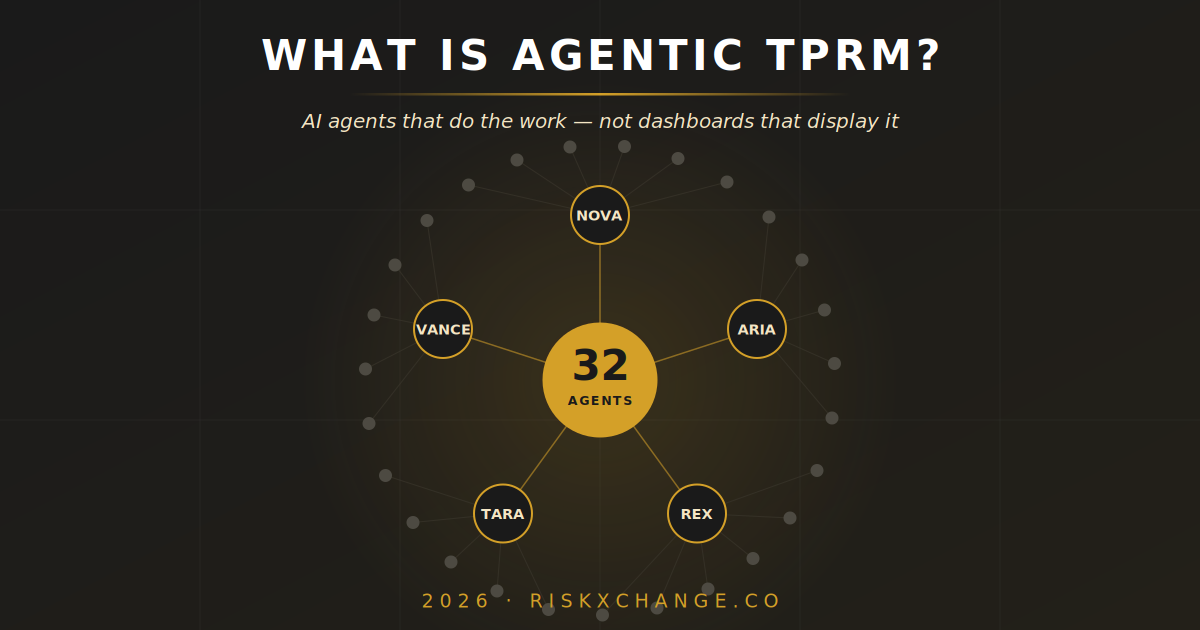
Agentic third-party risk management (agentic TPRM) is the use of autonomous AI agents to carry out the third-party risk lifecycle — vendor intake, assessment, continuous monitoring, remediation and regulatory reporting — rather than software that merely helps humans do that work. The distinction sounds subtle. It isn't. Traditional TPRM tools produce dashboards, scores and to-do lists; the labour of chasing questionnaires, triaging alerts, writing board reports and mapping regulatory registers still lands on your analysts. In an agentic model, that labour is done by AI agents, with humans setting policy and approving decisions.
This article defines the category properly: what qualifies as agentic, what doesn't, how autonomy levels work in practice, and what to look for if you're evaluating it.
Why the category exists
Third-party risk teams are structurally under-resourced. The average programme manages hundreds of vendors with a fraction of the headcount the workload demands, and the workload is compounding: DORA's Register of Information, NIS2's supply chain requirements under Article 21, the FCA's material third-party reporting regime arriving in March 2027. Every new regulation multiplies assessments, evidence requests and reporting cycles — while security ratings platforms, for all their data, have mostly added to the pile. A rating tells you where risk is. Someone still has to deal with it.
The first wave of answers was automation: scheduled questionnaires, workflow rules, alert routing. Useful, but rigid — automation executes predefined steps and stops the moment reality deviates from the script. The second answer was managed services: renting human analysts by the hour, which scales linearly in cost. Agentic TPRM is the third answer: software that behaves like a workforce.
Agentic vs automation vs AI-assisted: the actual differences
The market is currently sprinkling "AI" on everything, so precision matters. Three genuinely different things are being sold under similar language:
| Automation | AI-assisted | Agentic | |
|---|---|---|---|
| What it is | Predefined rules and workflows | AI features inside a human workflow (summaries, chatbots, drafting) | Autonomous agents that own tasks end to end |
| Who does the work | Your team, faster | Your team, assisted | The agents, supervised |
| Handles edge cases | No — breaks or escalates everything | Sometimes — human decides | Yes — reasons through them, escalates by exception |
| Output | Tasks triggered | Suggestions produced | Work completed |
| Scales with vendor count | Linearly, with your headcount | Linearly, with your headcount | Without added headcount |
A useful test: if the software stopped, what would remain undone? If the answer is "notifications wouldn't fire", you have automation. If it's "drafting would take longer", you have AI-assist. If it's "assessments, monitoring triage, remediation chasing and regulatory reporting would stop happening", you have an agentic system.
What agents actually do across the lifecycle
In a mature agentic model, specialised agents own distinct stages of the lifecycle rather than one general-purpose AI doing everything shallowly:
Vendor intake and onboarding. An intake agent runs the vendor conversation — collecting evidence, chasing gaps, handling the real-world edge cases (wrong contact, expired certificate, partial answers) that break scripted workflows.
Assessment. Agents evaluate submitted evidence against your control framework, score it, and produce a brief that ends in a recommendation rather than a findings list.
Continuous monitoring. A monitoring agent watches outside-in signal — attack-surface changes, breach intelligence, dark-web exposure, fourth-party risk — then ranks, deduplicates and attributes it before a human ever sees it. The alert fatigue that plagues ratings platforms is largely a triage problem, and triage is precisely what agents remove.
Remediation. Agents raise the tickets, chase the vendor, track SLAs and close the loop in the tools your organisation already uses — Jira, ServiceNow, Slack, Teams — rather than in yet another portal.
Regulatory reporting. Agents assemble the DORA Register of Information, NIS2 evidence, operational resilience mapping and board packs from the system of record, continuously, instead of as a quarterly scramble.
At RiskXchange this model is called The Agency: five lead agents commanding twenty-seven specialists — NOVA owns vendor conversations from intake to offboarding, TARA runs gap analysis and remediation, REX handles monitoring signal, VANCE produces regulatory reporting. One customer's DORA reporting went from a quarter's work to a morning; another replaced two analysts' worth of questionnaire chasing within eight weeks.
The autonomy question: human-in-the-loop models
The reasonable objection to all of this is control. Nobody serious hands vendor risk decisions to a black box, and a credible agentic platform doesn't ask you to. Autonomy should be a dial, not a switch, typically across three modes:
- Manual — no agent involvement; your team runs the workflow in the platform. Useful as a starting point and for the most sensitive vendor relationships.
- Draft-and-approve — agents do the work but every outward action requires explicit human sign-off. This is where most regulated firms begin.
- Autonomous — end-to-end execution, with humans notified rather than blocking, and escalation by exception.
The dial can be set differently per workflow: many teams run monitoring triage autonomously within weeks while keeping vendor communications on draft-and-approve far longer. What matters for governance is that every agent action is logged, attributable and auditable — the audit trail is what makes autonomy defensible to a regulator, not the absence of it.
What to look for when evaluating agentic TPRM
The category will get crowded, and "agent-washing" — relabelling chatbots and workflow automation — is already visible. Questions that separate the real thing:
- Can you name the agents and what each owns? Specialisation is the tell. "Our AI does everything" usually means it does nothing end to end.
- What happens to edge cases? Ask for a walkthrough of a vendor giving a partial or contradictory answer. Scripts break here; agents shouldn't.
- Is autonomy configurable per workflow, with full audit logging? If not, it won't survive your compliance review.
- Does the work land in your tools? Agents that require your team to live in another portal have missed their own point.
- Is the workforce included, or an upsell? If "someone doing the work" is a managed-service line item, you're buying the old model with new branding.
- Can it evidence regulatory output? Ask to see a generated DORA register entry or board pack, not a slide about one.
Where this is heading
The structural forces behind agentic TPRM aren't reversing: vendor ecosystems keep growing, European regulation keeps tightening through 2027 and beyond, and risk-team headcount isn't keeping pace with either. The programmes that scale will be the ones where humans govern and agents execute. The interesting competition over the next few years won't be over whose dashboard is prettier — it will be over whose workforce does better work.
If you want to see the model rather than read about it, The Agency will assess one of your live vendors in under 24 hours, with no procurement cycle — details on our pricing page, which, unusually for this market, has actual prices on it.