Your organization’s digital reputation is no longer an abstract concept; it’s a visible, trackable number that determines your market trust. When a partner or regulator asks, what is a security rating score, they’re seeking a clear indicator of your resilience in an environment where cybercrime costs were projected to reach $10.5 trillion in 2025. You likely feel the pressure from the board to translate complex vulnerabilities into clear business value, especially with strict mandates like CMMC 2.0 and the SEC’s four-day disclosure rule. It’s exhausting to manage third-party risks when you can't see the vulnerabilities your vendors are exposing.
This guide will show you how to move from a state of vulnerability to one of informed resilience. You'll learn how these scores quantify digital risk and provide a framework for evaluating your true security posture. We’ll break down the methodology behind these benchmarks and explain how to leverage this data to strengthen your entire supply chain through continuous, AI-driven oversight. By the end, you'll have the tools to communicate risk clearly to non-technical stakeholders and build a more resilient digital ecosystem.
Defining the Security Rating Score: Your Digital Credit Rating
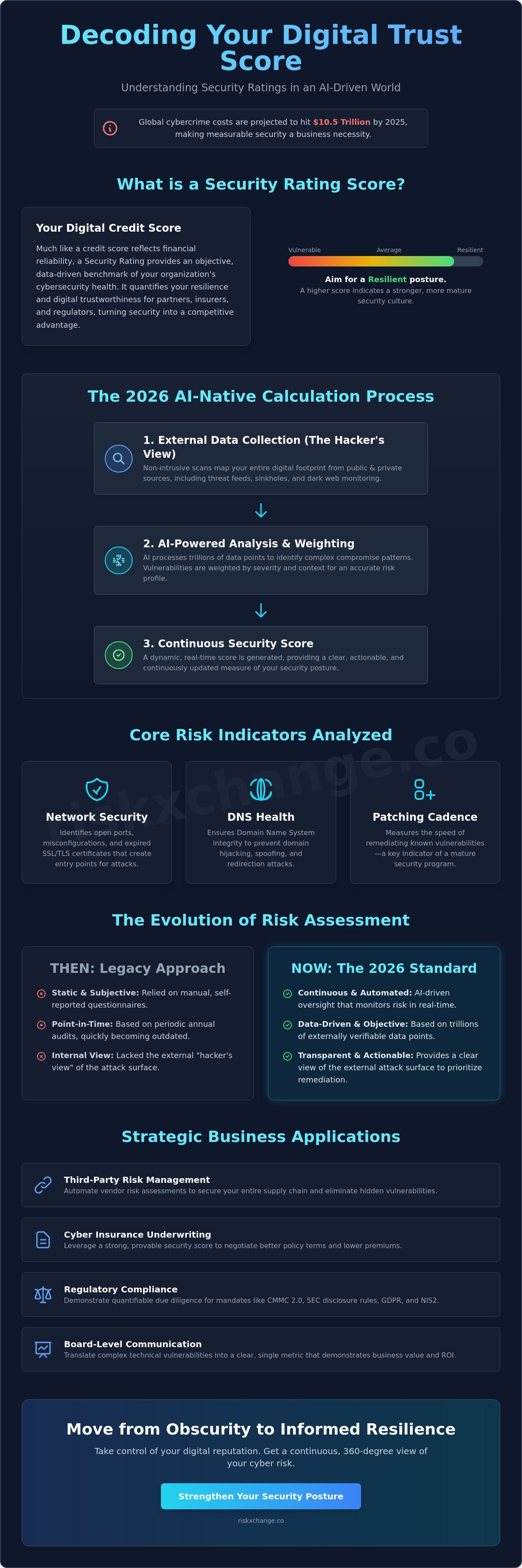
In an era where digital assets are the lifeblood of global commerce, businesses require a standardized method to measure risk. When stakeholders ask what is a security rating score, they are seeking an objective, data-driven assessment of an organization’s cybersecurity performance. Much like a consumer credit score predicts financial reliability, a Cybersecurity rating provides a clear, numerical benchmark of an organization’s digital trustworthiness. It moves the conversation away from vague promises of safety toward a state of measurable, informed resilience.
This shift represents a fundamental change in how we perceive risk. Historically, security was assessed through static, subjective questionnaires that relied on self-reporting. These documents were often outdated before the ink was dry. Today, scoring platforms use automated tools to evaluate an organization from the outside in. This externalized perspective provides a transparent view of how a company is perceived by the world, making it easier to build trust with partners, insurers, and investors. It transforms security from a technical hurdle into a competitive advantage.
The Core Components of a Cyber Risk Score
A robust score isn't a single data point; it’s a composite of several critical technical indicators that reflect your operational hygiene. These factors include:
- Network security: This involves identifying misconfigurations, expired certificates, or open ports that could serve as entry points for unauthorized access.
- DNS health: Analysts ensure the integrity of domain name system records to prevent redirection attacks or domain hijacking.
- Patching cadence: This metric measures how quickly an organization remediates known vulnerabilities. A fast patching cycle is one of the strongest indicators of a mature security culture.
Why the Industry Standard is Shifting in 2026
The landscape of 2026 demands more than periodic check-ins. We've moved from annual audits to continuous, automated oversight that tracks risk in real time. Regulatory bodies, including those overseeing GDPR and NIS2, increasingly require quantifiable metrics to demonstrate compliance and due diligence. This move toward transparency ensures that every entity in a supply chain is held to the same rigorous standard. A security rating is a dynamic benchmark that reflects real-time infrastructure integrity.
How Security Ratings are Calculated: The 2026 AI-Native Approach
Modern scoring methodologies have moved far beyond simple checklists. Understanding what is a security rating score requires looking at the sophisticated engine that drives it. Unlike traditional audits that require internal access, these ratings are generated through a non-intrusive, "outside-in" process. This means no software installation is required on your systems or those of your vendors. Instead, the platform observes your digital presence exactly as a motivated adversary would, providing a transparent view of your external risk profile.
The transition to AI-native analysis in 2026 allows for the processing of trillions of data points across the global internet. These platforms don't just look for open ports; they identify complex patterns of compromise that human analysts might miss. By integrating vast streams of risk intelligence, these systems move beyond static scanning to provide a holistic view of your security posture. This level of continuous real-time risk management ensures that your data remains current and actionable, rather than becoming a snapshot of the past.
Precision in scoring also depends on sophisticated weighting. Not all vulnerabilities impact your resilience in the same way. An outdated service on a non-critical guest network shouldn't carry the same weight as a critical flaw in your primary payment gateway. Modern scoring engines apply contextual logic to ensure that the final number truly reflects the severity of the risk. This prioritized approach helps decision-makers focus their resources where they'll have the most significant impact on their overall security posture.
Data Sources and Collection Methods
The data collection process is comprehensive and multifaceted. It draws from diverse sources, including public and private threat intelligence feeds, sinkholes, and dark web monitoring. These tools map an organization's "digital footprint" across cloud environments, on-premise infrastructure, and remote offices. Passive monitoring allows for the collection of this data without disrupting business operations, ensuring that the assessment remains objective and persistent without being intrusive.
The Role of Machine Learning in Scoring Accuracy
Machine learning is the cornerstone of accuracy in 2026. These algorithms are specifically designed to reduce the false positives that often plague manual assessments, ensuring that the data you receive is reliable. Beyond current status, AI now enables predictive scoring. By analyzing historical data and emerging threat patterns, the platform can forecast the likelihood of a future breach. Furthermore, automated asset attribution ensures that every IP address and domain is correctly mapped to the right organization, maintaining the fairness and integrity of the score.
The Externalized Perspective: Why the Hacker’s View Matters
Most organizations spend their time looking inward, focusing on internal logs and employee behavior. While these are essential components of a defense strategy, this inward focus often creates a significant blind spot. To truly grasp what is a security rating score, you must adopt the mindset of an adversary. Attackers don't start their journey by reviewing your internal policy manuals; they start by scanning your digital perimeter for the path of least resistance. This externalized perspective is the foundation of effective Attack Surface Management, providing the visibility needed to pre-emptively close gaps before they are exploited.
You might believe your internal firewalls provide adequate protection. However, a firewall is only as effective as the perimeter it guards. In a modern, decentralized environment, your perimeter is often more porous than you realize. External gaps, such as misconfigured cloud buckets or forgotten subdomains, are the primary entry points for breaches. A security rating score acts as a sophisticated guardian, offering 360-degree visibility that exposes these hidden vulnerabilities. It moves your organization from a state of obscurity to one of proactive control, ensuring that your defense is as visible and robust as the threats you face.
Mapping Your Digital Attack Surface
Your attack surface is not a static map; it is a growing ecosystem. Identifying "shadow IT," such as forgotten marketing microsites or unmanaged cloud instances, is critical because these assets often lack the rigorous controls of your core infrastructure. Additionally, non-human identities, which are projected to outnumber human employees by a ratio of 80 to 1 in 2026, significantly expand your risk perimeter. These service accounts and AI agents often have broad permissions that attackers can easily leverage. A security rating acts as a mirror, reflecting an organization’s true security posture to the outside world.
Bridging the Gap Between Internal and External Security
External scores are not meant to replace your existing stack; they are designed to validate it. While internal tools like endpoint detection and response (EDR) or antivirus software monitor what is happening inside your network, they cannot tell you how you appear to an external threat actor. By using an external score, you can verify if your internal security controls are actually producing the intended results. This dual perspective allows technical leadership to confirm that their investments are effectively hardening the perimeter and reducing the organization's overall digital footprint.
Strategic Use Cases: Beyond the Number
A numerical benchmark is only as valuable as the decisions it enables. When evaluating what is a security rating score, it's vital to look past the number itself and focus on its operational utility. In 2026, these scores serve as a universal language for risk, allowing diverse departments to align on security priorities. From the legal team vetting a new vendor to the CFO negotiating insurance premiums, the score provides a tangible anchor for complex discussions that were previously lost in technical jargon. It moves the organization from a defensive posture to one of strategic agency.
Strategic leaders use these metrics to manage the entire vendor remediation lifecycle. Instead of relying on a point-in-time assessment, they use the score to drive continuous improvement across their ecosystem. This data-driven honesty ensures that security isn't just a technical requirement but a core component of business resilience. By integrating these scores into your broader risk framework, you can ensure that every partnership and acquisition is backed by verifiable data. To see how this works in practice, you can explore our AI-native TPRM solution to automate your vendor oversight.
Transforming TPRM with Real-Time Ratings
Traditional third-party risk management often relies on static spreadsheets that are obsolete the moment they are submitted. Modern organizations are shifting toward continuous monitoring, using security ratings to maintain a persistent watch over their supply chain. This approach allows for the setting of "minimum score" thresholds for new vendor onboarding, ensuring that no partner introduces unacceptable risk. When a vendor’s score drops below a pre-defined level, the system triggers automated alerts, enabling your team to initiate remediation workflows immediately rather than waiting for the next annual audit.
Benchmarking and Competitive Analysis
Understanding your own performance is only half the battle; you must also know how you compare to your industry peers. Benchmarking allows you to identify if your security investments are keeping pace with market standards or if you are falling behind. High security scores are increasingly used as a competitive advantage in sales cycles and RFPs, signaling to potential clients that you are a reliable and secure partner. This transparency is also becoming a key component of ESG reporting, as investors look for quantifiable evidence of digital governance and operational resilience.
Beyond external competition, these scores are the most effective tool for board reporting. They translate thousands of granular technical vulnerabilities into a single, clear benchmark that executives can understand instantly. This clarity helps justify security budgets and demonstrates the ROI of risk mitigation efforts, turning the security department from a cost center into a guardian of corporate reputation.
Achieving Resilience with RiskXchange’s 360-Degree Platform
Managing a modern supply chain requires more than a passive understanding of technical vulnerabilities. It demands a shift from a state of constant vulnerability to one of informed resilience. RiskXchange provides this transition through an AI-native platform designed for real-time security and compliance oversight. By integrating what is a security rating score with comprehensive attack surface management and third-party risk management (TPRM), we offer a unified lens through which you can evaluate and command your digital reputation. This isn't just about monitoring; it's about taking proactive control of how the world perceives your organization’s reliability.
Our platform treats security as a trackable, numerical benchmark that anchors every strategic discussion. We move the conversation beyond the abstract, providing a data-driven foundation that satisfies both technical leadership and business-oriented executives. In an environment where CMMC 2.0 requirements are now incorporated into DoD solicitations and NIST CSF 2.0 emphasizes the "Govern" function, having a centralized ICT risk framework is no longer optional. RiskXchange simplifies this complexity, ensuring your organization meets the rigorous standards of 2026 with quiet, seasoned confidence.
The RiskXchange Difference: Actionable Risk Intelligence
Many platforms provide a number, but RiskXchange provides the "why" behind the score. We deliver actionable risk intelligence that identifies specific weaknesses and offers a clear path toward remediation. Our automated remediation workflows are a critical asset for TPRM, helping your vendors improve their own security postures without requiring constant manual intervention from your team. This collaborative approach strengthens the entire supply chain. With a global presence and localized expertise in London, Austin, and Dubai, we ensure that your risk management strategy is informed by both global threat intelligence and regional compliance nuances.
Get Started with Your Own Security Profile
Total clarity is the only way to effectively manage the modern threat landscape. Moving from obscurity to a state of command starts with seeing exactly what an adversary sees. A personalized risk report provides this externalized perspective, serving as a narrative device to help you understand your organization’s visibility. It allows you to validate the effectiveness of your existing controls and prioritize investments where they will have the most significant impact on your resilience. You have the power to transform your security posture from a technical obligation into a strategic business advantage. Request your personalized cybersecurity risk report today and begin your journey toward data-driven honesty and proactive defense.
Master Your Digital Reputation with Data-Driven Command
We have explored how a security rating score serves as a critical benchmark for digital trustworthiness. By adopting an externalized perspective, your organization can identify hidden vulnerabilities and forgotten assets before they become entry points for attackers. This transition from static audits to continuous, AI-driven oversight is the only way to maintain resilience in a volatile technological landscape. Understanding what is a security rating score is the first step toward transforming your security posture from a technical obligation into a strategic business asset.
Take command of your risk posture with an AI-native TPRM solution that provides 360-degree visibility across your entire supply chain. RiskXchange is trusted by Fortune 500 enterprises globally to deliver real-time risk management and compliance clarity. Empower your organization with a free RiskXchange security assessment today. You now have the framework to lead your team toward a more secure, measurable, and resilient future.