If you tell your board that a critical vulnerability has been "fixed" but cannot prove it has been remediated, you're leaving your organization's Cybersecurity Rating to chance. According to the 2023 IBM Cost of a Data Breach Report, it takes an average of 277 days to identify and contain a breach; however, many security teams still struggle to define exactly when a threat is officially closed. You likely feel the pressure of translating complex technical updates into clear risk metrics for stakeholders who demand absolute certainty. It's a common struggle where the line between a temporary patch and a formal resolution often blurs during high-stakes reporting cycles.
This guide provides the strategic clarity you need to master the remediation lifecycle and transform your security posture from reactive to proactive. You'll learn to differentiate between remediation and mitigation with precision, ensuring your attack surface remains resilient from an outside-in perspective. We'll explore a professional framework for risk closure, giving you the tools to explain security progress with the quiet confidence of a seasoned expert. This roadmap will move your internal conversations from a state of digital vulnerability to one of informed resilience.
What Does 'Remediated' Mean? Definition and Professional Context
The term 'remediated' describes a state of resolution that goes beyond a temporary patch or a superficial fix. It's the formal process of correcting a fault to restore a system to its optimal state. While the word originated in the 19th-century legal and environmental sectors to describe the cleanup of hazardous sites, it's now the gold standard in the digital space. In cybersecurity, a threat isn't just stopped; it's neutralized at the source to ensure it won't return.
Professional organizations favor this terminology because it implies a structured, documented approach to risk. Within the lifecycle of Vulnerability management, a finding is only considered remediated once the underlying root cause is addressed and verified. This transition from environmental law into digital infrastructure highlights a shift in how we view data. Just as a 1980 CERCLA environmental project required proof of long-term safety, a remediated digital asset requires proof of resilience against future exploits.
The Linguistic Nuance: Remediate vs. Remedy
'Remediate' is a back-formation from the noun 'remediation'. It carries a weight of systemic change that the word 'remedy' lacks. A 'remedy' is often a quick fix for a single symptom. If a server is running low on disk space, deleting temporary files is a remedy. To remediate the issue, an engineer might automate log rotation or expand the storage volume to prevent recurrence. You should use 'remedy' for isolated, low-stakes incidents and 'remediate' for systemic improvements that strengthen your attack surface.
Usage in Professional Reporting and Compliance
In GRC (Governance, Risk, and Compliance) frameworks like SOC2 or ISO 27001, language precision is a requirement. Auditors look for 'remediated' status because it signifies a closed-loop process. According to 2023 industry benchmarks, 65% of compliance failures stem from poorly documented fixes rather than the vulnerabilities themselves. Using the term in your reports provides a layer of legal protection. It demonstrates that you followed a professional standard rather than just applying an ad-hoc 'patch'.
- Patched: Refers specifically to software updates.
- Mitigated: Means the risk is reduced but the underlying flaw remains.
- Remediated: Confirms the flaw is entirely removed or corrected.
This distinction is vital for GDPR audits. Under Article 32, organizations must show they've implemented technical measures to ensure security. A 'fixed' bug might be seen as a reactive move; a remediated vulnerability is seen as a proactive fulfillment of regulatory duties. It moves the conversation from a state of digital vulnerability to one of informed resilience.
The Strategic Role of Remediation in Cybersecurity Risk Management
Visibility is the starting point, but it's not the finish line. An "outside-in" view shows exactly what attackers see, yet the strategic value of this perspective is lost if those gaps aren't closed. Security leaders often focus heavily on discovery, but the real metric of success is how quickly a vulnerability is remediated. A high-performing Cybersecurity Rating isn't a static achievement; it reflects your team's agility and ability to act on real-time data. Organizations that bridge the gap between detection and the final fix can reduce their total attack surface by as much as 30% within the first 90 days of a focused program.
AI now drives this process by sifting through thousands of alerts to identify the 5% of vulnerabilities that actually pose an existential threat. This isn't just about blind patching; it's about strategic prioritization based on actual risk. Following the Vulnerability Remediation Requirements set by CISA ensures your team meets federal-grade standards for internet-accessible systems. This provides a clear, authoritative roadmap for addressing critical issues within the 15-day or 30-day windows required for high-stakes environments.
Remediation in the Context of TPRM
Your security is only as strong as the weakest link in your supply chain. You must demand that third-party vendors provide proof that critical gaps have been remediated before they gain access to your sensitive data. Treat remediation speed as a primary KPI for vendor resilience. Research from 2023 indicates that 61% of organizations experienced a breach via a third party, making supply chain visibility a non-negotiable requirement. A proactive strategy turns vendor assessments from a checkbox exercise into a dynamic shield for your organization.
Vulnerability Management vs. Security Remediation
Vulnerability management is the map, while remediation is the journey. Identifying a risk accounts for only 10% of the effort; the remaining 90% lies in the technical and administrative execution of the fix. Neglecting this action leads to "remediation debt," where the cost and complexity of patching legacy systems grows by roughly 15% each year. It's a compounding risk that can eventually paralyze an IT department. You can monitor your security posture continuously to ensure this debt doesn't compromise your operational stability or your market reputation.
The 5-Step Security Remediation Lifecycle
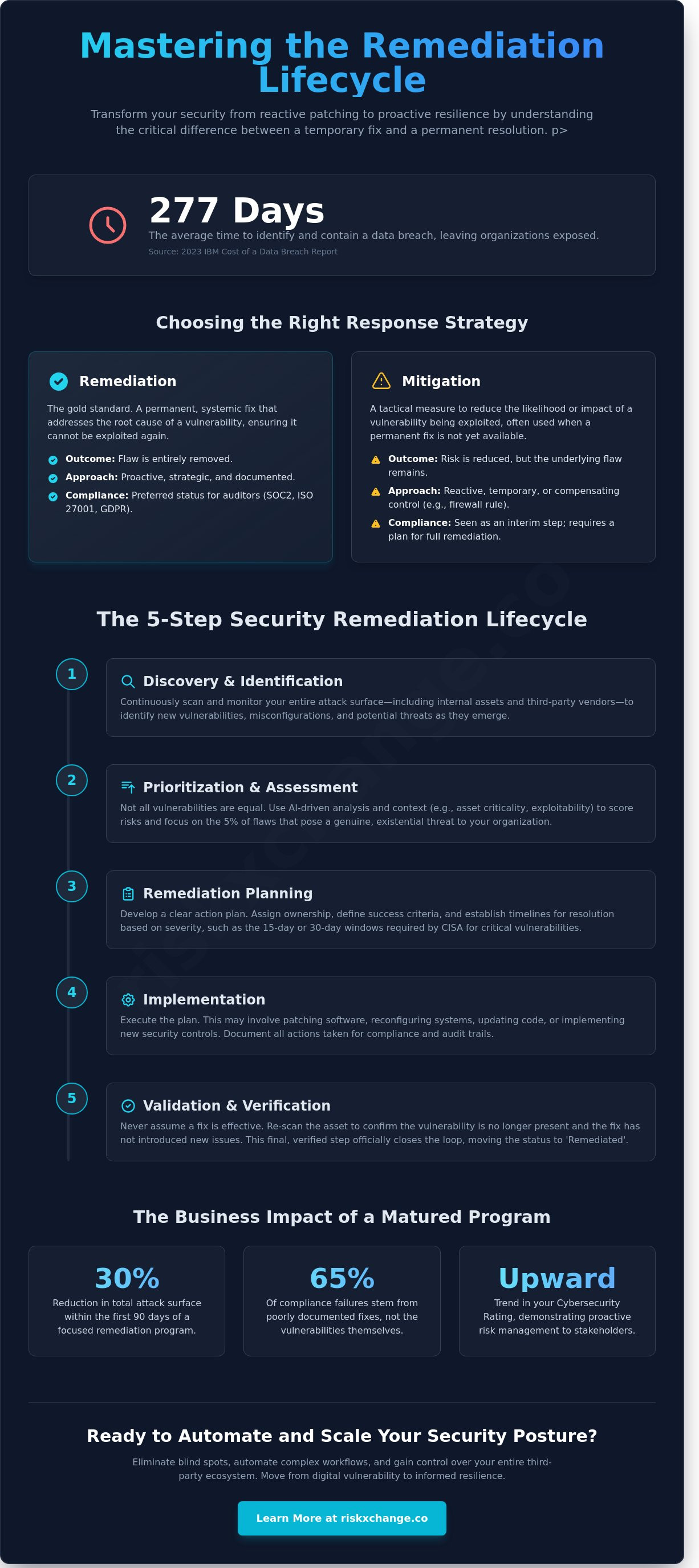
Security remediation isn't a reactive scramble; it's a disciplined, five-stage process designed to move an organisation from vulnerability to resilience. By treating risk as a manageable metric, companies can systematically close gaps in their digital perimeter. This lifecycle ensures that every identified weakness is not just seen, but effectively remediated to prevent exploitation.
- Detection and Identification: You can't fix what you can't see. Continuous monitoring provides an outside-in view of the attack surface, identifying "blind spots" like forgotten subdomains or unpatched legacy software.
- Prioritisation: Not all risks are equal. Teams must categorise vulnerabilities based on their potential impact, business criticality, and the likelihood of exploitation.
- Execution: This is the technical implementation phase. It involves deploying software patches, modifying cloud configurations, or rewriting insecure application code.
- Verification: Testing confirms the fix works. It ensures the vulnerability is gone and that the change didn't introduce new stability issues or security dependencies.
- Documentation and Reporting: Finalising the process provides a clear audit trail. This is vital for regulatory compliance and updating the company’s overall Cybersecurity Rating for stakeholder visibility.
Prioritisation: The 'Actionable' Phase
Effective remediation requires moving beyond a simple list of bugs. Security teams often face thousands of alerts; focusing on the wrong ones leads to wasted resources and increased exposure. By integrating automated asset discovery, organisations gain the context needed to rank threats according to actual business risk. A critical vulnerability on a public-facing web server demands immediate attention, while a similar bug on an isolated internal system might be scheduled for a later sprint. Referencing the Known Exploited Vulnerabilities (KEV) catalog helps teams identify which flaws are currently being used by threat actors in the wild. This data-driven approach eliminates alert fatigue by ensuring teams focus on the 4% of vulnerabilities that pose the highest actual risk to operations.
Verification and Continuous Monitoring
A vulnerability isn't truly remediated until it's verified through rigorous, real-world testing. Digital environments are dynamic; a configuration change made today might be accidentally reverted during a routine server update next month. Real-time data is the only way to ensure a fix remains active and effective over time. Static scans provide a snapshot, but continuous monitoring offers a persistent guard. Automated verification reduces the window of opportunity for attackers by instantly flagging if a previously closed vulnerability reappears. This cycle transforms security from a series of one-off projects into a sustainable state of informed resilience.
Remediation vs. Mitigation: Choosing the Right Response Strategy
Deciding how to handle a vulnerability often comes down to a choice between immediate relief and a permanent cure. Mitigation involves reducing the impact or likelihood of a threat without actually removing the underlying cause. It’s a defensive maneuver designed to buy time. Remediation means the vulnerability has been completely remediated by eliminating the root cause. While mitigation acts as a temporary shield, remediation is the only way to ensure the threat cannot be exploited again.
Choosing mitigation as a tactical stop-gap is often necessary for critical systems that require 99.99% uptime. If a server cannot be taken offline for a reboot, security teams might implement a Web Application Firewall (WAF) rule to block malicious traffic. This is a smart short-term move, but it’s not a final solution. Relying on long-term mitigation is a gamble. Data from the 2023 Ponemon Institute report shows that 60% of data breaches were linked to vulnerabilities where a patch existed but wasn't applied. If you leave a mitigated risk open for too long, you’re essentially leaving a locked door on a house with no walls.
Key Differences at a Glance
Mitigation is typically faster and requires fewer initial resources, making it the go-to response during an active incident. However, it leaves a "residual risk" because the flaw still exists in the code or configuration. Remediation requires more significant resource investment, such as developer hours or system downtime, but it reduces residual risk to near zero. For a deeper dive into these technical distinctions, explore our guide on Remediation vs. Mitigation: What's the Difference? to align your team's terminology.
Real-World Scenarios: Remediation in Action
Consider Scenario A: A security scan identifies a SQL injection vulnerability in a customer-facing portal. The team could mitigate this by rate-limiting requests, but the flaw is only truly remediated when the developers rewrite the code to use parameterized queries. This removes the "outside-in" vulnerability entirely.
In Scenario B, a company faces a zero-day threat with no available patch. The average time to exploit a new vulnerability has dropped to just 15 days according to Mandiant research. The team mitigates the risk by isolating the affected server from the network. This stops the immediate threat while they wait for a vendor update. Once the patch is applied, the status moves from mitigated to remediated.
RiskXchange helps you track these statuses across your entire vendor ecosystem. By providing a clear Cybersecurity Rating for every partner, we move your organization from a state of digital uncertainty to one of proactive control. Gain full visibility into your attack surface by using RiskXchange to monitor your vendor security posture in real time.
Scaling Your Security Posture: How RiskXchange Automates Remediation
Visibility alone doesn't secure an organization. Identifying a flaw is merely a diagnostic step; ensuring that the issue is effectively remediated is the cure. RiskXchange transforms Third-Party Risk Management (TPRM) from a passive observation exercise into a proactive defensive strategy. By bridging the gap between identifying a vulnerability and executing a fix, the platform ensures that security teams don't just see risks, they neutralize them. This transition from awareness to action is the foundation of a mature security posture.
Scaling this process across a supply chain of 1,000 or even 5,000 vendors requires more than manual spreadsheets. RiskXchange automates the entire remediation workflow, sending instant alerts and actionable instructions to partners the moment a security gap appears. Our AI-native engine analyzes historical performance data to predict remediation timelines with high accuracy. This capability allows executives to understand exactly when a critical threat will be neutralized, moving the organization from a state of digital vulnerability to one of informed resilience. It replaces guesswork with a data-driven roadmap for risk reduction.
Continuous Real-Time Risk Management
RiskXchange provides a definitive "outside-in" view of your digital footprint. This perspective mirrors how an attacker perceives your network, highlighting unremediated risks that internal scans might miss. CISOs gain 360-degree visibility into the supply chain, receiving actionable intelligence that prioritizes threats based on their potential impact. It's about taking control of the narrative by using a quantifiable Cybersecurity Rating to track health in real time. This continuous monitoring ensures that your security posture isn't a static snapshot, but a living, breathing defense system that adapts to new threats as they emerge.
Streamlining Compliance and Reporting
Maintaining compliance requires documented proof of action. RiskXchange generates board-ready reports that track every step of the remediation cycle, providing a clear audit trail for regulators and stakeholders. The platform integrates Environmental, Social, and Governance (ESG) metrics and data protection standards directly into the remediation workflow. This ensures your security decisions align with broader corporate responsibility goals and legal requirements. By automating these complex processes, you free your team to focus on high-level strategy rather than administrative overhead. You can book a demo to see how RiskXchange can automate your remediation process and provide the transparency your stakeholders demand.
Master Your Digital Resilience
Effective security isn't about responding to every alert with equal urgency. It's about strategic clarity and the ability to distinguish between temporary mitigation and permanent resolution. When a vulnerability is fully remediated, your organization isn't just safer; it's more resilient. Modern security leaders at Fortune 500 enterprises globally understand that managing a sprawling attack surface requires a structured five-step lifecycle to move from reactive patching to proactive control. This transition demands actionable 360-degree risk intelligence that provides a clear "outside-in" perspective of your entire digital footprint.
You can't manage what you can't see. RiskXchange provides the lens through which you can finally view your true security posture with precision. Our AI-native TPRM solution delivers the real-time visibility necessary to protect your global ecosystem from emerging threats. Take control of your attack surface with RiskXchange's automated remediation platform. You have the tools to turn complex risk into manageable metrics. Start building a more secure, transparent future for your business today.