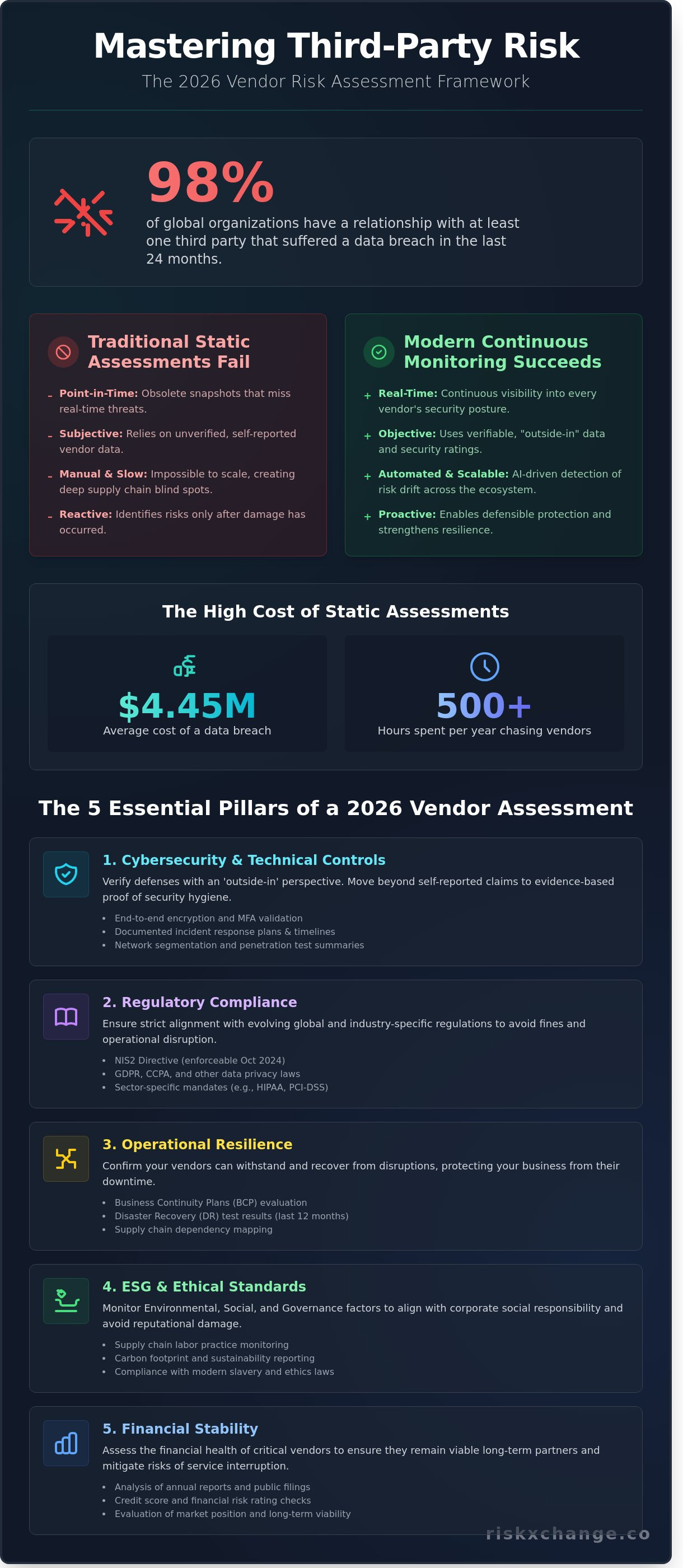
Did you know that 98% of global organizations maintain a relationship with at least one third party that suffered a data breach in the last 24 months? This reality confirms that your security posture is no longer defined solely by your internal defenses. You likely recognize the exhaustion of manual assessment fatigue when updating your vendor risk assessment checklist, especially when faced with blind spots in your deep supply chain. Relying on inconsistent, self-reported data from vendors often feels like managing a storm without a compass. It's a common struggle for leaders who need to balance rapid growth with rigorous, defensible protection.
This guide provides a professional, data-driven framework designed to help you master your third-party ecosystem for 2026. By adopting these strategies, you'll gain the tools to move from reactive defense to proactive, real-time visibility into every vendor's security posture. We'll walk through the specific steps to build a repeatable assessment process that accelerates onboarding while strengthening your overall cybersecurity resilience. You will learn how to leverage outside-in monitoring and quantifiable cybersecurity ratings to ensure your supply chain remains a manageable asset. Knowledge is power, but data is control.
Beyond the Spreadsheet: Why Traditional Vendor Risk Checklists Fail
The traditional vendor risk assessment checklist used to be the gold standard for procurement teams. That era ended when digital ecosystems became too interconnected for manual oversight. A yearly assessment is a snapshot of a single day. It becomes obsolete the moment a vendor changes a firewall configuration or adds a new cloud bucket. Relying on self-reported questionnaires introduces a dangerous level of subjectivity. Vendors naturally want to appear secure to win or retain business. This often leads to security theater where the answers on a spreadsheet don't match the technical reality of their environment.
Complexity at scale is the primary reason manual processes collapse. By 2026, the average enterprise relies on over 1,000 third-party providers. Tracking Nth-party risks, the vendors of your vendors, is impossible using legacy tools. Effective vendor risk management requires more than just trust; it requires verification. Security leaders are shifting from compliance-only mindsets to security-first strategies. They recognize that a "passed" audit from six months ago won't stop a zero-day exploit today. You need a vendor risk assessment checklist that lives and breathes with the threat landscape.
The High Cost of Static Assessments
Delayed risk identification is a direct path to data exfiltration. According to the 2023 IBM Cost of a Data Breach Report, the average cost of a breach reached $4.45 million. When a vendor breach occurs, the financial impact is compounded by damage to your own brand reputation. Customers don't blame the third-party processor; they blame the brand they trusted with their data. There are also hidden labor costs. Security teams spend an average of 500 hours per year chasing vendors for questionnaire updates. This is wasted effort that provides no real-time protection.
The Outside-In Advantage
The "outside-in" perspective allows you to see your vendor through an attacker’s lens. Instead of asking a vendor if they have a patching policy, you can observe their external attack surface to see if they actually apply those patches. This method replaces guesswork with evidence. By utilizing a quantifiable Cybersecurity Rating, you can benchmark a vendor's performance against industry standards instantly. This rating transforms security from an abstract concept into a tangible metric that executives can understand. It provides the visibility needed to take control of your supply chain and move from a state of vulnerability to one of informed resilience.
The 5 Essential Pillars of a 2026 Vendor Risk Assessment
Effective risk management in 2026 demands a shift from static, annual questionnaires to a model of continuous visibility. Your vendor risk assessment checklist must move beyond trust and focus on verifiable data. By 2025, 60% of organizations will use cybersecurity risk as a primary determinant in conducting third-party business engagements. To stay ahead, your framework should rest on five critical pillars that transform blind spots into actionable insights.
- Cybersecurity & Technical Controls: Verification of end-to-end encryption, mandatory Multi-Factor Authentication (MFA), and documented incident response timelines.
- Regulatory Compliance: Strict alignment with the NIS2 Directive, which became enforceable in October 2024, alongside GDPR and sector-specific mandates.
- Operational Resilience: Evidence-based evaluation of business continuity plans (BCP) and disaster recovery (DR) testing results from the last 12 months.
- ESG and Ethical Standards: Monitoring of supply chain labor practices and carbon footprint reporting to meet evolving corporate social responsibility laws.
- Financial Stability: Analysis of annual reports and credit scores to ensure the vendor remains a viable long-term partner.
Cybersecurity Checklist Essentials
Technical due diligence starts with an outside-in view of the vendor's digital footprint. You can't rely on self-reported claims; you need proof of network segmentation to prevent lateral movement during a breach. Demand recent penetration test summaries or, better yet, access to their real-time cybersecurity ratings. Attack Surface Management is the continuous discovery, monitoring, and remediation of all internet-facing assets that constitute an organization's digital footprint. This proactive stance ensures you're seeing the same vulnerabilities a potential attacker sees. You can monitor these metrics seamlessly to maintain a constant state of readiness.
Compliance and Data Protection
Data residency has become a complex legal minefield. Your vendor risk assessment checklist must include specific protocols for cross-border data transfers, especially following the latest EU-U.S. Data Privacy Framework updates. It's vital to map vendor controls directly to the NIST Cybersecurity Supply Chain Risk Management guidelines and ISO 27001 standards to ensure a unified defense posture.
Modern compliance also integrates Environmental, Social, and Governance (ESG) risks. Since 2024, 75% of global consumers have indicated they'll cut ties with brands that fail to demonstrate ethical supply chain oversight. Use these items to verify compliance:
- Validation of data encryption at rest and in transit (AES-256 minimum).
- Confirmation of data sovereignty and localized storage locations.
- Audit of third-party labor practices and sustainability certifications.
- Mapping of vendor sub-processors to identify fourth-party concentration risk.
This structured approach ensures your organization doesn't just react to threats but manages them with the quiet confidence of a tech-forward guardian.
Static vs. Continuous Monitoring: Evolving Your Evaluation Framework
Static snapshots of security are no longer sufficient for modern enterprise demands. By 2026, 60% of global organizations will prioritize real-time risk intelligence over traditional annual audits to manage their digital supply chains. A traditional vendor risk assessment checklist provides a single point-in-time view, but risk is fluid and evolves daily. AI now monitors for "drift," which is the measurable delta between a vendor's last assessment and their current security posture. When a partner's Cybersecurity Rating drops by 15 points or more, automated systems notify your procurement and security teams instantly. Adhering to NIST cybersecurity supply chain guidelines allows you to build a framework that replaces periodic "check-box" exercises with active resilience. This outside-in perspective ensures you see exactly what an attacker sees, closing the trust gap before a breach occurs.
The Lifecycle of a Modern Assessment
Modern assessments follow a rigorous three-stage cycle that maintains visibility throughout the partnership. During pre-onboarding, you use security ratings to filter out candidates scoring below a 650 threshold, ensuring only resilient partners enter your ecosystem. Active management involves setting automated triggers. For example, a new critical vulnerability detection in a vendor's software library initiates a mandatory re-assessment. Finally, offboarding requires a verified vendor risk assessment checklist to ensure data deletion and the revocation of all access keys, preventing "zombie" credentials from lingering in your environment after a contract ends.
Leveraging AI-Native TPRM
AI-native Third-Party Risk Management (TPRM) eliminates the manual burden of oversight that often leads to human error. Machine learning models now analyze data across 50,000 global supply chains to identify emerging vulnerability patterns before they are exploited. This technology reduces questionnaire fatigue by 40% through AI-assisted verification of vendor responses against external telemetry. It's a method that provides 360-degree visibility into your attack surface without the need to increase your security headcount. You gain a sophisticated, tech-forward guardian that transforms complex data into actionable risk mitigation strategies, ensuring your security posture remains stable even as the threat landscape shifts.
Step-by-Step: Implementing Your Vendor Risk Assessment Workflow
A static vendor risk assessment checklist is only effective when it's integrated into a repeatable, data-driven workflow. By 2026, Gartner predicts that 60% of organizations will use cybersecurity risk as a primary determinant in conducting business engagements. You must move from manual oversight to a structured system that prioritizes high-impact threats over administrative box-ticking. This transition requires a shift from "trust" to "verification" through continuous monitoring and clear accountability.
Vendor Tiering Strategy
Efficiency starts with classification. Applying the same 200-point audit to a cloud hosting provider and a local office supply company wastes resources. You should categorize partners into three distinct levels based on their access to your digital footprint:
- Tier 1 (Critical): Vendors with access to PII, financial data, or those essential for business continuity.
- Tier 2 (High): Partners with access to internal systems or sensitive intellectual property.
- Tier 3 (Standard): Commodity service providers with no access to sensitive data or networks.
Tailoring your approach ensures that your team focuses on the 15% of vendors that typically represent 80% of your total risk. For a deep dive into this process, see our guide on conducting a third-party risk assessment. This prevents "survey fatigue" and keeps your security team focused on high-value mitigation tasks.
Remediation and Taking Control
Assessments often fail because they identify problems without providing a path to resolution. You need to issue actionable intelligence that tells vendors exactly what to fix. If a Tier 1 partner shows an open database port or an expired SSL certificate, don't just flag it. Provide the technical telemetry they need to close the gap within a 48-hour window for critical vulnerabilities. This proactive stance moves the conversation from a state of digital vulnerability to one of informed resilience.
Setting strict deadlines based on risk severity is non-negotiable. High-risk issues should be resolved within 30 days; medium risks can follow a 60-day cycle. By using a standardized Cybersecurity Rating as a contractual KPI, you gain measurable leverage. It transforms security from a vague "best effort" into a tangible performance metric that you can track in real-time. This outside-in perspective allows you to see your vendors exactly as an attacker would, giving you the power to pre-empt breaches before they occur.
Establishing a continuous review cadence ensures your vendor risk assessment checklist remains relevant as the threat landscape shifts. Quarterly reporting on security ratings provides the board with clear evidence of risk reduction and vendor compliance. To start automating your supply chain visibility, book a demo with RiskXchange.
Automating Resilience: How RiskXchange Transforms Your Checklist into Action
Manual spreadsheets are the primary point of failure for 62% of modern risk management programs. These documents offer a static, frozen snapshot of a threat landscape that shifts every second. RiskXchange replaces these fragmented files with a 360-degree risk intelligence platform. This shift allows CISOs to view their entire ecosystem through an outside-in lens, revealing exactly what an attacker sees. By integrating cybersecurity, ESG, and compliance data into a unified interface, you eliminate the blind spots that often hide within a traditional vendor risk assessment checklist. We provide the quantifiable anchor your program needs: a real-time Cybersecurity Rating that tracks performance with mathematical precision across your entire supply chain.
This data-driven approach moves the conversation from abstract fears to actionable intelligence. Instead of guessing which vendor poses the highest risk, you can rank them by their actual security posture. Our platform simplifies the overwhelming complexity of the digital threat landscape, providing a clear path from vulnerability to proactive control. It's about more than just checking boxes; it's about building a culture of informed resilience that protects your brand's reputation and bottom line.
The RiskXchange TPRM Platform
Our AI-native engine automates the entire assessment lifecycle, reducing manual administrative workloads by approximately 75%. This technology allows your team to focus on remediation rather than data entry. While traditional annual audits capture a single point in time, RiskXchange provides continuous monitoring. This ensures you're alerted to a vendor's security lapse or misconfiguration within minutes, not months. If your internal team lacks the bandwidth to manage these alerts, our Professional Services analysts can handle the assessment for you. We combine strategic oversight with granular technical expertise to keep your supply chain resilient 365 days a year.
- AI-Driven Analysis: Automatically identifies gaps in vendor security controls.
- Continuous Monitoring: Replaces the "set and forget" mentality with real-time visibility.
- Expert Support: Professional analysts who act as an extension of your security team.
Next Steps for Your Organization
The standards for 2026 demand proactive control. Begin by auditing your current vendor risk assessment checklist against the rigorous benchmarks outlined in this guide. If your current process relies on self-reported questionnaires, you're operating with significant visibility gaps. Request a demo to see your own attack surface from an external perspective. It's time to move away from digital vulnerability and toward a state of constant readiness. You can take control of your supply chain risk with RiskXchange and start measuring the metrics that actually matter for your organization's safety.
Don't wait for a third-party breach to expose the weaknesses in your current program. By adopting a platform that prioritizes transparency and data-driven honesty, you can manage threats before they become incidents. Our mission is to provide the lens through which you can finally see your true security posture.
Future-Proof Your Supply Chain Resilience
Relying on legacy spreadsheets for your 2026 security strategy creates dangerous blind spots. The transition from annual snapshots to continuous monitoring isn't just a trend; it's a technical necessity for global resilience. By implementing a modern vendor risk assessment checklist, you transform passive data into actionable intelligence. This shift ensures your supply chain visibility remains sharp across every digital touchpoint. It's about moving from a state of digital vulnerability to one of informed, proactive control.
RiskXchange provides the 360-degree oversight needed to manage these evolving complexities. With an AI-native TPRM platform and a strategic global presence in London, Austin, and Dubai, we help Fortune 500 enterprises maintain a robust security posture. You'll gain an outside-in perspective that reveals exactly how attackers see your ecosystem. It's time to replace manual guesswork with quantifiable cybersecurity ratings that drive real business value. Your path to a more secure, transparent partnership network starts with data-driven confidence.