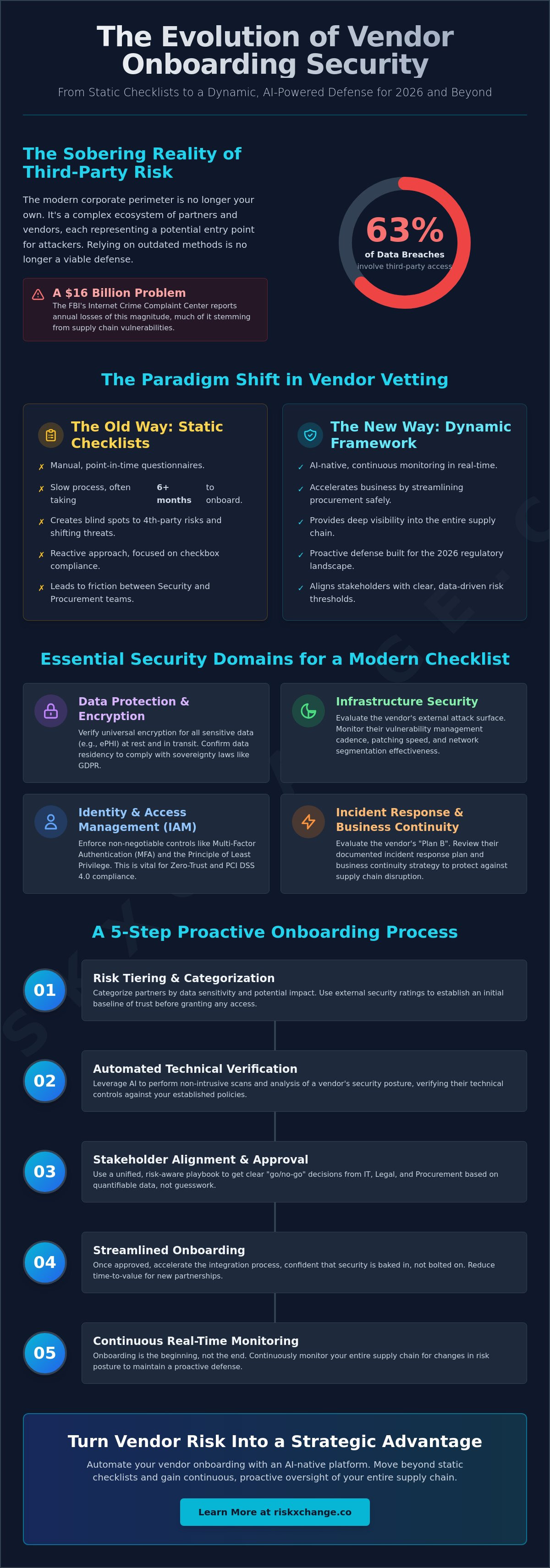
Did you know that 63% of data breaches now involve third-party access? It is a sobering figure from recent industry studies that highlights a critical vulnerability in the modern enterprise. You likely recognize the friction of traditional procurement, where onboarding can drag on for six months while risk remains opaque. Relying on a manual vendor onboarding security checklist often feels like checking a box that is already expired, leaving you blind to fourth-party dependencies and shifting threat profiles.
We understand that you need a faster, more reliable way to verify partners without compromising on safety. This article promises to transform your approach by introducing a risk-aware framework built for the 2026 regulatory environment, including the latest HIPAA Security Rule updates and PCI DSS v4.0 standards. You will learn how to move beyond static assessments toward a continuous, AI-powered dialogue that secures your supply chain in real time. We outline the essential technical controls, automation strategies, and quantifiable metrics required to turn vendor risk management into a scalable, proactive defense.
The Strategic Importance of a Modern Vendor Onboarding Security Checklist
In 2026, the corporate perimeter is no longer defined by your own network. It is the sum of every partner, SaaS provider, and subcontractor in your ecosystem. Verizon's 2025 Data Breach Investigations Report highlighted a stark reality: third-party involvement was present in 30% of all analyzed breaches. This figure represents a 100% increase from the previous year, proving that your vendor onboarding security checklist is not just an administrative hurdle. It is your primary line of defense against an increasingly volatile threat landscape. Moving beyond a "checkbox" mentality is essential to protect your organization from the $16 billion in annual losses reported by the FBI’s Internet Crime Complaint Center.
A structured approach to onboarding does more than satisfy auditors. It creates a predictable, repeatable framework that accelerates business growth. When procurement and security teams operate from a unified, risk-aware playbook, they reduce the friction that typically drags onboarding out for six months or longer. This shift from reactive firefighting to proactive control ensures that every new partnership adds value without introducing unmanageable vulnerabilities. By treating security as a trackable, numerical benchmark, you move the conversation from a state of uncertainty to one of informed resilience.
Defining the 2026 Vendor Risk Landscape
The modern landscape is characterized by deep fourth-party dependencies and the persistent growth of shadow IT. You aren't just trusting a vendor; you're trusting their entire downstream supply chain. AI-driven threats have fundamentally changed due diligence, as automated exploits can now identify and target vendor vulnerabilities with unprecedented speed. In this context, supply chain resilience is the capacity of an organization to maintain operational continuity and data integrity despite the inevitable security failures of its external partners. Effective third-party risk management now requires constant visibility into how these external entities are perceived from an outside vantage point.
The Role of Stakeholder Alignment
Onboarding is a cross-functional discipline that requires coordination between IT, Legal, Procurement, and Executive leadership. Without established "go/no-go" security thresholds, decision-making becomes fragmented and slow. A modern checklist provides a common language for these stakeholders, allowing them to categorize vendors by data sensitivity and establish clear baselines for trust. This alignment transforms the security team from a "department of no" into a strategic partner that enables faster time-to-value. By creating a culture of proactive risk control, organizations can ensure that compliance with standards like PCI DSS v4.0 and the updated HIPAA Security Rule is a natural byproduct of their standard operating procedures.
The Essential Security Domains of Your Onboarding Checklist
A high-performance vendor onboarding security checklist must look past administrative paperwork to scrutinize the technical reality of a vendor’s environment. While legacy processes often stop at collecting tax forms, a modern framework prioritizes data protection and infrastructure resilience. You need to verify that encryption is not just present but universal for all sensitive data, including ePHI, which the May 2026 HIPAA Security Rule updates now mandate as a required safeguard. Data residency must also be confirmed to ensure compliance with regional sovereignty laws, preventing legal complications before they arise.
Infrastructure security requires an externalized perspective. You should evaluate a vendor’s attack surface by monitoring their vulnerability management cadence and network segmentation. Identity and Access Management (IAM) is another non-negotiable pillar. Enforcing Multi-Factor Authentication (MFA) and the Principle of Least Privilege ensures that a breach at a partner organization doesn't grant a lateral path into your own systems. This is particularly vital as zero-trust principles have become the standard expectation for SOC 2 and PCI DSS 4.0 compliance in 2026. Finally, you must evaluate their incident response and business continuity plans. A vendor's "Plan B" is your only protection against a total supply chain standstill during a localized crisis.
Technical Control Verification
Verification moves beyond trust into the territory of measurable data. You should review recent penetration test summaries, focusing specifically on remediation timelines for critical vulnerabilities. Software vendors must demonstrate secure SDLC practices to prove that security is baked into their code rather than added as an afterthought. It's also essential to assess network-level protections against data exfiltration. If a vendor cannot provide clear evidence of these controls, you can leverage automated security ratings to gain an objective, real-time view of their posture without waiting for a manual response.
Operational and Legal Governance
The transition from ISO 27001:2013 to the 2022 version ended in late 2025, meaning all partners must now hold the 2022 certification. Your Master Service Agreements (MSAs) should include "Right to Audit" clauses that allow for independent verification of these standards. Service Level Agreements (SLAs) must be equally rigorous, defining strict windows for security patching and breach notification. Don't overlook cyber insurance. You need to verify that their coverage limits are sufficient and that exclusions don't leave you vulnerable to the financial fallout of a fourth-party failure. This legal layer ensures that your technical requirements are backed by enforceable accountability.
Operationalizing the Checklist: A 5-Step Onboarding Process
Operationalizing a vendor onboarding security checklist requires a shift from static data collection to active risk intelligence. You cannot rely on a single, universal process for every vendor. Instead, your workflow must be methodical and data-driven, ensuring that high-risk partners receive the scrutiny they deserve without slowing down low-risk procurement. This transition begins by moving away from manual spreadsheets and adopting an externalized perspective that evaluates how a vendor is perceived from an outside vantage point.
The process follows a logical progression designed to build confidence at every stage. It starts with initial risk tiering, where you categorize vendors based on the sensitivity of the data they will handle. Once the tier is established, you move to external security ratings. This step uses non-intrusive data to establish a baseline of the vendor's security posture before a single questionnaire is sent. From there, automated evidence gathering replaces the back-and-forth of email attachments with dynamic portals, leading into a collaborative gap analysis. The final stage is not just an approval; it is the kickoff for continuous monitoring, ensuring that the security posture you verified today remains stable throughout the contract lifecycle.
The Power of Risk Tiering
A "one size fits all" approach is the primary reason onboarding takes too long. You shouldn't subject a stationary supplier to the same rigorous audit as a cloud hosting provider. By defining Low, Medium, and High-risk profiles, you allocate your specialized resources where they matter most. High-risk vendors, especially those touching ePHI or cardholder data under PCI DSS v4.0, require deep technical validation. Low-risk vendors can move through an accelerated path, allowing your team to focus on the 30% of third-party relationships that typically represent the highest breach potential.
Collaborative Remediation
In the modern threat landscape, a simple "pass/fail" grade is often counterproductive. Collaborative remediation allows you to move from identifying vulnerabilities to fixing them. Use security ratings as a common language to show vendors exactly where their infrastructure falls short, such as outdated SSL certificates or open ports. Set time-bound expectations for critical fixes. This approach doesn't just secure your data; it builds a stronger, more transparent partnership. By the time you reach step five, the vendor onboarding security checklist has transitioned into a living document for continuous, AI-powered oversight.
Why Static Onboarding Checklists Fail in a Dynamic Threat Landscape
Completing a vendor onboarding security checklist is often viewed as the finish line of a procurement marathon. In reality, a static assessment is merely a snapshot of a vendor's security posture at a single moment in time. This "point-in-time" trap creates a dangerous illusion of safety. A clean audit on Monday can be rendered completely obsolete by a single server misconfiguration on Tuesday or a new zero-day vulnerability on Wednesday. Relying on annual or biennial reviews leaves your organization blind to the rapid decay of security controls between assessment cycles.
The transparency gap further complicates this issue. When vendors fill out self-reported questionnaires, they naturally present their infrastructure in the best possible light. They rarely disclose the presence of shadow IT, unauthorized sub-processors, or legacy systems that haven't seen a patch in years. This filtered information prevents you from seeing the true risks hidden within their environment. Without an externalized perspective, you're essentially trusting a vendor's homework without ever checking their work against the reality of the open internet.
Managing "fourth-party" risk is another area where manual checklists fall short. Your security is only as strong as your vendor's vendor. As supply chains become more interconnected, the visibility into these downstream dependencies becomes increasingly opaque. Manual follow-ups and spreadsheet version control cannot scale to meet this complexity. The administrative burden of chasing hundreds of vendors for updated documentation often leads to oversight, where critical remediation steps are missed simply because of human error or lack of bandwidth.
The Decay of Static Assessments
A single misconfiguration in a cloud environment can invalidate a comprehensive six-month-old audit in seconds. When a new critical vulnerability is announced, you need to know which vendors are exposed immediately, not during the next scheduled review. Security ratings are more reliable than self-reported data because they provide an objective, real-time benchmark of a vendor's actual defensive posture. This continuous flow of data ensures that your risk profile reflects current technical realities rather than historical promises.
The Visibility Challenge
True resilience requires seeing your vendors exactly how an attacker sees them. This external vantage point allows you to identify unauthorized sub-processors and exposed assets that the vendor might not even know they possess. Bridging the gap between a vendor's internal policy and their external reality is the only way to ensure your data remains protected. If you're ready to move beyond the limitations of manual assessments, explore how continuous risk management can transform your onboarding process.
Automating Vendor Onboarding with RiskXchange’s AI-Native Platform
The traditional, manual approach to a vendor onboarding security checklist is no longer sustainable. When procurement cycles stretch to six months, the business loses momentum and security teams fall behind. RiskXchange’s AI-native platform eliminates this bottleneck by automating the most labor-intensive stages of the process. By replacing manual evidence collection with intelligent workflows, organizations can reduce their total onboarding time by 50%. This efficiency doesn't come at the cost of depth; rather, it allows your team to focus their expertise on high-value risk mitigation instead of administrative follow-ups.
Real-time security ratings provide instant visibility into a vendor’s posture before you even hold a discovery meeting. This externalized perspective allows you to see exactly how a partner is perceived from an outside vantage point, identifying vulnerabilities that questionnaires often miss. Our AI-powered gap analysis then takes this data and automatically prioritizes risks based on severity and business impact. This moves the conversation from a state of vulnerability to one of proactive control, where every decision is backed by trackable, numerical benchmarks. You gain the clarity needed to evaluate a partner's true security posture without the delay of traditional assessments.
The most significant shift in 2026 is the realization that onboarding is not a one-time event. RiskXchange facilitates a seamless transition from the initial check to continuous real-time risk management. It is the "onboarding that never ends," providing a persistent lens through which you can monitor your entire supply chain. This approach ensures that the high standards you verify during the initial phase are maintained throughout the duration of the partnership, protecting your organization from the decay of static security controls.
The RiskXchange Advantage
RiskXchange integrates cybersecurity, data protection, and ESG metrics into a single, unified view. This holistic approach ensures that your supply chain resilience is measured against a comprehensive set of standards. By turning security into a quantifiable metric, we provide a tangible anchor for all stakeholder discussions, from technical leadership to business-focused executives. Our global reach allows you to monitor vendors across any geography, from Austin to Dubai, with the same level of precision and immediacy. This transparency builds trust and ensures that your organization remains compliant with evolving regulations such as the EU AI Act and the updated HIPAA Security Rules.
Getting Started with Intelligent Onboarding
Integrating RiskXchange into your current procurement stack is a straightforward process designed for immediate utility. The platform is highly customizable, allowing you to map automated workflows to your specific compliance needs and internal risk appetites. You can establish clear security thresholds that trigger automatically, ensuring that no vendor enters your ecosystem without meeting your exact standards. To see these capabilities in action, Request a demo of RiskXchange to automate your vendor onboarding and begin your transition to informed resilience.
Secure Your Ecosystem with Informed Resilience
The 2026 threat landscape demands a transition from administrative paperwork to actionable intelligence. You've seen how a modern vendor onboarding security checklist acts as the foundation for supply chain resilience, moving beyond static spreadsheets to embrace an externalized perspective. By prioritizing technical control verification and real-time ratings, you can eliminate the "point-in-time" trap that leaves so many organizations vulnerable to fourth-party risks.
True security isn't found in a one-off audit but in the continuous, AI-powered oversight of every partner in your network. RiskXchange provides the AI-native TPRM solution you need to manage compliance and cybersecurity risk with the quiet confidence of a seasoned expert. Our platform is trusted by Fortune 500 enterprises to deliver the quantifiable metrics required for strategic decision-making. Empower your team with a 360-degree view of vendor risk, Schedule your RiskXchange demo today. You have the tools to turn complexity into clarity; now it's time to lead your organization toward a more secure and resilient future.