Did you know that the average cost of a healthcare data breach has reached a staggering $10.22 million? With 41% of these incidents originating from third-party vendors, mastering TPRM for healthcare organizations is no longer optional; it's a core requirement for patient safety. You're likely managing an expanding attack surface of telehealth platforms and IoT devices, and you know that static, once-a-year vendor assessments cannot keep pace with 2026's threat environment. It's difficult to feel secure when the outside-in view of your network reveals vulnerabilities you didn't even know existed.
We understand that you need to protect patient health information without slowing down digital innovation. This guide will show you how to move from reactive checklists to a state of informed resilience. You'll learn to implement a scalable framework that provides real-time visibility into vendor security postures. We'll also explore how to automate compliance reporting for the newly finalized May 2026 HIPAA Security Rule updates, ensuring your Cybersecurity Rating remains a metric of strength rather than a liability.
The Expanding Attack Surface of Modern Healthcare
The modern hospital is no longer a self-contained fortress. As digital transformation accelerates, patient data flows through a complex network of cloud-based EHRs, billing platforms, and diagnostic labs. Effective Third-party risk management (TPRM) for healthcare organizations requires continuous oversight of every external partner that touches protected health information (PHI). It's a shift from internal defense to a broader strategic view of the entire supply chain, ensuring that every link remains secure.
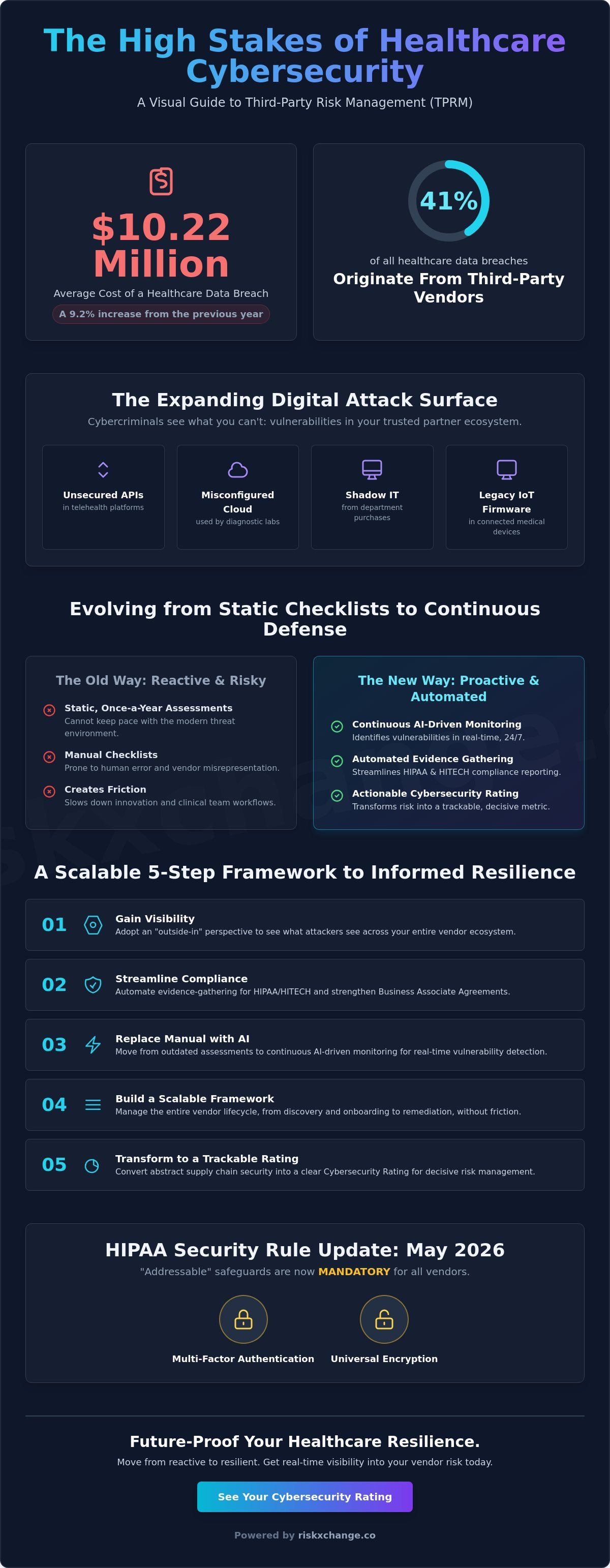
Cybercriminals view your organization from an outside-in perspective. They don't waste time attacking your hardened internal perimeter if they can find a weak link in a niche SaaS vendor or an unpatched medical IoT device. These blind spots represent the true attack surface. In 2024, 41% of all healthcare data breaches originated from these third-party partners. Key vulnerabilities often include:
- Unsecured APIs in telehealth platforms
- Misconfigured cloud storage used by diagnostic labs
- Shadow IT introduced by departmental software purchases
- Legacy firmware in connected medical devices
When a vendor's security posture slips, it creates a direct path into your ecosystem. You must see what the attackers see to maintain control over patient safety outcomes and operational continuity. Identifying these risks before they are exploited is the hallmark of a mature security program.
Beyond the Hospital Walls: Mapping the Digital Ecosystem
Your digital footprint extends far beyond your physical facility. Every integration with a third party, from telehealth apps to remote monitoring devices, introduces new variables. This includes "Nth-party" risk, which involves the vendors your vendors rely on for data storage or processing. If a sub-processor fails, the impact on your patient data is just as severe as a direct hit. Traditional network perimeters have effectively dissolved, replaced by a global web of interconnected services that require constant vigilance.
The Cost of Inaction: Breaches, Fines, and Patient Trust
The financial stakes are at an all-time high. In 2026, the average cost of a healthcare data breach reached $10.22 million, representing a 9.2% increase from the previous year. Beyond the immediate fines and legal fees, a supply chain incident causes a long-term erosion of patient trust that can take years to rebuild. Patients expect their most sensitive information to be handled with care. When a breach occurs, the damage is often amplified by the Response Gap. The Response Gap is the time between a vendor's vulnerability and the healthcare organization's awareness. Implementing robust TPRM for healthcare organizations is the only way to shorten this gap and protect the bottom line.
Navigating Healthcare Compliance: HIPAA, HITECH, and Beyond
Compliance isn't just a checkbox exercise; it's the legal framework that protects patient lives. As of May 2026, the HIPAA Security Rule update has transformed previously "addressable" safeguards into mandatory requirements. This means your organization is now legally obligated to ensure vendors implement multi-factor authentication and universal encryption. Effective TPRM for healthcare organizations automates the evidence-gathering process, turning what used to be a frantic audit scramble into a streamlined, continuous flow of data.
The contractual foundation of this relationship is the Business Associate Agreement (BAA). While the HHS provides a framework for Navigating Healthcare Compliance: HIPAA, HITECH, and Beyond through sample provisions, a contract alone doesn't stop a breach. You need to map technical security ratings directly to these regulatory controls. By using an AI-native platform, you can verify that a vendor's "outside-in" security posture actually aligns with the promises made in their BAA. This level of granular oversight is essential for providers with international footprints who must also align with global standards like the Digital Operational Resilience Act (DORA).
The Regulatory Core: PHI Protection Standards
HIPAA's Security and Privacy Rules demand that third parties treat PHI with the same rigor as the covered entity. The "Minimum Necessary" standard is a critical hurdle here; vendors should only access the data required for their specific function. Automated assessments help you satisfy HITECH Act requirements by providing a time-stamped trail of vendor due diligence. This ensures you aren't just trusting a vendor's word but are actively monitoring their compliance status in real-time.
Emerging Standards: NIST and the Cybersecurity Performance Goals
Adopting the NIST Cybersecurity Framework (CSF) has become a standard practice for resilient healthcare systems. The Department of Health and Human Services (HHS) has further refined this with their Cybersecurity Performance Goals (CPGs), which prioritize high-impact actions to reduce risk. Continuous monitoring provides a defensible security posture for regulators by demonstrating proactive management rather than reactive panic. By tracking a quantifiable Cybersecurity Rating, you move from a state of digital vulnerability to one of informed, measurable resilience.
Moving from Static Assessments to Continuous AI-Driven Monitoring
Traditional third-party risk management often relies on point-in-time snapshots. These questionnaires are essentially a "rear-view mirror" approach to security. In contrast, modern TPRM for healthcare organizations demands a continuous, data-driven perspective. Instead of waiting for a vendor to self-report their security status once a year, an AI-native platform provides a real-time Cybersecurity Rating. This metric transforms security from an abstract concept into a trackable, actionable asset that stays current as the threat landscape shifts.
This transition significantly reduces "survey fatigue" for both your internal IT teams and your vendors. You aren't wasting hundreds of hours chasing down spreadsheets or clarifying ambiguous answers. Instead, you're looking at a single source of truth that updates automatically. These real-time ratings provide the clear, quantifiable data needed for board-level reporting, moving the conversation from technical anxiety to strategic resilience. It allows leadership to see exactly where the organization stands at any given moment.
The Failure of Annual Security Questionnaires
A security questionnaire is obsolete the moment the "Send" button is clicked. It captures a vendor's posture at a single point in time, failing to account for the dynamic nature of digital threats. There's also the issue of inherent bias; vendors naturally present their security in the best possible light when self-reporting. These static assessments are blind to zero-day vulnerabilities in the supply chain, leaving your patient data exposed between assessment cycles. By the time you discover a weakness through a manual audit, the Response Gap has already widened, and the damage is likely done.
Leveraging AI for Real-Time Threat Intelligence
AI-native solutions change the game by identifying vulnerabilities without manual input. Machine learning algorithms analyze vast datasets to spot patterns of compromise across your entire vendor ecosystem. This "outside-in" view allows healthcare CISOs to practice proactive Attack Surface Management. Instead of treating all vendors with a "one size fits all" approach, AI prioritizes risks based on the criticality of the vendor's function and the sensitivity of the PHI they handle. If a small diagnostic lab shows signs of a credential leak, the system flags it immediately. This allows for rapid remediation before a minor vulnerability turns into a headline-grabbing breach. It's about taking control of the data before the attackers do.
A Strategic Framework for Healthcare Vendor Risk Management
Effective TPRM for healthcare organizations isn't a project with a defined finish line; it's a continuous lifecycle. To move from digital vulnerability to informed resilience, you must implement a structured five-step framework: Discovery, Tiering, Assessment, Remediation, and Monitoring. This process ensures that no vendor enters your ecosystem without a clear understanding of their security posture. By automating the discovery and onboarding phases, you reduce friction with clinical and business units, allowing for rapid innovation without compromising patient safety.
Implementing robust TPRM for healthcare organizations at scale requires "contractual teeth." You should link a vendor's Cybersecurity Rating directly to your Service Level Agreements (SLAs). For example, if a vendor's score falls below a pre-defined threshold, your contract should mandate a specific remediation window. At the end of the partnership, a formal offboarding process must verify the total destruction of any shared data. This prevents "zombie data" from lingering in a former partner's unmonitored environment, which is a common source of late-stage breaches.
Tiering and Classification: Prioritizing High-Risk Partners
Not every vendor represents the same level of threat to your organization. You must categorize partners based on their access to Protected Health Information (PHI). "Critical" vendors are those with direct, persistent access to patient records or core clinical systems. For these high-stakes partners, you should set a "minimum acceptable" security rating. Using an outside-in perspective allows you to verify these scores before onboarding begins. This targeted approach ensures your security team focuses their energy where it matters most, rather than performing deep-dive assessments on low-risk office supply vendors.
Remediation and Collaboration: Closing the Vendor Security Gap
When a vulnerability is identified, the goal is rapid resolution through collaboration. Instead of sending vague warnings, provide your partners with actionable risk data. You can leverage RiskXchange remediation modules to share specific technical findings directly with vendor IT teams. This transparency fosters a partnership rather than an adversarial relationship. Using automated remediation workflows allows you to track progress without constant manual follow-ups. To measure the success of your framework, track "Time-to-Remediate" (TTR) as a primary KPI. Reducing your TTR ensures that the "Response Gap" mentioned earlier remains as narrow as possible. Take control of your vendor remediation process today to ensure your supply chain remains a pillar of strength.
Future-Proofing Healthcare Resilience with RiskXchange
Managing a healthcare supply chain in 2026 requires more than just a defensive posture; it demands a single source of truth. RiskXchange provides this through an AI-native platform that integrates cybersecurity, ESG, and data protection into a unified 360-degree view. While only 13% of TPRM teams currently report fully mature automation capabilities, our solution bridges that gap by offering continuous, real-time risk intelligence. This empowers healthcare CISOs to move away from constant digital vulnerability and toward a state of informed resilience.
Choosing the right partner for TPRM for healthcare organizations means looking beyond simple software. It's about establishing a strategic partnership that provides both the technological edge and the granular insight needed to protect patient health information. RiskXchange simplifies the overwhelming complexity of the threat landscape, turning blind spots into clear, actionable visibility. By taking control of your supply chain risk, you ensure that your organization remains a reliable guardian of patient data in an era of continuous digital threats.
The Power of Cybersecurity Ratings in Healthcare
Our platform uses a quantifiable Cybersecurity Rating as the anchor for all risk discussions. These ratings provide an outside-in view that mirrors exactly how an attacker perceives your digital footprint. By analyzing your vendors' external security postures, we identify weaknesses before they can be exploited. This methodology is built on transparency, which helps build trust between healthcare providers and their third-party partners. These ratings also serve a vital communication function; they distill complex technical data into a single, trackable metric that executive stakeholders can easily understand. It moves the conversation from technical jargon to tangible business risk.
Seamless Integration into Healthcare Workflows
Efficiency is critical in a clinical environment where time is often the most valuable resource. RiskXchange ensures a seamless experience by offering robust API integrations with your existing GRC and IT service management tools. This prevents data silos and ensures that risk intelligence is available where your team already works. For organizations with limited staff or those still developing their internal expertise, our Managed Service option provides expert oversight without the need for additional hiring. You can Request a demo to see the healthcare-specific dashboards in action and discover how our AI-native platform can automate your compliance auditing. With 45% of healthcare providers now intending to use AI for monitoring and auditing, TPRM for healthcare organizations has never been more accessible or more essential.
Take Control of Your Healthcare Supply Chain Resilience
The era of manual, point-in-time assessments has ended. To meet the mandatory May 2026 HIPAA Security Rule requirements, your organization needs a framework that provides visibility into every vendor's digital footprint. Transitioning to continuous monitoring isn't just about avoiding the industry-leading $10.22 million average breach cost. It's about building a foundation of trust with your patients and ensuring operational continuity across your entire medical ecosystem.
RiskXchange empowers you to master TPRM for healthcare organizations through actionable real-time security ratings and continuous 360-degree monitoring. With a global footprint spanning offices in London, Austin, and Dubai, we provide the elite expertise required to secure modern healthcare networks. Take control of your healthcare supply chain risk with RiskXchange’s AI-native platform. You have the tools to move beyond blind spots and lead your organization toward a future of informed, proactive resilience.