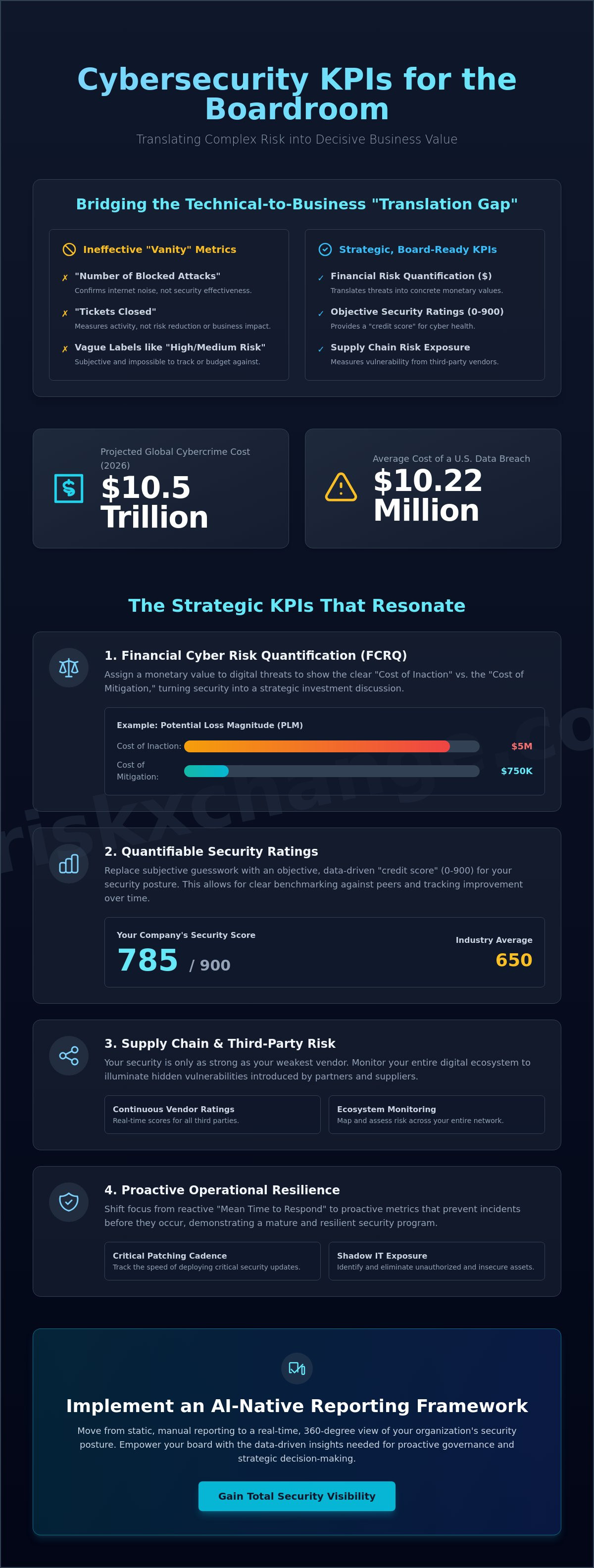
Global cybercrime costs are projected to hit $10.5 trillion in 2026, yet most boardrooms still treat security as an expensive technical mystery. You likely understand that raw data doesn't drive decisions, but translating complex threat vectors into the top cybersecurity kpis for executives that resonate with the C-suite is a persistent challenge. When the average U.S. data breach cost has reached a record $10.22 million, the gap between technical oversight and executive confidence has never been more critical to bridge.
We recognize that your board requires clarity, not an overwhelming list of technical jargon. This article provides a strategic framework to translate granular risk into financial impact and operational resilience. We'll preview the essential metrics that define your external security posture and show you how to move from a state of vulnerability to one of proactive command. You'll gain a clear list of board-ready KPIs and a method for linking security maturity directly to business value, ensuring your leadership team views security as a measurable competitive advantage.
Why Traditional Technical Metrics Fail to Resonate at the Executive Level
Security operations centers often speak a language that sounds like static to a Board of Directors. While technical teams focus on firewall logs and intrusion detection alerts, executives are concerned with fiscal responsibility and market reputation. This disconnect creates a "translation gap" where vital security data is lost in technical noise. To lead effectively, leadership teams need a narrative shift from technical activity to business outcomes. It's no longer enough to report on what the security team is doing; you must report on what those actions mean for the organization's survival.
The "number of blocked attacks" is a classic vanity metric that hides true risk. Reporting that your systems blocked 50,000 pings yesterday doesn't prove you're secure; it simply confirms that the internet is a noisy environment. It doesn't tell the board if a single sophisticated actor is currently dwelling in the supply chain or if a critical vulnerability remains unpatched. Executive cybersecurity KPIs are different. They are quantifiable measures of strategic risk and resilience that focus on the organization's ability to maintain operations under pressure and protect its most valuable assets.
The Difference Between Operational Metrics and Strategic KPIs
Operational metrics are the gears of the security machine. They track efficiency, such as how many tickets were closed or the speed of a malware scan. While important for managers, they don't provide the 360-degree view required for high-level governance. Strategic KPIs focus on risk posture, regulatory compliance, and financial exposure. By aligning reporting with the NIST Cybersecurity Framework, organizations can move beyond "keeping the lights on" to demonstrating how security investments protect the bottom line. This approach allows executives to see the digital landscape through the lens of business continuity rather than just IT maintenance.
The Move Toward Quantifiable Risk Ratings
One of the most effective ways to communicate security health is through quantifiable risk ratings. Much like a corporate credit score, these ratings provide an objective benchmark of an organization's digital posture. They offer an externalized perspective, showing exactly how your organization appears to outside threats and hackers. This shift from qualitative labels like "High" or "Medium" risk to hard numerical data is essential for the top cybersecurity kpis for executives. It replaces subjective guesswork with data-driven honesty, allowing the board to track improvements over time and understand exactly where the organization stands in a volatile technological landscape. By focusing on these benchmarks, security becomes a trackable, manageable asset rather than an abstract expense.
Strategic Cybersecurity KPIs: Translating Risk into Business Value
Effective reporting requires moving beyond technical health to financial relevance. To determine the top cybersecurity kpis for executives, we must look at how risk impacts the balance sheet. This involves quantifying the potential financial fallout of a breach and comparing it against the cost of prevention. By doing so, security moves from being a cost center to a risk-management function that safeguards enterprise value. Leadership teams can then make decisions based on data rather than intuition, especially since the average cost of a U.S. data breach reached $10.22 million in 2025.
Financial Impact & ROI Quantification
Financial Cyber Risk Quantification (FCRQ) is the process of assigning a monetary value to digital threats based on probability and impact. FCRQ acts as the bridge between security and CFOs. By calculating the Potential Loss Magnitude (PLM), you can present the board with a clear "Cost of Inaction" versus "Cost of Mitigation" scenario. This transforms abstract vulnerabilities into strategic business insights. Integrating a real-time risk management platform ensures these projections remain accurate as threats evolve.
Industry Peer Benchmarking
Board members frequently ask how their organization compares to competitors. By using objective 0-900 ratings, you can establish an industry baseline that identifies whether you are a security leader or a laggard. This externalized perspective is vital for 2026 reporting. It allows executives to see the organization as it appears to underwriters and regulators. Benchmarking provides the narrative context needed to explain why certain investments are required to maintain a competitive and resilient posture.
Finally, tracking IT security spend as a percentage of the total IT budget ensures that your investment remains proportional to the evolving threat landscape. This should be coupled with a compliance adherence metric that monitors progress against frameworks like NIST CSF 2.0 or GDPR. These KPIs don't just show that you're compliant; they demonstrate a disciplined commitment to governance and enterprise-wide accountability. When combined, these metrics provide the high-level oversight necessary to drive informed executive decision-making and build long-term board confidence. It moves the conversation from vulnerability to informed resilience, ensuring that every dollar spent contributes to a measurable reduction in enterprise risk.
Monitoring the Extended Enterprise: Third-Party & Supply Chain KPIs
Internal security protocols are no longer the sole measure of an organization's safety. As digital ecosystems become more interconnected, your supply chain often represents your largest unmanaged attack surface. Recent data reveals that third-party breaches have doubled year-over-year, highlighting a critical fragility in complex vendor networks. To provide a complete picture of risk, the top cybersecurity kpis for executives must extend beyond the corporate perimeter to include the vendors, partners, and service providers that handle your data.
Traditional vendor management relied on static, annual questionnaires that offered a mere snapshot in time. In 2026, this approach is insufficient. Executives need real-time visibility into the health of their ecosystem. By tracking the Average Vendor Security Rating across your entire portfolio, you can move from a state of obscurity to one of informed control. This numerical benchmark allows you to identify "Security Laggards" before they become a liability, ensuring that your organization's resilience isn't compromised by a weak link in the chain.
- Percentage of Critical Vendors with 'A' or 'B' Ratings: This metric provides a high-level view of the risk concentration within your most vital partnerships.
- Mean Time to Remediate (MTTR) Third-Party Vulnerabilities: This measures how quickly your vendors close security gaps once they are identified, reflecting the agility of your external defense.
- Vendor Concentration Risk: Tracking how much of your business relies on a single provider helps prevent systemic failure if that provider is compromised.
Supply Chain Attack Surface Visibility
Visibility must go deeper than your direct partners. N-th party risk involves understanding who your vendors' vendors are, as a breach three levels down can still halt your operations. An AI-native TPRM solution platform allows for the mapping of these hidden dependencies, identifying where risks overlap. Instead of reactive damage control, this proactive oversight ensures you understand the full scope of your externalized perspective, allowing for more precise infrastructure oversight.
TPRM Compliance and Regulatory Tracking
Regulators are increasingly holding executives accountable for supply chain failures. Frameworks like the Digital Operational Resilience Act (DORA) and the Cyber Incident Reporting for Critical Infrastructure Act (CIRCIA) require strict monitoring of ICT risk. By integrating TPRM KPIs into your corporate risk register, you ensure that compliance isn't just a checkbox but a continuous process. This level of transparency builds board confidence, demonstrating that the organization understands and manages its true security posture across the entire digital landscape.
Operational Resilience Metrics: Beyond Mean Time to Respond
Resilience is the cornerstone of a modern security strategy. While technical teams track Mean Time to Detect (MTTD) and Mean Time to Respond (MTTR), executives must view these as drivers of business continuity. If the global average time to identify and contain a breach remains at 241 days, every hour saved translates directly to preserved capital. Breaches contained in under 200 days cost an average of $1.14 million less. This makes speed a financial metric. When selecting the top cybersecurity kpis for executives, focus on how operational agility prevents minor incidents from becoming enterprise-wide catastrophes.
Patching Cadence and Exposure Windows
Speed must be balanced with risk-based prioritization. Tracking the time between vulnerability discovery and remediation is vital, but you shouldn't treat all patches equally. A sophisticated strategy prioritizes vulnerabilities based on real-world exploitability rather than just theoretical CVSS scores. This approach reduces the "Window of Opportunity" for ransomware actors who thrive on unpatched, internet-facing assets. By narrowing this window, you move from a state of vulnerability to one of informed resilience. It ensures that your most critical pathways are shielded first, moving the conversation from a state of exposure to one of proactive control.
Shadow IT and External Attack Surface Management
You cannot protect what you cannot see. Shadow IT, including unmanaged cloud instances and forgotten IoT devices, creates "Unknown Unknowns" that bypass traditional defenses. In the remote-work era, digital leakage is a constant threat. AI-native tools are now essential for identifying these assets before they become entry points for adversaries. Monitoring your external attack surface provides that necessary externalized perspective, allowing you to see your organization as a hacker does. This visibility is a prerequisite for any meaningful risk assessment and ensures your security posture is based on your true digital footprint.
Finally, measure the strength of your "Human Firewall" through phishing simulation success rates. While technical controls are primary, human error remains a significant attack vector. A resilient organization combines hardened infrastructure with a security-conscious culture. To maintain this level of oversight, organizations are moving away from static quarterly reports toward real-time intelligence. You can automate your risk monitoring to ensure that your resilience metrics reflect the current state of your digital ecosystem. This transition from obscurity to clarity is what defines a mature security posture in 2026, providing the steady, methodical progression needed for long-term stability.
Implementing an AI-Native Reporting Framework with RiskXchange
Manual spreadsheets and static quarterly reports can't keep pace with a threat landscape that evolves in milliseconds. For leadership to maintain proactive control, they need a transition from obscurity to clarity. Implementing an AI-native reporting framework allows organizations to aggregate the top cybersecurity kpis for executives into a single, unified lens. RiskXchange provides this 360-degree view, moving the conversation from a state of vulnerability to one of informed resilience by treating security as a trackable, numerical benchmark rather than an abstract concept.
This systematic approach ensures that the "Translation Gap" identified earlier is permanently closed. When security is treated as a trackable business metric, it ceases to be a cost center and becomes a competitive advantage. Executives can demonstrate to partners, underwriters, and regulators that their security posture is managed with the same rigor as their financial performance. This projects an image of a sophisticated, tech-forward guardian, instilling a sense of calm confidence even when navigating volatile technological shifts.
Real-Time Security Ratings and Continuous Monitoring
Traditional audits offer a mere snapshot in time, often becoming obsolete before the final report is even delivered. Continuous monitoring replaces this reactive cycle with immediacy and thoroughness. AI-driven analytics evaluate vast datasets to identify patterns that human analysts might miss, offering a level of precision that manual oversight cannot replicate. This allows for the creation of custom executive views that filter out technical noise, highlighting only the critical indicators that impact enterprise-wide accountability and governance. By focusing on these real-time ratings, you gain a lens through which you can evaluate your true security posture at any given moment.
Streamlining Third-Party Risk Management (TPRM)
Managing the extended enterprise is often the most resource-intensive aspect of a modern security program. Automation simplifies this complexity, removing the administrative friction inherent in traditional vendor assessments. By moving to continuous real-time monitoring of your entire supply chain, you eliminate the blind spots that lead to costly breaches. Research from 2026 confirms that organizations using AI and automation saved nearly $2 million per breach compared to those that didn't. This level of infrastructure oversight ensures that your organization remains compliant with evolving regulations like DORA and CIRCIA while maintaining a steady, methodical progression toward resilience. You can Book a demo to see your organization's real-time risk rating and discover how to transform risk into a measurable driver of board-level confidence.
Mastering Strategic Resilience in 2026
The shift toward strategic resilience requires a fundamental change in how you perceive and report on digital risk. By moving away from operational vanity metrics and focusing on the top cybersecurity kpis for executives, you transform security from an abstract technical cost into a measurable business asset. You've seen how quantifying financial impact and automating supply chain oversight creates a narrative of proactive control that resonates with board members and regulators alike.
RiskXchange empowers this transition through an AI-native TPRM platform designed for the complexities of the 2026 threat landscape. Trusted by Fortune 500 companies and operating from hubs in London, Austin, and Dubai, we provide the immediacy and thoroughness required to manage risk across your entire ecosystem. It's time to replace manual snapshots with continuous, real-time intelligence that secures your organization's future.
Get your free external risk assessment and security rating to see exactly how your organization is perceived from the outside. Take command of your security posture and lead your organization toward a state of informed resilience.