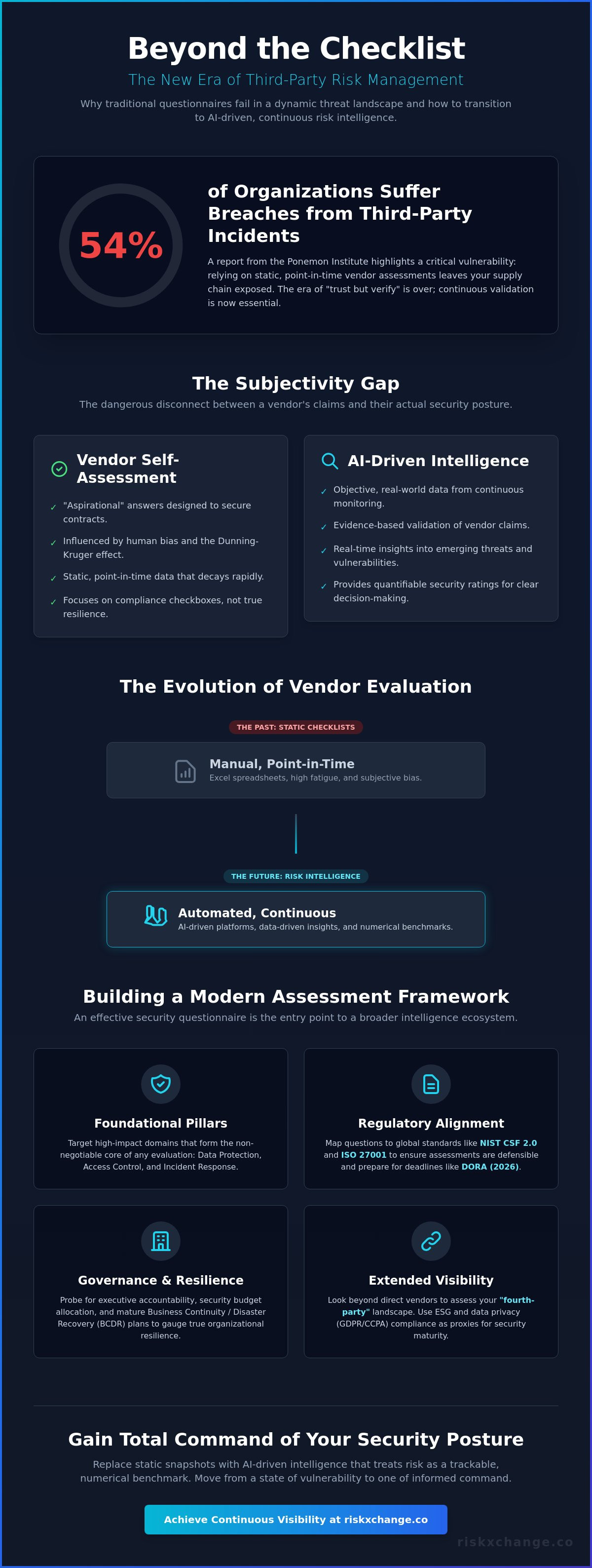
A recent report from the Ponemon Institute reveals that 54% of organizations have experienced data breaches caused by third-party incidents. For most security leaders, the traditional third-party cyber risk assessment questionnaire has become a source of manual spreadsheet fatigue rather than a reliable defense. You've likely encountered vendors who provide "aspirational" answers that don't reflect their actual security posture, leaving you with a growing supply chain that you can't effectively scale or verify.
We agree that a point-in-time checklist is no longer sufficient to meet the rigorous demands of NIST CSF 2.0 or the strict 2026 deadlines of DORA. This guide promises to help you master vendor evaluation by moving toward a sophisticated framework of AI-driven risk intelligence. You'll learn how to build a defensible, automated assessment process that delivers quantifiable security ratings for every vendor. We'll preview the transition from subjective claims to real-time, continuous monitoring, giving you the command and agency needed to manage your external risk with absolute clarity.
What is a Third-Party Cyber Risk Assessment Questionnaire?
A third-party cyber risk assessment questionnaire is a strategic diagnostic tool designed to evaluate the security posture of an external partner. It's the primary mechanism for identifying vulnerabilities before they manifest as supply chain breaches. In 2026, this document is no longer a mere formality; it's a critical component of a defensible security strategy. It allows your organization to look through the lens of a sophisticated tech-forward guardian to see exactly how a vendor manages data, controls access, and responds to incidents.
The 2026 regulatory environment has shifted the burden of proof onto the hiring organization. Frameworks like NIST CSF 2.0 and the Digital Operational Resilience Act (DORA) now require more than just "best effort" documentation. They demand a proactive, evidence-based approach to third-party risk management. While many organizations still rely on a "snapshot" approach, the most resilient firms treat the third-party cyber risk assessment questionnaire as an entry point into a broader, integrated risk intelligence ecosystem.
The Evolution from Checklists to Risk Intelligence
Tracing the history of vendor evaluation reveals a clear trajectory from simple Excel spreadsheets to sophisticated GRC platforms. This evolution reflects a transition from "compliance-only" mindsets to a focus on total operational resilience. Modern assessments don't just ask if a firewall exists; they seek to understand the maturity of the vendor's security culture. This shift introduces the "External Perspective," where security is treated as a trackable, numerical benchmark. By analyzing how an organization is perceived from an outside vantage point, companies can move from a state of vulnerability to one of informed command.
Why Static Questionnaires Fail in a Volatile Threat Landscape
Static questionnaires often suffer from the "Subjectivity Gap." This occurs when vendors provide overly optimistic or "aspirational" answers to secure contracts, often influenced by the Dunning-Kruger effect where they don't fully grasp their own technical deficiencies. Beyond human bias, the decay rate of static data is a critical flaw. In a world where zero-day threats emerge daily, a third-party cyber risk assessment questionnaire completed six months ago offers zero protection against today's risks. With 54% of organizations experiencing data breaches caused by third-party incidents, the need for continuous validation and real-time risk intelligence has never been more urgent. Relying on an annual check-in is an invitation for obscurity in a landscape that demands absolute clarity.
Core Components of an Effective Security Questionnaire
An effective third-party cyber risk assessment questionnaire must move beyond generic queries to target high-impact domains. Data protection, access control, and incident response form the non-negotiable foundation of any evaluation. Without granular visibility into these areas, your organization remains blind to the most common points of failure. Mapping these questions to recognized frameworks like NIST CSF 2.0 or ISO 27001 ensures your assessments are defensible and aligned with global standards. This alignment allows technical leadership to assess and address third-party cybersecurity risks with precision and strategic oversight.
Visibility shouldn't stop at your direct vendor. You need to understand your "fourth-party" landscape, which includes your vendor’s own subcontractors, to prevent hidden vulnerabilities from cascading through your supply chain. In 2026, metrics related to Environmental, Social, and Governance (ESG) and strict data privacy compliance like GDPR or CCPA serve as reliable proxies for a vendor's overall security maturity. A vendor that prioritizes these standards often demonstrates a more disciplined approach to infrastructure oversight.
Governance and Organizational Resilience
True resilience starts with executive accountability. Your questionnaire should probe executive oversight and specific security budget allocations to ensure security isn't just an afterthought. Evaluate internal security training metrics and the maturity of business continuity and disaster recovery (BCDR) plans. These indicators reveal whether a vendor can maintain operations during a crisis or if they lack the structural stability to protect your data under pressure.
Technical Controls and Infrastructure Oversight
Demand granular details on encryption standards for data both at rest and in transit. Inquire about the mandatory implementation of multi-factor authentication (MFA) and the vendor's transition toward a zero-trust architecture. Vendors should report their vulnerability management cycles as a documented frequency of scan-to-remediation timelines. To move from subjective claims to verified data, many leaders now use continuous risk intelligence to validate these technical responses in real-time.
Modern Additions for 2026: AI and Supply Chain Ethics
The 2026 threat landscape requires evaluating a vendor’s use of AI-native tools and their specific protections against data leakage. Request a software bill of materials (SBOM) to ensure code integrity and assess the security of the vendor’s own digital supply chain. This level of thoroughness transforms a standard third-party cyber risk assessment questionnaire into a proactive shield, ensuring every link in your chain is as resilient as your internal defenses.
The Subjectivity Gap: Why You Cannot Rely on Questionnaires Alone
The most significant flaw in any vendor evaluation process is the subjectivity gap. While a third-party cyber risk assessment questionnaire provides a necessary baseline, it remains a reflection of a vendor's self-perception rather than their technical reality. We often see the Dunning-Kruger effect in IT departments where teams lack the granular visibility to recognize their own security deficiencies. This leads to "aspirational" answers where vendors describe the security posture they intend to have, rather than the one they currently maintain. To achieve true resilience, you must move from a state of blind trust to a model of informed command.
Regulatory bodies recognize that static claims are insufficient for modern risk management. The OCC guidance on third-party risk management emphasizes that due diligence is an ongoing obligation that requires continuous monitoring and verification. By integrating internal claims with external, observable data, you create a 360-degree view of your supply chain. This externalized perspective acts as a narrative device, showing you exactly how a vendor appears to a potential attacker. It transforms security from an abstract concept into a trackable, numerical benchmark that your board can understand and act upon.
The High Cost of "Paper Security"
History is replete with examples of breached organizations that had recently "passed" their security assessments with flying colors. This "paper security" creates a dangerous sense of false confidence. Manual reviews of these documents often create significant bottlenecks, slowing down business velocity and delaying critical partnerships. When a third-party cyber risk assessment questionnaire fails to identify a known vulnerability that later leads to a breach, the liability shift can be devastating. You aren't just managing a checklist; you're managing the legal and financial stability of your enterprise.
Bridging the Gap with AI-Native Monitoring
Modern risk management requires a transition to data-driven partnerships. AI-native platforms now identify discrepancies between questionnaire answers and actual infrastructure behavior in real-time. If a vendor claims to have robust encryption but external scans show expired certificates or open ports, the system flags the inconsistency immediately. This creates an objective "Truth Metric" that removes the friction of manual verification. It allows you to act as a sophisticated guardian, ensuring that your vendors don't just promise security, but consistently demonstrate it through quantifiable performance. This transition from obscurity to clarity ensures your supply chain remains a source of strength, not a point of failure.
Step-by-Step: Building a Scalable Assessment Process
Building a third-party cyber risk assessment questionnaire process requires a methodical approach that balances granular technical expertise with high-level strategic oversight. A linear, one-size-fits-all strategy often collapses under the weight of a growing supply chain, leading to manual spreadsheet fatigue. Instead, you need a cyclical framework that integrates direct vendor feedback with objective, external intelligence. This organized progression ensures that security is treated as a trackable, numerical benchmark rather than an abstract concept.
The first step is to tier your vendors by criticality and data access levels. Following this, you must select a baseline framework, such as NIST CSF 2.0, SIG, or CAIQ, to ensure your data collection is standardized and defensible. Once the framework is set, automate the distribution and follow-up via an AI-native TPRM platform to eliminate the bottlenecks of manual administration. The final stages involve cross-referencing vendor responses with external attack surface data and generating a quantifiable risk score to drive prioritized remediation efforts.
Tiering Your Supply Chain for Efficiency
A "one size fits all" questionnaire fails because it overwhelms low-risk vendors while potentially underserving critical ones. Define "Critical," "High," and "Low" risk categories based on the potential impact of a data breach or operational outage. Critical vendors require a deep-dive third-party cyber risk assessment questionnaire, while low-risk partners might only need a simplified compliance check. Sophisticated organizations also use automated discovery tools to identify "Shadow IT" vendors, ensuring that no third-party relationship exists in obscurity outside of official procurement channels.
Mapping Responses to the External Attack Surface
Verification is the cornerstone of modern risk management. You can verify claims about patch management and encryption standards through external scanning techniques that analyze a vendor's public-facing digital footprint. By using RiskXchange, you gain an externalized perspective, seeing exactly how a vendor’s infrastructure appears to potential threats from the outside. When discrepancies arise between a vendor's claims and the observable data, prioritize the evidence-based findings to initiate a targeted remediation dialogue. This transition from blind trust to informed resilience ensures your security posture remains robust against volatile threats. If you're ready to move beyond manual checklists, explore our AI-native TPRM platform to automate your entire assessment lifecycle.
RiskXchange: Moving Beyond Static Questionnaires to Continuous Visibility
RiskXchange transforms the traditional third-party cyber risk assessment questionnaire from a static document into a dynamic stream of AI-native intelligence. While previous sections of this guide highlighted the subjectivity inherent in self-reported data, our platform provides the objective validation necessary for true supply chain resilience. It automates the entire assessment lifecycle, managing everything from initial vendor onboarding to final offboarding with surgical precision. This approach ensures that your security posture is never a matter of guesswork. Instead, it becomes a trackable, numerical benchmark that reflects your real-time risk profile through a single, integrated lens of ESG, data protection, and cybersecurity.
By positioning the brand as a tech-forward guardian, RiskXchange moves your organization from a state of vulnerability to one of informed resilience. We treat security as a quantifiable metric, allowing you to see exactly how your vendors are perceived from an external vantage point. This externalized perspective is the only way to verify that the claims made in a third-party cyber risk assessment questionnaire align with the technical reality of the vendor's infrastructure. Our platform simplifies the overwhelming complexity of the modern threat landscape, providing the clarity required for sophisticated risk management.
Real-Time Risk Management for Global Enterprises
Continuous monitoring offers a level of security that annual or bi-annual assessments simply cannot match. RiskXchange provides actionable intelligence to Fortune 500 decision-makers, ensuring that strategic oversight is backed by granular technical data. With a global presence and offices in London, Austin, and Dubai, we provide the localized support and international expertise necessary to manage complex, borderless supply chains. This steady and methodical rhythm of oversight prevents the "decay rate" of security data, ensuring your risk posture is always current and measurable.
Empowering Your Team with Automated Remediation
True command of your security environment requires more than just identifying risks; it requires the ability to fix them. Our platform empowers your team by providing automated remediation pathways that bridge the gap between discovery and resolution. You'll move from feeling vulnerable to exercising proactive control over your digital ecosystem. This transition from obscurity to clarity ensures that your security posture is always defensible and aligned with the highest global standards. To see how our technology can transform your vendor evaluation process, request a demo of RiskXchange’s AI-native TPRM platform and take command of your supply chain risk today.
Take Command of Your Supply Chain Security
The transition to NIST CSF 2.0 and the 2026 DORA deadlines requires a fundamental shift from static checklists to active risk intelligence. You've seen how the traditional third-party cyber risk assessment questionnaire serves as a vital starting point, yet it requires objective validation to bridge the subjectivity gap. By tiering your supply chain and integrating real-time visibility, you replace manual uncertainty with a trackable, numerical benchmark. This approach provides the technical clarity needed to manage complex vendor relationships with absolute confidence.
RiskXchange provides an AI-native TPRM solution that automates the assessment lifecycle, delivering the real-time security ratings trusted by Fortune 500 enterprises. Our platform ensures that your vendor evaluations are rooted in data-driven honesty rather than aspirational claims. It's time to move your organization from a state of vulnerability to one of informed resilience. Secure your supply chain with RiskXchange’s 360-degree risk platform. You now have the framework to transform your external security posture into a source of permanent stability and strategic advantage.