If your organization relies on a security assessment conducted six months ago, you're essentially navigating a 2026 threat landscape using a map from 2024. A point-in-time audit becomes obsolete the moment it's finalized because your attack surface changes every hour. You likely feel the pressure of maintaining supply chain visibility while struggling to explain technical vulnerabilities to board members who only care about business risk. It's a common challenge; a 2023 industry report found that 60% of security leaders feel their current tools provide an incomplete view of their external risks.
We're here to help you take control. This guide moves you beyond static checklists toward a continuous, data-driven strategy that protects your entire ecosystem in real-time. You'll discover a clear roadmap for both internal and external evaluations that turn raw data into actionable intelligence. We will also examine how to leverage your Cybersecurity Rating to gain an outside-in view of your posture, ensuring you can identify and remediate threats before they're exploited. By the end of this article, you'll have the framework needed to move from digital vulnerability to informed resilience.
Defining the Security Assessment: Beyond the Digital Health Check
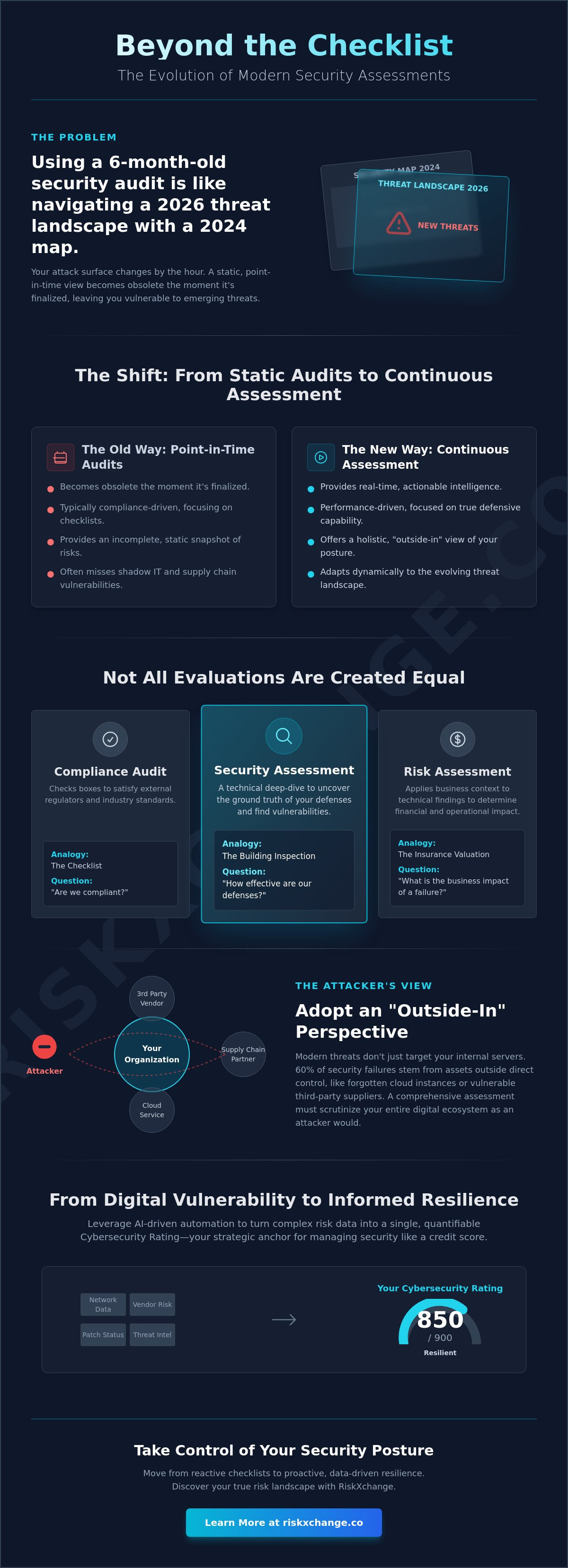
A Information technology security assessment isn't a passive checklist or a one-time hurdle. It's a proactive, strategic evaluation of your organization's entire digital posture. While many executives confuse these evaluations with audits, the two serve different masters. An audit is typically compliance-driven, checking boxes to satisfy external regulators. In contrast, a security assessment is performance-driven. It's designed to uncover the ground truth of your defenses before an adversary does.
This process also differs from penetration testing. While a pen test is exploit-driven, focusing on a specific path of attack, an assessment provides a holistic view of your risk landscape. It moves your organization from a state of digital vulnerability to one of informed resilience. We treat security as a measurable asset. By utilizing a Cybersecurity Rating, we transform abstract technical data into a quantifiable metric. This rating acts as your strategic anchor, allowing you to track improvements and manage your "outside-in" profile with the same precision as a credit score.
The Core Objectives of a Modern Assessment
The primary goal is to eliminate the "unknown unknowns." In 2024, IBM reported that the average time to identify and contain a breach was 258 days. A rigorous assessment shortens this window by focusing on three pillars:
- Identifying Blind Spots: We map your entire attack surface, including shadow IT and forgotten cloud instances that often sit outside the view of internal IT teams.
- Validating Control Effectiveness: It's not enough to own a tool; it must be configured correctly. We test whether your existing protocols actually stop the threats they were designed to mitigate.
- Empowering the C-Suite: We translate granular technical findings into actionable intelligence. This allows decision-makers to allocate budgets based on empirical data rather than speculative fear.
Security Assessment vs. Risk Assessment: Clearing the Confusion
People often use these terms interchangeably, but they represent different stages of the management cycle. Think of a security assessment as a professional building inspection. The inspector tests the wiring, checks the structural integrity of the beams, and ensures the locks are functional. It's a technical deep dive into the "how" of your protection.
A risk assessment is the insurance valuation that follows. It takes the technical data from the inspection and applies business context. It asks what the financial impact would be if a specific failure occurred. You can't have a reliable risk assessment without the technical foundation of a security assessment. Both are necessary to achieve a 360-degree view of your enterprise. By 2026, companies that integrate these two disciplines see a 30% faster response time to emerging threats because they aren't wasting time debating the data's accuracy.
The Anatomy of a Comprehensive Security Assessment Framework
Effective risk management requires a structured blueprint. Organizations typically align their efforts with industry-standard frameworks such as NIST SP 800-53, ISO 27001, or SOC2. These standards provide a repeatable methodology for testing security controls. The NIST definition of security assessment emphasizes that these evaluations aren't just technical drills; they're systematic examinations of system properties to determine control effectiveness.
Scoping remains the most critical phase. You must define exactly which assets are in-bounds. In 2026, 60% of security failures stem from assets that were forgotten during the scoping process. Modern assessments have shifted focus. They no longer look only at internal servers. They now scrutinize the entire supply chain and organizational hierarchy. AI plays a pivotal role here. It processes vast amounts of telemetry data to find patterns that human analysts might overlook. This ensures your security assessment is data-driven rather than anecdotal.
Technical Security: Probing the Infrastructure
Infrastructure testing focuses on the hard shell of your digital environment. Engineers evaluate network segmentation to ensure that a breach in one department doesn't lead to total system compromise. They also verify encryption standards for data at rest and in transit. Access management is scrutinized to ensure the principle of least privilege is active. Automated vulnerability scanning identifies known weaknesses across thousands of nodes simultaneously. The attack surface is the total sum of all possible entry points for an unauthorized user. By quantifying these entry points, you can prioritize remediation based on actual risk.
Organizational and Human Risk Factors
Technical excellence counts for little if your internal policies are weak. 82% of successful intrusions involve social engineering or human error. A robust security assessment evaluates employee awareness and incident response readiness. Organizational security is often the weakest link because it relies on human behavior rather than immutable code.
Modern risk profiles also integrate ESG (Environmental, Social, and Governance) factors. Investors now view governance as a direct indicator of a firm's resilience. To stay ahead, companies must look beyond their own walls. You can gain total visibility into your external posture to see exactly what attackers see. This outside-in perspective turns abstract threats into a manageable Cybersecurity Rating, moving your team from a state of vulnerability to one of informed control.
Static vs. Continuous: Solving the Point-in-Time Problem
In 2026, the traditional annual security assessment is essentially dead on arrival. A static report offers a snapshot of a moment that has already passed, yet the modern threat landscape moves in milliseconds. Relying on a point-in-time audit is like checking a weather report from last month to decide if you need an umbrella today. While static assessments provide a necessary foundation for compliance, they can't keep pace with rapid threat evolution.
The 2026 standard has shifted toward Continuous Security Monitoring (CSM). This approach moves beyond the "pass-fail" mentality of annual reviews. Real-time Cybersecurity Ratings provide a more accurate reflection of risk than any static document. They act as an active defense layer, turning security into a tangible, trackable metric that decision-makers monitor daily. This transition allows organizations to see their true security posture through an "outside-in" lens, identifying blind spots before they're exploited.
The Limitations of Manual Security Reports
Manual data collection is a massive resource drain. Industry data shows that security teams spend up to 40% of their time gathering evidence for manual audits. This effort often results in a "remediation lag," where critical vulnerabilities remain unaddressed for an average of 65 days while the report is being finalized. Using the Federal Information Technology Security Assessment Framework provides a necessary structural guide, but manual execution fails to address the speed of modern threats. Manual reporting typically fails due to:
- Data obsolescence occurring before the final report is published.
- Significant misallocation of high-value engineering talent.
- A complete lack of real-time supply chain visibility.
This lag forces a reactive firefighting posture. Moving toward automation allows for a psychological shift where risk is managed with quiet confidence and proactive control. It moves the conversation from a state of digital vulnerability to one of informed resilience.
Leveraging AI for Real-Time Risk Intelligence
AI-native platforms now ingest vast datasets to provide instant visibility across the entire attack surface. These systems offer continuous validation for complex frameworks like NIST SP 800-53, ensuring that compliance is a constant state rather than a yearly hurdle. This technology identifies shifts in the digital footprint as they happen, providing actionable data to the CISO and the board alike.
Continuous security monitoring reduces the mean time to detect (MTTD) by providing a 24/7 view of the digital footprint.
By treating security as a trackable metric, you transform the security assessment from a bureaucratic chore into a strategic advantage. This real-time intelligence allows for seamless supply chain visibility and ensures that your defensive posture is always aligned with the current threat environment.
The 'Outside-In' Perspective: Assessing Your Supply Chain
Attackers don't see your organization as a single, isolated fortress. They view you as a node within a complex, interconnected ecosystem. Adopting an outside-in perspective allows you to see your digital presence exactly as a threat actor does, identifying the weakest links before they're exploited. This shift in mindset is essential because your perimeter effectively extends to every vendor you trust. Data from the 2024 Ponemon Institute report indicates that 60% of data breaches now originate through a third-party partner. If your security assessment ignores these external dependencies, you're essentially leaving the back door unlocked while you double-bolt the front.
Step-by-Step: Evaluating Third-Party Security Posture
Managing a global supply chain requires moving beyond static, once-a-year audits. You need a proactive framework to verify that your partners maintain the same standards you do. This process moves risk from a vague concern to a manageable metric through four key steps:
- Identify and Tier: Catalog every vendor that handles sensitive data or connects to critical systems. Prioritize them based on the level of access they require.
- Automate Ratings: Deploy automated monitoring tools to generate real-time Cybersecurity Ratings for your entire ecosystem. This provides a quantifiable baseline for vendor health.
- Standardize Criteria: Apply the same rigorous assessment criteria to every partner to ensure objective risk measurement across the board.
- Remediate: Create a clear remediation workflow that triggers automatically when a vendor's rating drops below an acceptable threshold.
This structured approach provides the visibility needed to make informed decisions about your business partnerships. It ensures that your vendors are assets to your growth, not liabilities to your reputation.
Managing the Shadow IT and Digital Footprint
Your digital footprint grows every time a team launches a new cloud instance or registers a subdomain without central oversight. These forgotten assets often lack the security controls of your primary systems, making them prime targets for reconnaissance. Attack Surface Management (ASM) plays a vital role in a modern security assessment by continuously scanning for these vulnerabilities. By maintaining a dynamic inventory of all digital assets, you eliminate the blind spots created by Shadow IT. This level of supply chain visibility ensures that your risk management strategy covers 100% of your exposure, not just the parts you've officially documented.
Gain full visibility into your digital footprint and take control of your external risk by booking a comprehensive security assessment with our expert team.
Taking Control: Automating Resilience with RiskXchange
A manual security assessment provides a valuable snapshot, but it's ultimately a look in the rearview mirror. In a landscape where threats evolve hourly, your organization needs a proactive, continuous mechanism for oversight. RiskXchange represents the final stage of this maturity journey. Our AI-native platform doesn't just identify risks; it automates the entire resilience lifecycle to ensure your defense is as dynamic as the threats it faces. We help you move beyond the limitations of point-in-time checks toward a state of constant readiness.
The RiskXchange 360-Degree Platform Advantage
We bridge the gap between granular technical vulnerabilities and high-level business strategy. By utilizing an outside-in perspective, we show you exactly what an attacker sees across your attack surface. This data is distilled into a single, quantifiable Cybersecurity Rating, a metric that provides the C-suite with instant clarity. Our platform delivers several core advantages that transform how you manage digital risk:
- Automated Vendor Risk: We automate approximately 80% of the vendor risk assessment lifecycle, saving your team hundreds of manual professional service hours each year.
- Unified Visibility: Cybersecurity, data protection, and ESG metrics are integrated into a single pane of glass, ensuring compliance across multiple regulatory frameworks without fragmented reporting.
- Actionable Intelligence: Real-time alerts move your team from "blind spots" to total visibility, allowing for immediate remediation of critical vulnerabilities before they are exploited.
Getting Started: From Visibility to Action
Transitioning from a state of vulnerability to informed resilience is a structured, methodical process. You can integrate RiskXchange into your existing security stack via our robust API, ensuring that real-time risk data flows directly into your SOC or GRC tools. This seamless integration allows your team to maintain their existing workflows while gaining much deeper insights. For organizations with complex global supply chains, our professional consulting services offer custom implementation paths that align with your specific risk appetite and operational goals.
It's time to stop guessing and start knowing. By adopting a continuous security assessment model, you're not just checking a compliance box; you're building a foundation of trust with your partners and customers. Take control of your digital footprint today. Our experts are ready to show you how total visibility can transform your risk management from a reactive burden into a strategic competitive advantage. We provide the tools and the mentorship you need to secure your future with confidence.
Mastering Resilience through Continuous Visibility
Managing digital risk in 2026 requires moving beyond the static checklists of the past. You've seen how the traditional, point-in-time security assessment fails to capture the rapid fluctuations of a modern attack surface. True resilience stems from an outside-in perspective that accounts for every vulnerability across your entire ecosystem. By shifting to a model of continuous monitoring, you eliminate the blind spots that often hide within complex supply chains. It's about seeing what the attacker sees before they have a chance to act.
RiskXchange provides the clarity needed to navigate this landscape with confidence. Our AI-native real-time risk intelligence is already trusted by Fortune 500 enterprises globally to maintain actionable 360-degree supply chain visibility. You don't have to guess where your weaknesses lie; you can measure them with precision. It's time to replace uncertainty with a quantifiable strategy that protects your brand and your partners. You're ready to transform your reactive defenses into a proactive shield that grows with your business.
Take control of your digital footprint with a free RiskXchange security rating today.