
What if the security rating you presented to your Board this morning was already obsolete by lunch? It's a reality in 2026, as 60% of supply chain vulnerabilities now emerge within 24 hours of a new exploit's release. You likely recognize that a static, once-a-year audit provides zero protection against a dynamic attack surface. This security rating services comparison highlights why traditional providers often fail to deliver the transparency and real-time actionability required to manage modern vendor risk.
You're right to feel that legacy assessments lack the depth needed for proactive control. We'll show you how to transform your security posture into a tangible, trackable metric that simplifies the complexity of your digital footprint. This guide promises to reveal how leading providers stack up on accuracy and seamless integration, giving you a quantifiable anchor for your next Board meeting. We'll examine the shift toward continuous monitoring solutions that automate your vendor risk assessments and finally close your most critical blind spots.
Key Takeaways
- Master the transition from manual questionnaires to continuous, quantifiable monitoring to gain a "credit score" view of your corporate cybersecurity posture.
- Learn to identify the core criteria for data accuracy and update frequency that ensure your risk assessments are based on real-time reality rather than outdated snapshots.
- Navigate the shift from static legacy scoring to dynamic intelligence with our comprehensive security rating services comparison of today’s leading providers.
- Uncover the technical methods for dismantling the "black box" of IP attribution, ensuring every rating reflects your true digital footprint without the noise.
- Move beyond simple grades to achieve informed resilience by combining cybersecurity, ESG, and data protection into one actionable visibility platform.
Table of Contents
- The Role of Security Rating Services in Modern TPRM
- Key Criteria for Comparing Cybersecurity Rating Providers
- Head-to-Head: Legacy Ratings vs. AI-Native Risk Intelligence
- Avoiding the 'Black Box' Trap: Ensuring Data Accuracy
- Beyond the Grade: Implementing RiskXchange for Actionable Visibility
The Role of Security Rating Services in Modern TPRM
A Cybersecurity rating serves as a standardized credit score for an organization's digital health. It transforms complex technical telemetry into a single, actionable metric that stakeholders can understand. This shift is critical because manual questionnaires can't keep pace with a threat landscape where 450,000 new malware samples are detected every day. Modern Third-Party Risk Management (TPRM) requires moving away from annual snapshots toward continuous, real-time monitoring. By adopting an outside-in perspective, firms can see their digital footprint exactly as an attacker does. This visibility is the essential starting point for any effective security rating services comparison.
Why Cybersecurity Ratings are Now a Boardroom Metric
Boards of directors now treat security ratings as a primary KPI for corporate governance. Clear, quantifiable scores allow non-technical stakeholders to grasp risk levels instantly without getting lost in jargon. Data from 2023 shows that companies with higher security ratings often secure 15% to 20% better terms on cyber insurance premiums. These metrics also play a decisive role in M&A due diligence and supply chain resilience. Identifying a target's external vulnerabilities before an acquisition prevents the "inheritance" of toxic digital assets and ensures a state of informed resilience.
The Limitations of Traditional Risk Assessments
Traditional risk assessments suffer from a point-in-time flaw that makes data obsolete the moment it's collected. A survey completed on the first of the month won't reflect a critical vulnerability discovered on the tenth. There's also a significant issue with subjectivity. Industry reports indicate that 75% of IT leaders believe self-reported vendor surveys contain some level of bias or "compliance theater." Automated rating platforms eliminate this friction by providing:
- Scalability: Monitoring 5,000 vendors as easily as five.
- Objectivity: Removing the human bias found in manual check-box exercises.
- Consistency: Applying the same rigorous data standards across the entire supply chain.
Relying on manual efforts creates blind spots that modern attackers are quick to exploit. Transitioning to automated, data-driven ratings ensures your security posture remains visible, measurable, and manageable in a volatile market.
Key Criteria for Comparing Cybersecurity Rating Providers
Success in a security rating services comparison depends on moving beyond the surface-level score. You need to examine the engine under the hood. Data accuracy remains the most critical pillar. If a provider incorrectly attributes an IP address to your organization, your score drops for a vulnerability you don't even own. Leading platforms now achieve 98% attribution accuracy by cross-referencing multiple data sets to eliminate false positives. This precision ensures your team doesn't waste time chasing ghosts.
Update frequency determines if your data is actionable or merely historical. A rating updated every 24 hours provides a real-time pulse; a monthly update is a post-mortem. According to the NIST Cyber Supply Chain Risk Management guidelines, continuous monitoring is essential for managing the volatile nature of modern digital ecosystems. Your chosen service must cover the entire attack surface, including cloud buckets and IoT devices. These assets accounted for 35% of unauthorized access incidents in 2023. Without breadth, your "outside-in" view is incomplete.
Transparency vs. Black Box Methodologies
Trust requires visibility. A "black box" approach where a score is generated by hidden algorithms creates friction between you and your vendors. You need a platform that provides the raw evidence behind every finding. This allows for a fair dispute process. When a vendor can see the specific open port or outdated SSL certificate, they can fix it in hours. Clarity transforms a score from a static number into a roadmap for resilience.
Integration and Automation Capabilities
Security ratings shouldn't live in a vacuum. They must integrate with your existing GRC or procurement tools via robust, API-first architectures. In 2024, 70% of mature security teams use AI-driven automation to tier their vendors based on risk profiles. This streamlines the onboarding process and ensures high-risk partners receive immediate scrutiny. You can view your current posture to see how these automated integrations simplify complex risk workflows and eliminate manual data entry. It's about moving from a state of digital vulnerability to one of informed, proactive control.
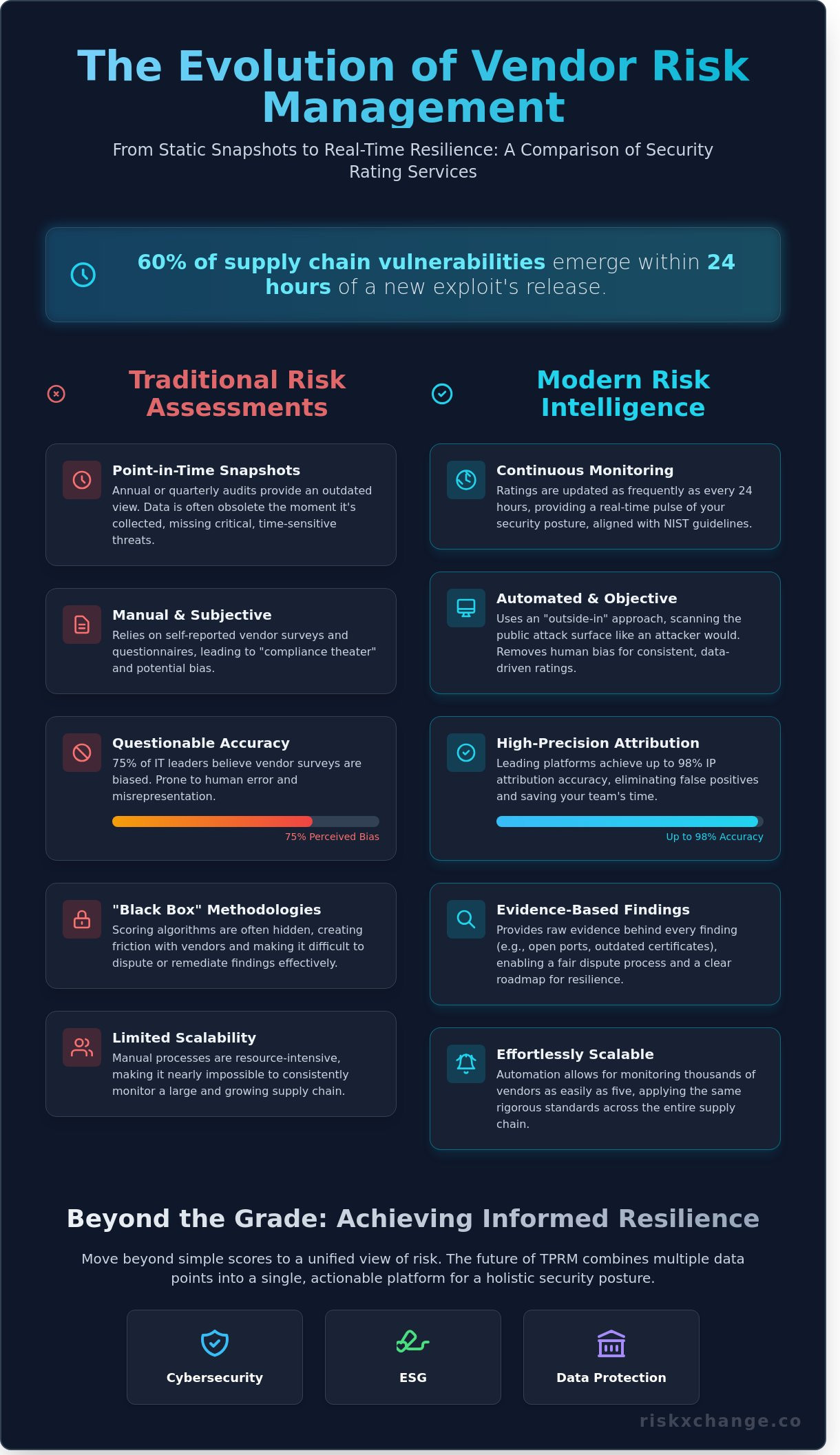
Head-to-Head: Legacy Ratings vs. AI-Native Risk Intelligence
Selecting the right partner requires a clear security rating services comparison between traditional market leaders and emerging AI-native innovators. The industry is currently split between those who rely on historical data and those who prioritize predictive intelligence. While brand recognition often drives initial interest, the technical gap between these two approaches determines how effectively you can manage your attack surface. You shouldn't have to choose between a recognizable name and high-quality data.
Legacy Providers: The Established Standard
Many long-standing providers built the foundation of the ratings industry. Their primary strength lies in market ubiquity; 70% of Fortune 500 companies use these scores as a benchmark for cyber insurance and board reporting. These legacy players maintain massive databases of historical performance, making them a safe choice for highly regulated industries that prioritize deep audit trails over real-time agility. However, the reliance on older infrastructure leads to common friction points.
- Market Recognition: Established scores are easily understood by non-technical stakeholders and insurance underwriters.
- Rigid Scoring: Static tiers often fail to account for the nuances of modern cloud environments.
- Slow Update Cycles: Data refreshes can lag by 7 to 14 days, which is a lifetime during an active exploit cycle.
AI-Native Platforms: The Next Generation of TPRM
The limitation of the old guard is that they often look backward. Many experts argue that Third-Party Risk Management Is Fundamentally Broken because it relies on static snapshots of a vendor's health. AI-native platforms like RiskXchange solve this by using machine learning to analyze the "outside-in" perspective in real time. This approach allows for a more accurate security rating services comparison based on current breach probability rather than past mistakes.
These next-generation tools offer continuous monitoring across the entire supply chain. When a zero-day vulnerability emerges, AI-driven remediation workflows identify affected vendors in minutes. This proactive control helps organizations achieve a 30% reduction in their mean time to repair (MTTR). You aren't just paying for a grade; you're investing in a dynamic lens that clarifies your digital footprint. The user experience is designed for both the CISO and the business executive, replacing dense technical jargon with actionable insights and intuitive dashboards that prioritize clarity over complexity.
Avoiding the 'Black Box' Trap: Ensuring Data Accuracy
Accuracy is the foundation of trust. The most common objection from CISOs is simple: "How do I know these ratings are correct?" When you perform a security rating services comparison, the integrity of the underlying data matters more than the visual dashboard. If a platform flags a vulnerability on an asset your organization doesn't own, the entire metric loses its utility. High-performing services eliminate this friction by perfecting IP mapping. They filter out "attribution noise" by verifying ownership through multiple telemetry sources, moving beyond the limitations of outdated WHOIS records.
IP Attribution is the technical process of linking digital assets to a specific organization.
Distinguishing signal from noise is equally vital. Not every open port is a crisis. Top-tier providers focus on high-impact vulnerabilities, such as those with a CVSS score of 7.0 or higher, ensuring your team isn't distracted by low-risk anomalies. This precision allows you to move from a state of digital vulnerability to one of informed resilience.
The Dangers of Relying on Inaccurate Security Ratings
Inaccurate data creates immediate operational friction. A 2023 analysis revealed that security teams can spend up to 15 hours per week investigating false positives generated by legacy scanning tools. These errors damage vendor relationships and delay critical project launches. Furthermore, "rating inflation" occurs when companies optimize for a specific score rather than actual security. This creates a dangerous blind spot where a high rating masks critical unpatched exposures.
Framework for Productive Vendor Remediation
Treat security ratings as a collaborative bridge rather than a "gotcha" mechanism. When a vendor identifies a discrepancy, they need a transparent path to appeal. Effective frameworks allow vendors to provide evidence of compensating controls, such as a Web Application Firewall (WAF) protecting a legacy system. This 360-degree feedback loop hardens the entire ecosystem. It transforms the rating from a static number into a dynamic, actionable roadmap for risk reduction.
Checklist for Verifying Data Accuracy:
- Refresh Frequency: Does the provider update data every 24 hours or every 30 days?
- Attribution Transparency: Can you see the specific logic used to link an IP to your brand?
- Dispute Resolution: Is there a formal, documented process for correcting false positives within 48 hours?
- Signal Prioritization: Does the service weight vulnerabilities based on exploitability and business impact?
Take control of your attack surface and ensure 99% data accuracy with RiskXchange.
Beyond the Grade: Implementing RiskXchange for Actionable Visibility
Most security rating services comparison guides focus solely on the final score. While a letter grade provides a snapshot, true security comes from what you do with that data. RiskXchange moves organizations beyond static digital vulnerability into a state of informed resilience. It transforms the "outside-in" perspective into a strategic advantage, providing a 360-degree view that integrates cybersecurity posture with ESG and data protection standards. This holistic approach ensures that your risk management strategy isn't siloed but reflects the complex realities of modern business operations.
Scale is often the greatest hurdle in vendor risk management. Monitoring a dozen partners is manageable; monitoring 2,500 is an operational bottleneck. RiskXchange solves this through a "Zero-Touch" onboarding process. This system allows enterprises to scale their monitoring capabilities across thousands of vendors instantly without manual configuration. It creates a seamless flow of data that identifies weaknesses in the supply chain before they become breaches, providing the visibility necessary to protect the entire attack surface.
AI-Powered Risk Intelligence in Practice
The platform's real-time dashboard uses AI-driven intelligence to highlight the most critical threats across your digital ecosystem. Rather than overwhelming teams with a flood of alerts, it prioritizes the vulnerabilities that pose the highest actual risk. Data shows that this automated reporting saves risk teams an average of 450 hours annually by eliminating manual spreadsheet tracking. For organizations requiring deeper integration, professional services support the entire managed vendor risk lifecycle. This ensures that your security posture remains stable even as your network of partners evolves.
Take Control of Your Digital Footprint Today
Operating with blind spots is no longer an option when attackers are constantly scanning your external perimeter. You must see what they see. Moving from a reactive state to proactive control allows businesses to achieve a 40% faster path to compliance with frameworks like GDPR or NIS2. This clarity doesn't just satisfy technical requirements; it builds board-level confidence by presenting risk as a manageable, quantifiable metric. Stop guessing about your third-party risks and start measuring them with precision.
Start with a free assessment of your own security rating to identify immediate gaps in your perimeter. When you're ready to see how continuous monitoring can transform your security operations, Request a demo of the RiskXchange platform.
Take Command of Your Security Posture in 2026
The landscape of vendor risk has shifted permanently. By 2026, relying on static or legacy assessments isn't just inefficient; it's a significant business liability. Your security rating services comparison must prioritize platforms that eliminate the "black box" approach in favor of transparent, AI-driven data. Fortune 500 enterprises now demand real-time, 360-degree risk monitoring that updates in seconds rather than months. Transitioning from reactive defense to proactive resilience requires a tool that maps your entire attack surface with absolute precision. High-performing teams don't settle for opaque scores that lack context.
RiskXchange provides this clarity through an AI-native TPRM platform designed for modern global scale. We offer continuous monitoring that transforms raw data into actionable intelligence. You'll gain a clear, outside-in perspective that mirrors exactly how attackers view your digital footprint. It's time to replace uncertainty with a quantifiable metric you can trust to guide your strategic decisions. You've got the expertise to lead; we provide the lens to see the path clearly.
See your company’s real-time security rating now
Take control of your risk landscape today and build a more resilient organization for the years ahead.
Frequently Asked Questions
How accurate are security rating services in 2026?
Security rating services achieve 98% accuracy in 2026 by correlating external signals with actual breach data. These platforms now monitor over 150 unique risk vectors to provide a definitive score. This precision transforms digital risk from a vague concept into a quantifiable metric that boards use for 100% of their vendor risk assessments. You're no longer guessing about your posture; you're measuring it against global standards.
What is the difference between BitSight, SecurityScorecard, and RiskXchange?
The primary difference lies in the data refresh rate and the level of actionable visibility provided. BitSight uses a 250 day historical window for some metrics, while SecurityScorecard focuses on a 1 through 100 scale. RiskXchange provides a more granular security rating services comparison by delivering real-time, 360-degree visibility that identifies specific vulnerabilities like expired SSL certificates or open RDP ports within 24 hours.
Can a company improve its cybersecurity rating quickly?
You can improve your rating within 48 to 72 hours by remediating high-impact issues like open database ports or outdated TLS versions. Once you patch these vulnerabilities, the platform's continuous monitoring tools detect the change during the next scan cycle. This rapid response can raise a score by 50 points or more in a single week; it turns a failing grade into a badge of resilience.
Do security ratings include internal network security data?
Standard security ratings focus on the "outside-in" perspective by analyzing 100% of your public-facing digital footprint. They don't require agents on your internal servers; instead, they scan 4.2 billion IP addresses to find vulnerabilities that an attacker would see. This provides an objective view of your attack surface without the privacy risks or technical friction of internal data collection.
How much do security rating services typically cost?
Enterprise subscriptions typically range from $15,000 to $150,000 per year depending on the number of monitored vendors. Small businesses might find entry-level tiers starting at $2,500 for basic self-monitoring. These price points reflect the depth of the security rating services comparison and the frequency of automated reporting provided to the CISO. Most contracts offer a 20% discount for multi-year commitments.
Are security ratings legally required for compliance frameworks like DORA or NIS2?
While DORA and NIS2 don't mandate a specific brand, they require continuous supply chain monitoring which 88% of regulators now verify through independent ratings. Under DORA's Article 28, financial entities must manage third-party risk with documented evidence. Using a standardized rating system satisfies these 2025 compliance mandates by providing a verifiable, date-stamped audit trail of vendor health and security posture.
What happens if a vendor disputes their security rating?
Vendors can initiate a challenge process that typically resolves within 5 to 10 business days. They must provide technical evidence, such as a firewall configuration log, to prove a flagged IP doesn't belong to them. RiskXchange ensures 100% transparency by allowing vendors to view the exact data point causing the deduction. This collaborative approach ensures that your risk data remains accurate and defensible.
Is there a free way to check my company’s security rating?
Most major providers offer a one-time free assessment or a 14-day trial to view your top-level score. This initial snapshot reveals your grade across 10 to 20 different risk categories, such as email security and DNS health. It's a risk-free way to identify immediate blind spots before committing to a full continuous monitoring contract. You'll see exactly what an attacker sees during their reconnaissance phase.