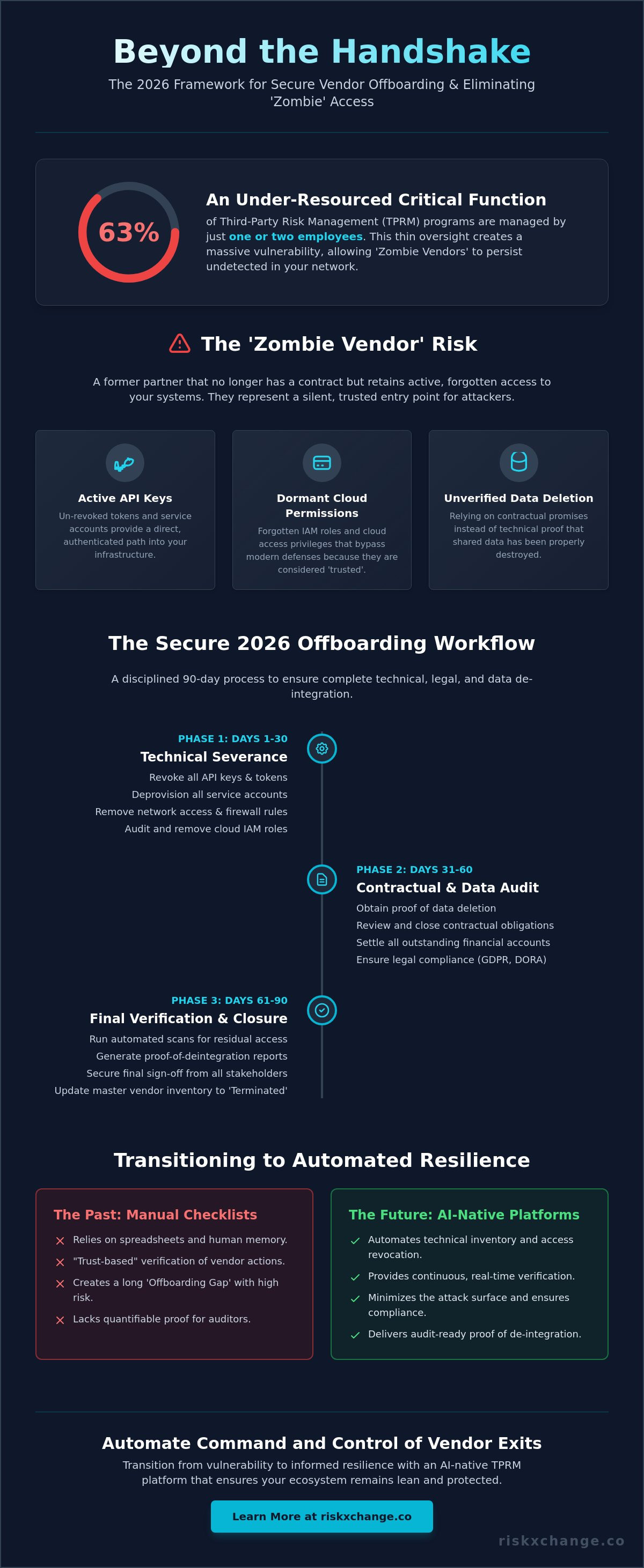
63% of third-party risk management programs are currently managed by only one or two dedicated employees. This thin layer of oversight often fails to catch zombie vendors that retain active API keys long after a contract ends. Establishing a secure vendor offboarding process is no longer just a legal formality; it's a critical defense against residual supply chain vulnerabilities. You likely recognize the unease of wondering if a former partner actually deleted your shared data or if a hidden connection still lingers in your architecture.
Transitioning from a state of vulnerability to one of informed resilience requires moving beyond manual checklists. This article provides a strategic framework for 2026 that helps you master the complexities of vendor de-integration to eliminate ghost access and data leaks. We'll preview a foolproof, automated workflow that delivers quantifiable proof of de-integration for auditors while reducing your attack surface through total visibility. Learn how to ensure your ecosystem remains lean and protected even as your supply chain evolves.
The 'Zombie Vendor' Risk: Why Offboarding is Your Greatest Vulnerability
A secure vendor offboarding process is far more than a final handshake or a settled invoice. It represents a strategic de-integration of digital, financial, and legal assets. While many organizations focus heavily on the initial handshake, they often leave the back door unlocked. This creates the "Zombie Vendor," a former partner that technically no longer works for you but still possesses active API keys or dormant cloud permissions. These entities haunt your network, providing a silent entry point for attackers who exploit the trust you once established.
By 2026, the risk of ghost access has intensified. AI-driven integrations now create deep, automated webs between platforms that don't simply vanish when a contract expires. We rely on an "External Visibility" metric to assess this risk. If an external entity can still see your infrastructure through an unrevoked token, they likely still have a path to your data. True security is achieved only when your organization is no longer visible to the departed party. Moving from a state of vulnerability to one of informed resilience requires a total severance of these automated ties.
The Forgotten Stage of the Vendor Lifecycle
Organizations frequently invest months in onboarding due diligence, yet offboarding is often treated as an administrative afterthought. This creates a psychological trap where leadership assumes "out of sight" equals "out of network." While a typical Vendor Management System might track the contract status, it rarely accounts for the technical sprawl left behind. Manual checklists are no longer sufficient in an era of ephemeral cloud instances and microservices. These connections are too dynamic for a spreadsheet to manage effectively; they require continuous, real-time oversight to ensure every digital thread is severed.
Quantifying the Cost of Failed De-integration
The financial and reputational stakes are high. Regulations like the EU's Digital Operational Resilience Act (DORA) and GDPR impose heavy penalties for unauthorized data access, even if that access belongs to a former partner. Your external security rating can also plummet if a former vendor suffers a breach while still holding your credentials, as auditors will view this as a failure of your own internal controls. The Offboarding Gap is the specific duration of time between the formal termination of a contract and the verified revocation of all technical access points. Minimizing this gap is the only way to ensure your attack surface doesn't expand as your vendor list changes.
Critical Security Risks in the Modern Offboarding Workflow
The threat landscape of 2026 has shifted from brute force entry to the exploitation of residual trust. Attackers now prioritize "forgotten" vendor tunnels, which are legitimate access points left open after a partnership ends. These tunnels often bypass modern defenses because they're viewed as trusted pathways. A secure vendor offboarding process must account for these architectural leftovers. It's no longer enough to assume a vendor has stopped using their access; you must verify that the access itself no longer exists.
Identity debt represents one of the most significant hurdles in modern de-integration. While human users are often deprovisioned quickly, service accounts and API keys frequently remain active. These non-human identities lack the oversight of traditional HR processes, making them perfect vehicles for long-term persistence. To manage this complexity, organizations are looking toward NIST's supply chain risk management framework to establish clear protocols for identity lifecycle management. This framework emphasizes that the end of a relationship is just as critical as its beginning.
The Data Retention Paradox complicates this further. Many organizations rely on contractual promises of data deletion, yet contracts are not security controls. In the event of a post-termination breach at a former vendor, your shared data remains at risk regardless of what the legal paperwork says. This is why continuous real-time risk management is essential to confirm that data flows have actually ceased. Without technical verification, you're merely trusting a promise that the vendor's infrastructure might not even be capable of keeping.
Operational risk also enters the frame during the exit phase. Abruptly severing a connection can break downstream business logic or disrupt AI models that rely on specific vendor data streams. A rushed de-integration can be just as damaging as a slow one, potentially causing system-wide failures that take days to resolve.
Data Exfiltration via Dormant Tunnels
Vendors often maintain "support accounts" created for troubleshooting. These accounts frequently bypass multi-factor authentication requirements and remain active long after the official exit. If the final data handover occurs via unencrypted file transfers, you risk exposing sensitive IP to interception. Procurement teams often miss these Shadow IT connections, leaving the security team to hunt for ghosts in the infrastructure.
Legal and Compliance Liabilities
Disputes over intellectual property can arise when shared data is used in a vendor's AI training sets without explicit permission. Your "Right to Audit" clause is your most powerful tool for verifying data destruction, but it must be exercised before the SLA expires. Once the agreement ends, managing the transition of liability becomes significantly more difficult, potentially leaving your organization responsible for a former partner's negligence.
The Nth-Party Ripple Effect: Mapping Downstream Dependencies
Supply chain contagion occurs when the removal of a single provider triggers a cascade of failures across thousands of downstream partners. A secure vendor offboarding process must account for these deep-seated dependencies to prevent systemic collapse. You aren't just offboarding a single company; you're effectively disconnecting from their entire ecosystem of subcontractors and service providers. If these connections aren't mapped before the exit, you risk breaking vital business logic that your organization depends on for daily operations. This isn't just about security; it's about the continuity of your business functions in a world where every service is interconnected.
Concentration risk presents a unique challenge during a transition. Moving from one dominant vendor to another often replaces one set of Nth-party vulnerabilities with another, potentially identical set. This lateral move doesn't reduce your attack surface; it simply renames it. Strategic de-integration requires a clear-eyed view of how your new provider relies on the same infrastructure as the old one. Emergency remediation for a broken dependency can be financially devastating. Industry data indicates that third-party compromises cost financial organizations an average of $4.91 million per incident, and an emergency exit only increases the likelihood of such a breach.
Mapping the Nth-Party Ecosystem
Visualizing the web of subcontractors connected to your outgoing vendor requires AI-native tools capable of real-time monitoring and metadata analysis. Nth-party risk is the hidden financial and security liability of a vendor’s own supply chain. Verifying that fourth-party data access has been revoked is a technical necessity that goes beyond simple contract language. You must move from a state of obscurity to absolute clarity, ensuring that no subcontractor retains a dormant pathway into your environment. This externalized perspective allows you to see exactly how your organization is perceived by the entire supply chain, giving you the agency to command your own security posture.
The 'Broken Link' Operational Analysis
Conducting a dependency audit before pulling the plug on a SaaS provider prevents operational paralysis. You need to identify which niche Nth-party services are integrated into your workflows. Shadow Nth-parties, those subcontractors your vendor uses without your explicit knowledge, are the hardest to offboard. Finding and onboarding a replacement for these services in a crisis is an expensive, high-risk endeavor. A methodical approach ensures that you don't discover a critical dependency only after it has been severed, allowing for a smooth transition that maintains your security rating and operational stability.
The Secure 2026 Offboarding Checklist: A Step-by-Step Workflow
Executing a secure vendor offboarding process requires a transition from manual checklists to an automated, data-driven workflow. By 2026, the speed of digital integration means that a slow exit is a vulnerable exit. Organizations must move with precision to ensure that every digital, financial, and legal tie is severed without disrupting the broader business ecosystem. This framework replaces ambiguity with command, providing a clear path to total de-integration.
- Step 1: Contractual Audit and Legal Notification. Initiate the 90-day window for termination. Review all "Right to Audit" clauses and data return requirements to ensure legal leverage remains intact.
- Step 2: Technical Inventory and API Key Revocation. Hunt for "ghosts" in your architecture. Identify every service account, webhook, and API key associated with the vendor to prevent unauthorized persistence.
- Step 3: Verified Data Destruction and Asset Recovery. Secure any physical hardware and confirm the deletion of sensitive information from the vendor's cloud environment.
- Step 4: Financial Closure and Final SLA Review. Match final payments against performance metrics. Ensure all contractual obligations were met before the relationship officially concludes.
- Step 5: Post-Exit Continuous Monitoring. Enter the "Dark Verification" phase. Use real-time oversight to ensure no data flows or login attempts originate from the former partner's infrastructure.
Technical De-integration: Beyond Passwords
Modern security demands the automated discovery of all active service accounts and cloud permissions. It's not enough to change a password; you need to rotate shared secrets, certificates, and cryptographic keys to prevent unauthorized re-entry. Revoking access to integrated AI models and training data repositories is especially critical. If a vendor's algorithms still have access to your data sets, your intellectual property remains exposed. To maintain total visibility during these transitions, you can automate your vendor exit workflow with an AI-native TPRM solution platform.
The Data Destruction Protocol
Requesting a certified Certificate of Destruction (CoD) for all sensitive data is a non-negotiable requirement. You must verify that your information has been purged from the vendor's primary servers, backups, and disaster recovery sites. Verified data destruction is the only defensible proof of compliance during an audit. Without this documentation, you're left with a significant liability gap that regulators will exploit during a compliance review.
Operational Handover and Knowledge Transfer
Documenting the offboarding process ensures your procurement cycles remain efficient and repeatable. Internal teams need clear documentation to maintain any systems previously supported by the vendor. Conduct a final exit interview to gather intelligence on vendor performance and hidden dependencies. This proactive control transforms a point of vulnerability into a moment of informed resilience, strengthening your security posture for the next partner in your supply chain.
RiskXchange: Automating Command and Control of Vendor Exits
RiskXchange serves as a 360-degree lens for organizations seeking to verify vendor de-integration with absolute certainty. While manual processes often leave gaps in visibility, our AI-native TPRM solution platform transforms the secure vendor offboarding process into a continuous, data-driven operation. It's no longer enough to trust that a vendor has followed your exit protocols. You need the ability to confirm that every digital pathway is closed and every shared credential is dead. RiskXchange provides this command, moving your organization from a state of vulnerability to one of informed resilience.
Real-time security ratings act as a persistent anchor for your risk management strategy. By monitoring the security posture of both active and offboarded entities, you gain a clear understanding of your true attack surface. This level of oversight ensures that your security rating isn't compromised by the "ghosts" of past partnerships. It allows leadership to make decisions based on trackable, numerical benchmarks rather than administrative assumptions. This shift from obscurity to clarity positions your brand as a sophisticated, tech-forward guardian of its own data.
Continuous Verification: The Post-Exit Guard
RiskXchange provides immediate alerts if a "Zombie Vendor" attempts to reconnect to your network after the contract has ended. This automated discovery is vital for identifying dormant service accounts or cloud permissions that were missed during the initial technical inventory. Monitoring the security posture of former vendors also prevents "guilt by association" during third-party audits. If a former partner suffers a breach, you can provide quantifiable proof through your RiskXchange score that your ecosystem was fully de-integrated before the incident occurred. This level of transparency is essential for maintaining compliance with 2026 regulations such as DORA and the SEC's revised oversight mandates.
Take Control of Your External Attack Surface
Implementing RiskXchange’s automated offboarding verification is a streamlined process designed to integrate with your existing infrastructure. By leveraging AI-driven assessment lifecycles, you can significantly reduce the professional service fees typically associated with manual vendor audits. The platform simplifies the overwhelming complexity of the modern threat landscape, acting as a reliable guardian for your supply chain. It provides the clarity needed to evaluate your security posture from an external vantage point, ensuring you always have the agency to manage your risks. Request a demo to secure your vendor offboarding today and establish a permanent state of supply chain resilience.
Master Your Supply Chain Resilience
Transitioning from a state of vulnerability to one of proactive control requires a fundamental shift in how you handle vendor exits. By implementing a secure vendor offboarding process, you eliminate the threat of zombie vendors and ensure that data de-integration is both total and verifiable. You've seen how mapping Nth-party dependencies and revoking dormant API keys prevents supply chain contagion. These steps are essential for maintaining your security rating and meeting the strict compliance mandates of 2026. True resilience isn't just about who you let in; it's about how thoroughly you close the door when they leave.
RiskXchange empowers your team with 360-degree real-time risk intelligence and an automated vendor assessment lifecycle. Our platform is used by Fortune 500 enterprises globally to move from obscurity to absolute clarity. Secure your supply chain with RiskXchange’s AI-native platform and take command of your external attack surface. You can build a future where every partnership is visible, measurable, and manageable. Embrace the confidence that comes with expert oversight and professional precision.