May 2026 · RiskXchange
Every TPRM vendor claims to use AI. Every vendor claims their data is the most accurate, their scores the most current, their integrations the most extensive. So how do you cut through the noise?
We looked at eight dimensions that CISOs and risk leaders tell us matter most in a TPRM platform decision. Here is how RiskXchange, SecurityScorecard, and BitSight compare on each one — honestly, with specifics.
1. Score Freshness — How Current Is Your Vendor's Risk Picture?
A score that refreshes every 30 days is a rear-view mirror. By the time a BitSight rating reflects a new breach or remediated vulnerability, your team may have already made decisions on stale data.
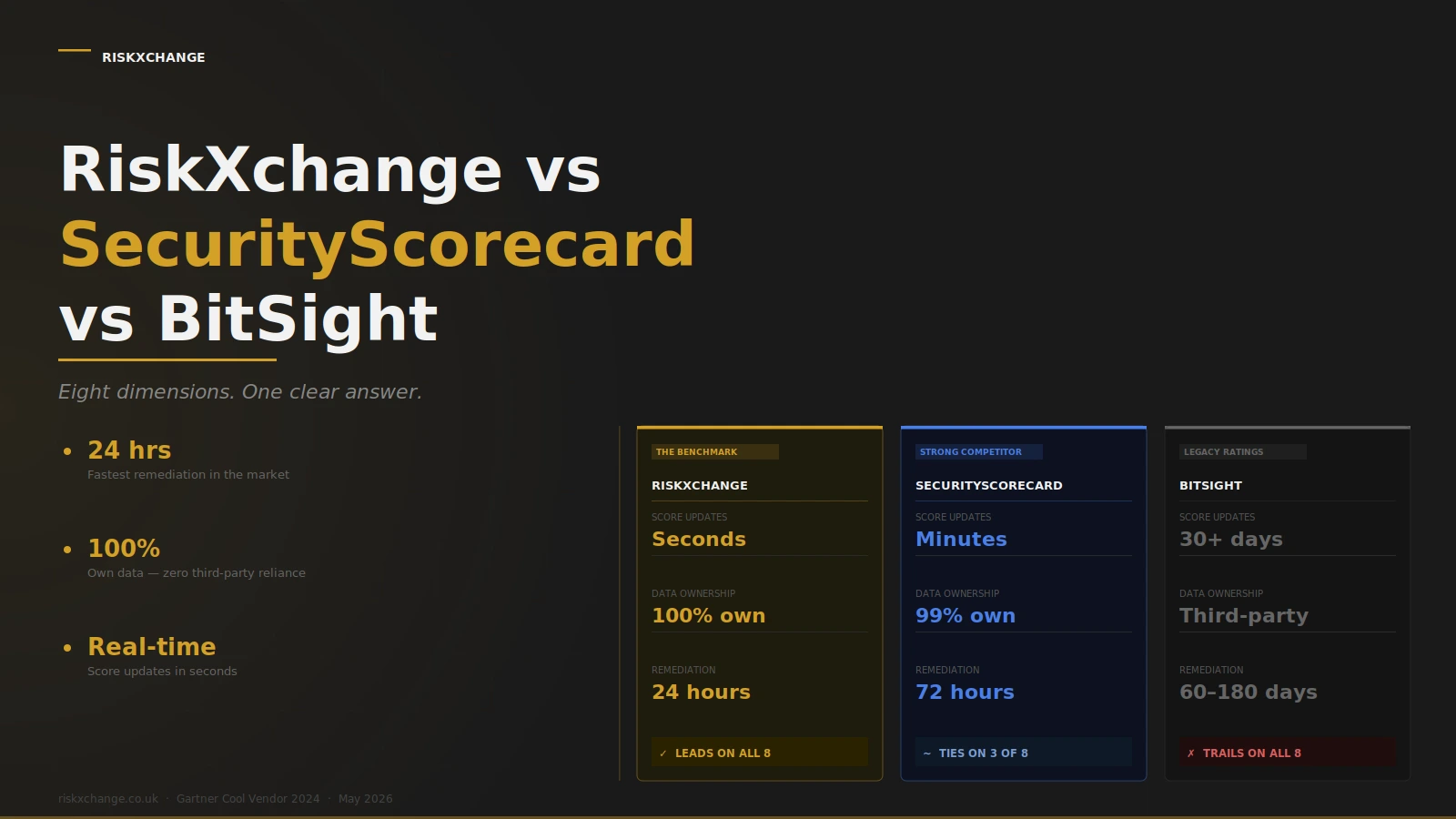
SecurityScorecard updates scores in near real-time — a genuine improvement over BitSight's refresh model, which can take 30 days or longer unless a manual request is raised.
RiskXchange scores update in real-time — seconds, not minutes. When something changes on your vendor's attack surface, you see it immediately.
2. Data Ownership — Who Actually Collected What You're Looking At?
Data accuracy depends on who collected it and whether it has been through any intermediary hands.
BitSight relies on third-party sources for portions of its data — a dependency that introduces quality control gaps that neither the customer nor BitSight fully controls.
SecurityScorecard has made data ownership a core competitive claim, asserting 99% own-data ratio across its 12M+ rated organisations.
RiskXchange owns and collects 100% of its own score and intelligence data since inception. No third-party pass-through. The data you see is data we collected, processed, and stand behind.
3. Scoring Methodology — Can You Trust the Number?
A risk score is only as useful as the methodology behind it. If the algorithm is opaque, updated infrequently, or carries historical issues forward into current scores, the rating misleads as much as it informs.
BitSight's algorithm is not publicly validated and is updated annually. Worse, historical issues can drag down a vendor's current score even when those issues have been resolved — meaning the rating may not reflect where a vendor actually stands today.
SecurityScorecard publishes and regularly updates its methodology. Scores are validated against breach likelihood — a meaningful standard.
RiskXchange's algorithm is transparent, validated, and updated regularly throughout the year — not on an annual cycle. When a vendor's posture changes, the score reflects it promptly.
4. Automation and Workflows — What Does the Platform Actually Do?
Outside-in ratings are one input into a TPRM programme. The real work — onboarding vendors, chasing responses, running questionnaires, tracking remediation, producing board reports — still falls on your team unless the platform automates it.
BitSight relies heavily on manual processes for vendor management and assessments. Its automation is largely limited to the scoring layer itself.
SecurityScorecard has built a strong ecosystem: 90+ integrations, a rule-and-automation centre for custom workflows, and TITAN AI across three tiers (Watch, Assess, Secure).
RiskXchange takes a different approach entirely. The Agency is 32 specialised AI agents — five lead agents (NOVA, REX, ARIA, TARA, VANCE) and 27 sub-agents — each owning a defined part of the vendor lifecycle. NOVA manages vendor relationships and chases slow responders. ARIA automates questionnaire pre-population, analysis and document parsing. TARA handles continuous monitoring, tiering and remediation. VANCE produces regulatory reports and audit-ready board packs. The open API connects to any system supporting open standards — no proprietary integration list required.
SecurityScorecard has AI features on top of a traditional platform. RiskXchange built the agents first.
5. Remediation Speed — How Quickly Do Fixes Show Up in Scores?
A vendor remediates a critical finding. How long before their score reflects it?
With BitSight, the answer is somewhere between 60 and 180 days — sometimes longer — depending on manual validation requirements. In practice, your vendors are fixing problems that your score won't acknowledge for months.
SecurityScorecard reflects remediation within 72 hours, with score updates in minutes once approved. A significant improvement over BitSight.
RiskXchange reflects remediation within 24 hours. Score updates happen in seconds once approved. It is the fastest reflection of real-world remediation in the market.
6. Analytics Accuracy — Can You Act on What You're Seeing?
Continuously updated, contextualised analytics are only useful if the underlying data is accurate. If historical events distort current scores, or if data sources haven't been independently validated, the analytics layer becomes noise on top of noise.
BitSight's historical issue weighting means a vendor's current score may not accurately reflect their present security posture — a well-documented limitation.
SecurityScorecard's data accuracy is ranked ahead of BitSight by Forrester and its analytics are continuously updated.
RiskXchange delivers continuously updated actionable analytics with accuracy confirmed by customers in regulated industries including financial services, insurance, and energy. We don't make the comparison to Forrester reports — we point to the firms whose regulators accepted our outputs.
7. Platform Transparency — Can Prospects See How the Platform Performs?
Transparency is a signal of confidence. If a vendor won't show you how their platform is performing in real time, there is usually a reason.
BitSight offers no public transparency into data accuracy rates or platform performance.
SecurityScorecard publishes a public Trust Page with real-time platform performance data — discovered issues, tracked companies, and live accuracy figures. A genuine differentiator.
RiskXchange also maintains a public Trust Page showing real-time score and compliance information. We believe customers and prospects should be able to see what they are buying into before they sign anything.
8. Integration Ecosystem — How Open Is the Platform?
TPRM does not exist in isolation. It needs to connect to GRC tools, ticketing systems, SIEMs, contract management platforms, and board reporting infrastructure.
BitSight has a smaller integration ecosystem and less flexible API access than its main competitors.
SecurityScorecard has built a market-leading integration network — 90+ partners, API-first architecture, and developer documentation for app building.
RiskXchange is API-first by design, with full public documentation written for the teams that will actually implement it. The open API supports any system using open standards — not a curated partner list you have to fit inside.
The Summary
| Dimension | RiskXchange | SecurityScorecard | BitSight |
|---|---|---|---|
| Score freshness | Real-time (seconds) | Near real-time (minutes) | 30+ days |
| Data ownership | 100% own data | 99% own data | Third-party reliance |
| Scoring methodology | Transparent, updated year-round | Transparent, validated | Annual updates, not validated |
| Automation | 32 AI agents, open API | 90+ integrations, TITAN AI tiers | Manual-heavy |
| Remediation speed | 24 hours / seconds | 72 hours / minutes | 60–180+ days |
| Analytics accuracy | Confirmed by regulated-industry customers | Forrester-ranked above BitSight | Historical weighting distorts scores |
| Platform transparency | Public Trust Page | Public Trust Page | No public transparency |
| Integration ecosystem | Open API, full documentation | 90+ partners, API-first | Limited |
The picture that emerges is this: BitSight built the category. SecurityScorecard built a strong competitor. RiskXchange built what comes next.
Faster data. Cleaner data. An agent framework that does the work your team currently does manually. And the openness to connect to whatever your existing stack looks like.
Ready to see The Agency in action?
Request a demo · Talk to our team
RiskXchange Limited · Gartner Cool Vendor 2024 · 344 Gray's Inn Road, London