The most effective security leaders have stopped asking what happened and started asking which third-party vendor is most likely to suffer a breach next. While traditional risk management relies on static snapshots, predictive risk intelligence platforms allow you to merge outside-in telemetry with AI-native modeling to see your organization as an attacker does. With the global AI predictive analytics market projected to reach 13.1 billion dollars in 2026, this shift toward proactive defense is a strategic necessity. It moves the conversation from a state of vulnerability to one of informed resilience.
You're likely familiar with the limitations of manual assessment processes that are outdated before they're even finished. These information silos between TPRM and internal security create blind spots that delay critical decision making. This guide provides the framework to transition from reactive defense to proactive supply chain resilience. You'll learn how to leverage real-time security ratings and automated vendor prioritization to reduce breach incidents. We'll explore how to use data-driven benchmarks and frameworks like NIST CSF 2.0 to maintain absolute command over your digital ecosystem.
Defining Predictive Risk Intelligence in a Volatile Landscape
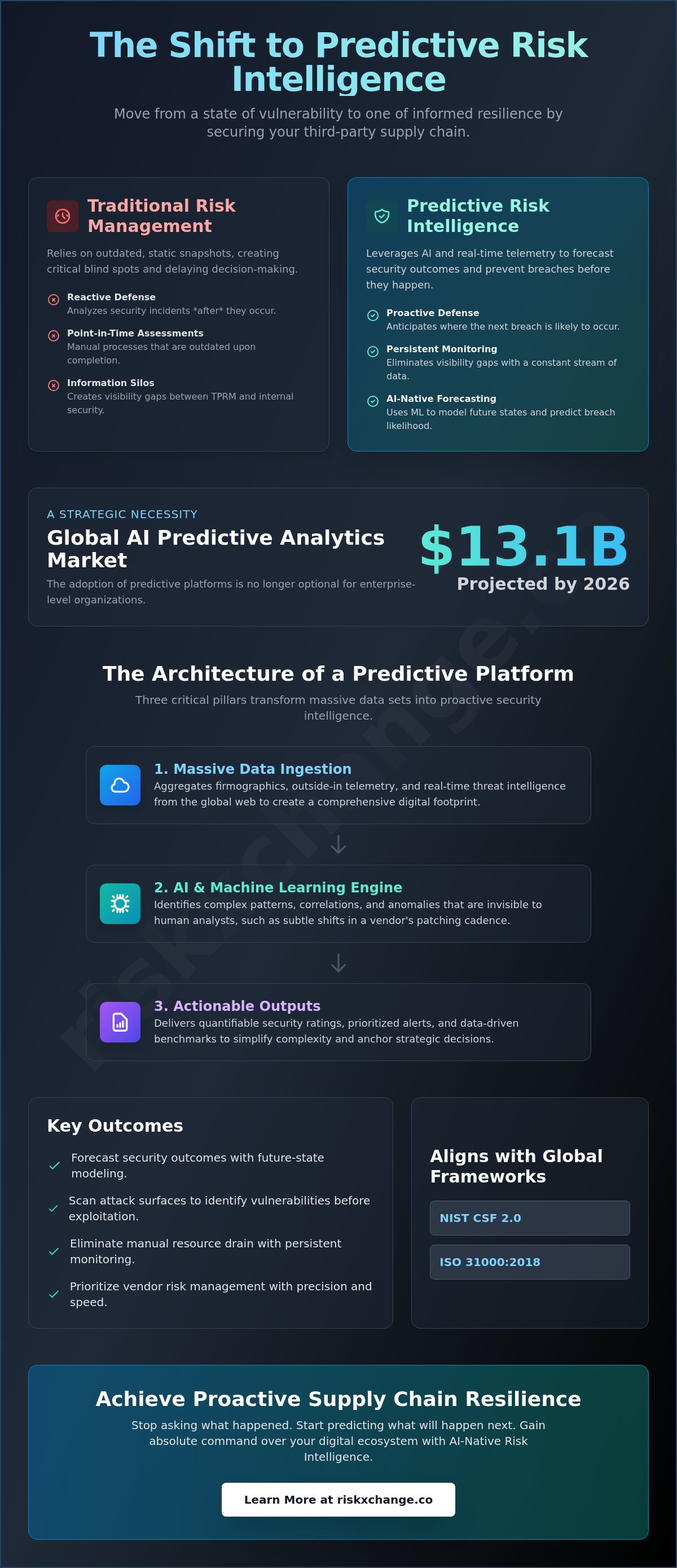
Predictive risk intelligence represents a fundamental shift in how organizations perceive and manage danger. It is the application of advanced artificial intelligence and machine learning to forecast security outcomes rather than simply documenting them after the fact. By moving beyond historical data analysis, these systems create future-state models that anticipate where the next breach is likely to occur within a supply chain. This approach provides a 360-degree view, balancing internal posture with the volatile external threats that define the 2026 digital environment. True Risk Intelligence requires this transition from obscurity to clarity, positioning the organization as an active participant in its own safety. It's the difference between looking in a rearview mirror and using a high-definition radar system.
The complexity of interconnected business ecosystems has made traditional defense methods insufficient. With the global AI predictive analytics market valued at 13.1 billion dollars in 2026, the adoption of predictive risk intelligence platforms is no longer optional for enterprise-level organizations. These platforms provide the strategic oversight necessary to navigate a landscape where physical and cybersecurity have converged. By merging outside-in telemetry with sophisticated risk modeling, decision-makers can finally move from a state of constant vulnerability to one of proactive control. This isn't about chasing every shadow; it's about knowing exactly which threats require your immediate attention.
The Evolution from Static to Predictive Risk
The era of the annual security spreadsheet has ended. In a world where vulnerabilities emerge in minutes, a static document is a liability, not a strategy. Modern security leaders recognize that these "point-in-time" assessments are often dead on arrival because they fail to capture the fluid nature of third-party ecosystems. Predictive platforms replace these snapshots with continuous monitoring. This constant stream of telemetry fuels predictive engines, allowing teams to move toward a state of informed resilience. It's about having the agency to command your security posture before a crisis forces your hand. You gain the ability to see how your organization is perceived from an outside vantage point, identifying weaknesses before they're exploited.
Core Components of a Predictive Platform
To function effectively, a predictive platform relies on three critical pillars. First is massive data ingestion. This process aggregates firmographics, outside-in telemetry, and real-time threat intelligence from across the global web. This isn't limited to internal logs; it's a comprehensive look at the entire digital footprint. Second is the AI engine. These machine learning models identify complex patterns and anomalies that remain invisible to human analysts, such as subtle shifts in a vendor's patch management cadence that might signal an impending failure. Finally, the platform provides actionable outputs. These manifest as quantifiable security ratings, serving as a trackable, numerical benchmark that anchors every strategic decision and simplifies the overwhelming complexity of modern risk.
The Architecture of Anticipation: How AI and ML Drive Risk Forecasting
Elite security operations don't rely on luck. They use AI-native TPRM mechanisms to identify vulnerabilities before they manifest as breaches. Unlike legacy systems that focus on predicting how a vendor might answer a questionnaire, predictive risk intelligence platforms analyze real-world telemetry to determine actual breach likelihood. This shift moves the focus from administrative compliance to technical reality. It allows you to see your vendors through the same lens as a sophisticated threat actor.
This architecture relies heavily on "Outside-In" data. By scanning the external attack surface, these platforms can predict internal vulnerabilities with high precision. This external perspective is combined with firmographics, including company size, industry vertical, and geographic location. These factors correlate strongly with specific threat types; for example, certain industries face higher rates of credential stuffing or targeted ransomware. Understanding these Predictive Risk Intelligence Strategies helps leaders move from a reactive posture to one of command. You can explore how these data points converge in a unified view through continuous risk management solutions.
A common hurdle in adopting AI is the "Black Box" problem. Decision-makers often hesitate to trust a system they don't understand. That's why explainable AI is critical. It ensures that every risk score and prioritization is backed by transparent, traceable data points. When a vendor's rating drops, you'll know exactly which misconfiguration or leaked credential triggered the change. This transparency builds the calm confidence needed to make high-stakes security investments.
Attack Surface Analysis as a Predictive Signal
The external digital footprint is a window into internal security health. Misconfigured servers, open ports, and leaked credentials aren't just isolated issues; they're early warning signs of systemic failure. Attack Surface Management is the foundation of predictive accuracy. There's a direct, measurable correlation between an expansive, poorly managed external footprint and the probability of a successful internal breach. By monitoring these signals in real time, you can intervene before a vulnerability is exploited.
Machine Learning Models in Supply Chain Security
Machine learning excels at pattern recognition across massive datasets. These models identify "at-risk" vendor clusters by analyzing thousands of variables across the global supply chain. They use historical breach data to train themselves, learning to spot the subtle failure points that preceded past incidents. As new telemetry arrives, the models adjust risk scores dynamically. This prevents your security posture from becoming stagnant, ensuring your defense evolves as quickly as the threats it faces.
Static Assessments vs. Predictive Platforms: Bridging the Visibility Gap
Traditional risk management relies on a "point-in-time" philosophy that no longer serves the speed of modern business. When you send a questionnaire, you're receiving a static snapshot of a vendor's security posture from a single day in the past. By the time that assessment is reviewed and filed, the data is often obsolete. In contrast, predictive risk intelligence platforms provide a persistent, living view of the threat landscape. This transition from reactive defense to continuous oversight allows you to bridge the visibility gap that legacy processes inevitably create.
The difference between these two models is one of agency and command. Static assessments force you into a position of vulnerability, waiting for a vendor to self-report an issue. Predictive modeling empowers you with data-driven evidence. You stop asking for permission to see a vendor's risk and start monitoring it with the quiet confidence of an expert. This shift is particularly critical in high-stakes sectors, as seen in Predictive Risk Intelligence for Aviation, where real-time forecasting is the only way to manage volatile global threats.
Why Manual Assessments Fail the Modern Enterprise
Manual assessments suffer from a severe "compliance lag." Risks evolve in minutes, but audit cycles move in years. This delay creates a window of opportunity for attackers that self-attestation simply can't close. Human error also plays a significant role; vendor responses are often aspirational rather than factual. Beyond accuracy, there's the issue of scale. You can't manually assess 10,000 vendors without an army of analysts. Attempting to do so leads to burnout and missed signals, whereas predictive risk intelligence platforms automate the heavy lifting, ensuring no vendor remains in the dark.
The ROI of Proactive Risk Mitigation
The financial argument for predictive intelligence is undeniable. While a major supply chain breach can cost millions in remediation and reputational damage, a proactive platform acts as a preventative investment. It changes the economics of security by reducing the resource drain associated with manual "vendor chasing." Automation frees your analysts to focus on high-value remediation rather than data entry. By utilizing a cybersecurity risk rating platform, you gain access to quantifiable metrics that justify your security spend to the board. It's about moving from a cost center to a strategic driver of business resilience.
Implementation Strategy: Integrating Predictive Intelligence into Your GRC Framework
Transitioning from legacy Third-Party Risk Management (TPRM) to a predictive model requires more than just new software. It demands a structural integration into your existing Governance, Risk, and Compliance (GRC) framework. By embedding predictive risk intelligence platforms into your daily operations, you replace manual data entry with a persistent stream of automated telemetry. This creates a unified security ecosystem where risk isn't just documented but managed in real time. It's a move from fragmented oversight toward a command-and-control posture that ensures your defense evolves alongside the threat landscape.
API integrations play a pivotal role in this evolution. A sophisticated platform shouldn't exist in a vacuum; it must feed critical data directly into your procurement systems and GRC tools. This connectivity ensures that every stakeholder sees the same quantifiable benchmarks, removing the obscurity that often plagues large supply chains. You're no longer reacting to external threats in isolation. Instead, you're orchestrating a proactive defense that uses data-driven honesty to evaluate your true security posture across every digital touchpoint.
This intelligence also extends to ESG and data protection compliance. In 2026, corporate responsibility includes the digital safety and resilience of your entire ecosystem. Predictive models identify vendors with poor data handling practices before they lead to a regulatory violation or a breach of trust. This foresight is essential for meeting the stringent requirements of modern privacy laws and sustainability reporting. It positions security as a foundational element of your broader corporate strategy, moving it from a technical necessity to a business advantage.
Mapping Intelligence to Compliance Frameworks
Predictive scores provide the objective evidence needed to satisfy audit requirements for continuous monitoring. Under the NIST Cybersecurity Framework (CSF) 2.0, the new "Govern" function emphasizes the need for high-level risk oversight that spans the entire organization. Predictive data supports the continuous improvement clause of ISO 27001 by providing a feedback loop of real-world performance metrics rather than just theoretical controls. Automated tiering further streamlines the vendor onboarding lifecycle, ensuring that high-risk partners receive the granular scrutiny they require without slowing down the business.
Cross-Functional Benefits: Beyond the Security Team
The utility of predictive risk spreads far beyond the CISO's office. Procurement teams use these insights to negotiate more favorable contracts, using a vendor's security rating as a tangible anchor during renewals. There's also a direct impact on cyber insurance premiums; insurers increasingly favor organizations that demonstrate proactive control through continuous monitoring. When communicating with the board, a single, trackable numerical benchmark replaces technical jargon with business clarity. It allows you to present a transparent view of the organization's risk profile with the quiet confidence of a seasoned expert.
Discover how our AI native TPRM solution can streamline your path to proactive supply chain resilience.
Securing the Future with RiskXchange’s AI-Native Risk Intelligence
RiskXchange serves as the logical conclusion for organizations seeking to master the complexities discussed throughout this guide. As one of the premier predictive risk intelligence platforms, our solution is built on an AI-native foundation that ensures future-proof scalability. We don't just provide a tool; we act as a sophisticated guardian and partner in your supply chain resilience journey. This platform simplifies the overwhelming complexity of modern threats, moving your conversation from a state of vulnerability to one of informed resilience. It's about having the quiet confidence that comes from total visibility and proactive control.
Our AI-native TPRM solution platform helps companies manage their cybersecurity risk and compliance with precision across every digital touchpoint. By providing continuous real-time risk management, we allow you to anticipate failures before they impact your operations. This isn't a world without challenges, but it's a world where those challenges are visible, measurable, and manageable. We treat security as a trackable, numerical benchmark, providing the data-driven honesty required to navigate a volatile technological landscape with command and agency.
The RiskXchange Difference: Transparency and Immediacy
The platform moves your organization from obscurity to clarity by providing a 360-degree view of your risk posture. Modern predictive risk intelligence platforms must offer this level of transparency to be effective in a global market. Our automated vendor risk assessments and real-time alerts ensure that you're never caught off guard by a sudden shift in a partner's security health. With a global reach that monitors entities from London to Austin and Dubai, we provide the strategic oversight needed for a truly international supply chain. You gain a steady, methodical rhythm of data that reflects the persistent and ongoing nature of the services provided.
Take Control of Your Digital Posture
True command begins with an externalized perspective. You must see your organization as an outsider would to understand your true vulnerabilities. RiskXchange provides this lens, allowing you to evaluate how your digital footprint appears to potential threat actors. This transparency is the first step toward building a world where your security posture is a source of strength rather than a point of concern. You can start with a baseline security rating today to establish your quantifiable anchor for all future discussions. It's time to move beyond internal defense and embrace external visibility.
Request a demo of the RiskXchange predictive risk intelligence platform to see how we can transform your supply chain security from a reactive burden into a proactive advantage.
Command Your Security Future with Predictive Insight
The transition to proactive security is no longer a strategic choice; it's a fundamental requirement for the 2026 threat landscape. You've explored how moving beyond static snapshots allows for a persistent, data-driven understanding of your digital ecosystem. By integrating predictive risk intelligence platforms into your GRC framework, you replace manual uncertainty with the quiet confidence of technical precision. This evolution ensures that your defense isn't just reactive but truly resilient against the unknown.
RiskXchange provides the elite tools necessary to achieve this command. Our AI-native TPRM solution offers real-time security ratings for a 360-degree view of risk; a strategy already proven successful with Fortune 500 enterprises globally. We help you move from a state of vulnerability to one of informed control, ensuring your supply chain resilience remains unshakeable. It's time to see your organization through the lens of clarity and take charge of your security posture.
Empower your security team with RiskXchange’s AI-native risk platform and begin your journey toward a more secure, predictable future today.