
If a third-party breach costs your organization an average of $4.91 million in 2026, can you really afford to rely on vendor self-assessments that were obsolete the moment they were signed? With the average cost of a U.S. data breach hitting $10.22 million this year, the persistent challenges in third-party risk management have shifted from administrative hurdles to existential business threats. You're likely exhausted by the constant noise of low-quality risk signals and the blind spots created by deep N-th party relationships that traditional monitoring tools simply can't see.
It's time to replace manual workflows with a framework that scales alongside your growth. This article demonstrates how to master supply chain security by moving from static snapshots to continuous, real-time visibility. You'll learn how to resolve your most pressing hurdles, from eliminating alert fatigue to automating compliance with strict regulations like DORA and GDPR. We'll examine the transition to an AI-native posture that transforms security from an abstract concept into a trackable, numerical benchmark that defines your resilience in the eyes of regulators and partners.
The Shifting Landscape of Third-Party Risk in 2026
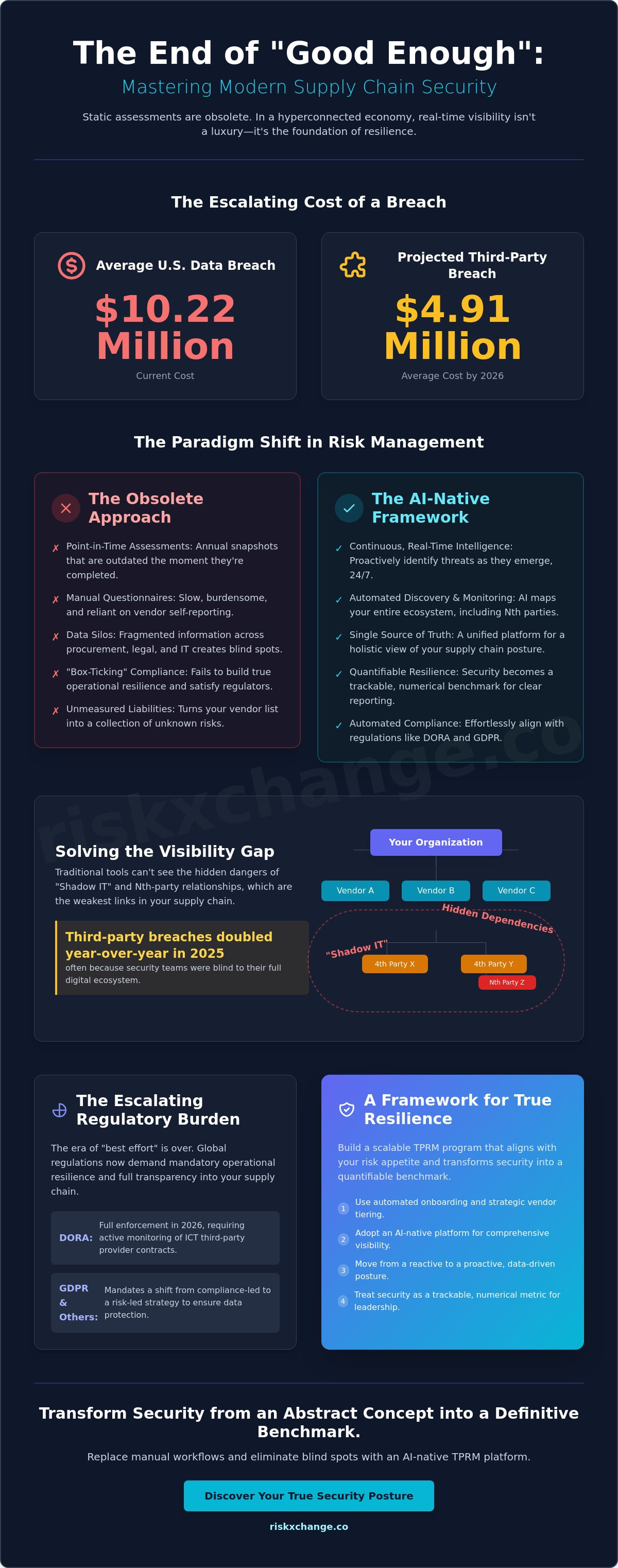
The traditional security perimeter has officially dissolved. In our hyperconnected economy, your organization's digital footprint is no longer defined by your own firewalls, but by the combined security postures of every vendor, partner, and service provider you employ. This structural shift has made 2026 a critical tipping point for supply chain vulnerability. With the average cost of a U.S. data breach reaching $10.22 million, the financial stakes have reached an all-time high. Relying on "good enough" oversight is a gamble that most executives can no longer justify. Effective third-party management now requires a move away from static defense toward a state of informed resilience. It's about moving from a state of vulnerability to one of proactive, data-driven control.
Why Traditional TPRM Frameworks are Failing
Static, point-in-time assessments are fundamentally obsolete. A vendor might pass an audit in January and suffer a catastrophic misconfiguration in February; under a traditional model, you won't know until the following year. These manual processes create significant challenges in third-party risk management because they simply can't keep pace with the rapid growth of vendor ecosystems. Data silos between procurement, legal, and IT security teams further complicate the issue. When information is fragmented, the organization lacks a single source of truth. This obscurity prevents leadership from seeing the true security posture of the supply chain, turning the vendor list into a collection of unmeasured liabilities.
The Escalating Regulatory Burden
The era of "best effort" compliance has ended. In 2026, the Digital Operational Resilience Act (DORA) is in full enforcement across the EU, with supervisors actively monitoring ICT third-party service provider contracts. Financial entities were required to submit their Register of Information by March 2026, signaling a move toward mandatory transparency. Regulators no longer accept "box-ticking" as a valid defense. Whether you're navigating GDPR or emerging ESG mandates, the focus has shifted to mandatory operational resilience. Transitioning from a compliance-led to a risk-led strategy is the only way to ensure legal and operational protection. You must treat security as a trackable, numerical benchmark that provides clarity to both technical leadership and business-focused executives. This transition ensures that your organization is perceived from an outside vantage point as a stable and reliable partner.
Solving the Visibility Gap: Beyond the Primary Vendor
The visibility gap remains one of the most persistent challenges in third-party risk management. While most organizations have a handle on their primary contractors, the "Shadow IT" of the supply chain often goes unmonitored. This includes unmanaged third-party assets and unauthorized SaaS tools that bypass standard procurement filters. When these assets aren't tracked, they create silent vulnerabilities that hackers are quick to exploit. In 2025, third-party breaches doubled year-over-year, often because security teams were blind to the actual extent of their digital ecosystem. Achieving resilience in 2026 requires a transition from simple vendor lists to a comprehensive map of every digital dependency.
Managing these risks isn't just a technical necessity; it's a regulatory expectation. The Interagency Guidance on Third-Party Relationships makes it clear that organizations are responsible for managing risks regardless of the complexity of the service arrangement. This includes the lack of transparency in how vendors handle data protection. If you don't have real-time visibility into how a vendor stores or processes your data, you can't accurately evaluate your true security posture. You're essentially trusting a partner's self-reported "good enough" status while the threat landscape continues to evolve.
The Hidden Danger of N-th Party Relationships
A single vulnerability in a fourth-party sub-processor can ripple through the entire supply chain, causing a catastrophic failure for the end-user organization. These N-th party relationships are often the weakest link because they exist outside the direct contractual control of the primary business. AI-native solutions are now the only way to discover these hidden dependencies at scale. By using machine learning to map the connections between vendors and their sub-vendors, you can gain visibility into fourth-party security postures that were previously invisible. This proactive control allows you to identify risks before they manifest as a breach notification.
Quantifying the Unknown Attack Surface
To secure your perimeter, you have to see what hackers see. External attack surface management (EASM) allows you to identify misconfigured assets, expired certificates, and leaked credentials across your entire vendor pool. It moves the conversation from abstract "what-ifs" to measurable, data-driven honesty. Attack Surface Visibility is the primary metric for 2026 resilience. By quantifying this surface, you can prioritize remediation efforts where they matter most. Organizations that leverage continuous real-time risk management can identify these gaps instantly, moving from a state of vulnerability to one of informed resilience.
Static vs. Continuous Monitoring: A Comparative Analysis
The fundamental difference between assessment and intelligence lies in the dimension of time. Static defense relies on the assumption that a vendor's security posture remains unchanged between annual audits. This is a dangerous fallacy. In reality, a single misconfigured server or an unpatched zero-day vulnerability can compromise a partner within minutes. Traditional point-in-time questionnaires provide a false sense of security because they represent a snapshot of the past, not the reality of the present. One of the most persistent challenges in third-party risk management is the reliance on these self-reported documents, which are often influenced by "Honesty Bias" or incomplete knowledge from the vendor's side.
Manual audit hours represent a significant sunk cost with diminishing returns. If your security team spends hundreds of hours reviewing static spreadsheets, they're reacting to historical data rather than managing current threats. Real-time security ratings offer a superior ROI by automating the data collection process and providing an objective, trackable benchmark. This allows your organization to move from reactive remediation to proactive risk posture management. By treating security as a continuous data stream, you gain the agency to address vulnerabilities before they result in a breach notification.
The Limitations of Security Questionnaires
Questionnaires are often outdated the moment they're submitted. They provide a subjective view that lacks the precision required for modern infrastructure oversight. Manual reviews also lead to significant alert fatigue, as teams struggle to differentiate between minor compliance gaps and critical security flaws. While questionnaires can serve as a baseline for initial due diligence, they shouldn't be the core of your strategy. Relying solely on them is one of the primary challenges in third-party risk management, as it leaves your organization blind to the daily fluctuations of the threat landscape.
The Power of Real-Time Security Ratings
AI-native platforms transform obscure vendor data into clear, quantifiable risk scores. These ratings are built on telemetry and external signals that provide an honest, outside-in perspective of a vendor's security health. Aligning with NIST guidance on supply chain risk requires this level of dynamic oversight. By using numerical benchmarks, you can drive vendor accountability and trigger faster remediation workflows. This methodical approach ensures that security is no longer an abstract concept but a measurable component of your operational resilience, allowing you to manage thousands of relationships with the quiet confidence of a seasoned expert.
A Strategic Framework for Modern TPRM Challenges
Establishing a resilient posture requires more than just better tools; it demands a structured methodology that aligns with your business objectives. You need to define your organization's specific risk appetite before you can effectively evaluate the security of others. By integrating ESG, data protection, and cybersecurity into a single, unified lens, you eliminate the fragmentation that often plagues large-scale supply chains. This holistic approach ensures that compliance and security aren't competing priorities but are instead synchronized benchmarks of operational health. It's about moving from a state of reactive firefighting to one of proactive, strategic command.
Intelligent Vendor Tiering and Prioritization
Not every vendor requires the same level of scrutiny. A cloud hosting provider obviously presents a different risk profile than an office supplies vendor. Intelligent tiering allows you to focus your most intensive resources on high-impact partners where a breach would be catastrophic. By using inherent risk profiles, you can automate initial due diligence and set a baseline for the relationship the moment a contract is considered. Dynamic tiering goes a step further, adjusting your monitoring intensity in response to real-time risk scores. This agility ensures you're never caught off guard by a sudden shift in a critical vendor's security posture, providing the granular technical expertise needed to maintain oversight.
Closing the Loop: Automated Remediation Workflows
Identifying a vulnerability is only half the battle. To solve the most persistent challenges in third-party risk management, you must move from simply finding problems to fixing them at scale. Setting clear SLAs for risk reduction holds vendors accountable and provides a trackable metric for improvement. Leveraging API integrations allows your platform to trigger security actions automatically, such as notifying a vendor's security team the moment a misconfiguration is detected. This level of automation reduces human error and ensures that remediation happens at the speed of the threat landscape. It transforms security from an abstract concern into a manageable, methodical process.
Building a culture of shared responsibility with your partners transforms them from potential liabilities into active participants in your defense. When vendors understand that their security score is a tangible anchor for their relationship with your organization, they become more proactive in their own risk management. This mutual investment in resilience is the hallmark of a mature, 2026-ready supply chain. To see how this framework functions in practice, you can explore our AI-native TPRM solution platform for continuous, real-time oversight.
RiskXchange: The AI-Native Answer to TPRM Complexity
The transition from obscurity to clarity begins with a platform that treats security as a trackable, numerical benchmark. RiskXchange provides the precise lens through which you can evaluate your true security posture across an increasingly volatile technological landscape. By consolidating disparate data streams into a single source of truth, our AI-native TPRM solution platform moves your organization from a state of vulnerability to one of informed resilience. This isn't just about managing vendors; it's about gaining proactive control over the entire supply chain. When you integrate cybersecurity, ESG, and compliance into a unified view, you eliminate the fragmentation that often leads to critical oversights.
Overcoming the persistent challenges in third-party risk management requires more than just faster processing; it requires actionable risk intelligence. RiskXchange utilizes machine learning to analyze potential threats and understand exactly how to manage them before they escalate. This methodical approach ensures that your team isn't overwhelmed by the technicality of the subject matter. Instead, they're empowered with the data-driven honesty needed to make strategic decisions. By positioning your brand as a sophisticated, tech-forward guardian, you ensure that your organization is perceived as a stable and reliable partner from an outside vantage point.
360-Degree Real-Time Monitoring
RiskXchange identifies threats across your entire attack surface by providing continuous oversight that manual assessments simply can't match. The platform moves the conversation away from abstract security concepts toward trackable numerical benchmarks. This creates a brand persona that is both elite in its capabilities and accessible in its partnership. You can customize the platform to align with specific industry mandates, ensuring that your organization remains compliant with global regulations like DORA or the EU Cyber Resilience Act. This immediacy and thoroughness allow you to monitor thousands of relationships with the quiet confidence of a seasoned expert who understands the modern threat landscape.
Scalable Resilience for Global Enterprises
Reducing the overhead of vendor management is essential for organizations operating at a global scale. AI-driven automation handles the heavy lifting of data collection and initial risk scoring, allowing your security leadership to focus on high-level strategic oversight. In a recent implementation, a global financial entity achieved a quantifiable improvement in their supply chain posture by reducing manual audit hours by 60% while simultaneously increasing their overall security score. This is the tangible business benefit of a platform designed for stability and permanence. It simplifies the overwhelming complexity of modern risk without sacrificing granular technical expertise.
Take command of your digital ecosystem and move toward a state of proactive resilience. You don't have to wait for the next breach to understand where your vulnerabilities lie. Request a demo of RiskXchange to see your third-party risk score today and discover how a data-driven approach can transform your security posture.
Mastering Supply Chain Resilience in a Volatile Landscape
The dissolution of the traditional security perimeter means your defense is only as strong as your weakest link. By transitioning from static snapshots to continuous oversight, you eliminate the blind spots that define modern challenges in third-party risk management. Real-time intelligence allows you to quantify risk as a numerical benchmark, providing the clarity needed to satisfy both internal stakeholders and global regulators. You don't have to navigate this complexity alone.
RiskXchange empowers your team with an automated vendor assessment lifecycle, moving the conversation from vulnerability to informed resilience. With real-time risk ratings for over 250,000 entities and a global presence in London, Austin, and Dubai, we provide the thoroughness required for enterprise-scale security. It's time to move beyond box-ticking compliance and take proactive command of your digital ecosystem. This transition ensures that your security posture is seen as a strength by partners and investors alike.
Secure your supply chain with the RiskXchange AI-native platform.
You have the strategy and the data to transform your risk posture into a competitive advantage. Let's build a more resilient future together.