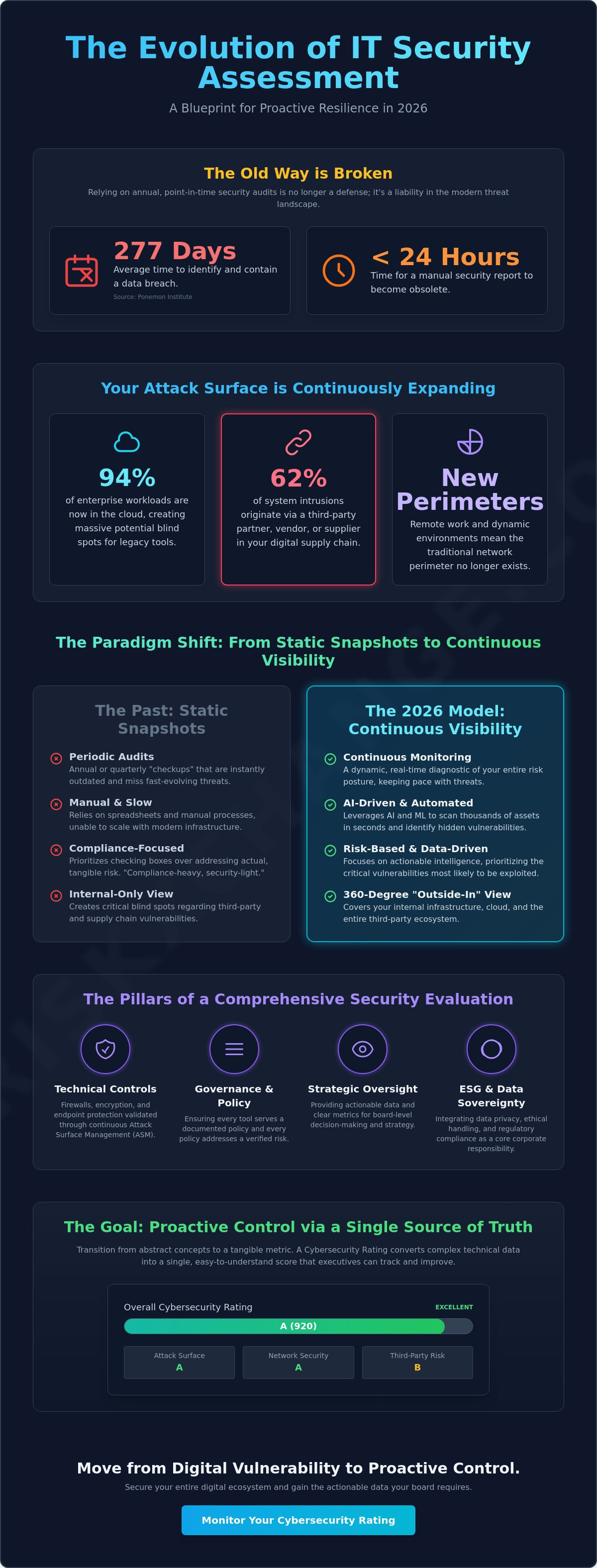
Your last manual it security assessment was likely obsolete within 24 hours of the final report. With research from the Ponemon Institute showing it takes an average of 277 days to identify and contain a breach, relying on annual audits is no longer a defense; it's a liability. You recognize that your attack surface is growing faster than your team can manually audit. These hidden blind spots create a persistent sense of vulnerability that traditional, point-in-time methods simply cannot address.
We're here to help you regain proactive control. This guide outlines a comprehensive strategy for 2026 that replaces periodic audits with a continuous, AI-driven framework. You'll learn how to transform your security posture into a quantifiable Cybersecurity Rating that provides clear visibility for stakeholders and identifies external risks in real time. We'll explore how to build a repeatable assessment model that secures your entire digital ecosystem while providing the actionable data your board requires for strategic decision-making.
What is an IT Security Assessment in 2026?
By 2026, an it security assessment has evolved from a periodic checklist into a dynamic, 360-degree evaluation of an organization's digital footprint. It's a systematic analysis that covers your internal infrastructure, cloud environments, and the sprawling third-party ecosystem that supports your operations. The goal is no longer just to find holes; it's to provide a continuous diagnostic view of your entire risk posture.
The 2026 landscape demands a departure from the "annual checkup" model. Cyber threats now iterate in hours, not months. Relying on a report from six months ago is like checking a weather forecast from last spring to plan a trip today. This shift toward continuous diagnostic monitoring allows leaders to move from a state of reactive vulnerability to one of proactive resilience. We anchor this modern strategy in the "Outside-In" perspective. This approach prioritizes how your organization appears to potential attackers, identifying the exact signals your digital presence broadcasts to the open web.
The Evolution of Security Evaluations
Traditional evaluations often focused on the Information security audit, which prioritized compliance over actual risk. While meeting regulatory standards remains necessary, modern assessments are risk-based and data-driven. By 2026, AI and machine learning have matured to automate the identification of hidden vulnerabilities, scanning thousands of assets in seconds. This automation feeds into a centralized cybersecurity rating. This rating acts as a quantifiable anchor, transforming abstract security concepts into a tangible metric that executives can track and improve over time. It simplifies the complex, providing a clear benchmark for digital health.
Why Your Current Assessment Might Be Obsolete
If your it security assessment still relies on manual spreadsheets and point-in-time scans, it's likely failing you. Rapid cloud adoption, which now encompasses over 94% of enterprise workloads, has created massive blind spots that legacy tools can't see. Static reports are obsolete because they can't capture the volatility of modern threats or the risks introduced by remote work configurations.
Visibility must extend beyond your own walls. Recent data shows that 62% of system intrusions originate through a third-party partner or vendor. Every assessment in 2026 must include comprehensive supply chain visibility. Without it, you're only seeing half the picture. Modernizing your strategy means closing these gaps and ensuring that every connection to your network is visible, measurable, and manageable. It's about taking control of your narrative before an adversary does it for you.
The Pillars of a Comprehensive Security Evaluation
A resilient security posture requires a shift from static checklists to a dynamic, multi-dimensional strategy. While technical controls like firewalls and encryption remain vital, they're only effective when supported by a robust governance framework. An it security assessment in 2026 must bridge the gap between technical execution and strategic oversight. This ensures that every tool serves a documented policy and every policy addresses a verified risk. Without this alignment, organizations often find themselves "compliance-heavy but security-light," possessing the right certifications but lacking the agility to stop a zero-day exploit.
The modern risk lifecycle now integrates Environmental, Social, and Governance (ESG) factors alongside traditional data protection. Investors and regulators now view data privacy as a core component of corporate responsibility. A 2025 industry report indicates that 60% of security leaders now prioritize data sovereignty within their risk lifecycle. This shift means a comprehensive IT security assessment guide must account for where data lives and who can access it across borders, moving beyond simple encryption to include ethical data handling and carbon-neutral infrastructure choices.
Success in this environment depends on actionable intelligence. Raw data collection creates noise; intelligence creates clarity. Instead of sifting through 10,000 daily alerts, teams need prioritized insights that highlight the 5 critical vulnerabilities most likely to be exploited. We use a Cybersecurity Rating as a quantifiable anchor for these pillars. This rating converts complex technical data into a single, easy-to-understand metric. It allows executives to track progress over time and compare their posture against industry benchmarks with total transparency. You can monitor your own rating to see how your security measures translate into measurable resilience.
Attack Surface Management (ASM)
Attackers don't view your network through an org chart. They see a collection of internet-facing assets. ASM is the process of identifying every one of these points, from official servers to forgotten subdomains. Shadow IT accounts for 35% of the average enterprise's digital footprint. These abandoned marketing sites or unpatched testing environments are prime entry points. A modern it security assessment utilizes continuous discovery to find these blind spots before an adversary does, ensuring your "outside-in" perspective remains clear and current.
Third-Party Risk and Supply Chain Integrity
Your security is only as strong as your weakest vendor. Assessing your own network is no longer enough when 98% of global organizations are connected to at least one third-party provider that has experienced a breach. Cascading risk occurs when a vulnerability in a small software component or a secondary service provider ripples through the entire supply chain. Managing this manually is impossible at scale. Automated vendor assessments replace slow, error-prone spreadsheets, reducing the time spent on due diligence by 80% while providing real-time visibility into the health of your entire ecosystem.
Static Snapshots vs. Continuous Visibility: Choosing Your Approach
Transitioning from a reactive posture to a proactive one requires a fundamental shift in how you view your it security assessment. Traditional methods rely on a snapshot approach, which creates a dangerous illusion of safety. A modern it security assessment must prioritize continuous visibility to manage an ever-evolving attack surface. While manual audits provide a baseline, they can't keep pace with the 2026 threat landscape where vulnerabilities emerge in minutes, not months.
The Limitations of Manual Audits
Manual audits fall into the "point-in-time" trap. A report delivered on a Monday often reflects a reality that shifted by Wednesday. Industry data suggests that 64% of vulnerabilities identified in annual assessments are discovered months after they first appeared. This lag time gives attackers a massive window of opportunity. Manual evidence collection also introduces human error, as spreadsheet-based tracking is prone to oversight. It's a slow, labor-intensive process that lacks the scalability needed for global operations. Relying on periodic consulting fees creates a cycle of "fix and forget" rather than sustained resilience.
The Power of AI-Native Monitoring
AI-native monitoring replaces static data with live intelligence. These systems identify patterns in threat actor behavior before a breach occurs, moving your team from defense to anticipation. By leveraging an "outside-in" perspective, you gain a clear view of how attackers see your digital footprint. This approach uses a quantifiable Cybersecurity Rating to communicate risk to stakeholders instantly. Automation handles the heavy lifting, allowing a small team of four to manage a global risk profile that previously required a full department. It simplifies the overwhelming complexity of modern infrastructure into actionable insights.
This transition is essential for meeting modern regulatory demands. Frameworks like NIS2, which became enforceable in October 2024, and GDPR require organizations to demonstrate ongoing risk management. Aligning your strategy with the NIST Cybersecurity Framework ensures that your continuous monitoring efforts meet global standards. The cost-benefit is clear; real-time visibility eliminates the "surprise" costs of emergency remediation. You move from a state of digital vulnerability to one of informed resilience, ensuring your security posture remains robust every single day of the year.
How to Conduct an IT Security Assessment in 5 Modern Steps
A modern it security assessment is no longer a static, once-a-year event. It's a cyclical process that evolves alongside your digital footprint. By 2026, the average enterprise manages 135% more data than in 2023, making a repeatable, automated roadmap essential for resilience. This strategy moves your organization away from reactive firefighting and toward a state of informed, proactive control.
Step 1 & 2: Asset Discovery and Threat Profiling
You can't protect what you can't see. Start by cataloging every information asset, including ephemeral cloud instances and shadow IoT devices. Adopt an "outside-in" view to visualize exactly what an attacker sees when scanning your perimeter. This perspective reveals exposed ports and misconfigured subdomains that internal scans often miss. Profile threats based on your specific industry and geography; for instance, financial services in 2025 saw a 22% increase in targeted ransomware variants compared to the previous year. This data-driven approach ensures your defense matches the actual intent of your adversaries.
Step 3 & 4: Vulnerability Analysis and Control Evaluation
Once assets are identified, you must score vulnerabilities by calculating the likelihood of exploitation against the potential business impact. Don't treat every "critical" patch with equal urgency. Instead, prioritize those on internet-facing systems that house sensitive data. Evaluate your internal controls against established frameworks like NIST CSF 2.0 or ISO 27001. Because your perimeter extends to your supply chain, you must also how to conduct a third-party risk assessment for every key vendor. Use real-time security ratings to move beyond static questionnaires and gain a continuous view of vendor health.
Step 5: Actionable Reporting and Continuous Loop
Discard the traditional 100-page PDF report. Modern leadership teams require dynamic risk dashboards that provide a quantifiable Cybersecurity Rating. This metric allows you to track progress over time and communicate risk in a language the board understands. Set up automated alerts for significant drops in your rating or a vendor's posture. This creates a feedback loop where remediation leads directly back into discovery. By establishing a monthly cadence for high-impact review, you transform the it security assessment from a compliance hurdle into a strategic advantage.
Stop guessing about your digital vulnerabilities. Get your free Cybersecurity Rating from RiskXchange and take control of your risk posture today.
Taking Control: Moving to a Resilient Digital Ecosystem
Transitioning from digital vulnerability to informed resilience isn't just a technical upgrade; it's a strategic shift in how your organization survives. For years, businesses operated in a state of reactive defense, treating every new threat as an isolated incident. By 2026, this fragmented approach has become a liability. A modern it security assessment must provide a single source of truth that consolidates every internal and third-party risk into one actionable view. This level of visibility eliminates the blind spots where attackers thrive, replacing uncertainty with a clear, data-driven roadmap.
The Cybersecurity Rating serves as the ultimate metric for measuring this success. It transforms complex technical data into a tangible, trackable score that both CISOs and board members understand. When security is treated as a measurable asset, it becomes easier to justify budgets and demonstrate progress. You aren't just guessing if your perimeter is secure; you're looking at a live validation of your resilience. Moving to this model allows you to simplify a chaotic risk landscape through sophisticated technology that does the heavy lifting for you.
Simplifying the Complex with RiskXchange
RiskXchange provides a 360-degree view of your risk landscape through an AI-native platform designed for the complexities of modern attack surface management. By analyzing billions of data points, the platform provides the same "outside-in" perspective used by threat actors. This proactive approach has earned the trust of Fortune 500 companies globally, enabling them to manage thousands of vendor relationships with precision. The platform automates the most grueling aspects of TPRM, ensuring that your it security assessment is always current and never relies on outdated spreadsheets. It's about moving beyond static snapshots to achieve real-time clarity.
Your Next Steps Toward Visibility
Establishing a baseline is the first move in any serious strategy. You can't manage what you don't measure. Start by generating a baseline security rating to identify your most critical gaps immediately. Once you understand your current posture, integrate continuous monitoring into your existing GRC workflows. This ensures that security remains a living process rather than a once-a-year checkbox. With nearly 60% of data breaches linked to third-party vulnerabilities, maintaining this constant oversight is the only way to protect your reputation and your bottom line. Take the first step toward a more secure future today.
Take control of your digital footprint with RiskXchange
Take Control of Your Digital Footprint Today
Securing a modern enterprise requires more than a periodic checkup. By 2026, a successful it security assessment must transition from a static snapshot to continuous, real-time visibility. You've explored the five essential steps to build a resilient ecosystem, focusing on an outside-in perspective that mirrors how attackers view your network. This shift ensures your team isn't just checking boxes but actually reducing the attack surface across your entire global supply chain. It's about moving from a state of digital vulnerability to one of informed resilience.
RiskXchange empowers your organization with AI-native 360-degree risk management. Our platform provides the real-time security ratings trusted by Fortune 500 enterprises to maintain oversight of complex digital landscapes. We help you manage the volatility of the modern threat landscape by making risks visible, measurable, and manageable. Don't leave your digital footprint to chance when you can have actionable data at your fingertips. You can transform your security posture from a point of vulnerability into a pillar of business confidence today.
Request a Free Demo of the RiskXchange Platform
Your journey toward total visibility starts with a single, informed step. You've got the strategy; now it's time to deploy the tools that make it reality.