In 2025, the average cost of a data breach in the U.S. surged to $10.22 million, yet many security leaders still face immediate rejection when justifying cybersecurity budget to CFO stakeholders. It's a common frustration; you see a critical vulnerability in the supply chain, while your finance team sees a black hole for capital that offers no traditional ROI. You're likely tired of trying to quantify the value of a non-event while facing a 15% increase in cyber insurance premiums this year. We understand that bridging this gap requires more than technical jargon; it requires a shift in perspective from cost management to capital preservation.
This guide provides the strategic framework you need to secure your 2026 funding by translating technical risks into the financial language of risk quantification and outside-in visibility. You'll learn how to leverage metrics like a tangible Cybersecurity Rating to align your program with NIST CSF 2.0 governance standards. We'll explore how the May 2026 CIRCIA reporting mandates can transform security from a reactive expense into a strategic investment that protects your organization's market value and ensures continuous supply chain resilience.
The Language Barrier: Why CFOs Reject Cybersecurity Budgets
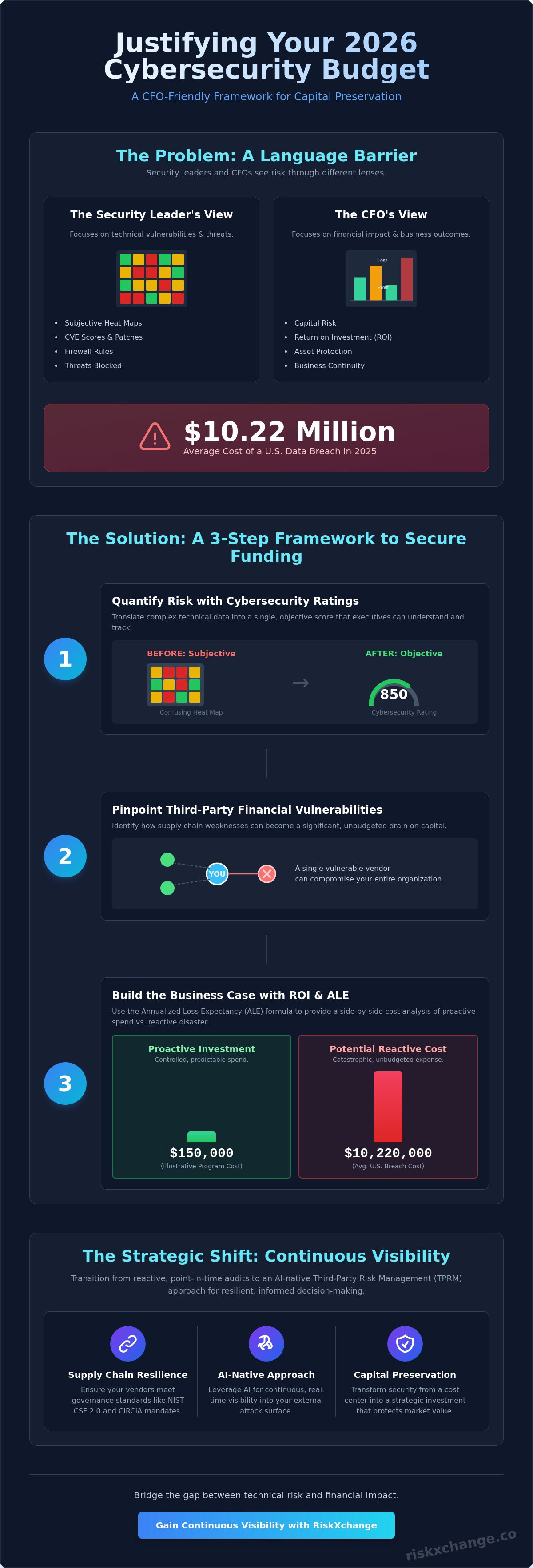
CFOs don't think in terms of patches, firewall rules, or CVE scores. They think in terms of cash flow, asset protection, and risk-adjusted returns. When you present a "heat map" filled with subjective red and yellow dots, you're speaking a language that doesn't translate to the balance sheet. This subjectivity is the primary reason for budget rejection. To succeed in justifying cybersecurity budget to CFO leaders, you must move beyond technical vulnerabilities and start discussing capital risk and business continuity.
The "Heat Map" problem is a significant friction point in the boardroom. These matrices fail because they lack financial context; a "high risk" vulnerability doesn't tell a CFO whether the potential loss is $10,000 or $10 million. By the time you reach the executive level, the conversation must shift from "how many threats we blocked" to "how much capital we're protecting." Quantifying Cyber Risk allows you to bridge this gap by assigning a dollar value to potential incidents. This turns an abstract threat into a measurable business impact that finance teams can actually model.
From Technical Jargon to Financial Metrics
Stop talking about "critical patches." Start talking about "asset protection." Auditors and CFOs require metrics that reflect the bottom line. Traditional security metrics often feel like "noise" to a finance professional who is focused on the 2025 global average breach cost of $4.44 million. You need to define "Cybersecurity ROI" in a way that satisfies these fiscal requirements.
- Asset Valuation: Link security spend to the specific revenue-generating assets being protected.
- Loss Avoidance: Treat every prevented breach as a preserved capital asset.
- Compliance Efficiency: Show how automated monitoring reduces the man-hours required for regulatory reporting.
Cybersecurity ROI is the avoidance of capital loss and operational downtime. When you frame it this way, you change security from a "black hole" for cash into a defensive barrier for the company's most valuable assets.
Understanding Capital Allocation Logic
Every dollar spent on security is a dollar not spent on R&D or Sales. CFOs view these as competing interests. If you can't prove that your spend facilitates growth, you'll lose the allocation battle. You also need to address "Security Debt." Just as technical debt slows down software development, security debt creates a liability on the balance sheet that increases the cost of future operations and insurance premiums.
In fact, Forrester predicts that cyber insurance premiums will increase by 15% in 2026 due to emerging AI threats. By positioning security as a facilitator of faster, safer business growth, you align your program with the company's long-term objectives. Proactive risk management isn't just about stopping attacks; it's about providing the confidence to enter new markets and engage with new partners without increasing the attack surface to unmanageable levels.
Step 1: Quantifying Risk with Cybersecurity Ratings
CFOs rely on credit scores and financial ratings to make informed lending and investment decisions. They value these metrics because they provide an objective, standardized view of risk. You can apply this same logic when justifying cybersecurity budget to CFO stakeholders by utilizing a Cybersecurity Rating. Instead of presenting a list of 500 unpatched servers, you present a single, trackable score that reflects the organization's overall security posture. This metric transforms abstract technical debt into a tangible asset that the finance team can monitor over time.
A critical component of this score is the "outside-in" perspective. While internal teams often focus on defensive layers, attackers look for the path of least resistance across your digital footprint. By viewing your organization as an adversary does, you identify the exact "blind spots" that pose the greatest financial threat. This external visibility ensures that your budget requests aren't based on guesswork but on the actual attack surface that hackers are scanning right now. It moves the conversation from a state of digital vulnerability to one of proactive control.
Relying on annual audits or point-in-time assessments is financially misleading. In 2025, it took organizations an average of 241 days to identify and contain a data breach. If you only check your security posture once a year, you're essentially flying blind for 364 days. Continuous monitoring provides real-time data, ensuring that the budget you've been allocated is actually working to mitigate risks as they emerge. You can view your current security posture through a continuous lens to ensure no new gaps have opened since your last board meeting.
The Value of an Objective Security Score
An objective rating allows the Board to set a clear "Risk Appetite." If the Board decides the company must maintain a rating above a certain threshold, the budget required to reach that goal becomes a non-negotiable business requirement rather than a discretionary expense. This data-driven approach is essential for Justifying Cybersecurity ROI to executive leadership. A quantifiable score also simplifies negotiations with insurance providers, who are increasingly using these ratings to set premiums in a market where rates are expected to climb 15% in 2026.
Benchmarking Against the Market
CFOs are naturally competitive and want to know how the company stacks up against industry peers. If your Cybersecurity Rating is lower than the sector average, it signals a potential liability that could impact enterprise value. For example, in the healthcare industry, the average breach cost hit $7.42 million in 2025. Using peer data helps in justifying cybersecurity budget to CFO leaders by showing that "catching up" to industry standards is a prerequisite for maintaining market trust and avoiding the $10.22 million average cost of a U.S. data breach. It positions your security roadmap as a necessary step for maintaining a competitive advantage.
Step 2: Highlighting the Financial Impact of Third-Party Risk
Your supply chain is often the most significant "blind spot" on your balance sheet. While internal security controls are vital, over 60% of data breaches now originate through third-party vendors. For a CFO, this represents a hidden budget drain where the organization's financial stability is tied to the security posture of external partners. When you're justifying cybersecurity budget to CFO leadership, you must frame Third-Party Risk Management (TPRM) not as an IT hurdle, but as a strategy for protecting the company's operational continuity and capital.
The financial volatility of a supply chain disruption is immense. Consider the impact of a Tier-1 vendor outage; the resulting operational downtime often costs more than the data breach itself. By May 2026, the finalized CIRCIA regulations will mandate that covered entities report significant cyber incidents within 72 hours. This regulatory pressure means that a vendor's failure to maintain resilience becomes your immediate legal and financial liability. Moving from static, point-in-time spreadsheets to continuous monitoring allows you to see these risks before they manifest as a line item on an incident response bill.
The Supply Chain Multiplier Effect
Quantifying the potential loss from a single third-party breach is a powerful narrative tool. Beyond the $10.22 million average cost of a U.S. breach, you must account for legal fees and regulatory fines under frameworks like the CCPA or the Digital Operational Resilience Act (DORA). These costs multiply when multiple vendors are affected by the same vulnerability. Transitioning to an AI-native TPRM solution reduces the manual cost per assessment by up to 80%, allowing your team to scale oversight without a linear increase in headcount. This efficiency transforms a labor-intensive process into a streamlined, data-driven operation that protects the company's bottom line.
Streamlining Vendor Onboarding
Effective risk management is a revenue enabler. When security teams use automated platforms to assess new partners, they significantly reduce the "time-to-contract." In a competitive market, the ability to onboard a strategic partner in days rather than months is a tangible business benefit. Real-time monitoring provides an "outside-in" view of a partner's Cybersecurity Rating, giving your procurement team the leverage to demand better security standards before a contract is signed. This proactive control links supply chain visibility directly to corporate governance and ESG goals, showing the CFO that your budget request is an investment in a faster, more resilient business model.
Step 3: Building the Business Case (ROI & ALE)
Securing approval for your 2026 roadmap requires moving beyond the "what" and "how" to the "how much." While the Cybersecurity Rating provides the metric, the Annualized Loss Expectancy (ALE) provides the motive. CFOs are accustomed to evaluating capital expenditures against potential losses. By presenting a side-by-side analysis of proactive spend versus reactive recovery, you demonstrate that your budget is a tool for risk mitigation, not a discretionary expense. This is the final, essential step in justifying cybersecurity budget to CFO stakeholders.
A higher security rating acts as a lever, providing the evidence your insurer needs to keep your organization in a favorable pricing tier. With Forrester Research predicting that cyber insurance premiums will increase by 15% in 2026 due to emerging AI threats, maintaining a strong rating is a direct financial benefit. It's no longer just about avoiding a breach; it's about managing the fixed costs of doing business in a volatile digital economy. When you show the finance team that a $100,000 investment in a continuous monitoring platform can prevent a $2 million probable loss, the conversation shifts from "can we afford this" to "we can't afford not to do this."
The Math of Mitigation
ALE is calculated by multiplying the Single Loss Expectancy (SLE) by the Annualized Rate of Occurrence (ARO). For example, if a breach of a business-critical asset would cost $10.22 million (the 2025 U.S. average) and there's a 20% annual probability of such an event, your ALE is $2.04 million. You must also factor in "Hidden Costs" such as reputational damage, the legal fees associated with the May 2026 CIRCIA regulations, and the customer churn that follows a 241-day identification and containment cycle. Presenting these figures allows the CFO to see the true cost of "Security Debt" on the balance sheet.
Operational Efficiency and Tool Consolidation
CFOs often view security as a fragmented collection of point solutions that create a "security tax" on the organization. You can improve your business case by demonstrating how an AI-native TPRM platform allows for tool consolidation. Adopting AI and automation in your security strategy can save an average of $2.22 million per data breach, primarily by reducing the man-hours spent on manual remediation and vendor follow-ups.
By replacing manual spreadsheets with a single, automated lens, you reduce the headcount required for compliance while speeding up the "time-to-contract" for new revenue-generating partnerships. This creates a clear payback period for your technology stack. To see how your organization can quantify these risks and streamline its defensive posture, get your free Cybersecurity Rating today.
The Strategic Solution: RiskXchange for Continuous Visibility
RiskXchange serves as the financial lens that translates technical security telemetry into actionable business intelligence. While point solutions focus on internal defenses, our AI-native TPRM platform provides the continuous, outside-in visibility required to protect your capital and supply chain resilience. By centralizing risk data into a single, quantifiable Cybersecurity Rating, we empower CISOs to move from a state of digital vulnerability to one of informed, proactive control. This transparency is the final piece of the puzzle when justifying cybersecurity budget to CFO stakeholders, as it replaces speculation with real-time data.
Our platform doesn't just identify vulnerabilities; it manages the entire risk lifecycle across your global supply chain. This 360-degree view integrates cybersecurity posture with ESG and compliance requirements, such as the finalized May 2026 CIRCIA reporting mandates. By automating the assessment process, RiskXchange removes the manual overhead that often leads to "security debt" on the balance sheet. It allows you to align your security roadmap directly with the organization's growth objectives and capital allocation strategies.
Real-Time Intelligence for Real-Time Budgets
Point-in-time assessments are the enemy of financial stability. They create "budget surprises" when a major vulnerability is discovered days after the fiscal year begins. RiskXchange’s continuous monitoring ensures that your budget remains aligned with the actual threat landscape as it evolves. The platform allows you to generate board-ready reports in minutes, providing the transparent, data-driven honesty that CFOs demand. Organizations using our platform have successfully justified a 20% budget increase by demonstrating the clear link between enhanced security ratings and reduced annualized loss expectancy.
Taking Control of Your Attack Surface
The "outside-in" advantage means you see exactly what an attacker sees. This perspective allows you to prioritize investments based on the assets that present the highest risk to your bottom line. Building a culture of informed resilience means extending this visibility to your vendors, ensuring that every link in your supply chain meets your organization's risk appetite. It's time to stop viewing security as a cost center and start treating it as a strategic investment in continuity. See how RiskXchange can transform your budget conversations and provide the clarity your finance team requires.
Secure Your 2026 Roadmap with Data-Driven Confidence
Success in justifying cybersecurity budget to CFO leaders requires a fundamental shift from technical defense to strategic capital preservation. You've seen how translating abstract threats into an objective Cybersecurity Rating provides the clarity the Board demands. By focusing on the financial impact of your third-party ecosystem and calculating the Annualized Loss Expectancy for critical assets, you move the conversation from a cost center to a risk-adjusted investment. This approach ensures your program remains resilient against the 15% increase in insurance premiums predicted for 2026.
RiskXchange provides the real-time risk intelligence you need to maintain this visibility. Trusted by Fortune 500 enterprises and supported by global teams in London, Austin, and Dubai; our AI-native platform simplifies the overwhelming complexity of the digital threat landscape. It's time to take control of your attack surface and replace digital blind spots with actionable data. Book a demo to see your company’s Cybersecurity Rating today and lead your organization toward a future of informed resilience.