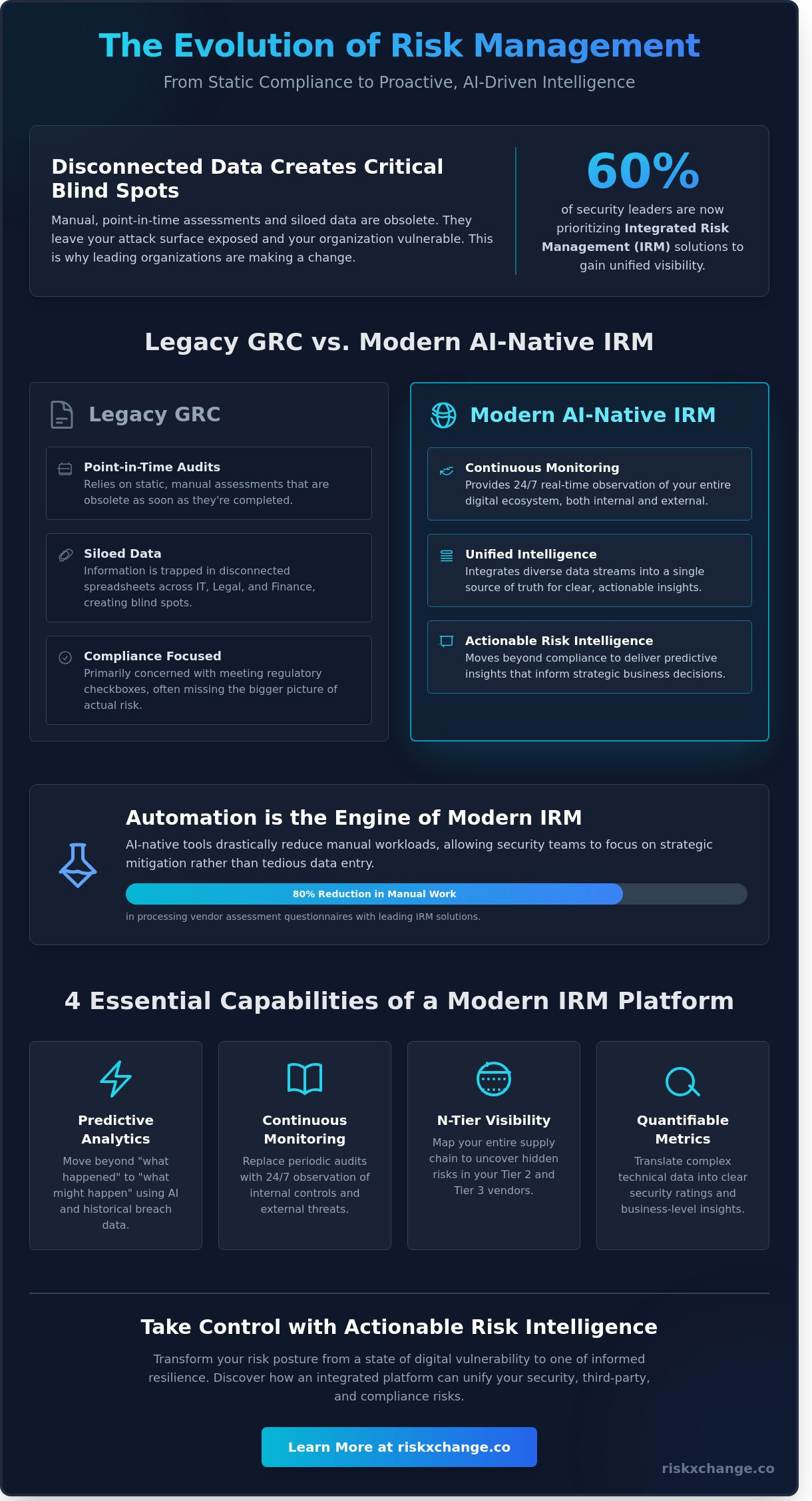
How much of your attack surface remains invisible because your compliance data is trapped in a silo, completely detached from your real-time threat intelligence? You've likely realized that manual, point-in-time assessments are obsolete by the time the ink dries. Relying on static spreadsheets to manage a complex supply chain in 2026 is a strategy built on hope rather than proactive control. This is why 60% of security leaders are now prioritizing integrated risk management solutions to eliminate the blind spots created by disconnected IT and compliance teams.
This guide provides a clear framework to evaluate and select the right IRM platform to unify your cybersecurity, third-party, and compliance risks into a single actionable dashboard. By moving toward a single source of truth, you can replace guesswork with actionable metrics that mirror how an attacker views your organization. We'll examine how to implement automated compliance reporting and continuous security ratings, transforming your risk posture from a state of digital vulnerability to one of informed resilience.
What are Integrated Risk Management (IRM) Solutions?
Integrated risk management solutions represent a fundamental shift in how modern enterprises identify and mitigate vulnerability. At its core, IRM is a set of practices and technologies designed to unify risk data across an entire organization. This isn't just about security; it's about clarity. By integrating diverse data streams, these solutions provide a single point of truth for decision-makers who need to understand their exposure in real-time.
The transition from traditional Governance, Risk, and Compliance (GRC) to modern IRM marks a significant evolution in corporate strategy. While GRC frameworks were often rigid and focused on meeting specific regulatory checkboxes, IRM is built for agility. It moves beyond simple compliance to deliver actionable risk intelligence that informs business outcomes. By 2026, the adoption of integrated risk management solutions will be a necessity for any firm managing a global footprint, as it transforms risk from an abstract concept into a trackable metric.
Looking toward the next few years, the landscape demands a 360-degree view of both digital and physical supply chain risks. The complexity of global networks means that a single point of failure can have cascading effects. Effective IT risk management is now a prerequisite for survival, as it integrates technical methodologies directly into the system development life cycle. This outside-in perspective ensures that leaders see their digital footprint exactly as a potential attacker would, allowing them to take control before a breach occurs.
The Shift from Siloed Risk to Unified Intelligence
Siloed data is the enemy of visibility. When information is trapped within the walls of IT, Legal, or Finance, it creates blind spots in the enterprise attack surface that attackers are quick to exploit. IRM serves as the bridge between these departments, breaking down communication barriers and synchronizing response efforts. It ensures that a financial risk is understood in the context of its technical implications and legal requirements. IRM is the lens through which a company sees its true security posture.
Key Components of an IRM Ecosystem
A comprehensive IRM ecosystem is built on several critical pillars that ensure nothing is left to chance. Strategic risk management and continuous digital risk monitoring provide the high-level oversight needed to protect the brand's reputation. Third-party risk management (TPRM) is equally vital, as industry data from 2023 shows that 62% of system intrusions involve a secondary party in the supply chain. To maintain resilience, companies must also leverage integrated risk management solutions to facilitate automated compliance and ESG (Environmental, Social, and Governance) tracking. These components work together to provide a seamless, data-driven framework that simplifies the overwhelming complexity of the modern threat landscape.
Core Capabilities: What to Look for in an IRM Platform
Selecting effective integrated risk management solutions requires a shift from reactive checklists to a proactive, data-driven strategy. Legacy systems often rely on static, point-in-time assessments that become obsolete the moment they're completed. To build true resilience, a modern platform must provide a unified view of your entire digital ecosystem. This begins with understanding the strategic framework of the discipline. For a foundational perspective, exploring What is Integrated Risk Management? reveals how it serves as a critical lever for business performance and compliance.
A high-performing IRM platform should deliver four essential capabilities:
- Predictive Analytics: Moving beyond "what happened" to "what might happen" using historical breach data.
- Continuous Monitoring: Replacing annual audits with 24/7 observation of internal and external controls.
- N-Tier Visibility: Mapping the supply chain deeply to uncover risks in Tier 2 and Tier 3 vendors.
- Quantifiable Metrics: Using security ratings to translate technical vulnerabilities into business-level insights for the board.
AI-Native Risk Detection and Automation
Automation is the engine of modern risk management. Leading integrated risk management solutions now utilize AI-native tools to reduce manual workloads by 80% when processing vendor assessment questionnaires. This efficiency allows security teams to focus on mitigation rather than data entry. Natural language processing (NLP) plays a vital role here; it can instantly parse complex data protection policies to identify misalignments with global regulations like GDPR or CCPA. By leveraging predictive analytics, these platforms spot patterns in historical breach data to alert you to a potential vulnerability before a threat actor exploits it.
The "Outside-In" Attack Surface Perspective
Your IRM must see what an attacker sees. This "outside-in" perspective is the only way to gain a realistic understanding of your digital footprint. It involves scanning the public-facing internet for misconfigured servers, leaked credentials, or unpatched software that exists outside your immediate perimeter. Integrating this external threat intelligence with your internal risk controls creates a comprehensive security posture.
Security ratings serve as the anchor for this visibility. They provide a tangible, real-time metric that makes risk measurable and manageable. When you can see a vendor's security rating drop from an A to a C in real-time, you can take immediate action to protect your data. This level of clarity transforms vendor selection from a guessing game into a precise, data-backed process. To gain this level of control over your ecosystem, you can monitor your security posture through a centralized dashboard that tracks these fluctuations as they happen.
Legacy GRC vs. AI-Native IRM: A Comparison Framework
Legacy GRC systems were built for a slower era. They rely on manual data entry and periodic audits that fail to capture the volatility of modern digital ecosystems. AI-native integrated risk management solutions represent a fundamental shift toward speed and precision. While on-premise GRC tools often take 9 months to deploy, cloud-native platforms achieve full integration in less than 30 days. This speed is vital when managing a global supply chain. A manual process might handle 100 vendors, but scaling to 10,000 requires the algorithmic power of AI to prioritize high-risk entities. For a CISO, the "single pane of glass" isn't just a buzzword; it's a necessity for real-time decision-making and strategic oversight.
- Deployment: Cloud-native solutions offer rapid setup compared to the 6 to 12-month timelines of on-premise hardware.
- Automation: Moving from manual workflows to automated triggers reduces the time spent on risk assessments by 75%.
- Scalability: AI-driven platforms manage thousands of third-party relationships without increasing headcount.
- Visibility: A unified dashboard provides an outside-in view of the entire attack surface, replacing fragmented spreadsheets.
Static Compliance vs. Continuous Resilience
Static assessments provide a snapshot of the past. In the 2026 threat landscape, where zero-day exploits proliferate rapidly, point-in-time checks are insufficient. Continuous monitoring identifies critical vulnerabilities in 14 days or less, whereas traditional audits might leave a gap of 180 days between reviews. This transition fosters a security-first culture. Organizations stop treating compliance as a checkbox and start treating risk as a dynamic metric. By adopting an outside-in perspective, teams see their attack surface exactly how a threat actor does, allowing for proactive defense rather than reactive patching.
Total Cost of Ownership (TCO) for IRM Solutions
The TCO of legacy systems is often obscured by maintenance and consultant fees. Organizations frequently spend 200% of the initial software cost on custom coding just to keep the system functional. Modern integrated risk management solutions use subscription models that eliminate these surprise expenses. According to the 2023 Cost of a Data Breach Report, the average breach cost reached $4.45 million. The ROI of IRM is found in its ability to prevent these events through visibility. Moving from perpetual licensing to a scalable subscription ensures your budget aligns with your actual risk footprint while reducing the likelihood of expensive data exfiltration events.
The Implementation Roadmap: Integrating Risk Across the Enterprise
Moving from fragmented security protocols to integrated risk management solutions requires a methodical shift from reactive fire-fighting to proactive resilience. This transition isn't just a software upgrade; it's a strategic realignment of how your organization perceives and mitigates threats. Follow this four-step roadmap to bridge the gap between digital vulnerability and informed control.
- Audit blind spots and data silos: You can't manage what you can't see. Begin by mapping your entire attack surface, including shadow IT and legacy systems. A 2023 IBM report revealed that 51% of organizations are increasing security investments following a breach, yet many still struggle with data trapped in departmental silos. Identify these gaps early to ensure your IRM strategy is built on a complete data set.
- Define risk appetite and KPIs: Establish clear thresholds for acceptable risk. Use your Cybersecurity Rating as a quantifiable KPI to track progress. This metric transforms abstract threats into a tangible score that the board can easily digest, moving the conversation from fear to factual investment.
- Select an API-ready platform: Choose a solution that offers seamless API integration with your existing tech stack. Your IRM must communicate with ERP systems and cloud infrastructure to ensure a unified flow of actionable intelligence. A platform that doesn't talk to your other tools only creates a new silo.
- Prioritize high-risk third parties: Roll out continuous monitoring for your most critical vendors first. Gartner estimates that 60% of organizations now work with over 1,000 third parties, making manual assessments a liability. Start with an outside-in view of your supply chain to neutralize the most significant threats first.
Overcoming Internal Resistance to Integration
Resistance often stems from the misconception that integration is a technical burden. Frame IRM as a business enabler that protects revenue rather than a hurdle for IT. When you present leadership with a quantifiable security rating, you move the conversation toward proactive resilience. Train staff to use real-time data for daily decision-making, ensuring they see the platform as a tool for empowerment. It's about turning security from a "no" department into a partner in growth.
Maintaining Compliance During the Transition
Compliance shouldn't be a seasonal event; it must be a continuous state. Map your IRM data directly to frameworks such as NIST, ISO 27001, and the 2024 DORA requirements. Automating the audit trail ensures you're ready for an inspection 24/7 without the last-minute scramble. This approach streamlines vendor onboarding, often reducing the time spent on manual risk assessments by up to 40%. It's the most efficient way to build a world where threats are visible, measurable, and manageable.
Take control of your security posture today. See how RiskXchange simplifies integrated risk management solutions.
Taking Control with RiskXchange: The Future of Actionable Risk Intelligence
Managing a modern enterprise requires a shift from passive observation to proactive command. RiskXchange delivers a 360-degree view of your digital footprint, ensuring no asset remains hidden from your security team. By utilizing our AI-native TPRM solution, organizations can build genuine supply chain resilience. This technology doesn't just flag issues; it prioritizes them based on actual threat data. Over 10% of Fortune 500 companies rely on these integrated risk management solutions to secure their perimeters and maintain operational continuity.
We've moved past the era of periodic audits and static spreadsheets. Our platform provides real-time ratings that reflect your current security posture at any given second. This continuous monitoring transforms digital vulnerability into informed resilience. When you understand your risks in a quantifiable way, you can allocate resources where they'll have the most impact. It's about moving from a defensive crouch to a position of strategic strength. Data from 2023 shows that companies using continuous monitoring identify vulnerabilities 50% faster than those relying on annual assessments.
The RiskXchange Difference: Beyond the Dashboard
Our "outside-in" approach distinguishes us from traditional tools. We analyze your attack surface exactly how a sophisticated threat actor would, identifying exposures before they're exploited. This external perspective is vital for comprehensive integrated risk management solutions. We also integrate ESG metrics and data protection protocols into our platform, allowing you to manage compliance and sustainability alongside core security. With dedicated expertise in London, Austin, and Dubai, we provide the global reach necessary for international operations while maintaining deep local knowledge of regional regulations.
Ready to Unify Your Risk Strategy?
The first step toward total visibility is knowing where you stand. We invite you to book a demo to see your own live security rating and discover how your organization appears to the outside world. You'll receive a clear, data-driven assessment that replaces uncertainty with actionable intelligence. It's time to take proactive control of your threat landscape and secure your future with confidence. Experience the power of integrated risk management with RiskXchange.
Master Your Risk Landscape with Actionable Intelligence
Navigating the complex digital ecosystem of 2026 requires a fundamental shift from static legacy GRC frameworks to dynamic, AI-native architectures. The transition to integrated risk management solutions isn't just a technical upgrade; it's a strategic necessity for global enterprises currently managing thousands of third-party relationships. By centralizing visibility across cybersecurity, ESG, and data protection, organizations can finally eliminate the blind spots that lead to systemic failures. Real-time supply chain monitoring has become the gold standard for maintaining operational continuity.
RiskXchange provides the sophisticated, AI-native TPRM platform needed for continuous oversight. Our technology offers a 360-degree view of your external attack surface, delivering the same "outside-in" perspective that potential adversaries use to identify vulnerabilities. It's a proven approach used by global leaders to maintain resilience in a market where over 60 percent of data breaches now originate within the supply chain. You don't have to manage these complexities alone. With a clear, quantifiable cybersecurity rating, you can transform abstract threats into manageable data points. Take proactive control of your enterprise security today.
Get your free cybersecurity risk rating today and start building a more resilient future for your organization.