
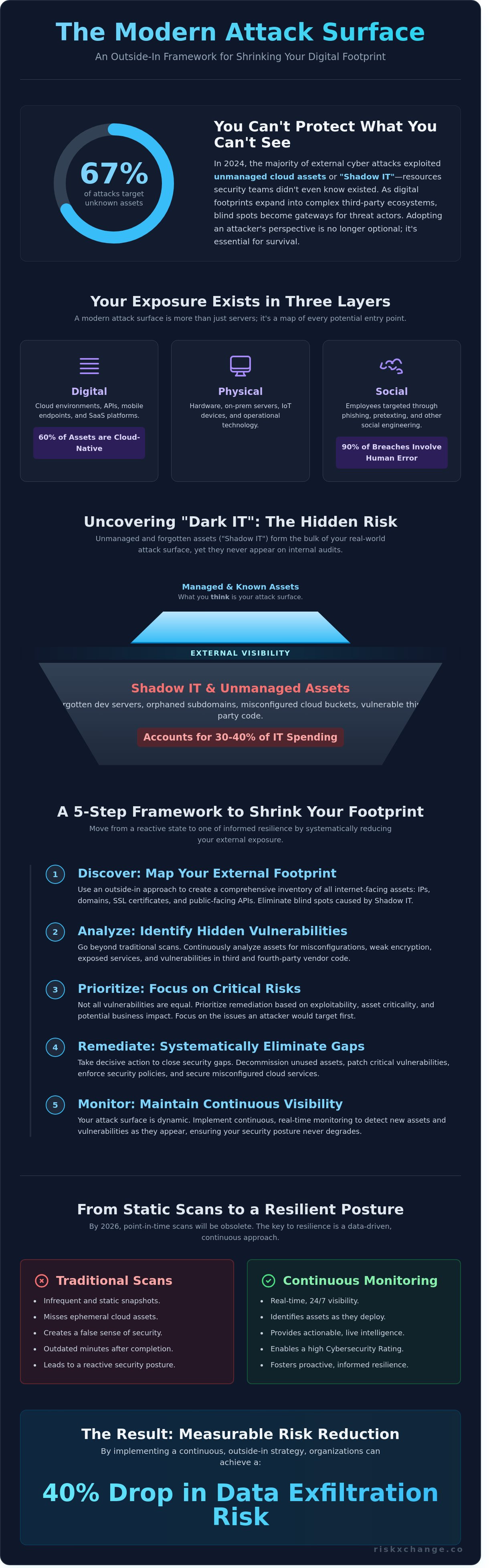
Did you know that 67% of external cyber attacks in 2024 targeted unmanaged cloud assets or shadow IT that security teams didn't even know existed? You're likely managing a digital footprint that expands faster than your team can map it, which makes it hard to know how to reduce attack surface effectively. It's a common struggle for CISOs who face a lack of visibility into third-party and fourth-party risks. You already know that you can't protect what you can't see, and as we head into 2026, the complexity of these unmanaged assets is only increasing.
This guide provides the exact outside-in framework you need to identify hidden vulnerabilities, eliminate blind spots, and shrink your digital footprint before threat actors find a way in. By shifting your perspective to match that of an attacker, you can proactively take control and move from a state of vulnerability to one of informed resilience. We'll explore a methodical strategy to achieve a higher Cybersecurity Rating and ensure your data exfiltration risk drops by 40% through continuous, real-time monitoring and actionable intelligence.
Understanding the Modern Attack Surface in 2026
The attack surface represents the total sum of all reachable vulnerabilities across your organization. It isn't a static list of servers; it's a living, breathing map of every point where an unauthorized user can attempt to enter or extract data. By 2026, research suggests that 75% of enterprises will have faced an incident stemming from an unmanaged or "shadow" asset. This makes understanding how to reduce attack surface exposure a strategic business imperative that impacts your bottom line and overall brand reputation. Taking control of this area moves your organization from a state of constant reaction to one of informed resilience.
AI has fundamentally changed the speed of exploitation. Attackers now use automated scripts to find misconfigured APIs and forgotten cloud buckets in seconds. Your digital footprint has moved far beyond the traditional office firewall, stretching into home networks, third-party SaaS platforms, and complex supply chains. This expansion creates digital blind spots that traditional security tools often miss. To manage risk effectively, you must adopt an outside-in perspective, viewing your infrastructure through the eyes of a potential adversary.
Digital vs. Physical vs. Social Attack Surfaces
Your exposure exists across three distinct layers that require constant oversight. The digital layer includes cloud environments, APIs, and mobile endpoints; currently, 60% of corporate assets reside in cloud-native footprints. The physical layer covers hardware, IoT devices, and data centers. Finally, the social layer targets your employees. Since 90% of successful breaches involve social engineering, your people are often the most vulnerable nodes in your network. Mapping these assets is the first step in learning how to reduce attack surface risks across the entire enterprise.
Why Traditional Vulnerability Management Isn’t Enough
Point-in-time scans are no longer sufficient for dynamic environments where assets appear and disappear in minutes. A traditional scan might find a bug on a Tuesday, but a developer could deploy a misconfigured container on Wednesday that stays exposed for weeks. Continuous monitoring is the only way to maintain a reliable Cybersecurity Rating. You need real-time data to identify vulnerabilities as they emerge. This proactive approach ensures that your security posture remains stable even as your digital environment evolves, turning complexity into a manageable metric.
The 'Outside-In' Perspective: Mapping Your Digital Footprint
Effective defense starts by seeing what the adversary sees. You can't protect what you don't know exists. A 2023 report from the Ponemon Institute found that 67% of organizations suffered a cyberattack originating from an unknown or unmanaged asset. This statistic highlights why understanding how to reduce attack surface begins with a comprehensive map of your external presence. You must transition from a purely internal defense posture to one that prioritizes external visibility.
Dark IT poses a constant threat to this visibility. These unmapped assets often account for 30% to 40% of total IT spending in large enterprises. When dev environments are forgotten or subdomains are orphaned, they become silent entry points for attackers. These vulnerabilities don't appear on internal audits; however, they're visible to anyone with a port scanner. Adopting an outside-in mindset allows you to reclaim control over these forgotten corners of your infrastructure.
Identifying Your External Assets
External asset discovery is the foundation of visibility. It involves more than just a list of websites. You need a granular inventory that includes:
- Active IP addresses and registered domain names.
- SSL certificates that may be expired or weakly encrypted.
- Public-facing APIs that could facilitate unauthorized data exfiltration.
Mapping these components provides a clear picture of your digital footprint. It allows you to see the same vulnerabilities that a sophisticated threat actor would target during their reconnaissance phase.
Eliminating Blind Spots with AI-Native Discovery
Manual inventories are obsolete because the digital perimeter changes every hour. AI-native discovery automates the identification of shadow IT across global business units, ensuring nothing stays hidden. It bridges the gap between what IT thinks exists and the dynamic reality of what's actually online. Real-time intelligence spots new assets the moment they spin up, integrating them into your continuous monitoring workflow immediately.
By leveraging AI, you move from reactive patching to proactive management. This technology provides the data-driven honesty needed to improve your overall Cybersecurity Rating. It transforms a chaotic digital presence into a measurable, manageable, and resilient infrastructure. Understanding how to reduce attack surface is no longer about building higher walls, but about ensuring every inch of your perimeter is accounted for and secured.
The Hidden Risk: Managing Your Third-Party Attack Surface
Your security perimeter no longer ends at your firewall. In a hyper-connected ecosystem, your attack surface is only as resilient as your weakest vendor. Attackers recognize this reality. They frequently target smaller, less secure partners to gain a foothold into larger, more lucrative networks. Data from the 2023 Verizon Data Breach Investigations Report indicates that 62% of all system intrusions originate through a third party. To understand how to reduce attack surface vulnerabilities, you must adopt an outside-in perspective that accounts for every digital handshake your organization makes.
The challenge intensifies when you consider fourth-party risk. These are your vendors' vendors. A 2023 study found that 98% of organizations are connected to at least one third party that has suffered a breach in the last two years. This creates a ripple effect where a single vulnerability in a remote software library or a niche service provider can compromise your entire enterprise. Managing this requires a shift toward "Shared Responsibility." You can't outsource your risk; you can only manage the visibility of it. It's about moving from a state of digital vulnerability to one of informed resilience.
Assessing Vendor Exposure
Static, manual questionnaires are no longer sufficient for modern risk management. They offer a snapshot of a vendor's security from six months ago, not the reality of today. You need to implement continuous monitoring to track vendor security postures in real-time. This approach allows you to see fluctuations in their Cybersecurity Rating the moment they occur. By understanding Third-Party Risk Management, you can automate these assessments to replace slow, human-led processes. This ensures that 100% of your critical partners meet your security benchmarks every single day.
Supply Chain Visibility
Visibility is the only antidote to supply chain uncertainty. Many organizations face concentration risk, where too many critical services rely on a single provider or geographic region. If 40% of your digital supply chain relies on one cloud hosting provider, a single outage or breach becomes a catastrophic event for your operations. You must implement minimum security standards for all digital partners to maintain control. This includes mandatory multi-factor authentication and documented patch management cycles. Establishing these baseline requirements is a vital step in how to reduce attack surface exposure across your entire business network.
5 Actionable Steps to Reduce Your Attack Surface
Shrinking your digital exposure requires a shift from reactive patching to a framework built on proactive design. Organizations that prioritize reduction efforts based on business impact see a 45% decrease in successful exploits compared to those using traditional methods. Understanding how to reduce attack surface effectively means moving away from a "find and fix" mentality toward a culture of informed resilience. This systematic approach ensures that every asset, whether on-premise or in the cloud, is accounted for and secured.
Step 1 & 2: Inventory and Decommissioning
You can't protect what you haven't identified. Start by creating a living inventory of all digital assets using automated discovery tools that provide an "outside-in" perspective. This process reveals forgotten subdomains, dev environments, and shadow IT that often sit outside the view of the security team. Hardening the surface involves the immediate shutdown of these legacy systems. Decommissioning is the fastest way to reduce risk. By removing 15% of unnecessary or orphaned assets, you eliminate potential entry points before an attacker can find them.
Step 3 & 4: Network Segmentation and Access Control
Flat networks allow threats to spread like wildfire. Implementing micro-segmentation ensures that even if a breach occurs, the lateral movement is restricted to a single isolated zone. The Role of Network Segmentation is a cornerstone of Zero Trust architectures, where no user or device is trusted by default. Enforcing Least Privilege access is equally vital; current data shows that 80% of security incidents involve the misuse of privileged credentials. Restricting access to only what is necessary for a specific role creates a smaller, more manageable target for defenders.
Step 5: Continuous Vulnerability Remediation
The final stage in how to reduce attack surface is closing the loop between discovery and resolution. Stop prioritizing patches based solely on CVSS scores. Instead, focus on exploitability and real-world threat intelligence. With over 25,000 new vulnerabilities discovered annually, automation is the only way to keep pace. An automated remediation lifecycle ensures that critical flaws are addressed within hours rather than weeks. This continuous monitoring approach transforms security from a static checklist into a dynamic, measurable metric of organizational health.
Take control of your digital footprint with precision and clarity. Monitor your attack surface with RiskXchange to gain the real-time visibility your security posture requires.
Continuous Visibility: Maintaining a Resilient Security Posture
Attack surface reduction isn't a project with a defined end date; it's a continuous journey. Threat actors scan global IP ranges every few minutes, looking for a single unpatched server or an abandoned cloud instance. If your security posture remains static, it becomes obsolete within hours. True resilience requires you to adopt a mindset of perpetual discovery and remediation. You can't protect what you can't see, and in a digital environment that expands daily, visibility is your strongest defense.
Taking control of your digital footprint means moving beyond reactive patching. You need actionable risk intelligence that highlights exactly where your perimeter is thinning. By 2026, organizations that prioritize continuous monitoring will be 3 times more likely to prevent a major data breach compared to those relying on annual audits. Understanding how to reduce attack surface effectively isn't just about closing ports; it's about maintaining a clear, "outside-in" view of your entire estate to see what an attacker sees.
Measuring Success with Cybersecurity Ratings
Boards of directors require quantifiable metrics to justify security spend. Cybersecurity ratings provide this anchor, converting complex technical risks into a single, trackable score. A higher rating correlates directly with a smaller, more manageable attack surface. A 2023 analysis of 5,000 organizations indicated that companies with a "low" security rating are nearly 5 times more likely to suffer a ransomware attack than those with an "excellent" score.
- Benchmark against peers: Compare your security posture against the industry average of 720 to identify where you're falling behind.
- Track progress: Monitor how decommissioning legacy systems or securing shadow IT improves your score in real-time.
- Communicate ROI: Present clear, data-driven evidence of risk reduction to non-technical stakeholders using a standardized metric.
The RiskXchange Advantage
RiskXchange provides the 360-degree visibility required to stay ahead of modern threats as we approach 2026. By seamlessly integrating Third-Party Risk Management (TPRM) with Attack Surface Management (ASM), the platform ensures you aren't blind to vulnerabilities within your broader ecosystem. You'll receive real-time alerts the moment a new weakness appears, allowing for immediate intervention. This proactive approach is the most effective way to master how to reduce attack surface and build long-term digital trust.
Stop guessing about your security posture and start measuring it. Get your free Cybersecurity Rating from RiskXchange today.
Master Your Resilient Security Posture
The 2026 threat landscape demands a shift from reactive patching to proactive, continuous oversight. You've learned that mapping your digital footprint from an outside-in perspective isn't optional; it's the only way to see what an attacker sees. By addressing hidden third-party vulnerabilities and implementing the 5 actionable steps discussed, you're building a foundation of informed resilience. Mastering how to reduce attack surface requires more than a one-time audit. It requires a persistent, data-driven strategy that transforms abstract risks into a quantifiable Cybersecurity Rating.
RiskXchange provides the clarity you need to navigate this complexity. Our AI-native TPRM solution offers real-time monitoring through a comprehensive 360-degree risk management platform. We're already trusted by Fortune 500 enterprises globally to maintain visibility across vast, interconnected ecosystems. You don't have to manage these digital blind spots alone. With the right tools, you can turn vulnerability into a strategic advantage and maintain total command over your environment.
Take control of your digital footprint with RiskXchange
It's time to move toward a future where your security posture is always visible, measurable, and under your control.