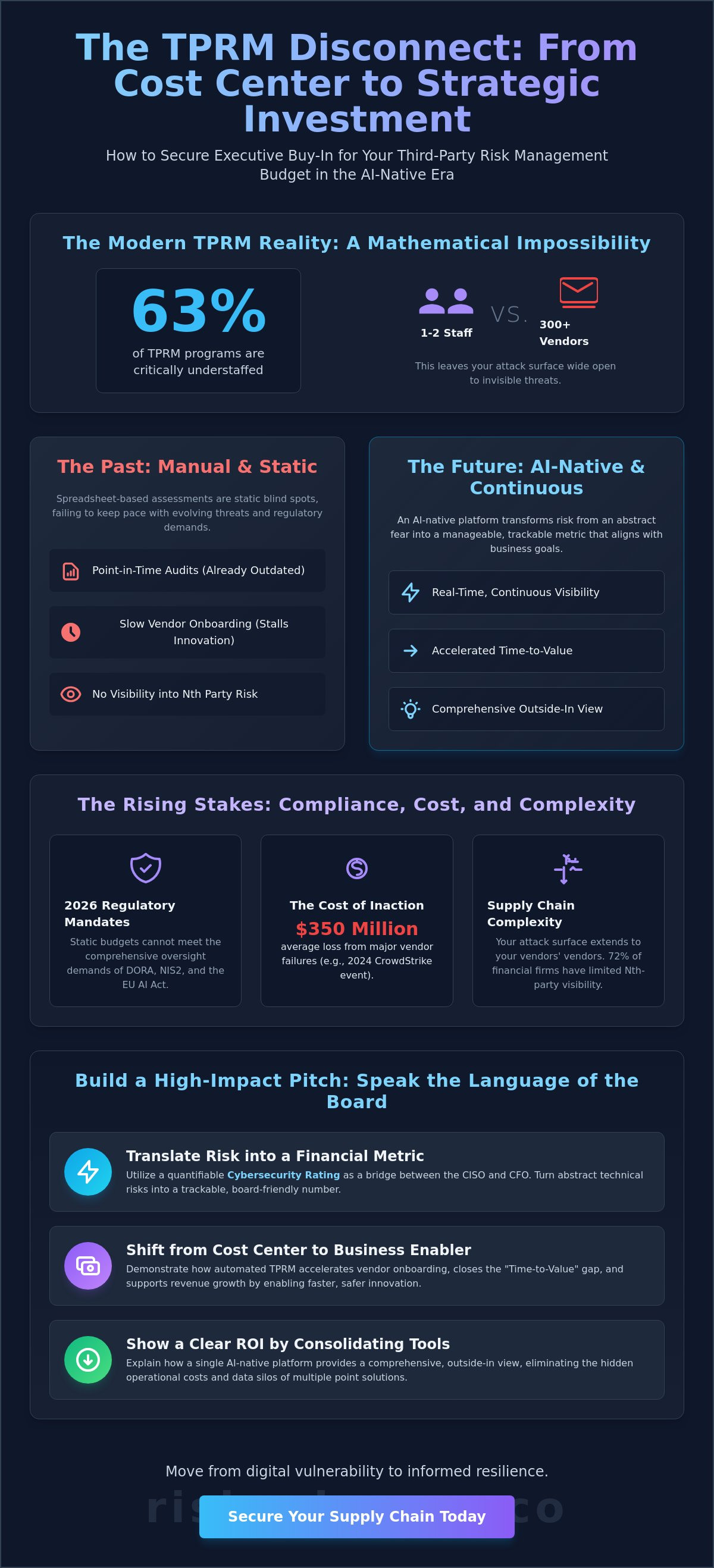
Consider this: 63% of TPRM programs are currently forced to manage over 300 vendors with only one or two dedicated staff members. It's a mathematical impossibility that leaves your organization's attack surface wide open to invisible threats. You already know that manual, spreadsheet-based assessments can't keep up with the 2026 regulatory demands of DORA, NIS2, or the EU AI Act. However, translating that operational reality into a successful funding request is often where the process stalls. Learning how to get executive buy-in for TPRM budget requires a shift from discussing abstract threats to presenting a clear, quantifiable Cybersecurity Rating that resonates with the board.
It's frustrating when the CFO sees your security requests as a bottomless cost center rather than a strategic investment. We understand the pressure of managing a complex supply chain while facing constant budget fatigue from previous tool requests. This guide provides a clear framework to master the art of translating supply chain risk into tangible business value. You'll gain access to the specific data points that resonate with financial leaders and learn how to secure approval for a modern, AI-native TPRM solution. We'll show you how to move from digital vulnerability to informed resilience by treating risk as a manageable, trackable metric.
The 2026 TPRM Landscape: Why Static Budgets No Longer Work
The 2026 regulatory environment has fundamentally altered the requirements for corporate oversight. Understanding Third-party risk management (TPRM) is no longer just a compliance exercise; it's a core component of business resilience. Historically, many organizations treated these budgets as reactive expenses. They only invested after a breach occurred. Today, securing funding requires a transition toward proactive resilience. If you're struggling with how to get executive buy-in for TPRM budget, start by exposing the hidden costs of manual processes. Traditional spreadsheets are static blind spots. They fail to capture the real-time shifts in a vendor's security posture, leaving your organization vulnerable to threats that evolve in hours, not months.
Moving from Point-in-Time to Continuous Visibility
Annual audits provide a snapshot of a moment that's already passed. This point-in-time approach is dangerous in a landscape where 53% of organizations manage over 300 vendors. Real-time risk intelligence identifies vulnerabilities as they emerge, significantly reducing the window of vulnerability across your entire supply chain. By positioning an AI-native platform as a tech-forward guardian, you move beyond the checkbox mentality. You're offering a continuous lens through which the board can view the company's true security posture. This visibility transforms risk from an abstract fear into a manageable, trackable metric known as a Cybersecurity Rating.
The Supply Chain Complexity Crisis
Modern SaaS ecosystems have created a geometric growth in fourth and fifth-party dependencies. Your attack surface now extends far beyond your corporate perimeter, reaching deep into the infrastructure of your vendors' vendors. Traditional procurement cycles can't keep pace with this digital transformation. When 72% of financial institutions are only partially aware of which vendors use AI, the risk of Nth party failure becomes a mathematical certainty. You must explain to stakeholders that the digital footprint they see isn't the whole story. An outside-in perspective is required to map the interconnected ecosystem that defines your operational reality.
Regulators aren't making suggestions; they're setting mandates. The Digital Operational Resilience Act (DORA) and NIS2 Directive require comprehensive oversight that manual systems simply can't provide. Public companies under U.S. SEC rules must now disclose these third-party risks with granular detail. To successfully navigate how to get executive buy-in for TPRM budget, you must define the stakes clearly. The Cost of Inaction is the financial delta between a proactive platform investment and the average $350 million loss seen in major vendor failures like the 2024 CrowdStrike event.
Aligning TPRM with Corporate Strategy and Revenue Goals
To successfully navigate how to get executive buy-in for TPRM budget, you must pivot the conversation from cost avoidance to revenue enablement. Executives often view security as a department that slows down innovation. By demonstrating how a modern TPRM strategy aligns with corporate growth, you transform the program into a competitive advantage. It's about showing the board how to Align cyber risk management with business needs, ensuring that every dollar spent on security directly supports the company’s ability to scale and compete in a digital-first market.
TPRM as a Business Enabler, Not a Gatekeeper
Manual due diligence often stalls vendor onboarding for weeks. This delay creates a significant "Time-to-Value" gap for new software and services that the business needs to stay competitive. Automated assessments allow the business to move faster without increasing the attack surface. By utilizing an AI-native platform, you reduce the friction between procurement, legal, and security teams. This creates a seamless workflow where risk is identified and mitigated in real-time, allowing the company to embrace new technologies with confidence. You can automate the vendor assessment lifecycle to ensure that security supports, rather than hinders, operational speed.
Protecting the Brand Reputation
Your company’s security posture is no longer an internal secret. Investors, partners, and customers now use an "outside-in" perspective to evaluate your resilience before signing contracts. A high Cybersecurity Rating serves as a powerful marketing tool in RFP processes, proving that you are a reliable steward of their data. Conversely, a breach through a third party can lead to "guilt by association," causing irreparable damage to your brand’s reputation and market value. In 2026, over 70% of enterprise organizations include specific cybersecurity performance requirements in their procurement contracts. If your organization can't prove real-time oversight of its vendors, you're likely losing revenue to competitors who can.
Modern TPRM also fulfills the "G" in ESG (Environmental, Social, and Governance) goals. Robust governance requires a deep understanding of your supply chain visibility. When you prove that your program provides continuous, actionable intelligence across the entire vendor ecosystem, you're not just asking for funding. You're offering a framework for long-term corporate stability. Mastering how to get executive buy-in for TPRM budget means proving that a transparent, well-monitored supply chain is fundamentally a more profitable one. This proactive control moves the needle from a state of digital vulnerability to one of informed resilience, ensuring the board oversees a stable, measurable business asset.
The Metric that Matters: Using Cybersecurity Ratings for Buy-in
Executives don't speak the language of CVSS scores or patch latency; they speak the language of financial risk and performance metrics. To master how to get executive buy-in for TPRM budget, you need a quantifiable anchor that translates technical complexity into business impact. The Cybersecurity Rating provides this bridge. It's a tangible, trackable metric that turns abstract security concepts into a clear score, allowing the CISO to present data in a format the CFO can actually use for financial planning. Benchmarking your organization against industry peers creates a healthy competition for budget because no board wants to be the outlier with the lowest score in their sector.
This "outside-in" perspective is essential for modern risk management. It forces the leadership team to see the company’s digital footprint exactly as an attacker does, highlighting the vulnerabilities that are visible to the entire world. When you view your supply chain through this lens, the conversation shifts from "what are we buying?" to "how are we perceived?". In 2026, 73% of organizations feel pressure to improve their TPRM programs, often because their own customers are monitoring them. If your vendors are dragging down your score, you aren't just a security risk; you're a liability to your sales team. This realization is often the catalyst for successful funding requests.
Benchmarking and Competitor Analysis
Using real-time data to show where the company stands relative to the industry average removes the guesswork from budget pitches. Objective scores identify critical "blind spots" in the vendor pool that spreadsheets simply can't find. A 360-degree risk view simplifies complex technical debt into an actionable score, moving the focus from internal defense to external visibility. This data-driven approach ensures that the most significant risks are addressed first, maximizing the utility of every dollar spent. It moves the needle from a state of digital vulnerability to one of informed resilience by providing a clear lens on the entire attack surface.
Quantifying Risk Reduction (The Before and After)
Proving the value of a platform requires visualizing the "Risk Delta." This is the measurable difference between your current posture and your security posture after implementing continuous monitoring. Tracking remediation progress over time serves as a key KPI for the executive board, showing that the investment is delivering tangible resilience. You can learn more about how an IT security assessment strengthens your defenses to establish this critical baseline. By presenting a clear path from digital vulnerability to proactive control, you instill the calm confidence needed to secure long-term support for your how to get executive buy-in for TPRM budget initiative.
A Step-by-Step Guide to Building Your TPRM Pitch
Constructing a successful funding request is less about the technology and more about the narrative. To master how to get executive buy-in for TPRM budget, you must follow a methodical progression that identifies the problem, provides the data, and offers the solution. This process starts with an inventory of hidden costs. Many programs operate with minimal staff while managing hundreds of vendors; the manual labor spent chasing spreadsheets represents thousands of wasted hours and a high probability of human error. By quantifying this operational drag, you set the stage for a conversation about efficiency and resource allocation.
- Phase 1: Inventory Hidden Costs. Document the time spent on manual assessments and the financial impact of spreadsheet errors that lead to missed vulnerabilities.
- Phase 2: Identify a High-Impact Use Case. Focus on a critical SaaS provider or a recent near-miss to illustrate the stakes to the board.
- Phase 3: Present the Solution as a Cost-Saver. Contrast the expense of an AI-native platform against the salary and benefits of adding five additional full-time employees to handle the manual workload.
- Phase 4: Define the ROI Timeline. Show exactly when the platform will pay for itself through accelerated onboarding and the prevention of a single major disruption.
Translating Technical Risk into Financial Impact
Executives often tune out when they hear technical jargon. Replace terms like "SQL injection" with "Potential Data Exfiltration Loss" to ground the discussion in financial reality. Use the "outside-in" narrative to show the Board exactly what an attacker sees when they look at your digital footprint. This mentor-based approach positions you as the expert who simplifies complexity, making the Board look smart and well-informed. It moves the conversation from a state of vulnerability to one of proactive control. You can request a platform demo to see how these metrics look in real-time before your next meeting.
Addressing the Top Executive Objections
Anticipate resistance by preparing direct, data-driven answers. When asked if the work can be done internally, highlight the scalability argument; manual processes cannot keep pace with 300 or more vendors. If they ask if this is "just another tool," explain that an AI-native platform actually consolidates siloed tools into a single, comprehensive view. Finally, address the "wait until next year" objection by highlighting the window of vulnerability. With NYDFS and SEC regulations already in effect, the cost of a compliance failure today far outweighs the price of a solution. This structured logic is the key to how to get executive buy-in for TPRM budget in a competitive fiscal environment.
RiskXchange: The AI-Native Solution for Budget-Conscious Executives
RiskXchange serves as the comprehensive 360-degree platform that executives need to see to finalize their funding decisions. When you're determining how to get executive buy-in for TPRM budget, the ability to replace multiple siloed tools with a single, AI-native solution is your strongest financial argument. Rather than asking for a sprawling tech stack that requires constant maintenance, you're proposing a unified lens that provides total supply chain visibility. This consolidation reduces the total cost of ownership and simplifies the vendor management process for procurement, legal, and security teams alike. It moves the organization away from fragmented data toward a state of informed resilience.
The platform utilizes advanced machine learning capabilities to automate the vendor assessment lifecycle. This isn't just about scanning for vulnerabilities; it's about creating a seamless flow from initial onboarding to real-time risk mitigation. For the 53% of companies managing over 300 vendors, this level of automation is the only way to maintain oversight without hiring a massive team. Our Professional Service Fees ensure that implementation is managed by seasoned experts, guaranteeing that the platform integrates into your existing workflows from day one. This managed approach reduces the risk of tool abandonment and ensures a faster ROI for the board.
Automating the Lifecycle for Maximum Efficiency
Efficiency is the primary driver for a CFO. Moving from onboarding to continuous monitoring without increasing headcount is a tangible business benefit that justifies the investment. RiskXchange provides real-time security ratings that offer actionable risk intelligence, allowing your team to focus on remediation rather than data collection. To ensure you select the right partner for your needs, consult our Third-Party Risk Management Software Buyer’s Checklist to see how we compare to legacy systems. This clarity helps you prove that the platform isn't just another tool; it's a strategic asset that protects the bottom line.
Taking Control of Your Digital Footprint
The journey from digital vulnerability to informed resilience requires a fundamental shift in perspective. By eliminating blind spots in your supply chain, you're not just checking a compliance box for DORA or NIS2; you're taking proactive control of your company's reputation. This outside-in view allows you to see what attackers see and fix vulnerabilities before they become a headline. Mastering how to get executive buy-in for TPRM budget concludes with a simple demonstration of value. We invite you to see your own Cybersecurity Rating in action through a personalized walkthrough. RiskXchange doesn’t just find threats; it makes them manageable. Request your demo today and move your organization toward a state of calm, data-driven security.
Take Control of Your Supply Chain Resilience
Securing necessary funding isn't about highlighting fear; it's about proving the strategic value of a resilient supply chain. We've explored how transitioning from static, point-in-time audits to continuous visibility eliminates the blind spots that lead to operational failures. By using a quantifiable Cybersecurity Rating, you bridge the gap between technical risk and financial performance. This approach simplifies board-level reporting and provides the clarity needed for 2026 regulatory compliance across global frameworks.
Mastering how to get executive buy-in for TPRM budget requires positioning your program as a business enabler that protects brand reputation and accelerates time-to-value. RiskXchange offers an AI-native platform providing 360-degree supply chain visibility, a solution trusted by Fortune 500 enterprises for real-time risk intelligence. It's time to move the conversation from digital vulnerability to proactive control. Take the first step toward total visibility and informed resilience today.
Request a Free Attack Surface Scan and See Your Cybersecurity Rating to show your board exactly where the organization stands. You have the expertise to manage this landscape; now you have the data to prove it.