With 63% of risk management programs operated by only one or two people, relying on manual spreadsheets isn't just inefficient; it's a liability. As over 60% of data breaches now involve third parties, the traditional method of sending static forms is no longer sufficient to meet strict Q1 2026 DORA reporting deadlines or NIS2 requirements. You've likely experienced how the manual cycle of chasing down answers creates massive onboarding delays and leaves your organization in a state of vulnerability. Learning how to automate vendor questionnaires is no longer about finding a tool to send emails faster. It's about building an AI-native validation loop that verifies self-attestations against real-time security data.
We understand that questionnaire fatigue is draining your resources and stalling critical business initiatives. This guide will show you how to transform manual vendor assessments into a streamlined, AI-driven engine that reduces risk and saves hundreds of hours. You'll learn how to reduce assessment turnaround times by 50% or more, shifting your focus from tedious data entry to strategic risk analysis. We will explore the steps to achieve a continuous, quantifiable view of your security posture, ensuring your organization is perceived as a resilient leader from an external vantage point.
The High Cost of Manual Vendor Risk Assessments
The traditional approach to third-party risk management often relies on a snapshot in time. This "Point-in-Time" trap creates a false sense of security, as a spreadsheet is often obsolete the moment it's submitted. By the time a risk officer reviews the data, the vendor's infrastructure or compliance status may have already shifted. This delay is more than an inconvenience; it's a fundamental vulnerability. When 80% of legal leaders report discovering critical risks only after the onboarding process is complete, it's clear the traditional due diligence model has failed.
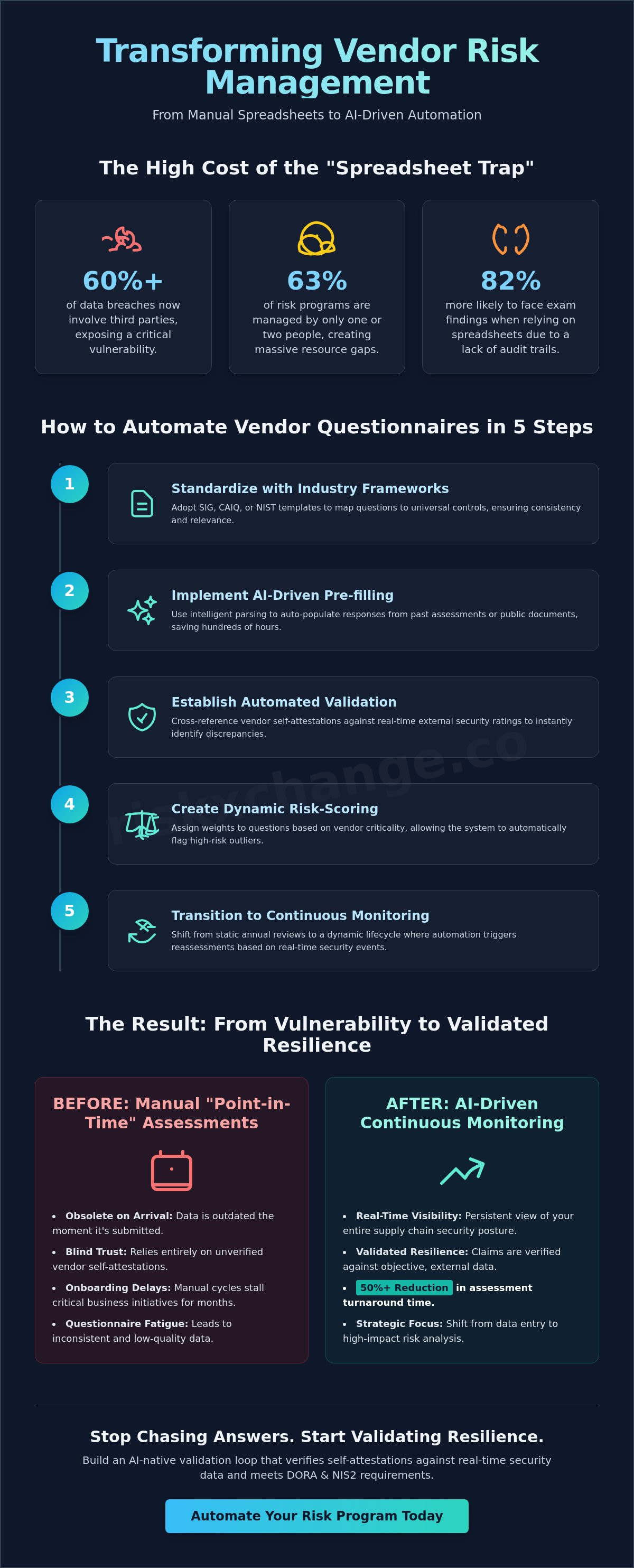
Manual assessments carry heavy hidden costs. Beyond the obvious drain on human hours, these processes cause significant onboarding delays that can stall major business initiatives for months. For the small teams managing these programs, the burden is immense. Industry data shows that 63% of TPRM programs are managed by just one or two employees. This resource gap makes it physically impossible to maintain the depth of review required without understanding how to automate vendor questionnaires. It's not just about speed; it's about the ability to see threats before they manifest.
We must also consider the psychological toll of "Questionnaire Fatigue." When vendors are forced to answer hundreds of repetitive, manual questions, the quality of their responses inevitably drops. This leads to inconsistent data and "best day" reporting, where a vendor describes their ideal security state rather than their daily reality. This friction damages the partnership and obscures the true risk profile of your supply chain.
The Inefficiency of the Spreadsheet Era
Manual tracking inevitably leads to version control nightmares and fragmented data silos. When assessments are conducted over email, there is no centralized audit trail, making it difficult to prove compliance during regulatory exams. As your vendor ecosystem grows, these manual workflows become a bottleneck. Organizations using spreadsheets are 82% more likely to face exam findings because they lack the structured, scalable oversight that modern digital environments demand. Automation replaces this chaos with a steady, methodical rhythm of data collection.
The Visibility Gap in Static Assessments
Self-attestations are a starting point, but they are insufficient for modern cybersecurity compliance. A static questionnaire captures a vendor's "best day," creating a disconnect between their stated policies and their actual security posture. To close this gap, teams need to move toward a model that combines internal responses with external, real-time technical signals. Learning how to automate vendor questionnaires is the first step in shifting from a state of blind trust to one of informed resilience, where every claim is validated by objective data.
How to Automate Vendor Questionnaires in 5 Steps
Building a resilient supply chain requires more than just faster emails; it demands a structured, five-step implementation path that moves from manual data collection to automated validation. When organizations evaluate how to automate vendor questionnaires, they often mistake speed for effectiveness. True automation doesn't just send forms faster. It creates a validation loop that ensures data integrity. This process aligns with the Interagency Guidance on Risk Management, which emphasizes the need for sound risk management throughout the third-party relationship lifecycle.
- Step 1: Standardize with industry-recognized frameworks. Adopt SIG, CAIQ, or NIST templates to ensure your questions are mapped to universal controls.
- Step 2: Implement AI-driven pre-filling. Use intelligent parsing to auto-populate responses from a vendor's previous assessments or public compliance documents.
- Step 3: Establish automated validation rules. Cross-reference vendor answers against external security ratings to identify discrepancies in real-time.
- Step 4: Create dynamic risk-scoring workflows. Assign weights to questions based on vendor criticality, allowing the system to flag high-risk outliers automatically.
- Step 5: Transition to continuous monitoring. Shift from annual reviews to a lifecycle approach where automation triggers reassessments based on security events.
This is the core of how to automate vendor questionnaires: replacing manual effort with intelligent validation. Leveraging an AI-native TPRM platform allows you to execute these steps within a single, unified workflow, moving your team from a state of vulnerability to proactive control.
Standardization and Framework Selection
Choosing the right framework is the foundation of a scalable program. While custom questionnaires might feel specific to your needs, they often create friction. Standardized formats like SIG Lite or SIG Full allow vendors to provide pre-vetted answers, which speeds up the process significantly. By mapping these questions to specific technical controls, you enable cross-platform automation. Many leading organizations now utilize "trust centers" to centralize this documentation, providing a single source of truth that simplifies the audit process for both parties.
AI-Native Pre-filling and Logic
AI-native tools transform the vendor experience by parsing historical data and public records to auto-populate forms. This reduces the time vendors spend on repetitive entries, which directly improves completion rates and data accuracy. Smart questionnaires also utilize conditional logic; they hide irrelevant questions based on the vendor's service type or risk tier. If a vendor isn't handling PII, they shouldn't see a privacy section. This surgical approach ensures that your team only reviews the data that truly impacts your security posture.
AI-Driven Validation: Moving Beyond Self-Attestation
The true power of modern risk management lies in the transition from blind trust to verified intelligence. Understanding how to automate vendor questionnaires is only half the battle; the other half is ensuring the answers provided are accurate and actionable. For too long, organizations have accepted self-attestations at face value, creating a state of vulnerability where a single "Yes" on a form can obscure a critical security gap. AI-driven validation changes this dynamic by implementing a "Trust but Verify" model that operates in real-time.
Machine learning models now possess the capability to identify contradictions between a vendor's claim and their actual external attack surface. If a vendor marks "Yes" for robust patch management but external scans reveal high-severity vulnerabilities on their public-facing assets, the system flags the discrepancy immediately. Organizations can utilize CISA's vendor assessment template as a foundational benchmark, but the validation must happen through technical cross-referencing. This automation reduces the "human-in-the-loop" requirement to high-stakes exceptions only, allowing your team to focus on strategic risk mitigation rather than chasing down missing data.
Cross-Referencing with Security Ratings
Effective automation compares internal responses to external technical signals. When a questionnaire response contradicts a security rating, the system creates a quantifiable risk alert. This isn't about catching vendors in a lie; it's about identifying a disconnect between their policies and their daily operational reality. By using trackable, numerical benchmarks, you can present a clear view of supply chain health to the board. This externalized perspective allows you to justify risk decisions with data rather than intuition, moving the conversation from a state of uncertainty to one of informed resilience.
Automated Evidence and Document Parsing
The manual review of SOC2 reports, ISO certificates, and insurance documents is a notorious bottleneck. AI-native platforms use Optical Character Recognition (OCR) and natural language processing to "read" these documents, verifying that they are current, signed, and relevant to the services provided. Automation tracks expiration dates and triggers renewal requests without human intervention. This shift to exception-based management ensures that your compliance posture remains persistent. You'll no longer waste hours checking dates on PDFs; instead, you'll manage the rare instances where a certificate has lapsed or a control has failed, maintaining proactive control over your entire vendor ecosystem.
Best Practices for Scaling Your Automation Program
Scaling a risk management program requires a transition from reactive effort to strategic precision. Once you've mastered how to automate vendor questionnaires, the focus shifts to optimizing the entire workflow to handle a growing supply chain without increasing headcount. Success at scale isn't defined by the volume of data collected, but by the accuracy and relevance of the insights generated. Building a system that grows with your business needs is the hallmark of a mature security posture.
- Tier your vendors. Not every third party requires a comprehensive, 200-question assessment. A SaaS provider with access to sensitive customer data demands deeper scrutiny than a janitorial service.
- Integrate with procurement and GRC. Create a single source of truth by ensuring risk data flows seamlessly between your security platform and your business tools.
- Enable self-service portals. Reduce friction by allowing vendors to manage their own documentation and update their status through a centralized portal.
- Set up automated alerts. Configure the system to flag critical changes, such as a sudden drop in a security rating or a modified answer on a high-stakes control.
Efficient scaling moves the conversation from a state of constant catch-up to one of proactive control. By implementing these practices, you ensure that your team spends their time analyzing high-risk exceptions rather than managing administrative tasks. To see these best practices in action, you can explore our AI-native TPRM platform for a more integrated approach to supply chain oversight.
Tiering and Scoping for Efficiency
Categorizing vendors by their business criticality and data access is the most effective way to maintain a lean operation. Trigger different questionnaire lengths based on these tiers to ensure you aren't overwhelming low-risk partners with unnecessary requests. This "right-sizing" of assessments preserves vendor goodwill and ensures that your internal resources are focused where they matter most. A well-defined scoping framework is essential when planning how to automate vendor questionnaires across a diverse vendor base, preventing the data silos that often plague manual programs.
Integrating into the Security Ecosystem
Risk data shouldn't live in a vacuum. APIs play a critical role in connecting your TPRM platform to your SIEM, ERP, or GRC systems. This connectivity ensures that risk data flows directly into the hands of decision-makers in real-time. A unified risk dashboard provides the externalized perspective necessary for executive reporting, treating security as a trackable, numerical benchmark. When your security stack is integrated, you gain a 360-degree view of your posture, moving your organization from vulnerability to informed resilience.
The RiskXchange Advantage: AI-Native TPRM
Managing supply chain risk in a volatile technological landscape requires a platform that moves beyond basic administration. RiskXchange delivers a 360-degree view of your ecosystem by merging automated validation with continuous, real-time risk management. While previous sections detailed the steps of how to automate vendor questionnaires, the RiskXchange platform serves as the engine that operationalizes these strategies at scale. It transforms raw data into actionable risk intelligence, allowing your organization to move from a state of vulnerability to one of informed resilience.
Our AI-native approach simplifies the complexities of global compliance. By providing automated mapping to critical frameworks such as NIST, ISO, and GDPR, RiskXchange ensures that your assessments are always aligned with the latest regulatory requirements. This isn't just about checking boxes; it's about maintaining a persistent and thorough oversight of every partner in your network. We treat security as a trackable, numerical benchmark, providing a tangible anchor for all strategic discussions and executive reporting.
Continuous Real-Time Risk Management
Most legacy tools rely on a static, "point-in-time" approach that leaves you blind to emerging threats between assessment cycles. RiskXchange contrasts this by providing an externalized perspective of your security posture. Our platform monitors your vendors' external attack surfaces in real-time, identifying vulnerabilities as they appear. This immediacy allows enterprise teams to respond to rating drops or critical answer changes before they result in a breach. Implementation is designed for global scale, ensuring that your team can manage thousands of vendors without losing the granular technical expertise required for high-stakes validation.
Empowering Decision Makers
The goal of understanding how to automate vendor questionnaires is to achieve proactive control over your digital environment. RiskXchange functions as a sophisticated, tech-forward guardian, simplifying the overwhelming complexity of the modern threat landscape. We provide the lens through which you can evaluate your true security posture, ensuring that your organization is perceived as a resilient leader by partners and regulators alike. Our platform projects the confidence of a seasoned expert, allowing you to focus on growth while we manage the persistent nature of supply chain risk.
Take command of your vendor risk management today. We invite you to see the RiskXchange platform in action and discover how our AI-native solutions provide the clarity and thoroughness your business demands. For global enterprise clients, our team offers strategic support to ensure your transition from manual processes to automated resilience is steady, methodical, and highly organized.
Mastering the Future of Third-Party Risk
Transitioning from manual, spreadsheet-based reviews to an AI-native engine is no longer a luxury for digital leaders; it's a strategic necessity to meet 2026 regulatory demands. By implementing a structured approach to how to automate vendor questionnaires, you replace the vulnerability of self-attestation with the clarity of technical validation. This shift ensures your team moves from tedious data entry to high-level strategic oversight, focusing resources on the risks that truly impact your operational resilience.
You now have the roadmap to achieve 360-degree risk visibility and real-time security ratings across your entire supply chain. Automated mapping to global compliance frameworks further simplifies the audit process, ensuring your organization remains a tech-forward guardian in a volatile landscape. Ready to transform your TPRM program? Request a Demo of RiskXchange's AI-Native TPRM Platform to see how we help you manage cybersecurity risk with precision and thoroughness. Take command of your vendor ecosystem and build a world where supply chain challenges are visible, measurable, and manageable.