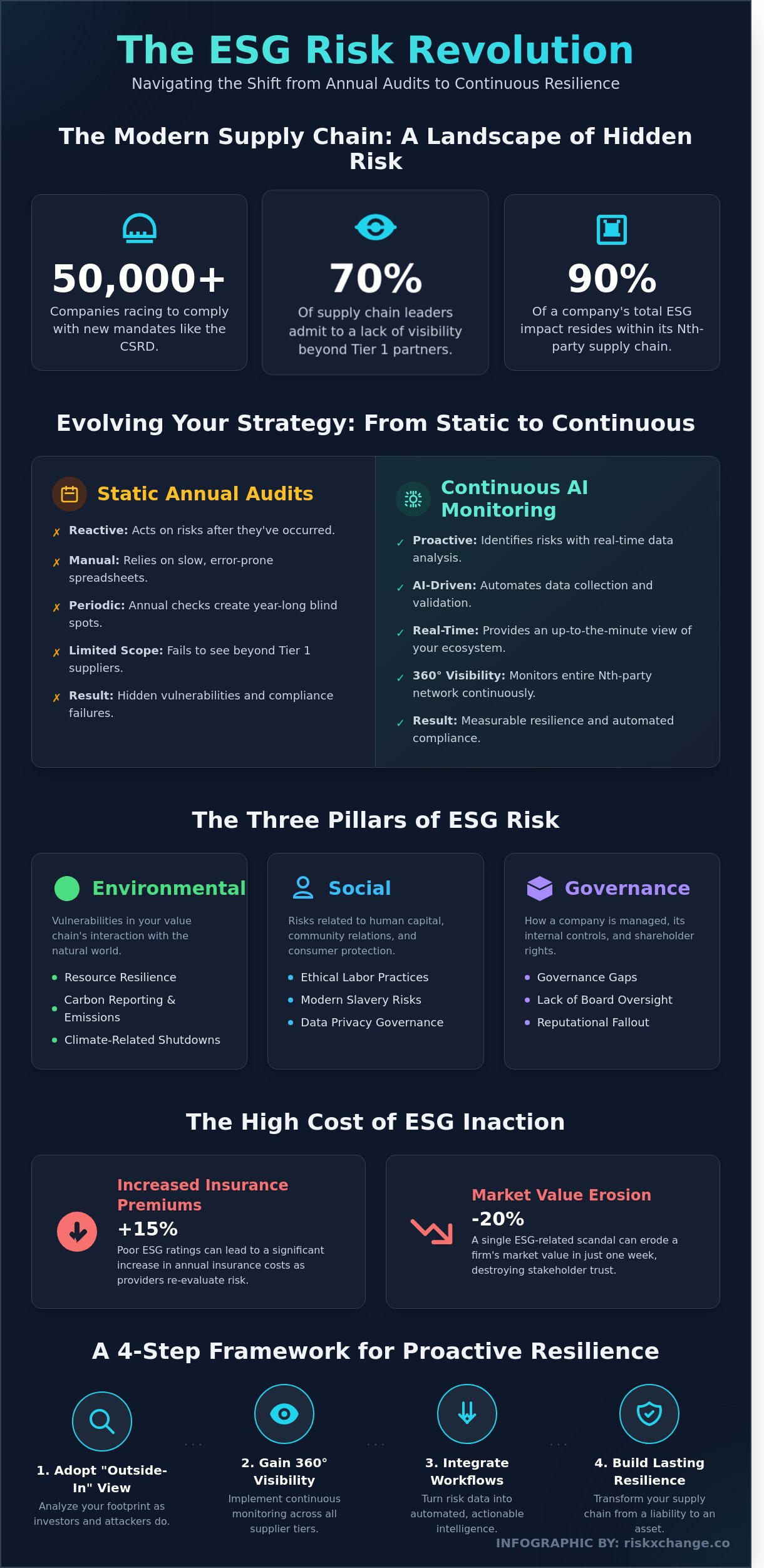
Over 50,000 companies are currently racing to comply with the Corporate Sustainability Reporting Directive (CSRD), yet 70% of supply chain leaders admit they lack visibility beyond their Tier 1 partners. You already know that manual vendor assessments are too slow and prone to human error to keep pace with these evolving mandates. Relying on annual spreadsheets leaves your organization exposed to hidden vulnerabilities deep within your Nth-party network. Modern esg risk management isn't about checking a box once a year; it's about maintaining a proactive, outside-in view of your entire ecosystem.
We understand the pressure of navigating SEC requirements while protecting your bottom line from reputational fallout. This article will show you how to master these complexities by shifting from static reporting to a continuous, AI-driven monitoring strategy. You'll learn to replace blind spots with real-time visibility and automate your compliance workflows. We'll outline a strategic framework for 2026 that transforms your supply chain from a source of uncertainty into a measurable pillar of resilience.
Defining ESG Risk Management in the 2026 Regulatory Landscape
ESG risk represents the tangible potential for financial or reputational loss rooted in environmental, social, or governance failures. It's no longer a peripheral concern for marketing teams; it's a core security metric. Modern investors and threat actors both utilize an "outside-in" perspective to evaluate your organization. They don't just look at what you report; they analyze your digital and ethical footprint to identify hidden vulnerabilities. This external scrutiny treats a governance gap or a carbon reporting error with the same gravity as a software vulnerability. By 2026, the transition from voluntary corporate social responsibility to mandatory global compliance is absolute. Frameworks such as the Corporate Sustainability Reporting Directive (CSRD) and the International Sustainability Standards Board (ISSB) standards now mandate rigorous transparency. Within this context, Environmental, social, and governance (ESG) factors have become the primary benchmarks for organizational resilience. ESG risk management is the systematic process of identifying and mitigating non-financial vulnerabilities across the value chain.
The Evolution of Risk: From CSR to Strategic ESG
The era of "feel-good" sustainability has ended, replaced by data-driven esg risk management that functions with the precision of a cybersecurity protocol. In 2026, AI-led auditing has effectively eliminated the possibility of greenwashing. These automated systems cross-reference public disclosures against real-time satellite imagery, social sentiment, and deep-web data. If a company claims carbon neutrality while its logistics partners increase emissions, the discrepancy is flagged instantly. This transparency has direct financial consequences. Insurance providers now utilize ESG scores to calculate premiums; companies with poor ratings often see a 15% increase in annual costs. Major credit agencies have also fully integrated these metrics into their sovereign and corporate ratings. Your ethical posture now determines your cost of capital and your ability to secure comprehensive coverage in a volatile market.
Why the Supply Chain is Your Biggest ESG Blind Spot
Your supply chain is likely your largest unmanaged security surface. Data indicates that 90% of a company’s ESG impact resides within its Tier 1, 2, and 3 suppliers. You aren't just responsible for your own actions; you're accountable for the entire ecosystem that supports you. A single human rights violation at a Tier 3 manufacturing site or an environmental breach in a distant data center creates a contagion effect. This scandal doesn't stay localized. It travels up the chain, becoming a brand crisis that can erode 20% of a firm's market value in a single week. To manage this, you need 360-degree visibility that moves beyond static annual surveys. Consider these critical areas for vendor oversight:
- Data Privacy Governance: Ensuring third-party vendors adhere to evolving social standards for consumer data protection.
- Resource Resilience: Monitoring if suppliers are vulnerable to climate-related shutdowns that disrupt your delivery.
- Ethical Labor Practices: Verifying that global partners don't introduce modern slavery risks into your brand's footprint.
Achieving this level of control requires continuous monitoring rather than periodic checks. You can't manage what you can't see. By treating esg risk management as a visibility challenge, you move from a state of reactive vulnerability to proactive resilience. This shift ensures that your organization remains a "safe bet" for stakeholders who are increasingly wary of hidden ethical or environmental liabilities.
The Three Pillars: Identifying Vulnerabilities Across E, S, and G
Many executives still view ESG as a narrow environmental initiative. This is a strategic error that leaves the enterprise exposed. True esg risk management is a comprehensive framework designed to identify hidden vulnerabilities across the entire operational landscape. It's not just about carbon; it's about the resilience of your entire business model. Research from PwC in 2023 revealed that 88 percent of institutional investors now prioritize ESG performance as much as financial results. These pillars are deeply interconnected. A failure in governance often leads to an environmental disaster, which then triggers a social crisis. We treat these categories as a unified risk ecosystem where a single weak link can compromise the whole.
Environmental (E): Beyond Carbon Footprints
Environmental risks extend far beyond simple emissions tracking. Resource scarcity and biodiversity loss are now immediate threats to supply chain continuity. In late 2023, severe drought conditions forced the Panama Canal to reduce vessel traffic by 36 percent, highlighting how physical climate risks disrupt global trade routes. Organizations must look at waste management and water usage within their third-party networks. Real-time data provides the visibility needed to track supplier compliance with environmental standards. Without this "outside-in" perspective, companies remain blind to the ecological liabilities hidden deep within their tier-two and tier-three partnerships.
Social (S): Labour Standards and Human Rights
Social responsibility is often dismissed as a secondary concern until a crisis hits. It shouldn't be. Modern slavery, diversity, and equity are now significant operational risks. The German Supply Chain Due Diligence Act, which took effect in January 2023, mandates that companies identify and account for human rights abuses in their global networks. Data privacy has also emerged as a critical social obligation. According to the 2023 Cisco Data Privacy Benchmark, 48 percent of consumers have switched brands due to concerns over data practices. Social failures lead to immediate consumer boycotts and legal action. Proactive esg risk management ensures your social posture remains a competitive advantage rather than a liability.
Governance (G): The Critical Role of Cybersecurity
By 2026, cybersecurity will stand as the definitive metric for corporate governance. It's the ultimate reflection of a company's internal controls and ethical management. A poor Cybersecurity Rating isn't just a technical issue; it's a governance failure that signals a lack of executive oversight. Boards are now held directly accountable for digital resilience and transparency. Governance in the context of Third-Party Risk Management (TPRM) requires constant vigilance over how vendors handle sensitive information. You can view your organization’s security posture through the same lens as an auditor or an attacker to ensure your controls are robust. Effective governance transforms cybersecurity from a reactive cost center into a measurable indicator of corporate health.
- Environmental: Physical risks to infrastructure and resource scarcity.
- Social: Data privacy trust and ethical labour practices.
- Governance: Executive accountability and quantifiable cybersecurity metrics.
The goal is informed resilience. We move the conversation from abstract concepts to actionable data. When you quantify these risks, they become manageable. This methodical approach ensures that no pillar is neglected. It allows leaders to take control of their narrative before the market does it for them. Stability is built on visibility. By integrating these three pillars into a single risk rating, your organization gains the clarity needed to thrive in a volatile market.
Static Audits vs. Continuous Monitoring: Evolving Your Strategy
The traditional annual audit is no longer a shield; it's a rear-view mirror. Many organizations rely on a once-a-year checkup to validate their supply chain integrity. This approach assumes that risk is a fixed point in time. It isn't. In 2023, the Gartner Group reported that 60% of organizations faced a significant third-party disruption that their existing risk assessments failed to predict. When you rely on a snapshot from six months ago, you're essentially flying blind through a storm. Effective esg risk management requires a shift from periodic validation to persistent, real-time visibility.
The most common objection, "We already do an annual ESG audit," often precedes a major security failure. A report from March 2023 is functionally useless in November 2023 if a geopolitical event or a data breach occurs in the interim. You cannot manage a 24/7 threat landscape with a 1/365 strategy. You need to see the threat as it develops, not after it's been archived in a static spreadsheet. This transition allows you to move from a state of digital vulnerability to one of informed resilience, where you're no longer surprised by vendor failures.
The Failure of the Annual Questionnaire
The annual questionnaire is plagued by honesty bias. Vendors naturally present the best version of themselves, often glossing over internal vulnerabilities to maintain their contracts. A 2023 study by Deloitte found that 40% of procurement teams spend over 500 hours annually chasing these manual responses. This administrative burden leaves little room for actual mitigation. Static data misses the nuance of sudden shifts, such as the 2022 energy crisis or rapid changes in labor laws, creating blind spots that attackers and regulators will eventually find.
Leveraging AI for Real-Time ESG Intelligence
AI is the only tool capable of processing millions of data points across global news, legal filings, and dark web forums. Modern supply chains are too vast for manual oversight. AI-driven platforms now scan over 150,000 global data sources daily to identify hidden risks. This technology transforms passive data into actionable intelligence, allowing you to treat your ESG posture as a trackable metric, similar to a Cybersecurity Rating. You gain the ability to act before a localized issue becomes a global crisis.
By integrating AI into your esg risk management framework, you move from a reactive posture to one of proactive control. Machine learning identifies patterns in ethical lapses or financial instability that a human analyst would miss. For instance, current predictive models can now identify supplier insolvency with 85% accuracy up to six months before it happens. This outside-in perspective allows you to see your suppliers exactly how a threat actor sees them. It ensures that your security posture remains resilient regardless of market volatility, moving beyond the limitations of legacy spreadsheets and manual checks.
How to Implement an ESG-Integrated Third-Party Risk Program
Transitioning your security posture to include ESG factors doesn't require a total overhaul of your existing systems. It requires a strategic pivot. By merging esg risk management into your current Third-Party Risk Management (TPRM) workflows, you move from a state of digital vulnerability to one of informed resilience. This integration provides the visibility needed to see your supply chain as potential attackers see it, allowing you to take control before a vulnerability becomes a crisis.
Effective implementation relies on a centralized data strategy. Ownership of this data typically sits with the CISO or Risk Officer, but the insights serve the entire executive suite. You'll need tools that offer continuous, outside-in monitoring to replace static, point-in-time assessments. This approach ensures your security and sustainability goals aren't just aligned; they're mutually reinforcing.
Step 1: Inventory and Tier Your Suppliers
Efficiency starts with knowing where to look. You can't apply the same level of scrutiny to every vendor in a 500-member supply chain. Categorize your suppliers based on their criticality to your operations and their inherent risk profile. High-risk vendors typically include any partner with access to personally identifiable information (PII) or those that form a single point of failure in your delivery model. According to the 2023 Cost of a Data Breach Report, the average cost of a breach involving a third party is $4.45 million, making this tiering process a financial necessity. Use these criteria to identify the top 15% of your vendors that require deep-dive ESG and security monitoring.
Step 2: Establish Your ESG Baseline Metrics
Quantifiable metrics turn abstract concepts into actionable data. Select KPIs that align with recognized frameworks like NIST for security or GRI for environmental impact. In this framework, your Cybersecurity Rating serves as the primary baseline for the "Governance" pillar. It's a tangible, trackable metric that reflects a vendor's true security posture. Set clear thresholds for acceptable risk; for instance, any vendor with a rating below 700 should trigger an immediate remediation plan. This creates a standardized language for risk that both technical teams and board members can understand. Defining these floors ensures your esg risk management strategy is backed by hard evidence rather than subjective surveys.
Step 3: Automate Data Collection and Reporting
Manual spreadsheets are where risk goes to hide. They're outdated the moment they're saved. Transition your program to an automated platform that provides real-time tracking and supply chain visibility. Automation allows you to move away from chasing vendors via email and toward a "Single Source of Truth" where all risk data lives. With a centralized dashboard, you can generate C-suite ready reports in a single click, showing exactly how your third-party ecosystem impacts your overall security rating. This level of transparency doesn't just manage risk; it builds trust with stakeholders by proving that your digital footprint is monitored and managed with precision.
Ready to see your supply chain through a new lens? Get your free Cybersecurity Rating today and start building a more resilient third-party program.
RiskXchange: Automating ESG and Cybersecurity Visibility
RiskXchange provides the essential bridge for organizations looking to unify their security and sustainability efforts. By providing a continuous, 360-degree view of your digital footprint, the platform transforms abstract goals into measurable outcomes. The core differentiator is our proprietary "outside-in" Cybersecurity Rating. This isn't a static report; it's a living metric that reflects how the world perceives your security posture at any given second. By integrating data protection and Third-Party Risk Management (TPRM) into a single dashboard, we eliminate the silos that traditionally hinder effective esg risk management.
Managing risk requires a shift from reactive patching to proactive oversight. Most companies only assess their vendors once a year, yet 62% of system intrusions in 2023 originated through a third-party partner. RiskXchange replaces these manual, point-in-time snapshots with a relentless stream of data. It's about visibility. You can't manage what you can't see. Our platform acts as a lens, bringing every vulnerability into sharp focus so you can prioritize remediation based on actual threat levels rather than guesswork.
Actionable Insights Through AI-Native TPRM
The platform leverages AI to provide real-time security ratings for your entire supply chain, ensuring that your esg risk management strategy accounts for every link in the network. Automation is the only way to keep pace with modern threats. By utilizing our Attack Surface Analysis tool, your team can identify exposed assets and misconfigurations before attackers exploit them. This proactive defense mechanism moves your organization beyond simple compliance and toward true digital sovereignty.
- Continuous Monitoring: We track changes in your security posture 24/7, providing instant alerts when a vendor's rating drops below your threshold.
- Attack Surface Analysis: Map your entire digital footprint to identify "shadow IT" and forgotten assets that pose a silent threat.
- Streamlined Compliance: Automated vendor risk assessments reduce the time spent on manual questionnaires by 40%, allowing your team to focus on high-level strategy.
Data-driven honesty is the foundation of our approach. We don't promise a world without threats; we provide a world where those threats are visible and manageable. This transparency allows CISOs and executives to speak the same language. When a Cybersecurity Rating is quantifiable, it becomes a powerful tool for board-level reporting and stakeholder trust. You're no longer guessing if your supply chain is secure; you're looking at the data that proves it.
Moving from Vulnerability to Informed Resilience
RiskXchange functions as a tech-forward guardian in your corner, simplifying the overwhelming complexity of the modern threat landscape. By centralizing risk data, you gain a clear path to taking control of your digital environment. The business benefits are tangible: lower operational risk, higher investor trust, and seamless compliance with evolving global regulations. It's a transition from being vulnerable to being resilient, backed by the quiet confidence of a seasoned expert.
The time for fragmented risk strategies has passed. Organizations that treat security and ESG as separate entities will inevitably face blind spots that lead to financial and reputational damage. By adopting a unified, automated approach, you ensure your company remains competitive and secure in an increasingly volatile market. Take the first step toward total visibility and proactive control today.
Book a demo to see your supply chain’s ESG and security posture today.
Secure Your Competitive Advantage for 2026
The 2026 regulatory landscape demands a shift from reactive checklists to proactive resilience. You can't rely on annual audits when global supply chains face volatile environmental and social shifts every day. Effective esg risk management now requires an outside-in perspective that treats sustainability and security as a single, measurable metric. By integrating ESG and GRC modules into a unified framework, you eliminate the blind spots that often lead to non-compliance or reputational damage.
RiskXchange provides the visibility you need to manage these complexities with confidence. Our AI-native TPRM platform is already trusted by Fortune 500 companies to monitor real-time cybersecurity ratings for more than 500,000 organizations worldwide. Moving from manual spreadsheets to automated, continuous oversight ensures your business stays ahead of emerging mandates. It's time to transform your digital footprint into a strategic advantage. Take control of your supply chain risk with a free RiskXchange assessment.
Building a resilient future starts with accurate data and a clear roadmap. Your team has the tools to turn these 2026 challenges into long-term stability.