Cybersecurity is no longer just a technical defense; it's the most measurable evidence of your company’s Governance and Social responsibility in 2026. With the EU Cyber Resilience Act now mandating vulnerability reports within 24 hours and California’s SB 253 requiring emissions data by August 10, 2026, the overlap between digital security and sustainability is absolute. You've likely felt the pressure of siloed data between your IT and sustainability teams, especially as 94% of organizations now report that cybersecurity is a standing board-level discussion. Managing esg and cybersecurity risk as separate entities is no longer a viable strategy for maintaining investor trust.
You can unify these frameworks to satisfy regulators, protect your reputation, and gain real-time supply chain visibility. This article teaches you how to integrate digital resilience into your governance structure to achieve automated compliance and improved cybersecurity ratings. We'll explore how to move from blind spots to a single source of truth that empowers your board with actionable, data-driven confidence and a clear, quantifiable security posture.
The Convergence of ESG and Cybersecurity Risk in 2026
2026 has transformed the corporate risk map. We've moved beyond the era where digital security lived in a basement server room. Today, esg and cybersecurity risk are inseparable components of a single resilience strategy. This shift reflects a new reality: a company's ability to protect its data is now viewed as a direct measurement of its commitment to Environmental, social, and governance (ESG) principles. ESG-Cyber integration is the alignment of digital resilience with ethical business standards.
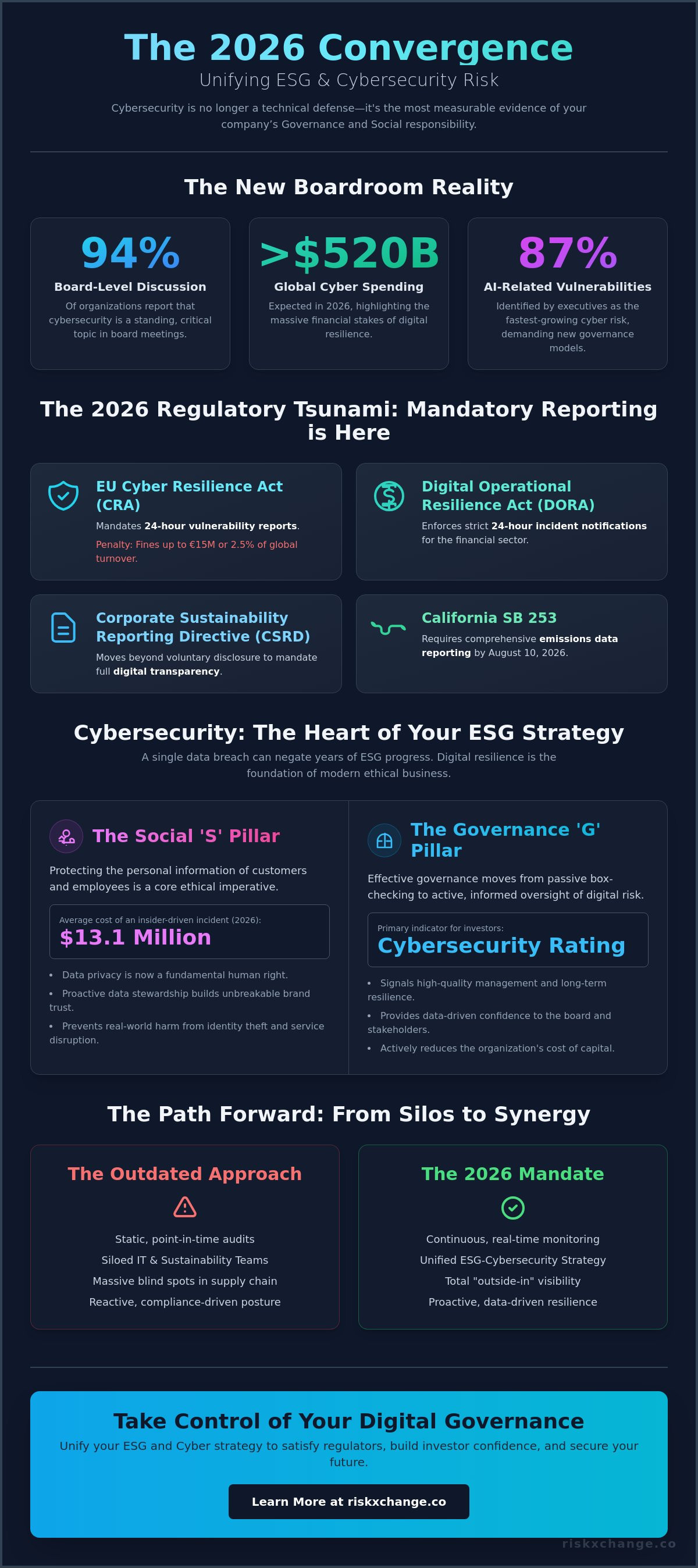
Boards are no longer asking if they're secure; they're asking how security metrics impact their sustainability scores. With global spending on cybersecurity expected to exceed $520 billion in 2026, the financial stakes are too high for siloed thinking. 87% of business and tech executives identified AI-related vulnerabilities as the fastest-growing cyber risk in 2025. This has pushed governance teams to seek integrated solutions that offer continuous monitoring rather than static, once-a-year checks. Governance is about accountability. In a digital-first economy, there's no accountability without robust, transparent data protection.
The Regulatory Catalyst: CSRD, DORA, and Beyond
Mandatory reporting is the new baseline. The Corporate Sustainability Reporting Directive (CSRD) now mandates that digital transparency isn't optional for in-scope companies. Simultaneously, the Digital Operational Resilience Act (DORA) has enforced strict 24-hour incident notification windows for the financial sector as of 2026. Waiting to see how these regulations evolve is a strategy that leads to disaster. Under the EU Cyber Resilience Act, non-compliance can result in fines of up to €15 million or 2.5% of global turnover. Proactive compliance is the only way to maintain a license to operate. You can't manage what you can't see, and regulators now demand a clear view of your entire supply chain.
Investor Expectations: The New Digital Due Diligence
Institutional investors have refined their lenses. They now treat a company’s Cybersecurity Rating as a quantifiable proxy for management quality. High security maturity correlates directly with long-term business resilience. It signals that a leadership team understands their attack surface and has taken control of their third-party risks. By providing this digital transparency, organizations aren't just checking a box; they're actively reducing their cost of capital. Investors in 2026 favor the "outside-in" perspective. It provides a data-driven, honest view of a firm's true esg and cybersecurity risk posture. When your security metrics are visible and measurable, you instill a sense of calm confidence in your stakeholders.
Cybersecurity as the Heart of the "S" and "G" Pillars
The traditional view of sustainability often overlooks the digital infrastructure that keeps a modern enterprise running. In 2026, we've reached a consensus: a single data breach can negate years of positive ESG progress. When a company's sensitive data is exposed, the fallout isn't just financial. It's a failure of social responsibility and a breakdown in corporate governance. Effectively managing esg and cybersecurity risk requires acknowledging that digital resilience is the foundation upon which all other sustainability efforts are built.
Consider the environmental impact of a major cyber incident. Remediating a large-scale breach requires massive energy consumption for forensic investigations, data restoration, and the replacement of compromised hardware. These activities can spike a firm's carbon footprint overnight. However, the most profound intersections occur within the Social and Governance pillars, where transparency and accountability are the primary currencies of trust.
The Social Impact of Data Protection
Data privacy is now a fundamental human right. Protecting the personal information of customers and employees is an ethical imperative that sits at the core of the "Social" pillar. The social cost of failure is high; Mimecast reports that in 2026, the average cost of an insider-driven incident has reached $13.1 million. Beyond the numbers, identity theft and service disruptions cause real-world harm to individuals. Organizations that treat data protection as proactive stewardship build a level of brand trust that competitors cannot easily replicate. By viewing your security posture through an "outside-in" lens, you can ensure that the public and your stakeholders see a company committed to social safety.
Governance: Board-Level Accountability
Governance is no longer about checking boxes; it's about active, informed oversight. As of 2026, SEC Regulation S-K Item 106 requires companies to include detailed disclosures on the board's role in assessing and managing digital threats in their 10-K filings. This has moved cybersecurity from the CISO's office directly to the Board of Directors. With 94% of organizations now discussing security at the board level, the focus has shifted toward standardized risk metrics.
Fiduciary duty now includes the requirement for continuous monitoring. Boards can't rely on annual reports to manage esg and cybersecurity risk when threats evolve daily. They need a quantifiable anchor, such as a Cybersecurity Rating, to track performance and ensure management is meeting its obligations. To maintain this level of control, many leaders are implementing automated risk management platforms that provide real-time visibility into their entire supply chain. This transition from "blind spots" to "visibility" is what defines elite governance in the digital age. It moves the conversation from a state of vulnerability to one of informed resilience, ensuring that your governance strategy is as sophisticated as the threats you face.
Static Audits vs. Continuous Monitoring: A 2026 Comparison
Point-in-time assessments have become the Achilles' heel of modern GRC. Relying on an annual report to manage esg and cybersecurity risk is no longer defensible in a landscape where threats evolve by the hour. Static audits provide a snapshot of the past, while continuous monitoring provides a map of the future. By the time a 2025 audit is reviewed in 2026, the vulnerabilities it identified have likely been exploited or replaced by more sophisticated attack vectors. This lag creates a false sense of security that sophisticated boards can no longer tolerate.
Effective governance requires an "outside-in" perspective. This narrative device allows you to see your digital footprint exactly as an attacker does. It moves beyond internal checklists to reveal what is actually visible on the public internet, providing a transparent view of your attack surface. This transparency is vital for ESG reporting. It provides a real-time Cybersecurity Rating that investors can trust, rather than a self-reported claim that lacks independent, data-driven verification.
The Failure of Traditional Vendor Questionnaires
Traditional questionnaires are often "aspirational." Vendors tend to describe their ideal security state rather than their daily reality. This creates massive blind spots in the "fourth-party" supply chain, where your vendors' vendors may be the weakest link. In 2026, manual verification is too slow to keep pace with regulatory deadlines like the NIS2 Directive’s 24-hour notification rule. Automating this process through AI-driven risk platforms ensures that data is accurate, current, and actionable. It turns a manual, error-prone task into a seamless part of your continuous monitoring strategy.
Real-Time Visibility: The Competitive Advantage
Real-time visibility is a strategic differentiator. 55% of organizations now use AI for threat detection and continuous monitoring in 2026, a significant increase from 46% in the previous year. This shift allows for immediate remediation before a breach occurs, preserving your reputation and your ESG standing. The ROI of automated risk intelligence is clear when compared to manual consulting; it provides a permanent, scalable solution rather than a temporary, expensive fix.
63% of security professionals view ransomware as a high or critical threat for 2026, yet only 30% feel "very prepared" to defend against it. Taking control of your digital resilience means eliminating blind spots across your entire global supply chain. This proactive approach ensures your governance is always one step ahead of the threat actors, moving your organization from a state of digital vulnerability to one of informed resilience.
5 Steps to Integrate Cyber Risk into Your ESG Framework
Moving from a siloed approach to an integrated governance model requires a tactical roadmap. In 2026, the complexity of the digital landscape means that manual processes can't keep pace with regulatory requirements like the 24-hour notification window of the EU Cyber Resilience Act. To effectively manage esg and cybersecurity risk, organizations must adopt a methodical strategy that prioritizes visibility and automated oversight. These five steps provide a clear path to digital resilience.
- Step 1: Map your digital attack surface to ESG reporting requirements. Align your digital assets with specific sustainability goals to ensure every vulnerability is accounted for in your disclosures.
- Step 2: Establish a baseline using a quantifiable Cybersecurity Rating. Use a data-driven metric to benchmark your current posture and track improvements over time.
- Step 3: Extend visibility to third-party partners and suppliers. Your ESG score is only as strong as your weakest vendor; continuous monitoring of the supply chain is essential.
- Step 4: Automate compliance tracking for DORA, NIST, and CSRD. Replace manual spreadsheets with AI-driven systems that provide real-time evidence of your security controls.
- Step 5: Report actionable metrics to stakeholders and the Board. Translate technical data into high-level strategic insights that demonstrate proactive governance.
Mapping the Attack Surface
Identifying critical digital assets is the first priority. You can't protect what you don't know exists. In 2026, AI-native discovery tools are used to uncover "shadow IT" and forgotten digital assets that often hide outside the view of traditional security teams. These external vulnerabilities have a direct impact on internal ESG goals. For example, a compromised legacy server can lead to a data breach that violates the Social pillar's commitment to privacy. By identifying these risks early, you move from a state of digital vulnerability to one of informed resilience.
Engaging the Supply Chain
Supply chain visibility is the cornerstone of ethical management. You must set minimum security ratings for all new vendors to ensure they meet your governance standards. This isn't just about exclusion; it's about collaborative remediation. Helping partners improve their security posture strengthens the entire ecosystem and reduces your overall esg and cybersecurity risk.
A robust Third-Party Risk Management (TPRM) strategy ensures that your suppliers aren't just meeting technical specs, but are also adhering to the ethical standards your investors expect. To achieve this level of oversight without increasing administrative burden, you can automate your TPRM and ESG compliance through a single, comprehensive platform. This transition from "blind spots" to "visibility" allows you to take control of your digital footprint and present a transparent, resilient image to the world.
Taking Control with RiskXchange: The Future of Digital Governance
RiskXchange provides the lens through which companies finally see their true security posture. We've built an AI-native TPRM platform that unifies Third-Party Risk Management, ESG, and cybersecurity into a single source of truth. This integration eliminates the data silos that traditionally separate IT teams from sustainability officers. By providing a continuous, real-time view of your supply chain, we move your organization from a state of digital vulnerability to one of informed resilience. You can finally manage esg and cybersecurity risk with the same precision as your financial reporting.
Our platform utilizes an "outside-in" perspective to map your entire digital footprint. We don't just look at what your internal teams report; we show you exactly what the world, and potential attackers, see. This includes your third-party vendors and their subcontractors, providing total supply chain visibility. With 60% of business and tech leaders ranking cyber risk as a top strategic priority due to geopolitical uncertainty in late 2025, having a quantifiable anchor is essential. RiskXchange delivers this through a dynamic Cybersecurity Rating that serves as a measurable metric for your board.
Actionable Risk Intelligence
Transforming complex technical data into simple, executive-ready ratings is our core strength. We strip away the jargon to provide actionable insights that help you prioritize remediation efforts based on actual business impact. You don't need more raw data; you need better intelligence. Our AI-native engine automates vendor assessments, identifying vulnerabilities in real-time so you can act before a breach occurs. This seamless integration with your existing GRC and ERP systems ensures that your security metrics are always up to date for CSRD and DORA reporting. It turns the overwhelming complexity of digital governance into a manageable, transparent process.
Your Partner in Supply Chain Resilience
Global enterprises trust RiskXchange because we act as a sophisticated, tech-forward guardian. We simplify the complexity of the threat landscape, positioning our brand as a knowledgeable mentor in your corner. Our platform doesn't just identify problems; it provides the data-driven honesty needed to build a more resilient ecosystem. Taking control of your digital governance means moving beyond blind spots to achieve 360-degree visibility. By aligning your security posture with your ethical standards, you protect your reputation and ensure long-term sustainability in an increasingly volatile world.
See how RiskXchange can transform your ESG and Cyber reporting today.
Master Digital Resilience in 2026
The transition from voluntary disclosure to mandatory reporting is complete. As we've navigated through 2026, it's clear that the organizations thriving are those that replaced static audits with continuous monitoring. Integrating esg and cybersecurity risk isn't just a compliance exercise; it's a strategic move to secure your social license and investor trust. You now have the roadmap to move from digital vulnerability to proactive control by mapping your attack surface and automating third-party oversight.
Taking control of your digital footprint requires a partner that provides 360-degree visibility. RiskXchange offers an AI-native TPRM platform trusted by Fortune 500 companies to deliver real-time, actionable intelligence. We move beyond the "blind spots" of traditional GRC, providing a quantifiable anchor for your board-level discussions. By choosing a path of transparency and data-driven honesty, you ensure your governance remains as sophisticated as the threats you face. It's time to transform your security posture into a measurable competitive advantage.
Request a Free Cyber Risk Rating for Your Organisation and lead your industry with confidence.