What if the greatest threat to your organization isn't a sophisticated zero-day exploit, but a forgotten staging server from 2022? Most CISOs realize that as their digital ecosystem expands, their visibility into Shadow IT and orphaned assets diminishes. You've likely felt the strain of managing the security posture of over 500 third-party vendors using nothing but fragmented data and manual spreadsheets. It's a reactive cycle that leaves your perimeter vulnerable. Implementing a robust digital footprint analysis allows you to flip the script. By adopting an outside-in perspective, you gain the same view as a potential adversary, turning hidden vulnerabilities into manageable metrics.
We understand that true resilience comes from proactive control. This guide provides a definitive framework to master the art of mapping and securing your organization’s external presence. You'll learn how to eliminate blind spots and fortify your entire supply chain against emerging threats. We'll explore how continuous monitoring and a quantifiable Cybersecurity Rating can transform your approach to risk. By the end of this article, you'll have an actionable strategy to reduce your attack surface and streamline your third-party risk management for 2026 and beyond.
Defining Digital Footprint Analysis for the Modern Enterprise
The standard definition of a digital footprint usually centers on personal privacy or individual data trails. In 2026, this perspective fails the enterprise. For a global corporation, digital footprint analysis isn't about clearing browser history; it's about mapping every single touchpoint your organization has with the public internet. It's the process of seeing your network through the eyes of a sophisticated threat actor. This outside-in view turns the hunter into the hunted by identifying vulnerabilities before they're exploited.
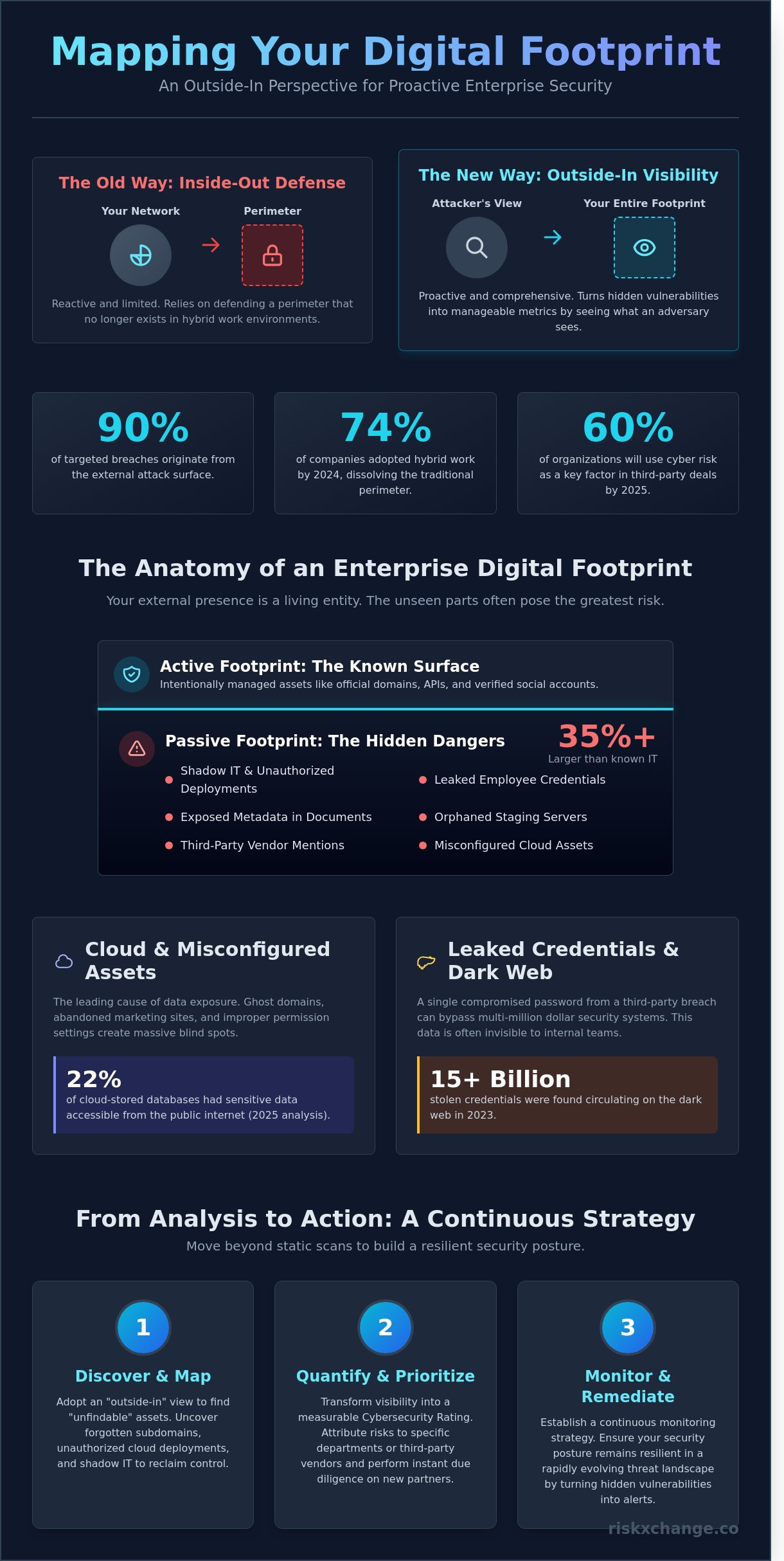
Security leaders now integrate this analysis directly into Governance, Risk, and Compliance (GRC) frameworks. By 2025, analysts predicted that 60% of organizations would use cybersecurity risk as a primary factor in third-party business engagements. This shift transforms visibility from a technical luxury into a regulatory necessity. You're no longer just protecting data; you're managing a quantifiable Cybersecurity Rating that impacts your brand's market value and insurability.
The Shift from Internal Defense to External Visibility
Traditional security relied on firewalls and EDR to guard the perimeter. That perimeter vanished when 74% of companies adopted permanent hybrid work models by 2024. Today, the external attack surface is the primary entry point for 90% of targeted breaches. You can't defend what you can't see. Moving to an outside-in model empowers CISOs. It replaces the anxiety of the unknown with proactive control. When you map your external assets, you close the gap between your perceived security and your actual exposure.
Active vs. Passive Organizational Footprints
Your footprint consists of two distinct layers. Active assets are the ones you manage: official domains, verified social media accounts, and public-facing APIs. These are your intentional digital signatures. Passive assets are far more dangerous because they're often invisible to internal teams. These include:
- Exposed metadata in public documents
- Leaked employee credentials found in dark web caches
- Third-party mentions and shadow IT instances
Passive data holds the most significant risk. In 2023, research showed that over 15 billion stolen credentials were circulating on the dark web. A single leaked password from a third-party breach can bypass a million-dollar firewall. Comprehensive digital footprint analysis uncovers these hidden threads, allowing you to neutralize the threat before it's used against you. It moves the conversation from a state of digital vulnerability to one of informed resilience.
The Anatomy of an Enterprise Digital Footprint
To secure a modern enterprise, you must view your infrastructure through the eyes of an adversary. An organizational digital footprint isn't a static inventory; it's a sprawling, living entity that expands with every new API, cloud instance, and third-party partnership. By 2026, the corporate shadow often exceeds the known IT environment by as much as 35 percent. This expansion typically accelerates during mergers and acquisitions, where a parent company inherits the unpatched vulnerabilities and forgotten assets of a subsidiary without immediate visibility. Effective digital footprint analysis identifies these hidden layers before they become entry points for a breach.
Attackers prioritize the "low-hanging fruit" discovered during the reconnaissance phase. This includes open RDP ports, unencrypted login pages, and development environments accidentally left public. Identifying these gaps requires a shift to an outside-in perspective, allowing security teams to see exactly what a motivated threat actor sees. Organizations that maintain a high Cybersecurity Rating do so by treating their external presence as a measurable, trackable metric that demands continuous oversight.
Cloud Infrastructure and Misconfigured Assets
Misconfigurations remain the leading cause of data exposure in cloud environments. A 2025 analysis revealed that 22 percent of cloud-stored databases contained sensitive information accessible via the public internet due to improper permission settings. Ghost domains, often consisting of abandoned marketing sites or expired SSL certificates, provide attackers with a trusted platform to host malware or launch phishing campaigns. Cloud Sprawl is the uncontrolled proliferation of cloud instances and services that lack centralized oversight, often leading to unmonitored security gaps. You can gain total visibility into these unmanaged assets to prevent them from becoming liabilities.
The Human Element: Employee and Executive Exposure
Your digital footprint isn't limited to hardware and software; it includes the people who operate them. Corporate email addresses found in historical data breaches provide a roadmap for credential stuffing attacks. For executives, the risk is even more acute. Professional social media presence serves as a rich source of corporate intelligence, allowing attackers to map internal hierarchies and craft hyper-personalized spear-phishing lures. These targeted attacks use specific details about an executive's career history or current projects to bypass traditional email filters. Digital footprint analysis must include these human-centric data points to build a comprehensive defense strategy that moves beyond the perimeter and into the realm of informed resilience.
Personal vs. Enterprise Analysis: Why the Difference Matters
Personal privacy tools focus on individual data protection, such as removing names from data broker sites or securing social media accounts. Enterprise digital footprint analysis serves a far more complex purpose. It's the strategic process of managing a sprawling, interconnected attack surface that extends well beyond the internal perimeter. While a consumer might worry about identity theft, a CISO must defend against systemic breaches that could compromise thousands of customers and billions in market cap.
One-time scans are no longer sufficient for modern risk management. In 2025, security research indicated that 68% of enterprise assets are hosted in the cloud, where configurations change by the minute. A static report is obsolete within hours of its generation. Enterprise security requires a continuous "outside-in" perspective that mirrors how an attacker views the organization. This shift moves the focus from periodic compliance checks to real-time resilience.
Effective analysis integrates these findings into a unified Cybersecurity Rating. This metric transforms abstract technical data into a quantifiable score, allowing executives to track security posture with the same precision as financial performance. It provides a common language for the board and the technical team to align on risk appetite and investment.
Scalability and Data Volume
The sheer volume of data involved in enterprise-level monitoring is staggering. A typical Fortune 500 company now manages an average of 135,000 cloud-based assets across various global regions. Manual OSINT (Open Source Intelligence) techniques, which rely on human analysts to scour the web, cannot keep pace with this growth. AI-native automation is the only way to process millions of data points across the clear, deep, and dark web simultaneously.
- AI-Driven Filtering: Modern platforms use machine learning to eliminate 95% of the noise, ensuring teams don't waste time on false positives.
- Dark Web Monitoring: Automated systems track leaked credentials and forum mentions in real-time, providing early warning signs of an imminent attack.
- Asset Discovery: AI identifies "shadow IT" and forgotten subdomains that manual audits frequently miss.
Actionable Intelligence vs. Information Overload
Seeing every vulnerability isn't the goal; fixing what matters is. Information overload often leads to analysis paralysis, where security teams are buried under thousands of low-priority alerts. High-fidelity digital footprint analysis prioritizes findings based on risk severity and business impact. If a vulnerability exists on a non-critical sandbox server, it's a low priority compared to a misconfigured database containing PII.
We bridge the gap between discovery and defense by linking analysis directly to remediation workflows. When a critical risk is identified, the system shouldn't just send an alert; it should provide the specific technical steps required to close the gap. This transition from "seeing" to "fixing" ensures that security resources are always directed toward the threats that pose the greatest danger to the organization's Cybersecurity Rating.
How to Conduct a Professional Digital Footprint Analysis
Executing a professional digital footprint analysis requires a systematic transition from blind vulnerability to informed resilience. This process moves beyond simple scanning to provide a comprehensive, outside-in view of your security posture. By following a five-phase operational framework, enterprises can transform raw data into actionable intelligence.
- Phase 1: Asset Discovery – This phase identifies every internet-facing touchpoint. It uncovers the "unfindable," such as the 34% of shadow IT assets that typically bypass internal inventory tools.
- Phase 2: Risk Attribution – Discovered assets are mapped to specific departments or third-party vendors. This ensures that every server, domain, and API has a clear owner responsible for its security.
- Phase 3: Vulnerability Assessment – Once the inventory is complete, each asset is analyzed for weaknesses. This includes checking for misconfigured SSL certificates, open ports, and outdated software versions.
- Phase 4: Continuous Monitoring – Security teams move from static snapshots to a live stream of data. This phase ensures that a new sub-domain created by a marketing team on a Tuesday doesn't become an entry point for an attacker by Wednesday.
- Phase 5: Reporting and Remediation – Technical findings are translated into a quantifiable Cybersecurity Rating. This allows CISOs to communicate risk to the board with clarity and prioritize fixes based on actual threat levels.
Leveraging OSINT and Automated Discovery
Modern discovery relies on Open Source Intelligence (OSINT) to map IP ranges and DNS records with surgical precision. Automated crawlers now scan the dark web for compromised corporate credentials, identifying leaks before they lead to unauthorized access. By January 2026, data suggests that 91% of credential-based attacks could be prevented if companies utilized automated discovery to identify exposed data in real-time. These tools ensure your asset inventory remains current as your infrastructure scales.
Establishing a Continuous Feedback Loop
Visibility is only useful if it leads to action. Integrating footprint data with existing SIEM and SOAR platforms allows for automated responses to new threats. When an unauthorized asset appears, real-time alerts trigger immediate investigation protocols. In 2026, Continuous Security Monitoring serves as the only viable defense against the compressed timelines of modern automated exploits that weaponize vulnerabilities within 4 hours of disclosure. This feedback loop ensures your defensive perimeter evolves as quickly as the threat landscape.
Ready to see what the world sees? Get your instant Cybersecurity Rating and take control of your external attack surface today.
Integrating Footprint Analysis into Third-Party Risk Management
Your security perimeter no longer ends at your internal firewall. It extends to every API, cloud provider, and software vendor within your ecosystem. This Supply Chain Ripple Effect means a vulnerability in a tier-three supplier becomes a direct threat to your enterprise data. In 2024, the Verizon Data Breach Investigations Report found that 15% of breaches involved a third party; a figure expected to climb as 2026 approaches. Digital footprint analysis allows you to treat your vendor's security posture with the same scrutiny as your own. You gain the ability to see exactly what an attacker sees across your entire partner network.
- Instant Visibility: Identify critical vulnerabilities in a partner’s infrastructure before they impact your network.
- Objective Data: Move beyond self-reported surveys to verify actual security performance.
- Ecosystem Resilience: Map dependencies to understand how a single point of failure could cascade through your operations.
Vendor Due Diligence Without the Questionnaires
Traditional vendor assessments are often stagnant and reactive. Sending a 200-question spreadsheet typically results in "compliance theater" where vendors report their ideal state rather than their current reality. Digital footprint analysis replaces these slow, manual processes with data-driven security ratings. By 2026, enterprises using automated footprinting will reduce vendor onboarding time by 75% compared to those relying on manual reviews. You can validate claims about encryption, patch management, and server configurations in minutes. This shift ensures that security assurance is based on live technical evidence rather than outdated paperwork.
Taking Control with the RiskXchange Platform
The RiskXchange platform provides the 360-degree view necessary to manage a global ecosystem. Our AI-native engine identifies and monitors the digital footprint of every entity in your supply chain, providing a quantifiable Cybersecurity Rating for each partner. This continuous monitoring transforms third-party risk from a periodic check-in into a real-time defense strategy. When a new exploit emerges, you don't have to wait for a vendor's email response; you can see their exposure immediately. This proactive control moves your organization from a state of digital vulnerability to one of informed resilience. Experience the power of real-time digital footprint analysis with RiskXchange to secure your future supply chain.
Take Control of Your External Attack Surface
Securing a modern organization requires moving beyond internal firewalls to embrace a comprehensive outside-in perspective. By 2026, the average enterprise attack surface is projected to expand by 40% as decentralized cloud assets and third-party integrations become the standard. Implementing a professional digital footprint analysis provides the essential lens to identify these hidden risks before they're exploited by external threats. You'll gain the clarity needed to separate minor personal data exposures from critical enterprise vulnerabilities that jeopardize your core operations.
RiskXchange empowers your security team with AI-native continuous monitoring that transforms complex data into actionable Cybersecurity Ratings. Our platform is trusted by Fortune 500 enterprises to provide the real-time visibility required to manage complex global supply chains seamlessly. We help you move from a state of digital vulnerability to one of informed resilience. It's time to replace uncertainty with measurable data and reclaim control of your digital presence. You've got the tools to stay ahead of the curve; let's put them to work.
Book a Demo to See Your Organization's Digital Footprint Score