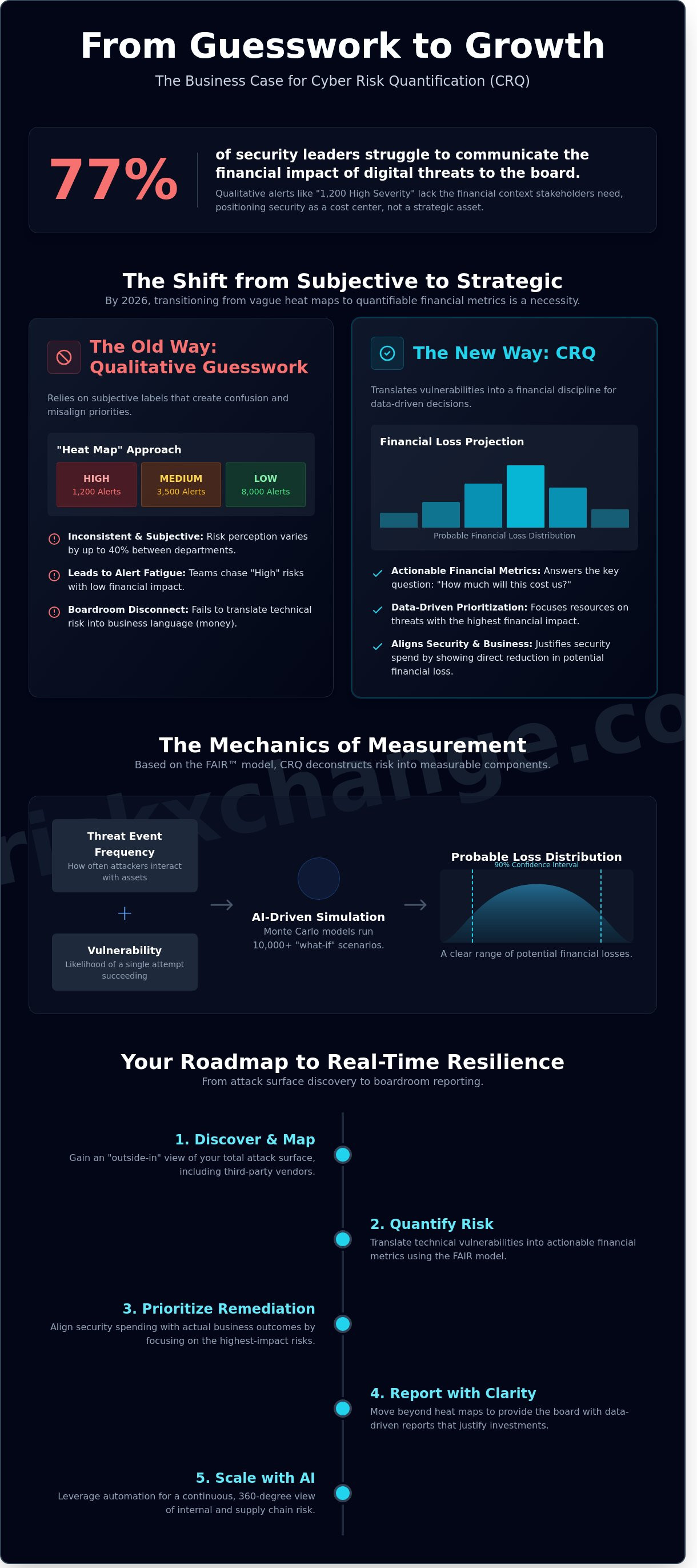
A 2024 survey by Forrester found that 77% of security leaders struggle to communicate the financial impact of digital threats to their boards. You've likely experienced the frustration of presenting a list of 1,200 "High" severity alerts only to be met with blank stares from the CFO. It's difficult to prove the value of your team when security is viewed as a black box rather than a strategic asset. You understand that your attack surface is growing, yet without cyber risk quantification, your department remains a cost center instead of a driver of resilience.
This guide provides a precise roadmap to translate technical vulnerabilities into the financial language your stakeholders demand. We'll show you how to move from a state of reactive defense to one of proactive control by using a framework that measures risk in dollars and cents. You'll gain a data-driven way to prioritize remediation and finally align your security spend with actual business outcomes for 2026. We're going to explore how an outside-in perspective and a trackable Cybersecurity Rating can turn your security posture into a measurable competitive advantage.
Beyond Red, Amber, Green: Why Qualitative Scoring Fails in 2026
The era of relying on subjective gut feelings to manage enterprise security has ended. By 2026, the transition from qualitative heat maps to Cyber Risk Quantification (CRQ) has become a necessity for survival. Qualitative scoring, which relies on red, amber, and green labels, fails because it lacks a standard unit of measurement. It can't translate a technical vulnerability into a dollar amount. This gap leaves boards guessing about their actual exposure. Effective risk management now requires a financial discipline that treats cyber threats as a line item on a balance sheet. It's about moving from a state of digital vulnerability to one of informed resilience.
The Problem with Ordinal Scales
Ordinal scales like "Low, Medium, High" or "1 to 10" are mathematically inconsistent. They treat the distance between a 2 and a 3 the same as the distance between an 8 and a 9, which is rarely true in fiscal terms. This subjectivity creates friction. A 2024 study showed that security professionals' risk perceptions vary by up to 40 percent based on their specific department. This inconsistency leads to alert fatigue. Teams chase "High" risks that have minimal financial impact while ignoring "Medium" threats that could cause a 5 million dollar outage. Without a unified Cybersecurity Rating to act as a quantifiable anchor, departments remain siloed in their own interpretations of danger.
The Shift to Business-Aligned Security
Modern security leaders have moved away from asking "Is it patched?" to asking "What is the probable loss?" This shift transforms security into a business enabler. Instead of being a cost center, the security team provides data that helps the leadership take calculated risks. The 2026 regulatory environment, driven by the SEC's 2023 disclosure rules and the Digital Operational Resilience Act (DORA) enforcement starting in 2025, demands this level of evidence. Static annual assessments are obsolete. Organizations now utilize real-time data to maintain an outside-in view of their attack surface. This continuous monitoring ensures that the CFO gets a clear answer to their primary question: "How much will this incident cost us?" By using cyber risk quantification, companies replace ambiguity with actionable financial metrics. This approach bridges the communication gap between the server room and the boardroom. It allows leaders to justify security spending by showing a direct reduction in potential financial loss.
The Mechanics of Measurement: How Cyber Risk Quantification Actually Works
Effective risk management requires moving beyond subjective "high, medium, low" labels. The Factor Analysis of Information Risk (FAIR) model serves as the international standard for cyber risk quantification, providing a logical structure to decompose risk into discrete, measurable components. By adopting this framework, organizations translate technical vulnerabilities into the universal language of business: money. This shift allows CISOs to present data that resonates in the boardroom, backed by a practical guide to cyber-risk quantification that aligns with global governance standards.
The process begins by distinguishing between frequency and probability. Frequency measures how often a threat event occurs, such as a brute-force attack hitting a firewall 1,200 times per hour. Probability, or vulnerability, represents the likelihood that any single attempt will succeed. To account for the inherent uncertainty in these variables, modern platforms utilize Monte Carlo simulations. These AI-driven models run 10,000 or more "what-if" scenarios to produce a range of probable outcomes. Instead of a single, often misleading number, you receive a distribution curve showing your 90% confidence interval for potential losses.
Deconstructing Breach Likelihood
Likelihood isn't a static figure; it's a dynamic calculation of Threat Event Frequency and Vulnerability. Threat Event Frequency analyzes how often an attacker interacts with your assets, while Vulnerability measures your susceptibility to those specific tactics. RiskXchange enhances this accuracy through "outside-in" visibility, which mirrors an attacker's perspective of your digital footprint. When you see what the adversary sees, like an unpatched 2023 vulnerability on a forgotten sub-domain, your likelihood calculations move from guesswork to precision. You can analyze your own attack surface to see these metrics in real-time.
Calculating Breach Impact in Dollars
Impact is split into two categories to ensure no cost is overlooked. Primary Loss includes the immediate, "out-of-pocket" expenses. According to 2024 industry data, the average cost of a breach has reached $4.88 million, covering incident response, forensic investigations, and legal fees. Secondary Loss accounts for the long-tail consequences. Secondary Loss is the cascading financial impact following the initial breach event. This includes regulatory fines, such as those seen under GDPR, and the 15% to 20% drop in customer retention that often follows a publicized security failure. By quantifying both, you gain a comprehensive view of your total financial exposure.
Ordinal Scores vs. Financial Quantification: Choosing the Right Metric
Modern enterprises often mistake a high security score for a low financial risk. While a 0-100 rating provides a technical snapshot of your hygiene, it doesn't tell a board of directors how much a data breach will cost in the next fiscal year. In 2026, the most resilient organizations use a hybrid model. This approach combines the speed of ordinal scoring with the strategic depth of cyber risk quantification. You need both to maintain visibility across an expanding attack surface while justifying the ROI of your security stack. It's about moving from a state of digital vulnerability to one of informed resilience.
The Use Case for Security Ratings
Security ratings provide an immediate, outside-in perspective of your digital footprint. They act as a vital first responder tool. Use these metrics for rapid vendor benchmarking and initial triage. Data from 2025 shows that 74% of high-performing CISO offices use automated ratings to monitor third-party risk in real time. This outside-in telemetry offers a continuous stream of data that serves as the baseline for deeper analysis. It's the "denominator" that tells you where to focus your resources, allowing you to filter out the noise and identify which 15% of your vendors pose the greatest threat to your operations. Because these ratings are updated daily, they offer a level of agility that manual assessments can't match.
Transitioning to Full Financial Modeling
Deep financial modeling is necessary when you're protecting "Crown Jewels" or requesting seven-figure investments. This is where cyber risk quantification transforms technical data into business intelligence. By integrating the Factor Analysis of Information Risk (FAIR) framework, you can calculate the probable frequency and magnitude of loss events. This standard allows you to speak the language of the CFO. For example, a 2024 study of Fortune 500 breaches revealed that organizations using financial modeling reduced their cyber insurance premiums by an average of 22%. They did this by providing underwriters with defensible, data-driven evidence of their risk posture. Use historical breach data to refine these models, moving away from "low, medium, high" labels toward specific dollar values that resonate in the boardroom. This clarity empowers you to prove that a $1.2 million investment in zero-trust architecture will mitigate a $10 million liability.
- Risk Scoring: Best for day-to-day hygiene, technical benchmarking, and automated vendor monitoring.
- Risk Quantification: Essential for capital allocation, insurance negotiations, and board-level reporting.
- Stakeholder Alignment: Technical teams need the "how" (scores), while executives need the "how much" (dollars).
Building a CRQ Roadmap: From Attack Surface Discovery to Boardroom Reporting
Implementing cyber risk quantification requires a methodical shift from subjective "red-amber-green" charts to a data-driven financial model. This transformation begins with visibility. You cannot quantify what you cannot see, which is why 73% of CISOs prioritized attack surface visibility in 2024. A robust roadmap follows four distinct stages to turn raw data into strategic intelligence.
- Step 1: Total Surface Discovery. Identify every internet-facing asset, including those owned by third-party vendors. This eliminates the "shadow IT" that accounts for nearly 40% of successful exploits.
- Step 2: Business Value Mapping. Assign a dollar value to every asset based on its contribution to revenue and the cost of potential downtime. A 2023 study by IBM found that the average cost of a data breach reached $4.45 million; mapping assets ensures your model reflects these realities.
- Step 3: Continuous AI-Native Integration. Move away from static annual audits. Use AI-native tools to ingest real-time threat intelligence and vulnerability data, ensuring your risk score is never more than a few minutes old.
- Step 4: Executive Synthesis. Consolidate technical findings into a single, actionable Cybersecurity Rating that reflects the organization's overall resilience.
The "Outside-In" Advantage
Attack Surface Management is the continuous discovery and monitoring of all internet-facing assets. This "outside-in" perspective is vital because it mirrors the methodology of a sophisticated threat actor. By assessing your supply chain without requiring internal access, you gain visibility into the 62% of breaches that originate through third-party partners. This approach reduces "Blind Spot" risk in your financial models, providing a comprehensive view of the digital footprint you're actually defending. It allows for a proactive stance where vulnerabilities are remediated before they can be exploited by external entities.
Reporting Results to the Board
Non-technical leaders require clarity; they don't want jargon. Visualizing Annualized Loss Expectancy (ALE) allows the board to see the probable financial impact of cyber events over a twelve-month period. When you present a $200,000 remediation cost against a $3.5 million ALE, the business case for security investment becomes undeniable. This level of cyber risk quantification is also essential for securing favorable insurance premiums. Insurers in 2025 increasingly demand quantified proof of a "low-risk" posture before granting coverage. Using cyber risk quantification transforms security from an abstract cost center into a manageable business variable that supports compliance sign-offs and long-term fiscal stability.
Ready to gain full visibility into your digital footprint? Start your attack surface discovery with RiskXchange and turn technical data into boardroom-ready insights.
Scaling Quantification with AI: The RiskXchange Approach to Real-Time Resilience
RiskXchange transforms cyber risk quantification from a static annual report into a dynamic business utility. Traditional models often stall because manual data collection takes weeks or months. RiskXchange automates this process by pulling millions of data points across your entire ecosystem in seconds. Our AI engine handles the heavy mathematical lifting, converting technical telemetry into clear financial impact figures. This removes the complexity barrier that prevents 70% of CISOs from presenting clear ROI to their boards. By using real-time security ratings, we provide a quantifiable anchor for every risk discussion, moving your strategy from guesswork to precision.
Our platform doesn't just look at internal logs. It provides a 360-degree view by combining your internal security posture with external third-party risk data. This "outside-in" perspective is critical because it mirrors how attackers actually scout your organization. When you see your digital footprint through this lens, the data becomes actionable. You aren't just reacting to alerts; you're managing a measurable business metric that fluctuates based on real-world conditions.
AI-Native TPRM and Quantification
Supply chain vulnerabilities accounted for 62% of system intrusions in 2024. RiskXchange closes this gap by automating vendor assessments to feed directly into your broader risk model. We move beyond point-in-time snapshots that become obsolete within 24 hours of a signature. Our platform provides continuous monitoring, ensuring your cyber risk quantification model reflects the current state of every partner in your network. This integration bridges the gap between GRC frameworks and technical security, offering a unified view of resilience that stakeholders can trust.
Taking Control of Your Digital Footprint
Modern security requires a shift from simple vulnerability management to comprehensive exposure management. Attackers exploit the gaps between tools and the assets you've forgotten. RiskXchange identifies these "blind spots" by mapping your entire attack surface automatically. This visibility provides a psychological shift from digital vulnerability to empowered control. When you understand the financial weight of every exposure, you can prioritize remediation based on actual business risk rather than arbitrary severity scores. It's about making informed decisions with the quiet confidence of a seasoned expert. To start your journey toward informed resilience, claim your free security rating today and see your posture through the eyes of a guardian.
Master Your Security Posture for 2026
The landscape of 2026 demands a shift from subjective "gut feel" assessments to rigorous, data-backed strategies. You've seen why qualitative scoring fails to meet modern compliance standards. Effective cyber risk quantification now requires a roadmap that starts with total attack surface discovery and ends with precise financial reporting for the boardroom. It's no longer enough to react to threats; you must anticipate them using AI-native tools that provide 360-degree risk intelligence.
RiskXchange empowers Fortune 500 enterprises with real-time supply chain visibility, ensuring no vendor becomes a hidden liability. By adopting an outside-in perspective, you gain the same view as potential attackers, allowing you to close gaps before they're exploited. This proactive control transforms your security from a cost center into a quantifiable business asset. You're ready to move beyond the noise and lead with confidence.
Take control of your digital resilience; get your free Cybersecurity Rating today.
Your journey toward a more secure and resilient enterprise starts with the right data.